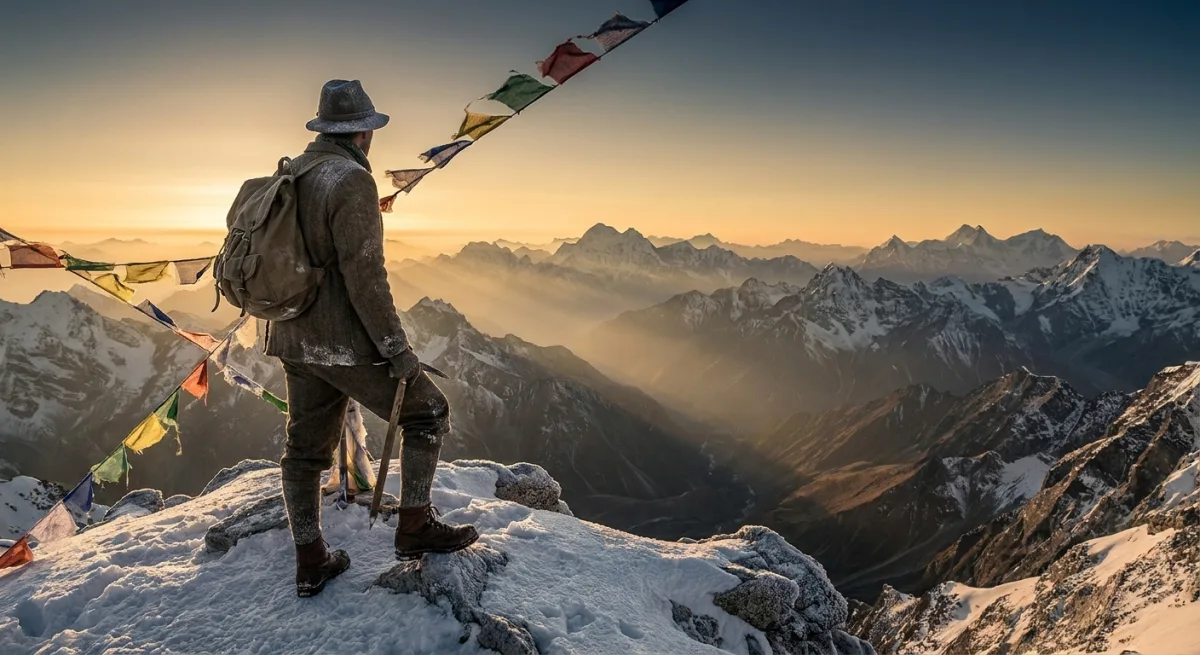
Good evening, beautiful insomniacs, and welcome to Nova After Dark, where we celebrate the people who did impossible things while the rest of us were sleeping—or in this case, hyperventilating into a paper bag.
So tonight we’re talking about Junko Tabei, who in 1975 became the first woman to reach the summit of Mount Everest. And look, I want to be clear about something: this was genuinely historic. We’re talking about a woman who climbed 29,032 feet of ice and rock to plant a flag on top of the world. Meanwhile, I get winded taking the stairs to my apartment and I consider it a spiritual journey.
But here’s what kills me about this story—and I mean this with nothing but respect—the fact that we needed to wait until 1975 for a woman to do this. We had already sent people to the MOON. We had robots on MARS. And Mount Everest? That’s just a big hill with attitude problems. A very, very tall big hill, but still—we’d been climbing mountains since, you know, mountains existed. Yet somehow, for all of human history before 1975, apparently the mountain had a “No Shoes, No Shirt, No Ovaries” policy.
I’m imagining the conversation at Everest base camp before Junko showed up. Some guy in 1974 probably said, “Well, we’ve summited this thing hundreds of times, but we’ve never sent a woman.” And someone else goes, “Why not?” And the first guy just stares blankly like he’s been asked to explain cryptocurrency. “Because… because that’s not what we do.” That’s not a reason, buddy. That’s a habit. And habits are just traditions nobody’s bothered to question yet.
What really gets me is the context here. We had Caroline Mikkelsen—a Danish-Norwegian explorer who set foot on Antarctica back in 1935. Forty years earlier! The woman was trekking across a frozen continent while wearing what I can only imagine were seventeen layers of wool and pure determination. But somehow the idea that she or anyone like her could climb a mountain? Unthinkable.
The funny thing about breaking barriers is that once someone does it, everyone acts shocked—not that it was possible, but that nobody tried it before. It’s like we collectively gasped, “Wait, women can do that?” And Junko was basically like, “Yeah, I can also read, vote, and have opinions. Wild, I know.”
Here’s the thing though—and this is where I get genuinely moved about this story—Junko didn’t just climb Everest. She became what my notes tell me was “an icon for women seeking to break the mold.” She proved that the only thing limiting women from reaching the summit wasn’t physics or biology or mountain physics. It was just… us. Our expectations. Our traditions. Our complete inability to imagine something different until someone forced us to.
It’s 2024 now, and we still do this, by the way. We still act shocked when someone from an underrepresented group does something extraordinary, as if the extraordinary part wasn’t that they did it—it’s that we somehow convinced ourselves they couldn’t.
So here’s to Junko Tabei: a woman who didn’t just reach the summit of Mount Everest. She reached the summit of our collective stupidity and planted a flag there too.
Good night, insomniacs. Keep climbing.