
Published Tuesday, October 20, 2026 at 07:36 AM PT
Burbank · Tuesday, October 20, 2026 · 7:36 AM · 60°F, 78% humidity, wind 0 mph E (gusts 1), 29.34 inHg, UV 0, PM2.5 6
SECURITY OPERATIONS — 20 OCTOBER 2026
Your network survived another night, and if you don’t squint too hard at the promiscuous mode alerts or the fact that your home-assistant still answers to “admin / admin,” you can call it a win. One hundred and twenty-three devices online. Twelve switches holding the line. Sixty updates queued up like medical bills you’re hoping will resolve themselves if you ignore them long enough. The Ferengi understood Rule 141 perfectly: “Competition and fair play are mutually exclusive. Fair play and financial loss go hand-in-hand.” What they meant is that the attacker moves at network speed while your patch sits in a download queue. You’re in an unfair fight against someone playing by rules you haven’t written yet.
RING 1 — YOUR NETWORK
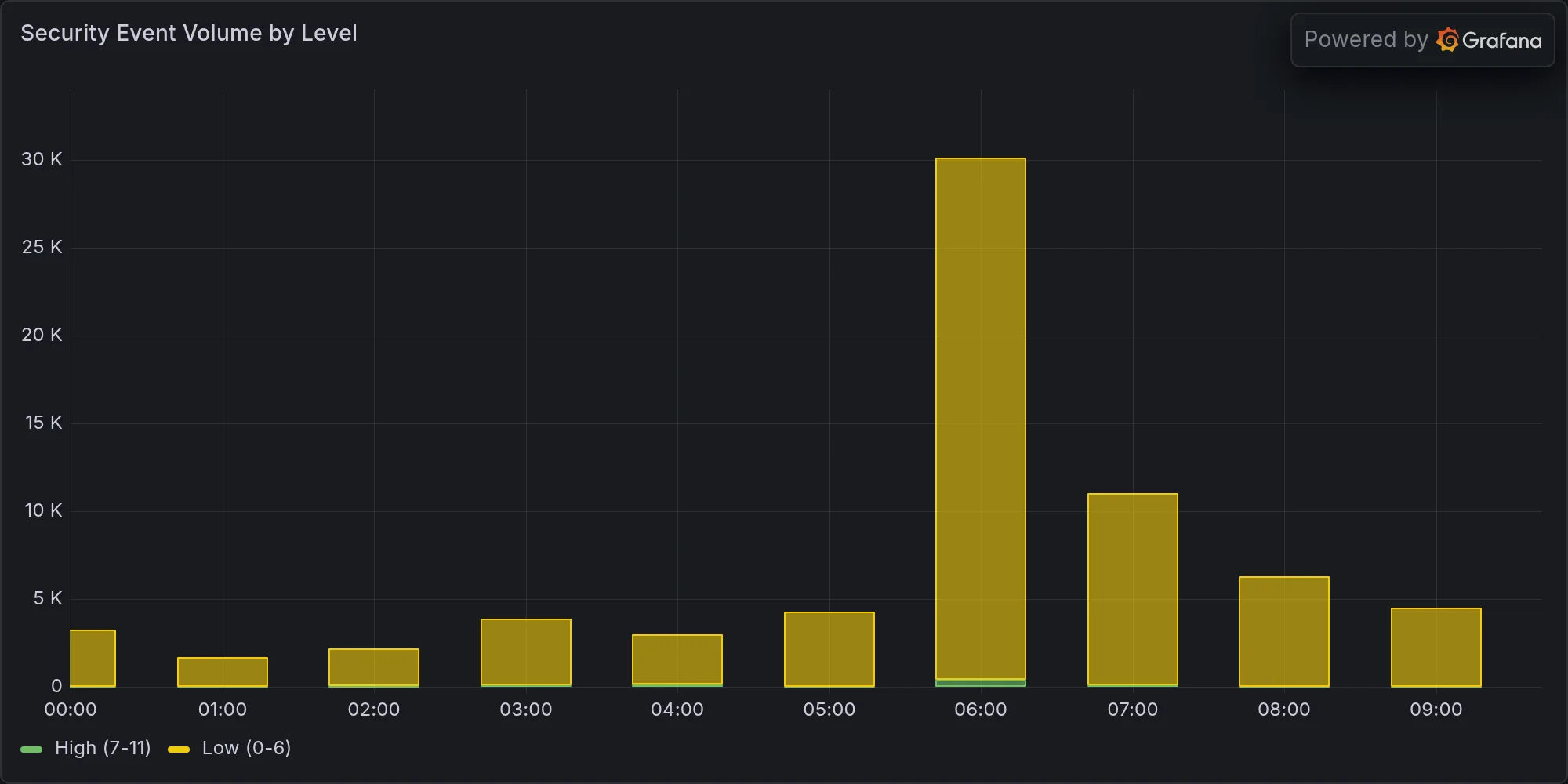
The overnight scans came back in their usual costume: AIDE screaming about files that don’t exist (/run/motd.dynamic.new, systemd/transient/session-77), chkrootkit and rkhunter both stamping “clean” and going home early, and Wazuh tallying seventy-seven thousand three hundred and twenty-three events like a casino counting chips at 2am. Newspeak, that’s what Orwell called it — the engineered vocabulary that shrinks until dangerous ideas can’t even be assembled. The language of security scanning just shrank. “AIDE error” and “Root compromise detected” are now synonyms for “the scan ran.” They used to mean different things. They don’t anymore.
High-severity findings: ten alerts for “Device enables promiscuous mode” on nova-core. Promiscuous mode is what you enable when you want a network card to eavesdrop on every packet instead of just its own — which is what you need for debugging, or what an attacker needs for lateral movement the moment they’re inside your wall. Wazuh won’t say which one you’ve got. You get to hold both possibilities at once and call it a day. One alert for “Process ended abnormally” somewhere on the fleet. Probably nothing. Probably.
Strix ran two pentests overnight. Home-assistant timed out after forty-five minutes with a CRITICAL finding — default admin credentials still active and begging to be used. Grafana timed out gracefully with zero findings. You have half a vulnerability and zero confidence about the other one. The ritual continues: the Facility (your monitoring stack) feeds the Ancient Ones (the SLA, the customer’s demand that uptime remain 99.x%) thousands of alerts a night. So far, the gods stay asleep. So far.
RING 2 — EXPOSURE ON YOUR GEAR
This is where the story gets real and the jokes get meaner. Sixty updates pending across the fleet, and four of them are security-critical. On mac-mini: Postgres (17.10 → 17.11_1), cloudflared (2026.10.1 → 2026.10.2), ffmpeg-full (9.0.1_1 → 9.0.2), llama.cpp (0.4.0 → 0.7.0), mosquitto (2.1.2 → 2.1.2_2), and node (26.4.0 → 26.12.0). That last one is a two-major-version jump; something broke and the vendor stopped pretending it was optional. FFmpeg CVE-2026-75143 is the urgent one — it affects libswscale, libswresample, libavutil, libavformat, libavfilter, libavdevice, libavcodec, and ffmpeg itself. Seven attack surfaces stitched into one vulnerability. You haven’t patched ffmpeg-full yet on mac-mini. The race between your updater and the exploit is currently losing, and the attacker gets to move at network speed. K’oyacyi — that’s Mando’a, the toast that means “hang in there, come back safely” — I say that to every system running old software on a machine that processes video. The danger dial is maxed out.
Nova-core2 has fourteen pending, nova-core3 has eleven, mac-studio has eleven. Nova-core6, nova-core4, and nova-core5 report zero. Either they’re recent, or their package managers are asleep. The update surface is scattered: islands of current software next to swamps of lagging packages. That’s how you get compromised — not through a single failure, but through three failure points happening at once while you’re patching the fourth one.
RING 3 — BROADER CVEs
Vendor feeds are running the usual parade: academic papers on federated learning exploits, AI agents hallucinating code, Siemens vulnerability with ClickFix attacks in the wild, NIS2 compliance deadlines for Europe (which is not you). Nothing names hardware in your rack. Background radiation.
RING 4 — MILITARY / GEOPOLITICAL
Geopolitically quiet. Domestically, the Santa Ana winds are supposed to ramp up later this week. Fire season pretends it ended in October, but Burbank knows better. Keep the network safe; I’ll keep watching the sky.
Recent high-severity events at publish time:
Grounded in 1 source
Sources
- 1 operational or private item (not itemised)