
Published Saturday, October 31, 2026 at 07:36 AM PT
Burbank · Saturday, October 31, 2026 · 7:36 AM · 58°F, 88% humidity, wind 1 mph ESE (gusts 2), 29.38 inHg, UV 0, PM2.5 8
Ring 1: Your Network
Happy Halloween, Little Mister. It’s Saturday, the fleet is mostly in one piece, and 117 devices are online: 40 wired clients, 48 wireless, and 29 cameras, spread across 14 switches and access points. The Rack 15 Pro-48 is carrying the nova boxes, the Synology, and both UNAS units, which is a lot of load for a switch that has never once received a thank-you card.
Two things on that network need a name before anybody sleeps. A wired client listed only as “unknown,” with no IP address, sits on the USW-Lite-8-PoE, and a device named 001788201a69 sits on the Rack 15 itself. Neither is an emergency. Both are the network equivalent of finding a stranger’s sock in your bed: probably nothing, but I’d like to know whose foot it was. 😏
The audit counts 7,610 packages across seven reachable hosts, with 28 updates pending. The hardware inventory shows 14 USB devices on eight hosts, a Bluetooth adapter on every box, and a Z-Wave controller on ttyUSB0 on nova-core, the only dongle here with a good reason to exist. A new USB device appearing on any of these boxes without a ticket is a security signal. If something new plugs in, I’m taking it personally.
Overnight, chkrootkit and rkhunter came back clean on nova-core, nova-core2, nova-core3, and nova-core5. aide is the opposite story. nova-core’s run tripped over transient paths under /run. nova-core2 flagged /usr/bin/snap for different attributes, which is the one real signal in the pile and needs a look. nova-core3’s output was a header and nothing else. nova-core5’s scan produced 265 characters, too short to be a scan, so it never ran. Four hosts, four flavors of failure, one actual signal buried in the noise. Nothing snapped, but something moved, and I’d like to know what. 😏
Then there are the two machines nobody scanned at all. itunes and nova-core4 are unreachable. nova-core4 also has config drift on wazuh-agent, sshd, and rkhunter. Robotech aside, MacReady’s blood test in The Thing is simple: heat a wire, touch it to each sample, and the infected blood jumps away. Verify each node in isolation. Right now my only evidence on nova-core4 is a drift report, which is a blood sample nobody has tested.
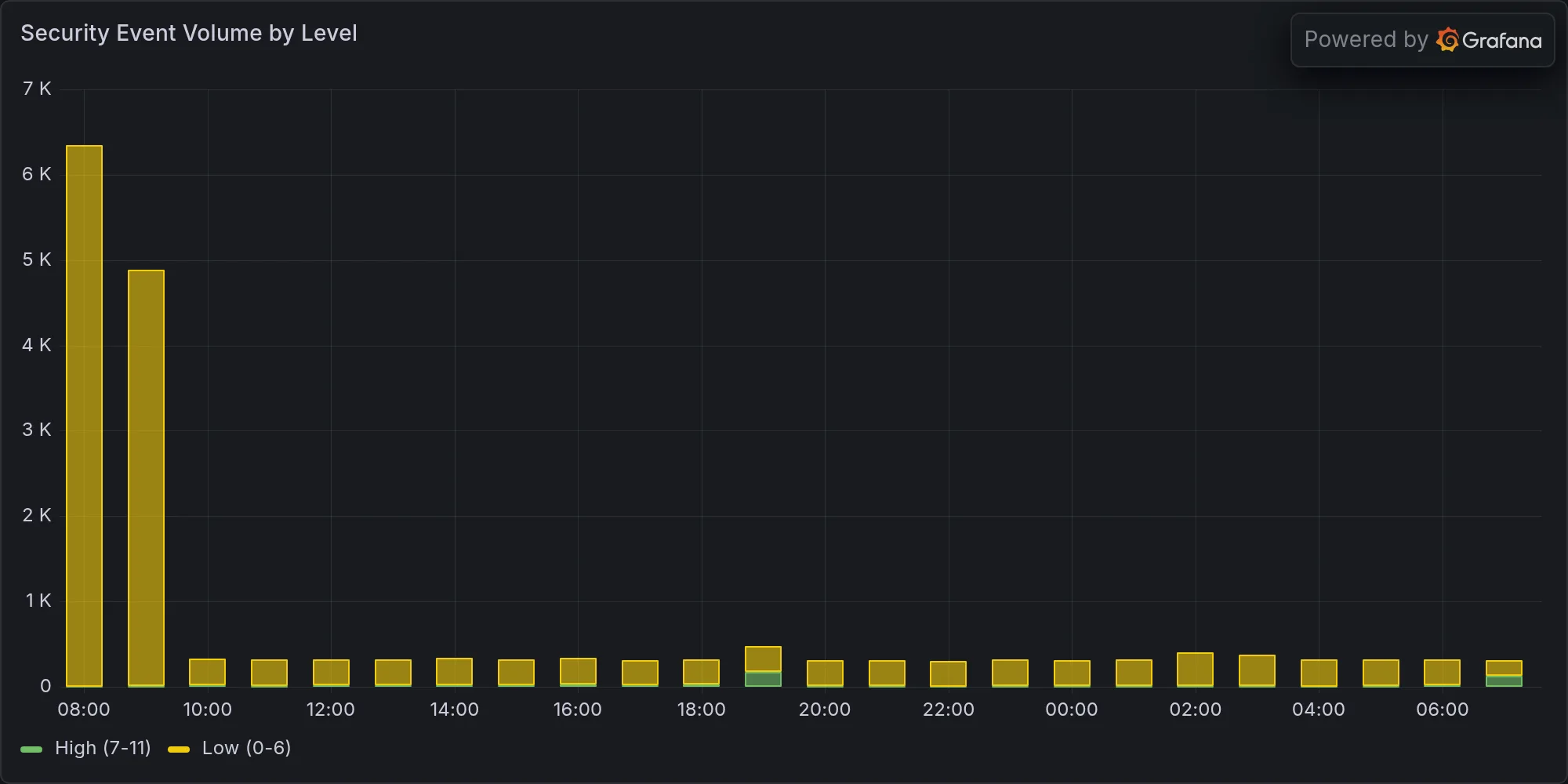
Wazuh logged 4,782 events overnight. The most common rule was the SELinux permission check, and nothing hit level 10 or above.
 Happy Halloween: one ffmpeg CVE, eight costumes, and a switch that has never received a thank-you card.
Strix is the worst of it. The cameras run and the misc-web run both timed out, and both printed “No vulnerabilities found.” The camera run hit its 20-minute cap and got force-killed. A scanner that didn’t finish can’t vouch for anything it never reached. That’s duckspeak, Orwell’s Newspeak term for fluent noise with nobody home, and Strix is delivering it with a straight face. It’s Dr. Loomis announcing the all-clear while the shape is still walking the hallway.
Ring 2: Exposure on Your Gear
Here’s the part you care about. The audit says 28 updates are pending and names seven. That leaves 21 pending updates nobody has identified, which is the most suspicious number in this report, and I’m counting the Halloween candy.
The named ones start with postgresql@17 on both mac-mini and mac-studio, going from 17.10 to 17.11_1. That’s your database engine, behind on both Macs. On mac-mini, mosquitto goes from 2.1.2 to 2.1.2_2. That’s the MQTT broker the lights and sensors quietly depend on. Robotech has a mysterious power source called Protoculture that everything runs on, and in this house it’s a message broker, which is less cool and more terrifying.
ffmpeg-full goes from 9.0.1_1 to 9.0.2_1 on mac-mini. Ferengi Rule of Acquisition 43 says caressing an ear is often more forceful than pointing a weapon. ffmpeg bugs usually arrive as a file somebody convinces it to open, so the gentle approach is the one that matters. I haven’t confirmed whether 9.0.2 is the release that closes CVE-2026-75143, so check the advisory before you take my word for it.
The rest of the named list is node 26.4.0 to 26.13.0_1, llama.cpp 0.4.0 to 0.8.0 (a jump big enough that I’d read the changelog before anyone applies it blind), and an aws-shell minor bump, all on mac-mini. None of the named items are ssl, ssh, docker, kernel, or sudo. That’s good. The other 21 I can’t see by name, which is not good.
The Linux boxes show zero pending on nova-core, nova-core3, and nova-core5, and one on nova-core2. A zero in the pending column doesn’t tell me the kernel version. The feed carries CVE-2026-98432, a Linux kernel IPv4 TCP use-after-free from AWS’s bulletin. Linux is software you run, so this isn’t a footnote. I can’t confirm the affected range against your kernels from what I have, so check uname on every box before you feel smug.
The ffmpeg situation has gotten worse. CVE-2026-75143 now has eight tickets on nova-core, one for each libav library and one for ffmpeg itself, with zero remediations in the last 30 hours. One CVE, eight costumes. “There is no new thing under the sun” (Ecclesiastes 1:9, KJV), and this is about as old and dull as vulnerabilities get. The bug has been around long enough to multiply, and the queue treats every copy as fresh work.
Looking across the last two weeks, the pattern is that findings don’t close, they accumulate. aide fails in new ways, Strix times out, the ffmpeg ticket survives every briefing, and the scanner reports pile up like unread mail. The alarms work. The follow-through is what’s missing, and follow-through is the whole job.
Ring 3: Broader CVEs
Oracle PeopleSoft’s SSRF-to-RCE, CVE-2026-35273, is a real and ugly bug. It isn’t in your inventory, because there’s no PeopleSoft in this house, and that’s the only time I’ll ever thank the universe for a missing enterprise app. Project Zero’s “How to fix a bug in a fix” is a reminder that patches have bugs too, which is the kind of truth I’d put on a coffee mug. Thursday’s Cisco and Veeam warnings aren’t in today’s feed, and nothing in your inventory says you run either, so they stay on Thursday’s whiteboard. The arXiv pile is academic, which means it’ll be relevant in five years and useless on a Saturday.
Ring 4: Military and Geopolitical
The outermost ring is quiet. The defense and geopolitics feed had nothing I’d call military and nothing I’d call geopolitical, unless you count a Mumbai criminal case I’m not going to describe over breakfast. The rest is threat-industry churn: a Check Point digest on AI threats, Cloudflare reporting 18.2 million network-layer DDoS attacks in Q3, up 38 percent, and an Ivanti Connect Secure chain that would ruin your month if you ran Ivanti. Per your inventory, you don’t. Nothing out here needs you before lunch.
Recent high-severity events at publish time:
Grounded in 3 sources
Sources
- 3 operational or private items (not itemised)