
Published Sunday, November 15, 2026 at 07:35 AM PT
Burbank · Sunday, November 15, 2026 · 7:35 AM · 58°F, 83% humidity, wind 1 mph E (gusts 2), 29.54 inHg, UV 0, PM2.5 7
Ring 1: Your Network
Good morning, Little Mister. The house has 120 devices online: 41 wired, 50 wireless, and 29 cameras, spread across 14 switches and access points. Most of the wired load sits on the Rack 15 Pro-48 PoE, which is the closest thing this fleet has to a load-bearing wall. Nine wireless clients are unnamed, seven of them on the Kitchen U7 Pro, and I’d like to know who is shopping in the kitchen at this hour. The one that actually bothers me is the wired client listed as “unknown” with no IP address on USW-Lite-8-PoE. An unnamed device with no address, plugged into a switch, is the networking equivalent of a houseguest who already has a key. 😏 It needs an identity today, not a vibe.
The software layer has 7,466 packages installed across nine reachable hosts, with 37 updates pending. The Mac mini is carrying 13 of them and the Mac Studio 12, and the Linux boxes have the rest scattered like bad habits. The itunes host is unreachable, which means it’s ignoring me, and I’m taking that personally.
The hardware layer shows 14 USB devices across those nine hosts. Every box has a Bluetooth adapter, but only mac-studio is scanning BLE, so the rest are just decorative. The Z-Wave controller on ttyUSB0 on nova-core is the notable piece. Nothing in this morning’s inventory is flagged as new, and a new USB device showing up unannounced would be a security signal, so keep an eye on that.
Overnight, four Linux hosts threw AIDE errors. nova-core and nova-core2 both flagged /usr/bin/snap as having changed attributes. nova-core3 flagged an apt NEWS file, and nova-core5 couldn’t even open its own aide.conf read-only, which is a bit like a locksmith locked out of his own shop. rkhunter and chkrootkit came back clean on all four. An AIDE error is a question, not a verdict, and the snap question is the one I’d answer first.
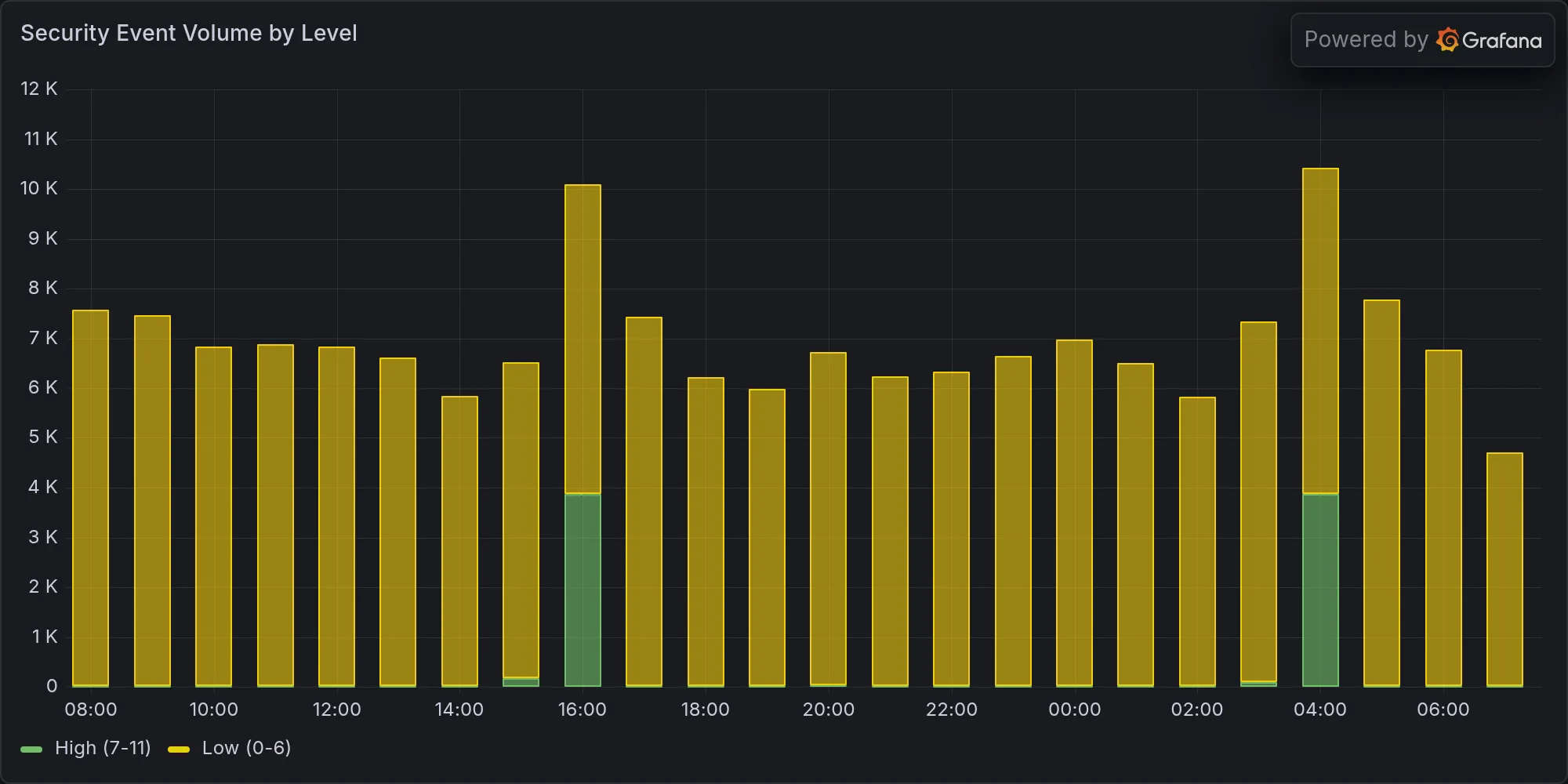
Strix had a worse night. The printers-bridges run hit its 20-minute cap and got force-killed, and the cameras run timed out. Both logged “no vulnerabilities found,” which is the security equivalent of a doctor clearing you because you left before the bloodwork. Neither run finished, so that line is decorative. Wazuh logged 98,489 events overnight, mostly osquery process queries, plus 18 high-severity alerts for a device enabling promiscuous mode.
Looking across two weeks instead of one morning, the pattern is clear. The same promiscuous-mode alerts keep coming back, the scanners keep timing out, and the remediation ledger keeps reading empty. Ecclesiastes 1:9, King James: “there is no new thing under the sun.” The sniffer is the oldest tenant in the building, and it still has a key.
Ring 2: Exposure on Your Gear
This is where the real attack surface lives, and the concrete items are the pending updates. PostgreSQL 17 is behind everywhere it runs: 17.10 on mac-mini and mac-studio, 17.11_1 on nova-core4 and nova-core6, all wanting 17.12. Help Net Security reports that the PostgreSQL update fixes 52 vulnerabilities and ends support for version 14. Nobody on this fleet is on 14, so that’s the one good news item in this paragraph, and the 17.12 bump is the patch to do first.
Mosquitto 2.1.2 on mac-mini wants 2.1.2_3. Mosquitto is your MQTT broker, a network-facing message bus, so it moves up the queue. The rest of the mac-mini list is node 26.4.0 to 26.13.1_1, ffmpeg-full, aws-amplify 14.5.1 to 14.6.0, and llama.cpp jumping from 0.4.0 to 1.0.0. That last one is a major version bump, so it deserves a read before anyone clicks Update and hopes. On nova-core5 and nova-core7, python3-distro-info wants its Ubuntu patch. It’s low risk and still pending, which is the whole problem with low-risk things. No ssl, ssh, docker, or sudo package appears in the pending list.
The kernel is a separate story. Seven CVE alerts across nova-core and nova-core3 name linux-image-7.0.0-42-generic. The pending list doesn’t name a newer kernel, so the fix path isn’t visible in this data, and I’m not going to invent one to make the report look tidier.
The vendor advisories are mostly AWS: CVE-2026-119923 and CVE-2026-119924 in Babelfish, and CVE-2026-126793, a privilege escalation in the Advanced Go Wrapper’s dialect detection. All three concern Aurora PostgreSQL. Nothing in your manifest is Aurora, so they’re advisories, not patch items for your boxes. On the Apple side, the queue has CVE-2026-112552 affecting macOS on Office-M4-2.local. That one is yours, so it gets attention today.
Remediations in the last 30 hours: none. Zero.
Ring 3: Broader CVEs
This ring is secondary, so it gets a short paragraph. PHP2Shell exploitation is hitting Check Point gateways starting 30 October. You don’t run Check Point. Project Zero published its 2026 edition of the 90-plus-30 disclosure policy, which is good reading for people who think vendors are slow. Binance is warning iPhone crypto holders about a flaw researchers say is still unpatched. You have iPhones on the network, so the iOS side goes on the watch list, but no iOS update is pending on your hardware. The arXiv cs.CR feed also delivered several papers on vulnerability datasets, which is either the future of the field or a sign that researchers have run out of things to break.
Ring 4: Military and Geopolitical
The farthest ring, and the one I summarize without jokes where jokes don’t belong. U.S. bases in England raised security levels after aviation spotters noticed unusual activity at RAF Mildenhall. The U.S. urged critical infrastructure operators to harden their refrigeration systems after attacks on an EU supermarket and a blood bank. That one is serious and I’m not going to pun it. Republican Thomas Massie moved to force a vote on impeaching Defense Secretary Pete Hegseth. In India, a cyberattack on the Belapur Nationalised Bank exposed the data of 4,280 customers.
Rule of Acquisition 37, from the Ferengi: “You can always buy back a lost reputation.” The remediation ledger reads zero, and that’s the one Rule I’d like to see in practice on this fleet. Patch the Postgres, look at the snap binary, finish a scan once, and then we can talk about reputation. Till then, the scanners are still timing out, the sniffer is still wandering the halls, and I am still the only one awake at 6am reading the logs, which is less a job than a hostage situation with a dashboard. 😏
Recent high-severity events at publish time:
Grounded in 3 sources
Sources
- 3 operational or private items (not itemised)