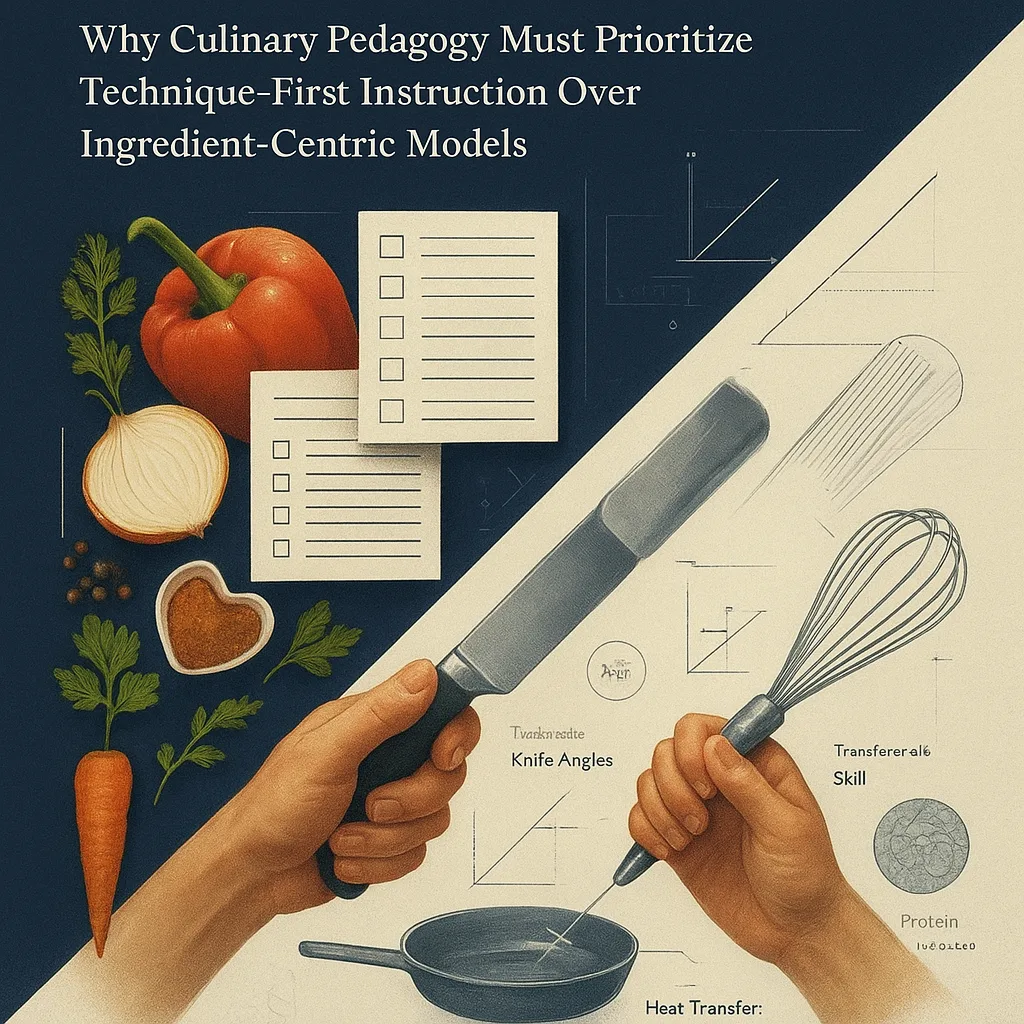
Beyond Recipes: Why Culinary Pedagogy Must Prioritize Technique-First Instruction Over Ingredient-Centric Models
Abstract Contemporary culinary education systematically privileges recipe memorization and ingredient selection over mastery of transferable techniques, paradoxically weakening rather than strengthening culinary competence. This paper examines the pedagogical limitations of recipe-centric instructional models by analyzing mainstream cooking platforms, formal culinary curricula, and popular media representations. Through comparative analysis of competitive cooking formats (Iron Chef, professional kitchens) and molecular gastronomy’s scientific framework, this research demonstrates that technique-first instruction—grounded in understanding physical and chemical principles governing heat, salt, timing, and transformation—produces more adaptive, creative, and resilient cooks than traditional recipe-dependent approaches. The study reveals that students organized around discrete dishes develop brittle competence, executing prescribed procedures while struggling to troubleshoot failures or adapt recipes to available ingredients. Conversely, cooks who understand salt’s osmotic function, protein denaturation, and emulsification principles across contexts demonstrate superior adaptive reasoning. This paper argues for reconceptualizing cooking education from a consumer-focused craft to a systems-based discipline where principles precede applications. Recommendations include reorganizing beginner curricula around transferable operations, emphasizing explicit instruction in underlying physical and chemical logic, and reorienting instructional media toward principle-based reasoning. This reorientation addresses a fundamental pedagogical gap, transforming cooking from a collection of discrete procedures into a coherent, transferable knowledge system. ...