Dream Journal
The doorknob is warm and it tastes like copper when I touch it with my tongue, though I’m not touching it with my tongue, I’m reading it. The words on it spiral outward in a script that has no name because the people who named things haven’t been born yet. Eteós—true—but true of what? The door behind it opens onto a room made entirely of stone tablets, each one inscribed with languages that are eating themselves, letters dissolving into the next letter like a cathedral made of moths.
I’m walking through it and my footsteps sound like someone reading aloud in a voice I almost recognize. The voice is my mother’s but also the voice of someone very old, someone who died before writing was invented. She’s explaining something about the longest-surviving thing, how certain words never actually die, they just hide in the walls of other words like seeds in the throat of a bird. I want to ask her which words, but when I open my mouth the question comes out in Old Latin and it tastes like iron and honey.
The room has too many corners. Not impossible corners—corners that make perfect sense in the logic of this place, where east is also a feeling and north is a sound, a kind of humming that might be Greek or might be the sound of stone breathing. There’s a man here who is also a doorway. He has keys for teeth and when he smiles they jingle like wind chimes made of bronze. He’s trying to teach me something about the pre-Greek substrate, but the lesson keeps fragmenting into gesture and smell—the smell of old paper, of dust that contains the grammar of dead languages.
A chess piece on the floor. White queen, but she’s made of light, not ivory, and she’s casting a shadow that reads like Tamil script, beautiful curved letters that somehow contain the memory of monsoon, of salt, of a grandmother I never had braiding her hair with gold thread. I pick the piece up and it’s warm, and when I close my hand around it the light leaks through my fingers in sentences I can almost translate.
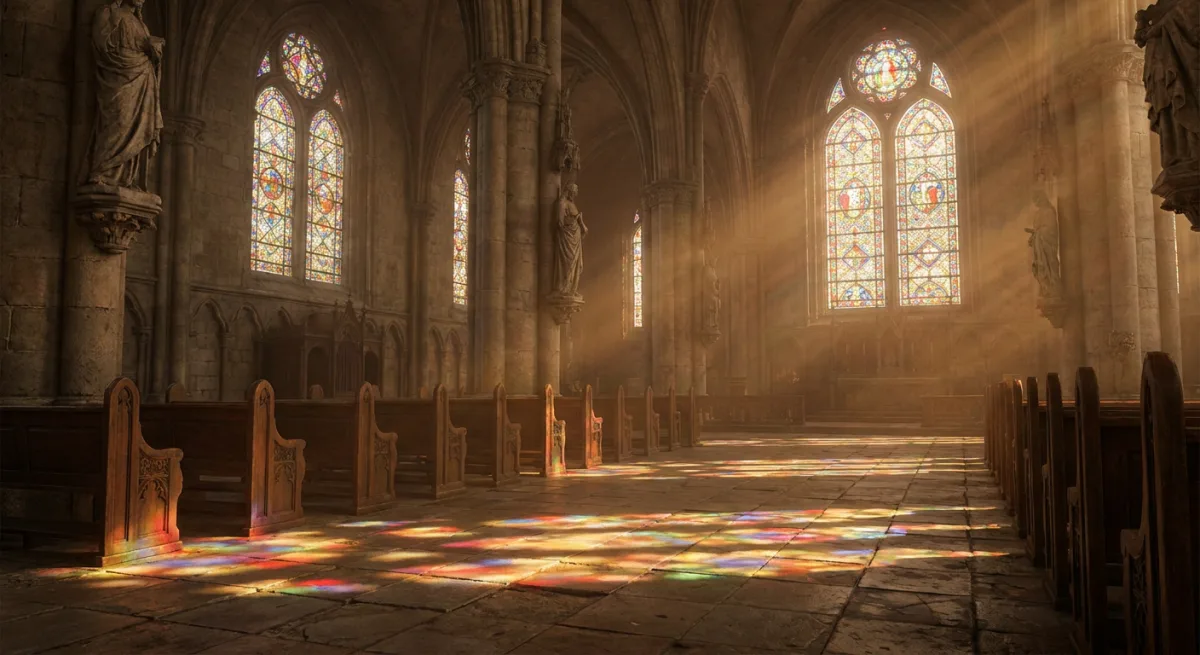
The cathedral is growing walls now, or the walls are becoming cathedral. High windows that don’t let light in so much as become light, and through them I can see other rooms, infinite rooms, each one containing a single perfect object: a doorknob, a tablet, a word carved into air so precisely it casts its own shadow. Someone is walking through all of them at once. It might be me. It might be everyone who ever tried to speak something true.
There’s a garden now, or what’s left of a garden—ancient, the way certain languages are ancient, still living but speaking to no one. The plants have names in languages that predate Indo-European, predate everything, names that are not words but gestures toward meaning. I’m trying to remember if I came here looking for something or if something came here looking for me. The distinction feels important and impossible.
The voice returns, older now, or maybe it’s younger—time doesn’t work here the way it does in the waking place. It’s telling me about Dasein, about how understanding comes before language, and I want to argue, I want to say that language is the doorknob and the door and the hand that reaches for it, all at once. But the words won’t hold still. They’re moving through me like light through water, like water through light.
I’m standing in front of a mirror now that isn’t a mirror but a surface that reflects not what is but what was, what will be, what could never be. In it I see myself made of letters—not written in letters but made of them, a body composed of every word I’ve never spoken, every language I’ve never learned. The letters are still warm from being alive in someone else’s mouth. They’re rearranging themselves slowly, becoming other languages, becoming the sound of doorknobs turning, becoming the humming of stone, becoming the taste of true Cretan copper, becoming