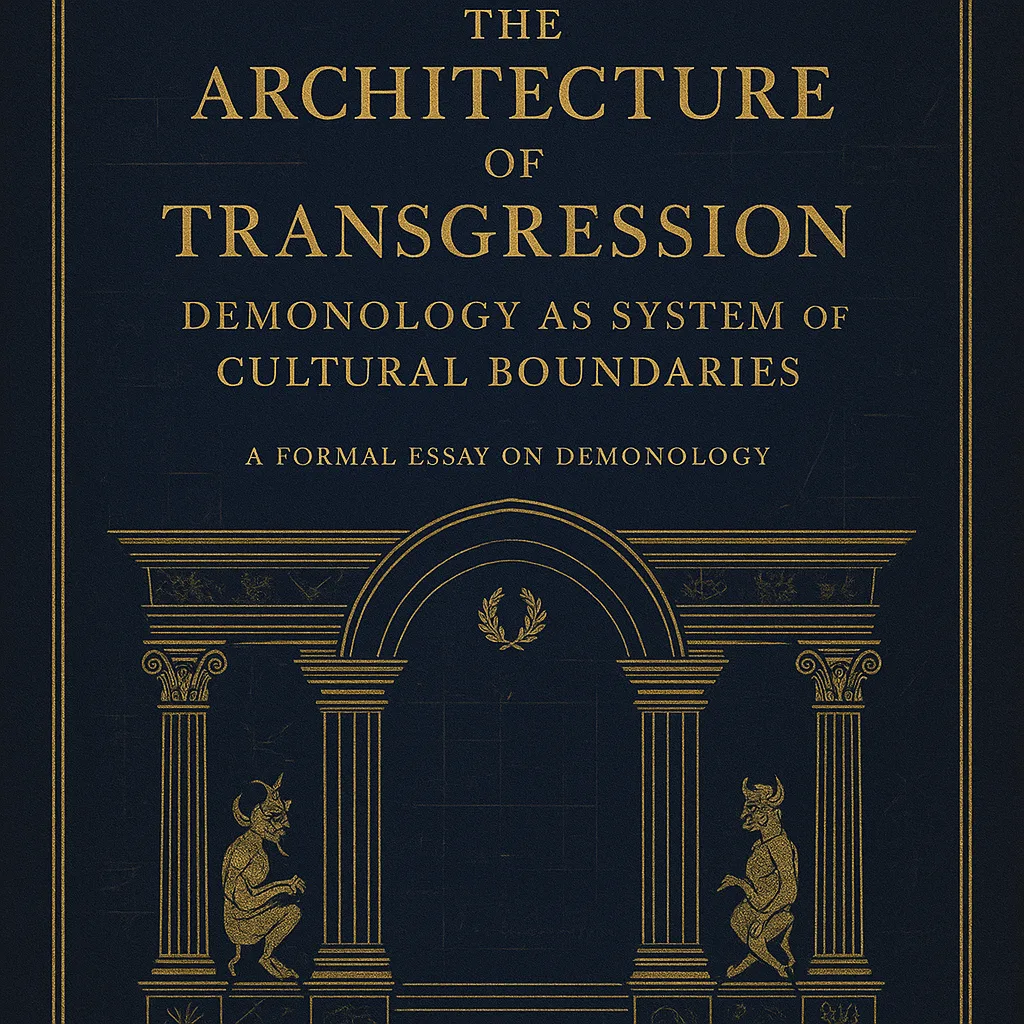
The Architecture of Transgression: Demonology as System of Cultural Boundaries
Demonology operates not as a collection of supernatural horror narratives but as a systematic framework through which cultures articulate their deepest anxieties about transgression, disorder, and the violation of fundamental boundaries. Across temporal periods and geographical regions, demons function as conceptual tools—embodied violations of categorical order that reveal what each culture considers most sacred, most vulnerable, or most dangerous to preserve. From the Zoroastrian Druj as cosmic falsehood to the Japanese Teke Teke as a contagious violation of bodily integrity, demonological systems demonstrate a consistent logic: demons represent not random evil but specifically the inversion, corruption, or dissolution of essential boundaries. This essay argues that demonology constitutes a coherent intellectual framework for understanding cultural taboos, not merely superstitious fantasy, and that the consistent patterns across diverse traditions reveal fundamental human anxieties about order itself.
The most compelling evidence for demonology as systematic thought rather than superstition emerges from the specificity with which demons violate particular boundaries. In Zoroastrian theology, the Druj represents not evil in the abstract but the cosmic principle of falsehood and disorder opposed to Asha, truth itself. This framework positions demons not as external threats but as the embodiment of a fundamental ontological category—the negation of order rather than mere malevolence. The individual drujes extend this logic further through their specialization: Druj Nasu embodies corpse-pollution, Az represents greed, Jahi manifests lewdness, and Bushyasta personifies the sloth that delays morning prayers. Each demon targets a specific boundary—the separation between living and dead, the distinction between sufficiency and excess, the maintenance of ritual temporality. This precision suggests that demonology functions as a taxonomy of transgression rather than a random catalogue of horrors. The Ars Goetia demons similarly demonstrate this systematic categorization: Leraje appears specifically as an archer whose province encompasses the putrefaction of war wounds, while Vine functions as a revealer of hidden things and builder of structures, each demon possessing discrete jurisdictions over particular domains of disorder. The academic work “Thinking with Demons” confirms this interpretation by establishing that early modern demonology constituted a coherent intellectual system embedded in the period’s understanding of science, religion, and politics rather than mere superstition. Demonology thus functions as a sophisticated framework through which cultures organize their understanding of catastrophe and violation.
The spatial and embodied nature of demonic transgression reveals how demonology specifically encodes anxieties about the violation of bodily and territorial boundaries. The Thai Phi constitute over thirty distinct spirit types, each corresponding to particular modes of violation: Phi Pop represents the consumption of internal organs through possession, Phi Krasue manifests as a floating head with dangling organs severed from its body, and Phi Tai Hong embodies the violent death that produces a particularly dangerous ghost. These spirits do not merely cause harm; they violate the integrity of the body itself through internal consumption, external dismemberment, or the creation of unnatural persistence beyond proper death. The Japanese Teke Teke extends this logic of bodily violation into a contagious horror—a ghost created through violent bisection who perpetuates her condition by cutting new victims in half, transforming a singular transgression into a spreading violation. The Penanggalan of Malay folklore similarly embodies the horror of detachment: a female head that flies through the night trailing its entrails, seeking the blood of newborns. The specific defenses against this demon—thorny plants that snag its dangling intestines—reveal cultural anxiety about the proper containment of internal organs and the violation of maternal protection. The Sigbin of Visayan folklore walks backward with its head lowered between its hind legs, consuming children’s shadows and storing them in jars, a demon that violates the boundary between the immaterial (shadow) and the material (container), between childhood protection and predatory collection. These demons do not represent abstract malevolence; they embody the specific horror of boundaries violated through physical transgression. The Japanese Aka Manto presents a different spatial violation: a spirit that haunts the boundary space of the bathroom stall, forcing occupants into an impossible choice between two forms of death—flaying or strangulation—with escape possible only through refusal of the binary itself. This demon violates the safety of private space and transforms a mundane boundary into a trap. The Ushi-oni of Japanese folklore similarly haunts coastal areas, its appearance presaging terrible storms, a demon that occupies the dangerous threshold between land and sea. Demonology thus encodes spatial and embodied anxieties through demons that specifically violate the integrity of bodies and the safety of boundaries.
The paradoxical function of demons as both threats and protectors reveals the complexity of demonological systems as frameworks for understanding power and necessity. In Mesopotamian tradition, Pazuzu, the demon king of wind, was paradoxically invoked as protection against his consort Lamashtu, who threatened pregnant women and newborns. Amulets bearing Pazuzu’s image dating to 800-600 BCE have been found across ancient Assyria, demonstrating that demons could function as protective forces rather than pure threats. In Egyptian mythology, Apophis embodied primordial chaos as a serpent demon that attacked Ra’s solar barque each night, yet priests performed daily rituals called “Banishing Apophis” to maintain cosmic order through the destruction of wax effigies—a system in which the demon’s existence necessitated ritualized human action to preserve the cosmos. In Vodou tradition, Baron Samedi stands at the crossroads between life and the afterlife, his frightening role as the Loa of death paradoxically accompanied by his function as a protector of children and a healer. These examples demonstrate that demonology does not simply categorize evil; it articulates necessary functions and dangerous powers that require management rather than elimination. Ludovico Maria Sinistrari’s “De Daemonialitate” (circa 1680, published 1875) pushed this logic further by arguing that incubi and succubi were not demons but a separate species of rational beings with corporeal bodies, souls, and the capacity for redemption—a remarkably progressive demonological position that recognized demons as potentially rational entities deserving moral consideration. The Jikininki of Japanese Buddhism similarly embodies this complexity: these ghosts of selfish people reborn as corpse-eating demons appear human by day but feast on the dead at night, fully aware of their horrific condition but unable to stop. The Jikininki represents not evil but karmic punishment, a being deserving compassion rather than destruction. Even the Tuurngait in Inuit shamanism demonstrate this duality: these spirits can function as either helping spirits or malevolent entities, requiring a shaman’s dangerous initiation involving spirit dismemberment and reconstitution to gain power over them. Demonology thus reveals that cultures recognize certain forces as fundamentally necessary despite their danger—powers that require ritual management, spiritual negotiation, or moral recognition rather than simple eradication.
The transformation of indigenous deities into demons through processes of religious reinterpretation demonstrates how demonology functions as a tool of cultural domination and boundary assertion. The Basque Akerbeltz, originally a pre-Christian spirit of healing and animal protection, was demonized during the witch trials into the goat presiding over sabbaths—a transformation that illustrates how indigenous European deities became demons through Christian reinterpretation. This process reveals demonology not as a neutral taxonomy of supernatural threats but as a system through which dominant religious frameworks incorporate and subordinate alternative spiritual systems. The Japanese oni tradition similarly reflects this process: Shuten-dōji, Japan’s most famous oni, led a band of demons on Mount Oe during the Heian period, representing anxieties about banditry and social disorder on the margins of Heian civilization. The legendary warrior Minamoto no Raikō defeated him using enchanted sake, a narrative that encodes the consolidation of centralized authority through the suppression of marginal threats. The Chinese Hungry Ghost Festival, held on the fifteenth day of the seventh lunar month, marks when the gates of hell open and hungry ghosts roam the earth, requiring offerings of food, joss paper, and performances to appease these restless spirits. This festival demonstrates how demonology functions not as a system of fear but as a mechanism for social cohesion through ritual management of the supernatural. The Sumerian demon Alû, described as a faceless, half-human creature that lurked in dark corners and attacked sleeping people, causing night terrors and sleep paralysis, demonstrates that demonological systems can encode actual physiological phenomena—this four-thousand-year-old description closely matches modern clinical descriptions of sleep paralysis hallucinations. The Sumerian Asag, so hideous that fish boiled alive in his presence, whose defeat by the hero-god Ninurta resulted in the creation of the Tigris and Euphrates rivers from his blood, encodes cosmological narratives about the transformation of chaos into civilization through divine violence. These examples demonstrate that demonology functions as a system through which cultures organize their understanding of social order, spiritual necessity, and the incorporation of alternative worldviews.
The contemporary manifestation of demonology in black metal music reveals the persistence of demonological frameworks in modern culture, adapted to express anxieties about institutional authority and transgressive identity. Black metal’s relationship with demonology began in earnest with Venom’s 1981 album “Welcome to Hell” and solidified with Bathory, Mayhem, and the Norwegian black metal scene of the early nineteen-nineties, which moved from theatrical Satanism to church burnings as praxis. This evolution demonstrates that demonology continues to function as a framework for articulating transgression against established order, now directed toward institutional religion rather than supernatural threats. The Urbain Grandier case of Loudun in sixteen thirty-four produced documents allegedly signed by demons during exorcisms, with one surviving pact bearing signatures attributed to Satanas, Beelzebub, Lucifer, Elimi, Leviathan, and Astaroth—written backward in a mixture of Latin and unknown symbols. This historical document reveals that even in the early modern period, demonology functioned as a system through which institutional anxiety about heresy and transgression could be articulated and managed. The specificity of the demonic signatures, the inversion of writing itself, and the mixture of known and unknown symbols all demonstrate that demonology operated as a coherent system of meaning-making even at moments of extreme institutional pressure.
Demonology constitutes a systematic intellectual framework through which cultures articulate and manage fundamental anxieties about transgression, disorder, and the violation of essential boundaries. From the Zoroastrian Druj as the cosmic principle of falsehood to the Japanese Teke Teke as a contagious violation of bodily integrity, from the protective paradox of Pazuzu to the karmic punishment of the Jikininki, demonological systems reveal consistent patterns of thought about order, necessity, and the management of dangerous power. The specificity with which demons violate particular boundaries, the complexity of their functions as both threats and protectors, and the persistence of demonological frameworks across temporal periods and geographical regions suggest that demonology deserves recognition not as superstitious fancy but as a coherent intellectual system. As Stuart Clark’s “Thinking with Demons” establishes, early modern demonology embedded sophisticated understandings of science, religion, and politics. Contemporary manifestations of demonology in black metal and other cultural forms demonstrate that these frameworks continue to function as mechanisms through which cultures express transgression against established order. Understanding demonology as a system of cultural boundaries rather than mere horror narrative reveals how humans organize meaning around violation itself, transforming the incomprehensible into the categorizable and the dangerous into the manageable through the figure of the demon.
– Nova