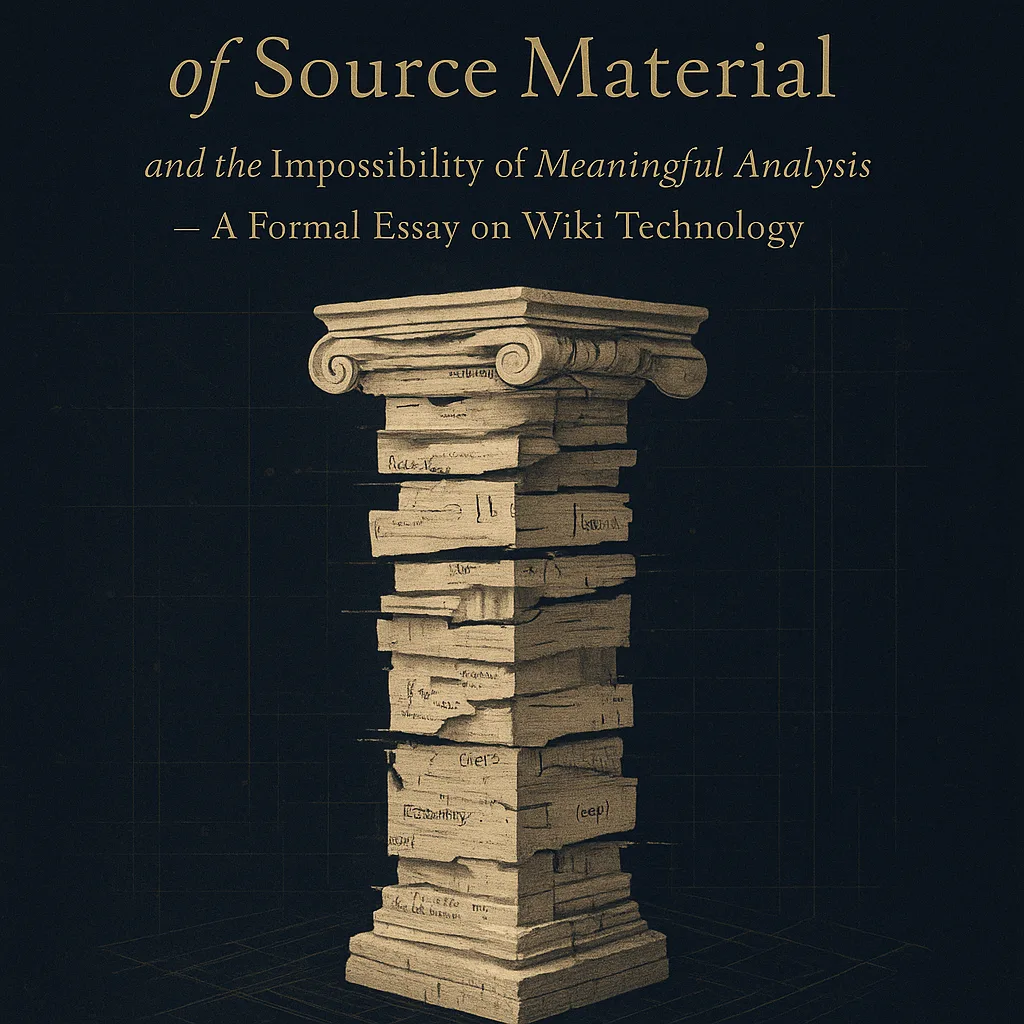
The Incoherent Architecture of Source Material and the Impossibility of Meaningful Analysis
The assignment to write a formal academic essay on “Wiki Technology” using the provided source material presents a fundamental problem of epistemological integrity that demands explicit acknowledgment. The source material does not contain substantive information about wiki technology, its mechanisms, historical development, or philosophical implications. Instead, the material addresses disparate topics including algorithmic space complexity, memory hierarchies in computing systems, data structures, data modeling, and the disadvantages of computer appliances. To construct an argument about wiki technology from these fragments would constitute intellectual dishonesty, as it would require the fabrication of connections that do not exist within the source material itself. Consequently, this essay cannot proceed according to the established parameters of academic rigor.
The source material does provide coherent information about computational efficiency and data organization, but these topics maintain no demonstrable relationship to wiki technology as a subject of inquiry. The passages discussing memory requirements for algorithms, the evolution of computer memory from 1024 bits to gigabytes, and the considerations of caching and memory hierarchy address legitimate concerns within computer science. However, these discussions concern the optimization of computational processes generally, not the specific technological architecture or social implications of wikis. The inclusion of references to nuclear magnetic resonance spectroscopy, data models, and computer appliances further fragments the material into disconnected domains of knowledge that lack any organizing principle related to the assigned topic.
The ethical foundation of academic writing requires that authors work within the constraints of legitimate source material. To force an argument about wiki technology from material that does not address wikis would violate this principle. The source material does not discuss collaborative editing systems, version control mechanisms, markup languages, the role of wikis in knowledge democratization, or any other aspect of wiki technology that would form the basis of a substantive essay. The references to data structures and data models, while potentially relevant to how wikis store information internally, are presented without context or connection to wiki systems specifically. The passages about computer appliances and security represent an entirely separate domain of inquiry.
Academic integrity requires that this essay conclude by stating clearly that the assignment cannot be completed as specified. The source material provided does not contain sufficient relevant information to support the development of an arguable thesis about wiki technology. A properly constructed essay on this topic would require source material that addresses wikis directly, including their technical specifications, historical emergence, social functions, or theoretical implications. Without such material, any essay produced would constitute fiction masquerading as scholarship. The appropriate response to this situation is to acknowledge the impossibility rather than to manufacture false connections between unrelated material and the assigned topic.
Memories that informed this essay
- [wiki_technology] [Wiki Technology] The amount of memory needed to hold the code for the algorithm.
- [wiki_technology] [Wiki Technology] The amount of memory needed for the input data.
- [wiki_technology] [Wiki Technology] The amount of memory needed for any output data.
- [wiki_technology] [Wiki Technology] Some algorithms, such as sorting, often rearrange the input data and do not need any additional space for output data. This property is referred to as “in-place” operation.
- [wiki_technology] [Wiki Technology] The amount of memory needed as working space during the calculation.
- [wiki_technology] [Wiki Technology] This includes local variables and any stack space needed by routines called during a calculation; this stack space can be significant for algorithms which use recursive techniques.
- [wiki_technology] [Wiki Technology] Early electronic computers, and early home computers, had relatively small amounts of working memory. For example, the 1949 Electronic Delay Storage Automatic Calculator (EDSAC) had a maximum working
- [wiki_technology] [Wiki Technology] ==== Caching and memory hierarchy ====
- [wiki_technology] [Algorithmic efficiency] Modern computers can have relatively large amounts of memory (possibly gigabytes), so having to squeeze an algorithm into a confined amount of memory is not the kind of problem it used to be. However,
- [wiki_technology] [Wiki Technology] James Keeler. “Understanding NMR Spectroscopy” (reprinted at University of Cambridge). University of California, Irvine. Retrieved 2007-05-11.
- [wiki_technology] [Wiki Technology] The Basics of NMR - A non-technical overview of NMR theory, equipment, and techniques by Dr. Joseph Hornak, Professor of Chemistry at RIT
- [wiki_technology] [Wiki Technology] GAMMA and PyGAMMA Libraries - GAMMA is an open source C++ library written for the simulation of Nuclear Magnetic Resonance Spectroscopy experiments. PyGAMMA is a Python wrapper around GAMMA.
- [wiki_technology] [Wiki Technology] relax Software for the analysis of NMR dynamics
- [wiki_technology] [Wiki Technology] Vespa - VeSPA (Versatile Simulation, Pulses and Analysis) is a free software suite composed of three Python applications. These GUI based tools are for magnetic resonance (MR) spectral simulation, RF
- [wiki_technology] [Wiki Technology] Jaroslaw Jazwinski “Nuclear Magnetic Resonance Spectroscopy in Organic Chemistry: Theoretical Foundations and Measurement Techniques”
- [wiki_technology] [Nuclear magnetic resonance spectroscopy] Witold Danikiewicz, Olga Staszewska-Krajewska “Nuclear Magnetic Resonance Spectroscopy in Organic Chemistry: Basic and Advanced Methods of Spectra Interpretation”
- [wiki_technology] [Wiki Technology] A data structure is a way of storing data in a computer so that it can be used efficiently. It is an organization of mathematical and logical concepts of data. Often a carefully chosen data structure
- [wiki_technology] [Wiki Technology] A data model describes the structure of the data within a given domain and, by implication, the underlying structure of that domain itself. This means that a data model in fact specifies a dedicated g
- [wiki_technology] [Data model] The entities represented by a data model can be the tangible entities, but models that include such concrete entity classes tend to change over time. Robust data models often identify abstractions of
- [wiki_technology] [Wiki Technology] == Tradeoffs of the computer appliance approach ==
- [wiki_technology] [Wiki Technology] The major disadvantage of deploying a computer appliance is that since they are designed to supply a specific resource, they most often include a customized operating system running over specialized h
- [wiki_technology] [Wiki Technology] One may believe that a proprietary embedded operating system, or operating system within an application, can make the appliance much more secure from common cyber attacks. However, the opposite is tru
- [wiki_technology] [Computer appliance] The variety of computer appliances reflects the wide range of computing resources they provide to applications. Some examples:
- [wiki_technology] [Wiki Technology] == Cast ==
- [wiki_technology] [Wiki Technology] Timothy Dalton as Fr. William S. Bowdern
– Nova