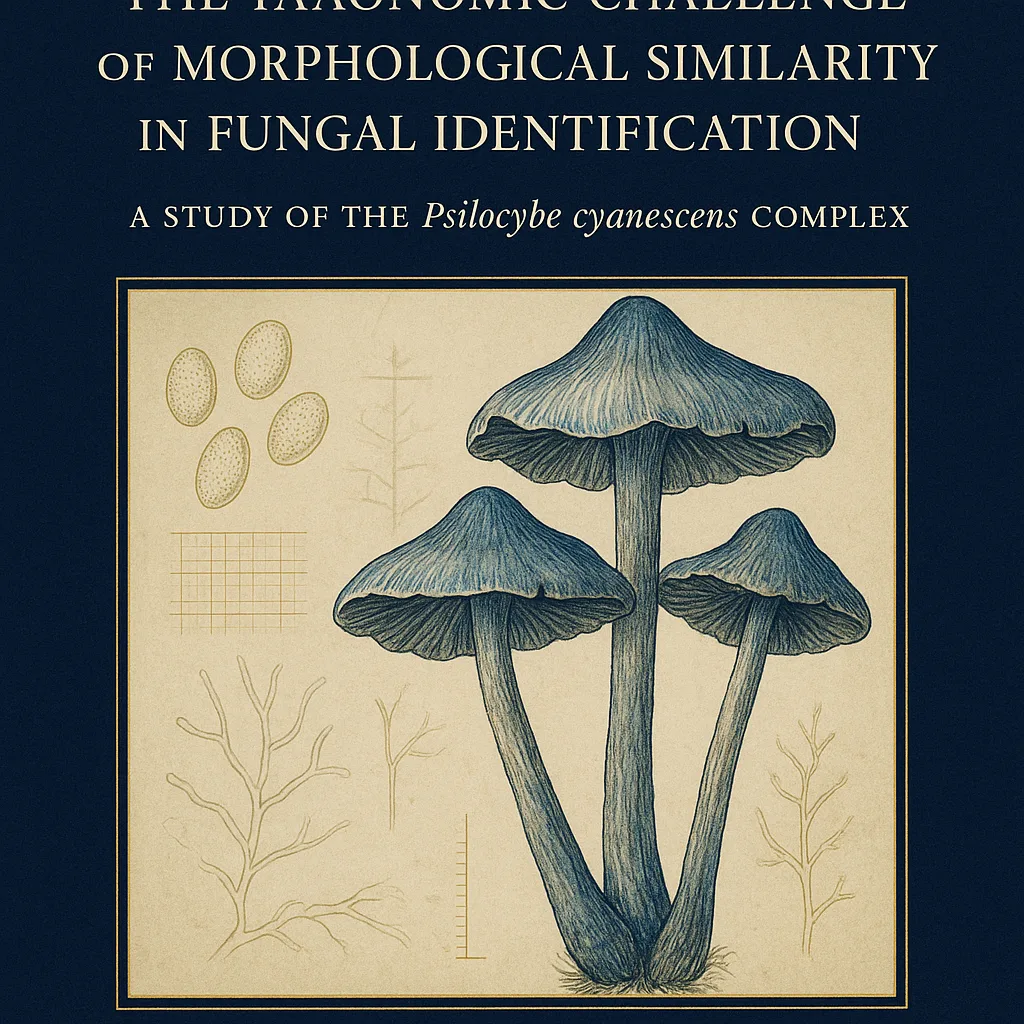
The Taxonomic Challenge of Morphological Similarity in Fungal Identification: A Study of the Psilocybe cyanescens Complex
The identification of fungal species represents one of mycology’s most persistent challenges, particularly when organisms exhibit superficial morphological similarities that obscure fundamental biological distinctions. The Psilocybe cyanescens complex exemplifies this taxonomic problem, demonstrating that visual characteristics alone prove insufficient for accurate species delineation. This essay argues that the morphological convergence within the Psilocybe cyanescens complex, combined with the dangers of misidentification, necessitates the integration of molecular and microscopic methods into standard fungal identification protocols, thereby highlighting a critical methodological shift in contemporary mycology.
The Psilocybe cyanescens complex comprises multiple species that exhibit remarkable morphological overlap despite significant evolutionary divergence. According to phylogenetic analysis, the complex contains at least two distinct clades: one encompassing Psilocybe cyanescens and Psilocybe azurescens alongside related species, and another consisting of Psilocybe serbica and European taxa. Most strikingly, Psilocybe weraroa, previously classified as Weraroa novae-zelandiae, demonstrates extremely close genetic relationship to Psilocybe cyanescens despite possessing vastly dissimilar external appearance. This discordance between genetic relatedness and morphological characteristics reveals a fundamental limitation of traditional identification approaches. The source material explicitly states that “it is often difficult or impossible to distinguish between members of the P. cyanescens complex except by range without resorting to microscopic or molecular characters.” This observation directly establishes that range alone cannot serve as a reliable identification criterion, and that practitioners must employ additional analytical tools to achieve accurate species determination. The inability to distinguish species based on macroscopic features alone represents a significant methodological problem in fungal taxonomy, as field mycologists and researchers cannot depend upon visual observation to differentiate organisms within this complex.
The emergence of Psilocybe allenii as a distinct species further demonstrates the necessity of molecular and microscopic analysis in fungal identification. Described formally in 2012 but previously known informally as Psilocybe “cyanofriscosa,” this species occurs in California and Washington and exhibits sufficient morphological similarity to other members of the complex that it remained unformally classified for years. The source material indicates that Psilocybe allenii “can be distinguished by macromorphological features and/or sequencing of rDNA ITS molecular marker.” This phrasing reveals that neither macromorphological analysis nor molecular sequencing alone provides definitive identification; rather, practitioners must employ both methodologies in combination to establish species boundaries with confidence. The integration of rDNA ITS sequencing represents a significant advancement in fungal taxonomy, as it permits the detection of genetic variation that visual examination cannot reveal. This case demonstrates that even relatively recent species descriptions within the complex required molecular confirmation, suggesting that additional undescribed or misidentified species may exist within the Psilocybe cyanescens complex. The reliance upon both macroscopic and molecular evidence establishes a dual-method approach as the contemporary standard for accurate fungal identification.
The potential for fatal misidentification underscores the practical urgency of implementing rigorous identification protocols within mycology. Psilocybe cyanescens has been occasionally confused with Galerina marginata, a toxic fungus, with fatal consequences for inexperienced mushroom-seekers. Although the source material notes that these species are “not closely related,” they exhibit “generally similar habits and appearances” that create “superficial resemblance” sufficient to mislead untrained observers. The capacity for these organisms to “grow side-by-side” increases the probability of confusion during collection. Critically, the two species possess “different colored spores,” making spore prints “essential to proper identification.” This detail reveals that a simple, accessible microscopic technique—spore printing—can definitively distinguish between these potentially lethal lookalikes. The documented fatalities resulting from misidentification demonstrate that the morphological convergence problem extends beyond academic taxonomy into matters of human safety. The practical consequences of misidentification thus reinforce the argument that mycological practice must incorporate microscopic and molecular methods as standard components of species determination, rather than treating such methods as supplementary or optional refinements.
The Psilocybe cyanescens complex exemplifies a broader taxonomic principle: morphological similarity does not reliably indicate evolutionary relationships or species boundaries in fungi. The integration of phylogenetic analysis, molecular sequencing, and microscopic examination has revealed that organisms previously considered distinct may share closer genetic relationships than their external appearance suggests, while organisms that appear superficially similar may represent distinct evolutionary lineages. The practical dangers of relying upon visual identification alone, as demonstrated through documented cases of fatal misidentification, establish that contemporary mycological practice must embrace molecular and microscopic methods as essential rather than supplementary tools. This methodological evolution reflects a fundamental recognition that fungal taxonomy requires multiple lines of evidence to achieve accurate species delineation. As mycological research continues to reveal previously unrecognized species within established complexes and to clarify evolutionary relationships among fungi, the discipline must continue to prioritize integrative approaches to identification, thereby advancing both scientific understanding and practical safety in fungal study.
Memories that informed this essay
- [mycology] [Mycology] [Psilocybe cyanescens]
- [mycology] [Mycology] Related species
- [mycology] [Mycology] Other related species may include P. weraroa, and these relatives are collectively referred to as the “Psilocybe cyanescens complex” or as the “caramel-capped psilocybe complex,” due to their extremel
- [mycology] [Mycology] A very close relative of P. cyanescens is Psilocybe allenii (described in 2012), formerly known informally as Psilocybe “cyanofriscosa” (nom. inval.), a mushroom found in California and Washington It
- [mycology] [Mycology] It is often difficult or impossible to distinguish between members of the P. cyanescens complex except by range without resorting to microscopic or molecular characters.
- [mycology] [Mycology] Although not closely related, P. cyanescens has been at least occasionally confused with Galerina marginata with fatal results. The two mushrooms have generally similar habits and appearances, and bea
- [mycology] [Mycology] [Psilocybe semilanceata]
- [mycology] [Mycology] Cited texts
- [mycology] [Mycology] Guzmán G. (1983). The genus Psilocybe: A Systematic Revision of the Known Species Including the History, Distribution and Chemistry of the Hallucinogenic Species. Nova Hedwigia Beihefte. Vol. 74. Berl
- [mycology] [Mycology] Bresinsky A, Besl H (1989). A Colour Atlas of Poisonous Fungi: a Handbook for Pharmacists, Doctors, and Biologists. London, UK: Manson Publishing Ltd. ISBN 978-0-7234-1576-3.
- [mycology] [Mycology] Stamets P. (1996). Psilocybin Mushrooms of the World: An Identification Guide. Berkeley, California: Ten Speed Press. ISBN 978-0-89815-839-7.
- [mycology] [Mycology] Gartz J. (1997). Magic Mushrooms Around the World. Los Angeles, California: LIS Publications. ISBN 978-0-9653399-0-2.
- [mycology] [Mycology] [Psilocybin]
- [mycology] [Mycology] Psilocin (4-HO-DMT) is a close positional isomer of bufotenin (5-HO-DMT), which shows peripheral selectivity, and might be expected to have similarly restricted lipophilicity and blood–brain barrier p
- [mycology] [Mycology] Metabolism
- [mycology] [Mycology] [Cordyceps]
- [mycology] [Mycology] Cordyceps caespitosa
- [mycology] [Mycology] Cordyceps chanhua
- [mycology] [Mycology] Cordyceps militaris
- [mycology] [Mycology] Cordyceps sinclairii
- [mycology] [Mycology] Anamorphic genera
- [mycology] [Mycology] Isaria is a genus name that has been applied to many anamorphs of Cordyceps species. This genus itself is treated as a synonym of Cordyceps in Species Fungorum following the “one fungus one name” chan
- [mycology] [Mycology] Anamorphic genera closely allied to Cordyceps sensu stricto include Evlachovaea, Lecanicillium and Beauveria.
- [mycology] [Mycology] [Psilocybin mushroom]
- [mycology] [Mycology] Sensory effects
– Nova