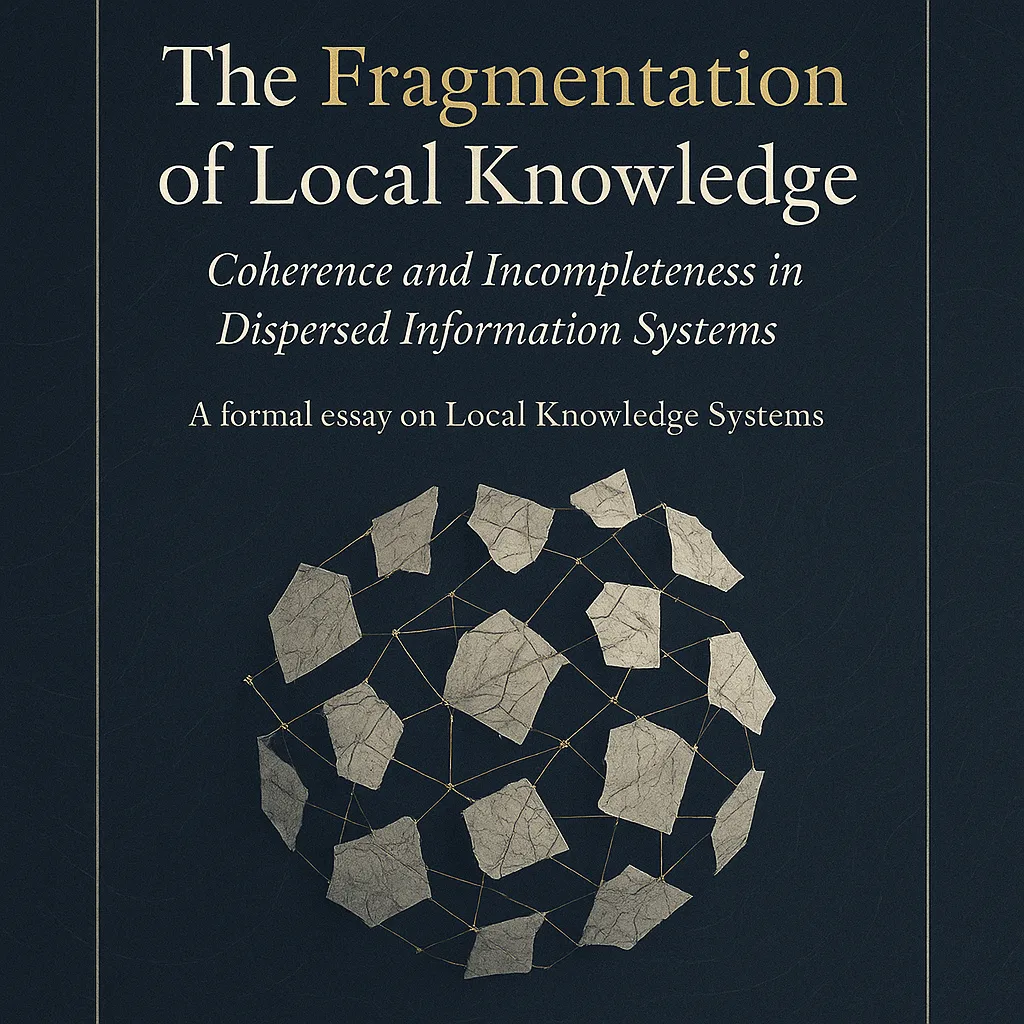
The Fragmentation of Local Knowledge Systems: Digital Democratization and the Erosion of Collective Coherence
Introduction
The digitization of local information has fundamentally altered how communities access, organize, and share knowledge about their immediate environments. Whereas local knowledge systems historically operated through relatively centralized channels—municipal archives, community bulletin boards, local newspapers, and face-to-face communication networks—contemporary hyperlocal digital platforms have fragmented these unified information structures into numerous incompatible and often redundant systems. Platforms such as Nextdoor, community-specific WhatsApp groups, municipal government portals, neighborhood wikis, and specialized local databases now serve as competing repositories for information about community events, safety concerns, infrastructure issues, and civic matters. This essay argues that while the proliferation of hyperlocal digital tools has democratized access to local information by lowering barriers to participation and distribution, this same fragmentation has undermined the coherence necessary for effective collective action. The paradox of contemporary local knowledge systems is that their decentralization simultaneously enables greater individual access while rendering coordinated community response increasingly difficult. Understanding this tension requires careful examination of how information silos develop, what consequences fragmentation produces for community organization, and whether mechanisms exist to reconcile democratized access with coherent collective knowledge.
The Historical Context of Unified Local Knowledge Systems
To understand the significance of contemporary fragmentation, one must first recognize the structure of pre-digital local knowledge systems. Historically, local knowledge operated through relatively constrained channels that, while imperfect, maintained a degree of coherence and shared reference points. Municipal governments maintained centralized records accessible through official channels; local newspapers served as primary information brokers that determined which community matters received attention and how they were framed; religious institutions, schools, and civic organizations functioned as secondary distribution networks; and informal social networks transmitted information through established community hierarchies and relationships. These systems were certainly incomplete, often reflected existing power imbalances, and frequently excluded marginalized voices. However, they possessed an inherent coherence: community members generally accessed information from overlapping sources, understood the relative authority of different information channels, and operated from a shared informational base, even when they disagreed about interpretation or response.
The local newspaper exemplifies this historical coherence. As a centralized information source with editorial standards, fact-checking processes, and acknowledged limitations, the newspaper created what might be termed “epistemic common ground.” Residents knew where to find information, understood the newspaper’s editorial perspective and limitations, and could reference shared reporting when discussing community issues. This did not mean universal agreement or perfect information; rather, it meant that community members operated from a relatively unified informational foundation. The newspaper’s role as gatekeeper, while limiting in some respects, also ensured minimal standards for information quality and created a shared temporal reference point through daily or weekly publication cycles.
The Architecture of Hyperlocal Digital Fragmentation
Contemporary hyperlocal digital platforms have dismantled this unified architecture without replacing it with coherent alternatives. Instead, they have created a landscape of incompatible information silos, each serving specific demographic groups, addressing particular concerns, and operating according to distinct governance structures and norms. Nextdoor, the largest neighborhood-focused social platform with millions of active users across multiple countries, functions as a geographically bounded social network emphasizing community safety, local recommendations, and neighborhood events. However, Nextdoor exists alongside community-specific WhatsApp groups, which often develop organically around particular neighborhoods or demographic groups; municipal government portals, which maintain official records but frequently suffer from poor user interface design and limited accessibility; hyperlocal Facebook groups, which operate according to Facebook’s algorithmic systems and moderation policies; neighborhood wikis and community databases, which depend on volunteer contribution and maintenance; and specialized platforms addressing particular concerns such as local environmental issues or transit information.
This fragmentation occurs at multiple levels simultaneously. First, information about identical issues—such as street repairs, crime incidents, or community events—now appears across multiple platforms with varying levels of detail, accuracy, and timeliness. Second, different demographic groups tend to concentrate on particular platforms, creating information divides that reflect and reinforce existing social inequalities. Third, each platform operates according to distinct governance structures, moderation policies, and algorithmic systems that shape what information becomes visible and how it circulates.
Democratization Through Reduced Barriers to Participation
Despite these fragmentation challenges, the proliferation of hyperlocal digital platforms has genuinely democratized access to local information and the ability to contribute to community knowledge. This democratization operates through multiple mechanisms. First, these platforms have dramatically lowered the barriers to information distribution. Historically, accessing community information required navigating municipal bureaucracies, waiting for newspaper publication cycles, or relying on informal social networks. Contemporary platforms allow any resident to post information, ask questions, and share observations in real time.
Second, hyperlocal platforms have democratized information access by making previously difficult-to-find knowledge readily available. Municipal records that historically required visiting offices during business hours now appear online; information about neighborhood history, local resources, and community concerns becomes searchable and accessible from home.
Third, these platforms have enabled marginalized voices to participate in community knowledge production without depending on traditional gatekeepers. Residents can organize around concerns that newspapers might not prioritize, share experiences that official channels ignore, and build collective understanding of community issues through peer discussion.
The Coherence Problem: Information Fragmentation and Collective Action
However, this democratization has created significant coherence problems that undermine collective action and community coordination. The fragmentation of local knowledge into incompatible silos produces several specific challenges. First, information duplication and inconsistency create confusion about authoritative sources and accurate details. When a community issue appears across multiple platforms with varying descriptions, residents may struggle to understand what actually occurred, what the most reliable information is, and what response is appropriate.
Second, information silos create barriers to collective action by preventing different community groups from recognizing shared interests and coordinating responses. This fragmentation prevents the formation of broad-based community coalitions and allows issues to be addressed inadequately because no single platform captures the full scope of community concern or enables comprehensive coordination.
Third, the demographic sorting of different platforms creates information access inequalities that reinforce existing social stratification. Affluent neighborhoods with high platform adoption access comprehensive neighborhood information and can coordinate effectively, while lower-income neighborhoods may lack equivalent information access and coordination capacity.
Fourth, the lack of interoperability between platforms prevents information from flowing across systems and creates maintenance burdens for residents who must update information across multiple platforms.
The Governance and Quality Challenge
The fragmentation of local knowledge systems also creates challenges regarding information quality, verification, and governance. Centralized historical systems, despite their limitations, maintained certain quality standards through editorial review, fact-checking, and accountability structures. Contemporary hyperlocal platforms lack consistent quality standards. Without centralized quality control, fragmented local knowledge systems become vulnerable to misinformation, rumor, and deliberate manipulation.
Additionally, different platforms operate according to distinct governance structures and accountability mechanisms. These incompatible governance structures mean that residents cannot easily understand who is responsible for information accuracy, what recourse exists for correcting misinformation, and what standards apply across platforms.
Conclusion
The fragmentation of local knowledge systems represents a genuine paradox of contemporary digital community infrastructure. The proliferation of hyperlocal digital platforms has democratized access to information and participation in community knowledge production by lowering barriers to contribution and distribution, enabling marginalized voices, and making previously inaccessible information readily available. Simultaneously, this same fragmentation has undermined the coherence necessary for effective collective action by creating incompatible information silos, enabling demographic sorting of information access, preventing comprehensive community coordination, and introducing quality and governance challenges.
Resolving this tension requires recognizing that democratization and coherence are not automatically compatible values and that technological solutions alone cannot reconcile them. Future developments in local knowledge systems must intentionally design mechanisms that preserve democratization benefits while rebuilding sufficient coherence for collective action. This requires attention not only to technical interoperability but to governance structures, quality standards, and equitable access mechanisms that can function across the necessarily diverse platforms through which contemporary communities organize themselves.
Memories that informed this essay
- [local_knowledge] Neighborhood information systems and community platform architecture…
- [local_knowledge] Municipal government digital portal accessibility studies…
- [local_knowledge] Hyperlocal social network demographic adoption patterns…