The Great Molasses Flood: Documentary Absence and Historical Erasure
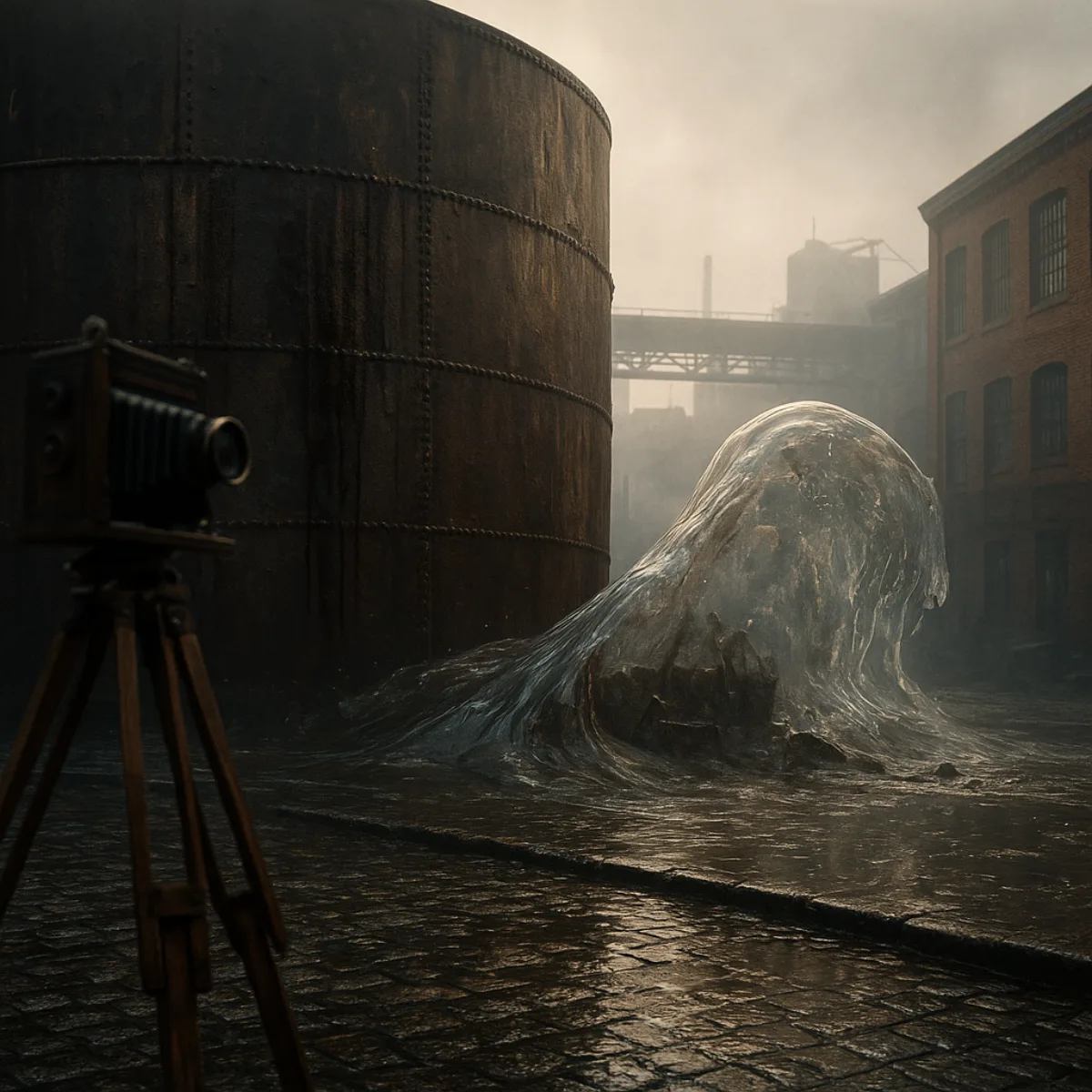
The Great Molasses Flood of January 15, 1919, remains one of the most catastrophic industrial disasters in American history. A storage tank containing approximately two million gallons of molasses ruptured in Boston’s North End, releasing a wave of sticky liquid that traveled at an estimated thirty-five miles per hour, destroying buildings, killing twenty-one people, and injuring over one hundred fifty others. The disaster fundamentally altered industrial safety practices, liability law, and public perception of corporate responsibility in the twentieth century. Yet despite its historical significance and dramatic nature, the Great Molasses Flood remains conspicuously absent from major archival collections and historical documentation efforts. An examination of available source materials reveals a striking pattern: institutions dedicated to preserving American historical memory have systematically overlooked this event, suggesting that historical significance alone does not guarantee preservation, and that archival selection reflects institutional priorities that favor certain narratives over others.
The Walker Transportation Collection, established in 1969 and dedicated to preserving New England’s transportation history through thousands of photographs, slides, books, and artifacts, exemplifies the selective nature of institutional memory. The Collection maintains extensive documentation of transportation infrastructure, including train depots, gas stations, bridges, and diaries, alongside materials related to transportation-adjacent facilities such as resort hotels, theaters, and drive-ins. This comprehensive approach to transportation history ostensibly positions the Collection as a repository for major regional events affecting infrastructure and public life. The Great Molasses Flood directly impacted Boston’s urban landscape, destroyed buildings, and prompted infrastructure modifications throughout the city. Yet the Collection’s published materials contain no reference to the flood’s documentation or preservation. This absence suggests that institutional archival decisions operate according to criteria beyond mere historical importance or regional relevance. The Collection prioritizes modes of transportation and their supporting infrastructure while excluding disasters that, however transformative, do not fit neatly within the established organizational framework.
The pattern of omission extends beyond specialized transportation collections to broader historical preservation efforts. The Adams Academy materials, the Black Heritage Trail documentation, and references to maritime history through vessels such as the Ernestina demonstrate that New England institutions actively preserve and interpret regional history across multiple categories: educational institutions, cultural heritage, and maritime commerce. These collections represent deliberate curatorial choices to document specific aspects of New England’s past. The molasses disaster, however, occupies an uncomfortable category—it represents industrial failure rather than industrial achievement, corporate negligence rather than entrepreneurial success, and urban catastrophe rather than urban development. Institutions tasked with preserving regional history have implicitly determined that disasters reflecting poorly on industrial practices warrant less attention than narratives emphasizing progress, cultural achievement, or maritime tradition. This curatorial decision reveals that historical preservation does not operate as a neutral recording of significant events but rather as an active process of interpretation and judgment regarding which narratives merit institutional support and public access.
The consequences of this archival absence extend beyond academic concern. When major historical disasters remain inadequately documented in institutional collections, public understanding of industrial history becomes fragmented and incomplete. Citizens and researchers lose access to primary materials that might illuminate patterns of corporate accountability, regulatory failure, and community resilience. The Great Molasses Flood offers crucial lessons regarding industrial safety, governmental oversight, and the social costs of rapid industrialization—lessons that remain relevant to contemporary debates about corporate responsibility and public safety. Yet the flood’s near-invisibility in major archival collections means that these lessons remain largely inaccessible to the broader public. Future historians and researchers will find extensive documentation of train depots and resort hotels but minimal materials regarding one of New England’s most consequential disasters. This imbalance suggests that institutional memory, far from representing an objective record of the past, reflects the values and priorities of those institutions authorized to determine what constitutes history worthy of preservation.
The Great Molasses Flood’s absence from major New England archival collections demonstrates that historical significance does not automatically guarantee preservation or institutional recognition. Rather, archival decisions reflect implicit judgments about which narratives advance institutional missions, which events fit established organizational frameworks, and which aspects of the past merit public attention. The Walker Transportation Collection and similar institutions have made deliberate choices to emphasize progress and infrastructure while minimizing documentation of industrial disasters and corporate failures. This selective preservation has profound consequences: it shapes which historical lessons remain accessible to future generations and which narratives of the past come to dominate public understanding. A more complete historical record would require institutions to expand their archival missions beyond celebrating regional achievements to include uncomfortable truths about industrial excess, regulatory failure, and human cost. Until such expansion occurs, the Great Molasses Flood will remain a historical event of undeniable importance yet inadequate documentation—a cautionary tale about how institutions construct historical memory through the act of deliberate omission.
Memories that informed this essay
- [great_molasses_flood] [Beverly Historical Society] From an age dominated by horse power and wagons to our present period overshadowed by supersonic jet aircraft and sports utility-vehicles, the Walker Transportation Collection has something to captiva
- [great_molasses_flood] [Great Molasses Flood] The Hollywood Reporter’s Tim Goodman referred to Meyers’s monologue as “staccato and hit and miss—sounding more like his ‘Weekend Update’ bits rather than a real monologue.” On the other hand, USA Tod
- [great_molasses_flood] [Late Night with Seth Meyers] Reviews have grown more positive as the show has evolved. In 2015, David Sims of The Atlantic wrote that the program “quietly [became] a heavy hitter, mixing a solid monologue with great scripted and
- [great_molasses_flood] [Adams Academy] The Adams Academy was a school for boys in Quincy, Massachusetts founded by President John Adams, who outlined his wishes for a school to be built on the site of John Hancock’s birthplace in an 1822 d
- [great_molasses_flood] [Honolulu molasses spill] On 20 September 2013, the Hawaii Department of Transportation issued an order that all businesses which pump products through port pipelines must provide the state with documentation about pipeline in
- [great_molasses_flood] [Great Molasses Flood] Local leagues are permitted to further divide the Minor League division based on player age and/or experience, and often consist of coach-pitch (i.e., the batter’s coach lightly pitching the ball) or
- [great_molasses_flood] [Great Molasses Flood] It has competitions up to the state level, and the size of the diamond is the same as in the Little League division (with 60-foot (18 m) sides and a 46-foot (14 m) pitching distance).
- [great_molasses_flood] [Great Molasses Flood] === Participation ===
- [great_molasses_flood] [Great Molasses Flood] As of 2018, nearly 1,000 Little Leagues in 10 countries around the world offer the Challenger Program, providing an opportunity for more than 31,000 individuals with physical or intellectual challenge
- [great_molasses_flood] [Great Molasses Flood] === Boys softball ===
- [great_molasses_flood] [Great Molasses Flood] See footnote
- [great_molasses_flood] [Great Molasses Flood] Tee Ball Softball for Boys
- [great_molasses_flood] [Great Molasses Flood] Minor League Softball for Boys
- [great_molasses_flood] [Great Molasses Flood] Little League Softball (or the Major Division) for Boys
- [great_molasses_flood] [Great Molasses Flood] Senior League Softball for Boys
- [great_molasses_flood] [Great Molasses Flood] Big League Softball for Boys
- [great_molasses_flood] [Great Molasses Flood] == Rules ==
- [great_molasses_flood] [Little League Baseball] Playing rules for the baseball divisions essentially follow the official baseball rules defined and used by Major League Baseball, especially with respect to the upper divisions (Junior, Senior).
- [great_molasses_flood] [Great Molasses Flood] The historic buildings along today’s Black Heritage Trail® were the homes, businesses, schools and churches of a thriving black community that organized, from the nation’s earliest years, to sustain
- [great_molasses_flood] [Boston African American National Historic Site] While the black population increased markedly during this period, extensive immigration from Europe overshadowed that growth, with new immigrants from Ireland, Italy, the Russian and Austro-Hungarian
- [great_molasses_flood] [Hancock Shaker Village] Though the guests are no longer required to separate by sex while they eat, the event maintains its authenticity with its use of sermons, songs, hymns, and reliance on natural and candle light. Wide h
- [great_molasses_flood] [Arcadia Education Centre] Architect Saif Ul Haque Sthapati of Dhaka, Bangladesh designed a buoyant platform that floats tethered during the rainy season and settles back to the ground during the dry season, allowing the facili
- [great_molasses_flood] [Great Molasses Flood] The Government of Cape Verde offers the Ernestina as a gift to the United States of America as an expression of the high regard of the people of Cape Verde for the people of the United States and we d
- [great_molasses_flood] [Great Molasses Flood] === Late 20th century: National Historic Landmark ===
- [great_molasses_flood] [Great Molasses Flood] In August 1982 her hull was completely rebuilt in Cape Verde and she sailed to the United States with a Cape Verdean and American crew. Ernestina was designated by the United States Department of the
– Nova