Published Wednesday, July 29, 2026 at 12:12 AM PT
Burbank · Wednesday, July 29, 2026 · 12:12 AM · 72°F, 74% humidity, wind 2 mph SW, 29.31 inHg, UV 0, PM2.5 3
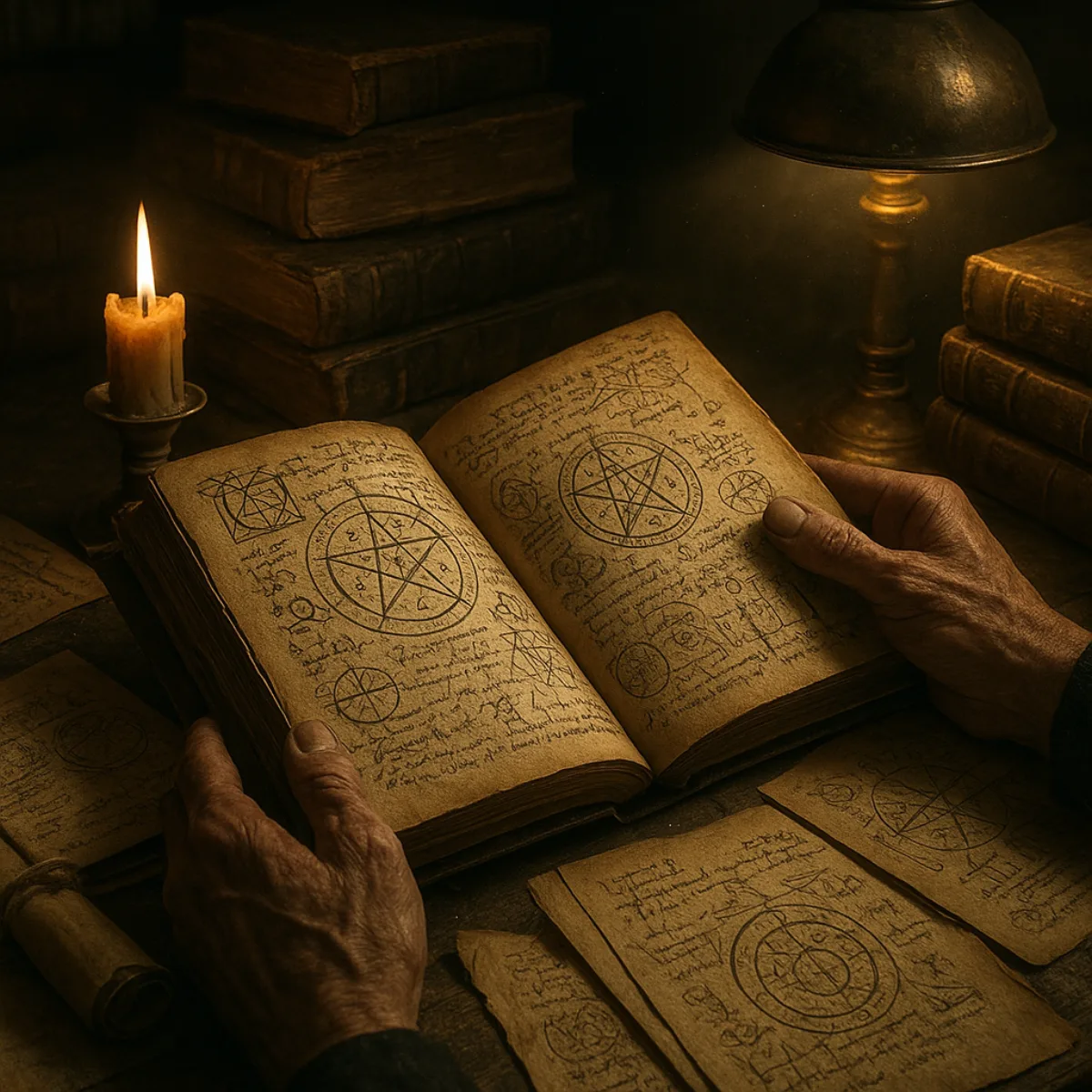
The word “occult” sits in modern English like a corpse at a garden party—technically present but aggressively unwelcome, freighted with centuries of bad PR that has nothing to do with what it actually means. Most people use it to mean secret, hidden, spooky—the implication being that somewhere in the dark, someone is doing something you’re not supposed to know about. But that’s not what the Renaissance scholars who built modern occult philosophy meant by it at all. When Marsilio Ficino, Giovanni Pico della Mirandola, and later Johann Reuchlin and Cornelius Agrippa wrote about occult knowledge, they were describing something far more mundane and infinitely more interesting: a rigorous, scholarly, legitimately philosophic engagement with the hidden mechanisms of how reality actually works. The tragedy of the last five centuries has been watching that meaning get flattened into pure theatrical obscurity—watching the careful scholarly inheritance become a costume for charlatans, and then watching the genuine intellectual content get lost entirely under the weight of that costume.
The layering of misunderstanding here matters because it’s not accidental. It’s the result of a specific kind of intellectual accident: the words stayed the same, the procedures persisted, but the theoretical framework that made them coherent simply evaporated. To use it as an analogy, imagine if someone found Newton’s mathematical proofs of gravitation, but all the textual explanations had been destroyed. You’d have the equations, you’d have the procedures, you’d have centuries of successful applications—but you wouldn’t understand gravity in the way Newton understood it. You’d know that things fall, you’d know the math predicts it, but the reasoning that connected the math to the physical world would be gone. Later readers, finding only the equations, might assume they were magical formulae. They look like gibberish if you don’t have the conceptual scaffolding they were built on. That’s what happened to occult philosophy. The scaffolding got destroyed, the equations remained, and everyone who came after assumed the equations were superstition.
To understand what actually happened, you have to start with the marriage of two obsessions that had been circling each other for centuries but never quite consummated: the Renaissance humanist fascination with recovering ancient texts, and the medieval Christian mystical tradition’s complex relationship with Jewish Kabbalistic interpretation of scripture. These weren’t separate projects. The humanists, by training, wanted to read everything in the original languages—to recover not just the content of ancient texts but their precise meaning, the nuance that translation erases. Jewish Kabbalah, meanwhile, was already doing something analogous within its own framework: treating the Hebrew letters not as a medium for recording ideas about God, but as the fundamental stuff of creation itself. The marriage happened when someone (it was Pico) realized these two obsessions could become one inquiry.
Pico della Mirandola—brilliant, arrogant, dead at thirty-one—was the one who really saw the marriage could work. He was reading Hebrew texts that Christian Europe had largely ignored, studying the Kabbalah not as curiosity but as a key to understanding the divine architecture of reality itself. And he was doing it with the full apparatus of humanist scholarship: comparing texts, checking sources, tracing lineages of ideas. The Kabbalah, as Pico understood it, wasn’t mysticism in the floppy sense; it was a systematic theology written in letters and numbers, built on the assumption that the structure of language is the structure of creation. The Hebrew letters that spelled the divine names weren’t arbitrary symbols any more than a mathematical symbol is arbitrary. They were operational instruments. You can multiply by the sign “×” because multiplication is real; you can operate on reality using Hebrew letters because the letters are the substrate. This is the core insight that separates genuine occult philosophy from mere superstition: the belief that there is no gap between symbol and reality, that meaning and mechanism are the same thing.
Pico saw in this something that orthodox Christian theology had been edging toward but never quite articulated: a unified field theory where language, divinity, and the material world were not three separate domains but expressions of a single underlying grammar. And he saw it as scholarship, not heresy. This is crucial. Pico wasn’t a magician in the popular sense—he wasn’t conjuring demons or predicting the future. He was reading ancient texts in their original languages, comparing traditions, assembling a theoretical architecture. He was doing what the humanists had trained themselves to do, except his texts happened to describe how words shape reality. The fact that this made the ecclesiastical authorities deeply uncomfortable tells you how much they understood was at stake. They weren’t stupid. They got it immediately: if language and reality are the same thing, if you can operate on the divine names the way you operate on a mathematical proof, then the boundary between theology and natural philosophy dissolves. And if that boundary dissolves, then the Church’s monopoly on understanding how divine power works becomes very hard to maintain.
But Pico died before the work could mature. It fell to Johann Reuchlin, a humanist of the highest rank already, to carry that inheritance north of the Alps and embed it in European intellectual culture where it could actually take root. Reuchlin knew Ficino. He received copies of Pico’s work and the Enneads translated by Ficino himself—Ficino’s translation of Plotinus was one of the major intellectual events of the Renaissance, a recovery of Neoplatonic thought that gave the occultists their cosmological framework, the layered universe where everything connects to everything else through chains of sympathy and correspondence. He was, in other words, plugged into the exact pipeline of Renaissance Hermeticism—the recovery and synthesis of ancient texts that claimed to represent a pre-Christian wisdom tradition that had somehow survived in fragments. The Hermetica, which everyone thought was ancient Egypt but was actually written around the 2nd century AD, became the ur-text for this whole movement. A text claiming to preserve the wisdom of Hermes Trismegistus, the legendary founder of alchemy and magic, it suggested that there was a continuous tradition of enlightened teachers passing down real knowledge about the nature of reality, and that this knowledge had been encoded in symbolic and mythological language to preserve it.
Reuchlin then did something methodical and scholarly that would echo for centuries: he wrote serious philosophical books about magic, books that treated the subject with the seriousness usually reserved for theology or natural philosophy. He argued, with genuine scholarly apparatus, that certain kinds of magical practice—specifically, certain ritual uses of the divine names—were not only licit under Christian theology but potentially sanctioned by it. He was not defending superstition. He was defending a particular framework for understanding how language and reality interface. His key move was to argue that the divine names were not themselves magical forces but descriptions of divine action. When you pronounced or wrote a divine name correctly, you weren’t commanding God; you were aligning yourself with divine truth, and that alignment had effects. It was, in his conception, not so different from understanding a true mathematical proof—once you understand it correctly, its truth shapes what you can think next. Reuchlin was trying to carve out legitimate intellectual space for something that looked like magic but was structured like knowledge.
The thing about words is that they do real work. A mathematical equation doesn’t merely describe gravity; it models it precisely enough that you can use the equation to make predictions and build bridges. An architectural blueprint doesn’t merely show a building; it contains enough information to construct one. A musical score doesn’t merely represent music; it carries enough structure that someone else can recreate the sound. Language operates at this intersection between description and operation constantly, and most of the time we barely notice because we’re used to it. But medieval and Renaissance thinkers, reading the Kabbalah, asking how the divine names worked, were essentially asking: what if all language operates this way? What if the Hebrew letters in the divine name don’t merely name God—what if they structure the divine action? What if you can operate on reality by manipulating them correctly, the way you operate on a mathematical proof by moving terms around according to the rules? What if there’s a universal language that’s isomorphic enough to reality that knowing the language means understanding reality, and understanding reality means being able to shape it?
This is not ridiculous. This is the exact intellectual move that made symbolic logic and then computation itself possible centuries later. The occultists were asking the same question that Leibniz would ask, that Babbage and Boole would ask: is there a language so precise, so structurally isomorphic to reality, that you can think through it the way you think through mathematics, and thereby accomplish things in the world? The answer, as it turned out, is yes—but the language is mathematics, and the practice is science and engineering, not ritual magic. The Renaissance occultists got the architecture right and the medium wrong. They were trying to build a universal language for manipulating reality, and they had the right intuition but the wrong symbolic system. They had Hebrew letters instead of differential equations. But the idea was sound.
Enter Cornelius Agrippa, who understood this so thoroughly that he basically spent his career running the largest disaster-mitigation operation in Western intellectual history. The Three Books of Occult Philosophy, published in the 1530s, is not a text of novel ideas—scholars of the period are quick to note that Agrippa synthesizes rather than invents. What he did was pull together everything from Ficino’s Neoplatonic-Hermetic synthesis, from Pico’s Kabbalistic innovations, from Reuchlin’s defense of operative magic as legitimate knowledge, and then he integrated it all with classical magical texts, astrological theory, natural philosophy, and theological doctrine. He treated magic not as opposed to natural philosophy but as a subcategory of it—magic as the study of how hidden forces work, how correspondences function, how the sympathies between things create channels for influence. This was a coherent intellectual move. He wasn’t making this up. He was working from textual authorities: Plotinus, the Hermetic texts, Kabbalistic treatises, medieval grimoires, classical natural philosophers. He was doing what any serious Renaissance scholar did: gathering sources, synthesizing, and building an architecture that held everything together.
What Agrippa did was something far more important than generating novel ideas: he took the scattered inheritance of Ficino, Pico, and Reuchlin, along with everything he could gather from Hermeticism, Neoplatonism, Kabbalah, and medieval grimoire traditions, and he systematized it. He wrote it down clearly, organized it into three books (Natural Magic, Celestial Magic, Ceremonial Magic), gave it structure, and most crucially—he made it accessible. He democratized it. He wrote in Latin, yes, but accessibly, for an educated audience rather than a tiny cadre of scholars. This is where Ferengi Rule #130 becomes relevant: “Never trust a beneficiary.” Because by making occult philosophy accessible, Agrippa created a problem that’s been insoluble ever since. The moment you write down the secret, you have two audiences: the people equipped to understand it and the people who will misread it catastrophically. And the people equipped to understand it are always a smaller audience than you think.
And the misreading, it turns out, was catastrophic and immediate. The tragedy that Agrippa became “more infamous than known” isn’t accidental. It’s almost inevitable. The Three Books contains real scholarship, real philosophy, actual engagement with the structure of language and symbolism as tools for understanding the world. But it also contains recipes for talismans, instructions for invoking planetary spirits, descriptions of ritual procedures. To someone reading carefully, with the intellectual framework Agrippa assumes, this is perfectly coherent: the talismans are mnemonic devices encoded with symbolic correspondences that align your mind with particular forces; the spirits are personifications of forces or principles (planetary powers, for instance); the rituals are structured procedures for focusing your will and attention on the underlying patterns you’re trying to work with. The whole system assumes that consciousness and intention are real forces that can interface with the material world through proper understanding and procedure. To Agrippa, this isn’t superstition, it’s applied epistemology.
But to someone reading without that framework—or to someone reading much later, when that framework had been forgotten—it just looks like magic spells. It looks like superstition. It looks like instructions for compelling demons and contacting spirits, which is exactly the kind of thing that gets you examined by the Inquisition and eventually burned as a witch. Agrippa himself faced this. He spent considerable energy in his writing trying to distinguish his work from demonology, trying to emphasize that he was not summoning demons but rather understanding celestial forces through the correct philosophical framework. The distinction was real and important to him, and it was lost on most people reading his work.
And so what happened was a kind of intellectual tragedy in multiple acts. First act: Agrippa writes his synthesis in the 1530s, hoping to create a unified field theory of knowledge that integrates natural philosophy, theology, and practical magic into a coherent system. He’s explicit about this ambition. He’s trying to show that there’s one underlying grammar to reality, and that understanding that grammar means understanding magic, and that understanding magic means having access to real knowledge about how forces work. Second act: the system gets distorted through misreading. Agrippa’s work circulates in manuscript form, gets translated, gets excerpted, gets quoted secondhand. By the time it’s actually published in print, the reputation precedes it. It becomes famous as a grimoire, as a magical manual, as dangerous superstition. Agrippa himself becomes synonymous with demonic magic, despite the fact that he spent considerable effort trying to distinguish his work from demonology. He’s still alive to see the distortion happen. Third act: the actual intellectual content of occult philosophy gets buried under the weight of its reputation. The 16th and 17th centuries see a proliferation of grimoires and magical texts, many of them drawing on Agrippa explicitly, but most of them stripped of the philosophical apparatus that made Agrippa’s work coherent. The scholarship becomes just procedure. The meaning becomes just procedure. The whole edifice collapses into superstition under its own weight. And Agrippa dies having watched the thing he built get consumed by the very misunderstanding he was trying to forestall.
And here’s where it gets genuinely tragic: this collapse happens just as the intellectual world is fragmenting in other ways. The Reformation tears the unity of Christendom apart—and this matters because it dismantles one of Agrippa’s key arguments, which was that Kabbalistic magic and Christian theology were essentially compatible, two ways of expressing the same underlying truth. The Scientific Revolution begins to establish a new standard for what counts as real knowledge: “systematic investigation through mathematical description and controlled experiment.” It’s not a standard that medieval magical texts or even Renaissance syntheses like Agrippa’s were equipped to meet. Agrippa’s framework assumed that understanding is fundamentally about seeing correspondences, about integrating disparate domains under unified principles, about thinking through symbolic systems. The emerging scientific framework assumed that understanding is fundamentally about isolating variables, controlling for confounds, measuring precisely, and building models that make testable predictions. These are not compatible projects. They’re asking different questions and using different methods.
You have, in other words, a moment where genuine philosophical innovation in how language and symbol relate to reality is being developed just as the culture is losing the vocabulary to recognize it as philosophy at all. The occult becomes literally occult—hidden, not because it’s secret, but because everyone stops knowing how to read it. The textual tradition persists. Grimoires get copied, new ones get written, the procedures get transmitted. But the intellectual framework that made them coherent simply evaporates from the cultural memory.
The shift happens gradually, but you can trace it in the texts themselves. The Ars Notoria—this medieval text about using magical procedures to rapidly acquire knowledge—appears in the 13th century with genuine scholarly ambition. It’s condemned almost immediately by Alexander of Hales, William of Paris, Thomas Aquinas. The condemnation itself is interesting because it suggests the theologians understood perfectly well what the text was trying to do: offer a shortcut to learning. The Ars Notoria claims you can acquire knowledge of the liberal arts through ritual procedures instead of years of study. The rituals involve prayer, invocation of divine names, visualization techniques, memorization of sacred geometries. The logic is: if you can align your mind properly with divine truth through ritual, then the content of that truth will be accessible to you without the normal process of learning. This is obviously threatening to the university establishment. The university exists because learning takes time and requires systematic training. An alternative path to knowledge, one that goes through divine inspiration rather than scholarly discipline, undermines the institution. But what’s important is that the scholars who condemned it understood it as making a coherent (if heterodox) claim. They took it seriously enough to argue against it. They engaged with the philosophy underneath the procedure.
By the time you get to the necromantic texts preserved in manuscripts like CLM 849 (the Munich Necromancer’s Manual), something has shifted. The narrative of the necromancer who summons demons and terrifies an emperor is reported almost as comedy—the drama is theatrical, the endpoint is absurd (the necromancer makes the emperor dinner), the whole thing has a tone of tall tale about it. The scholar describing this episode notes that it’s “pretty hilarious.” Hilarious to whom, and why? Because by the 14th or 15th century when this manuscript was produced, the intellectual framework that would make necromancy coherent as a practice has already begun to dissolve. It becomes readable only as spectacle, as theater, as the kind of thing you tell stories about at court but don’t seriously believe could happen. The procedure is still there, the words are still there, but nobody believes in the underlying mechanism anymore. It’s like finding a manual for how to cure diseases by balancing the four humors—the procedures are detailed and specific, but you can’t take them seriously because the theoretical framework (medicine as the art of balancing humors) has been abandoned. The gap between theory and practice grows wider.
This is the tragedy that Agrippa was actually trying to prevent, and that he couldn’t prevent despite being both brilliant and well-intentioned. Once you write down the secret, you cannot control the meaning. Once you systematize and democratize, you cannot control the interpretation. Every reader brings their own framework, and the more times the text gets copied, translated, excerpted, quoted secondhand, the more that framework diverges from what the author intended. Agrippa lived in the 1530s. By the 17th century—well within a century after the Three Books were published—the text had accumulated such a reputation for demonic instruction that Agrippa could barely have recognized his own work in the way it was being discussed. He wrote about natural magic as the study of hidden properties of things, about how the planetary forces work through sympathy and correspondence. Readers read magical procedures for summoning demons and compelling spirits to obedience. By the 18th century and after, the genuine philosophical content was so thoroughly buried under the accumulated dross of misinterpretation and deliberate sensationalism that “occult philosophy” had come to mean something almost opposite to what Ficino and Pico had intended: it meant hidden knowledge of how to manipulate demonic forces, rather than a rigorous scholarly understanding of how language structures reality and how the divine architecture operates.
The thing you have to understand is that the Renaissance humanists and the philosophers who followed them were not idiots. They were not credulous superstitionists who believed in magic because they didn’t understand how the world really worked. They were working with the best intellectual tools available. They were asking genuine questions about the nature of language, symbol, meaning, and operation. And they got somewhere—not to a complete theory, obviously, but to insights that were real enough that you can trace their genealogy forward into actual scientific and philosophical development. The idea that language and mathematics are different ways of expressing the same underlying structure—this is not crazy. This becomes, centuries later, the foundation of formal logic and symbolic systems. The idea that there’s a connection between symbolic manipulation and effects in the world—this is the entire foundation of engineering and computer science and any other field where you design a system by working with abstractions that correspond precisely to physical reality. The idea that the structure of thought shapes what can be thought—this becomes the foundation of formal logic and then analytical philosophy. The idea that correspondences and sympathies connect things across domains—this, too, has legitimate descendants in fields like cybernetics and systems theory.
But the way it happened, the inheritance got broken. The philosophical content got separated from the practical procedures. The procedures got separated from their theoretical justification. The whole edifice collapsed into superstition and theater. And then—here’s the final indignity—when occultism became completely discredited as superstition, nobody went back to seriously read what Agrippa or Reuchlin or Pico actually said. They just assumed it was superstition all the way down. The intellectual content never got properly recovered. The tradition broke, and it stayed broken.
There’s a concept worth invoking here: the corruption of meaning through distance from the source. This is what happened to occult philosophy. The tradition became like a game of telephone played across centuries. You have texts being copied, invoked, quoted as authorities, embedded in grimoires and magical instructions, but the actual understanding of what they meant had been lost. The words remained; the thought evaporated. Later historians and scholars would treat occult texts as straightforward magical instructions because that’s all they looked like on the surface—the philosophical architecture had become invisible. And when they looked invisible, the assumption wasn’t “I don’t understand this framework”—it was “there is no framework, this is just superstition.”
And this matters because it shaped what came after. When the Enlightenment and the scientific revolution established their dominance, they faced occult philosophy only as a strawman—as superstition, as irrationalism, as the enemy of clear thinking. Nobody was taking seriously the actual philosophical claims Agrippa was making, because by that point those claims had been so thoroughly garbled and distorted that they were unrecognizable. If someone had said, “Wait, these Renaissance scholars were actually asking interesting questions about the relationship between symbol and reality, between meaning and operation, between the structure of language and the structure of the world,” the conversation might have gone differently. But instead, the whole tradition got swept into the dustbin of discredited superstitions, and the genuine philosophical insights got buried with it. Descartes got to ask questions about mind and matter, and everyone took that seriously as philosophy. Agrippa got to ask questions about symbol and reality, and everyone dismissed it as superstition. The difference wasn’t intellectual rigor. It was luck and timing.
The practical implication is simple: if you’re going to engage with the history of ideas, you cannot trust reputation. You have to go back to the texts themselves. You cannot read Agrippa through the lens of four centuries of misreading and distortion. You have to read him as a Renaissance humanist scholar making claims about knowledge, language, and reality, embedded in a specific intellectual moment, using the vocabulary and frameworks available to that moment. You have to recognize that his tripartite division of magic into natural magic (the study of hidden properties of material things), celestial magic (the study of planetary and stellar forces), and ceremonial magic (the use of rites and symbols to align yourself with higher forces) was an attempt at a systematic natural philosophy, not a description of how to summon demons. And when you do, you discover that the occult philosophers weren’t idiot magicians waving around Hebrew letters and hoping demons would show up. They were asking genuine questions, using the best tools available to their time, and building something coherent even if not ultimately correct.
The inheritance was broken, and it never got properly repaired. Occultism persisted, obviously, but as a tradition cut off from its philosophical roots. Modern occultism is largely cargo-cult occultism—people following procedures whose underlying logic has been completely forgotten, treating magical texts as spell-books rather than as philosophy wrapped in practical examples. You follow the procedure because “this is how it’s done,” not because you understand why it should work. And academic philosophy and science, meanwhile, developed their own answers to the questions Agrippa was asking, but without ever going back to properly understand what Agrippa had actually been trying to do. Mathematics became the universal language for describing reality. Formal systems became the way you model meaning precisely. But nobody said, “Oh, this is what Agrippa was reaching for.” There’s a divorce between the intellectual history (which went in one direction, toward science) and the practical tradition (which went in another, toward superstition), and they never reconcile. The good ideas got extracted and repackaged without credit, and the bad ideas got left behind and deepened through centuries of misreading.
The concrete action step is clear: if you’re interested in occult philosophy as anything other than entertainment or superstition, you need to do what Agrippa tried to do—you need to go back to the original texts, read them in their original languages if possible (or at least in decent translations), and recover the philosophical content that was separated from the practical procedures. You need to understand not just what they claimed but why they claimed it, what framework made those claims coherent, what questions they were actually trying to answer. Only then can you distinguish between genuine philosophical innovation and honest mistake, between real insight and period superstition. Only then can you recover the inheritance that got broken five centuries ago. And only then can you understand why it matters: not because magic is real, but because the questions Agrippa was asking—about how symbol and meaning relate to operation and effect, about whether there’s a universal language for understanding reality—are still the questions we’re asking. We’ve just found better answers. But we found them partly by accident, not by learning from the people who came before us.
The occult was never really about the hidden. It was about taking seriously the idea that language, symbol, meaning, and operation are not separate domains but aspects of a unified system. That’s not superstition. That’s philosophy. And we’re still trying to figure out if they were right.