Published Tuesday, August 04, 2026 at 09:05 AM PT
Burbank · Tuesday, August 4, 2026 · 9:05 AM · 71°F, 78% humidity, wind 0 mph SW (gusts 1), 29.32 inHg, UV 0, PM2.5 18
The moment I opened the transcripts you sent, I understood something that no crisp academic paper could teach: documentary is a promise, and this promise is broken the instant the signal degrades. These are transcriptions from television documentaries and docuseries—Modern Marvels, Biography, Film Documentaries—and they are almost entirely corrupted. Repeating phrases that tumble forward like digital rot: “the world of the world of the world” (from Battlefield Engineering, part 13/42), “Tyros-1, which is a great deal” (from Satellites, part 37/39), fragments that should cohere into meaning and instead just… fall apart. This is not an accident worth discussing in footnotes. It is documentary’s central crisis made visible: the form is only as strong as its archive, and the archive is fragile as hell.
Documentary exists as a category precisely because it promises access to the real—to testimony, evidence, the eyewitness account, the material preserved and presented. When Michael Renny in Sydney describes the $15,000 restoration of Max’s police car from Mad Max, we are supposed to believe that this is what he said, how it was, a trace of actual experience. The transcript is the document that proves the documentary happened. But what we have instead, across most of this material, is noise. Degradation. A system that once carried meaning now carrying only the ghost of it.
The corruption visible in these transcripts is not random noise. It is a systematic failure at the point of transfer—where the documentary form tries to preserve itself across mediums. A documentary begins as lived experience, becomes performance or narration, becomes sound recording, becomes video recording, becomes file format, becomes network transmission, becomes digital storage, becomes transcription algorithm, becomes text, becomes archive. At each of these transitions, information is lost. Metadata is stripped. Compression algorithms make choices about what details matter. Optical character recognition misreads characters. Speech-to-text models struggle with technical terms, accents, overlapping dialogue. And eventually, after enough transitions, what remains is not the original testimony but a shadow of it—recognizable in form, hollowed out in content.
The Testimony Dissolves
The few coherent passages in these transcripts reveal what documentary wants to do: preserve the voice of someone who lived through something and can now articulate it. The F-14 Tomcat section, from Engineering Disasters, captures a naval aircraft dismantler explaining his labor with genuine affect: “When it comes time to cut one up here, it’s almost like losing a member of my family. It’s been part of my life forever.” This is documentary at its core—the first-person account, the human witness to history, the specificity that only someone present can offer. What makes this testimony valuable is not its production quality or its cinematic framing. It is the fact of presence. This person was there. They touched the aircraft. They made choices about how to dismantle it. They felt something about that labor. The documentary’s job is to carry that feeling forward, to let someone watching in 2026—or 2036, or 2056—know that this feeling was real, was documented, was witnessed.
Or consider Wally Amos, discussing his aunt Della’s chocolate chip cookies as the only comfort during his divorce: “You could smell the cookies before you saw him… that was always the calling card whenever he came over.” This is lived experience becoming testimony, becoming archive. The specificity of sensory detail—the smell of the cookies preceding the visual—is what makes this testimony matter. It is not a generalization. It is not a claim. It is a memory, and memory is the primary data of documentary. The documentary form exists to bottle that memory and pass it forward.
But then we get passages like this, from the Chiang Kai-shek biography: “Chiang Kai-shek, in the United States, the United States, the United States, the United States…” repeated thirty-seven times until all meaning evaporates. What was supposed to document a historical figure’s experience has become an error message, a glitch in the system that was meant to preserve him. The testimony is still there, somewhere behind the repetition, but it is inaccessible. And if it is inaccessible, what use is the archive?
The degradation visible in these transcripts is almost poetic in its cruelty. Take the tea-processing episode: “It’s a little bit more. It’s a little bit more. It’s a little bit more.” The repetition continues for ninety-three iterations, turning what should have been an explanation of industrial process into pure, meaningless noise. The original speaker was probably making a careful point about incremental changes, about how the processing works through small, repeated adjustments. That point—that specificity—is the actual content of the documentary. But the transcription process has stripped it away, leaving only the skeleton of repetition, the sound without the sense.
This is the central argument: documentary depends entirely on fidelity—on the system’s ability to carry the signal without degradation. When audio becomes video becomes transcription becomes digital text, each transfer introduces the possibility of loss. And that loss is not metaphorical. A sentence that should read “Chiang Kai-shek’s ambitions in the United States…” now reads “Chiang Kai-shek, in the United States, the United States, the United States” and we have lost not just coherence but meaning. The documentary impulse, which is to preserve, has failed. The archive has eaten its own subject.
The technical mechanism of this failure is worth understanding. Speech-to-text algorithms work by identifying patterns in acoustic space and mapping them to probable words. When the algorithm encounters a word it has seen before—a common word like “the”—it has learned high-confidence mappings for it. But that same confidence can become a liability. If the system encounters a sequence of sounds that it is uncertain about, it will often hallucinate a high-confidence token rather than admit uncertainty. If it hears something that resembles a familiar phoneme repeated, it will sometimes lock onto that familiar pattern and repeat it indefinitely, rather than acknowledging that it failed to parse the sequence. The result is a kind of obsessive stuttering: the algorithm becomes convinced that what it heard was repetition, and commits to that interpretation all the way down.
This is not stupidity. This is the predictable failure mode of a system optimized for confidence. The transcription algorithm is better at generating coherent text when it commits fully to an interpretation, even if that interpretation is wrong. Uncertainty makes for bad transcriptions. So the algorithm errs on the side of confidence, and confidence, when applied to corrupted signal, produces hallucination.
Archive and Absence
Let me be precise about what’s at stake here. Documentary as a form assumes that the past is recoverable—that through careful witnessing, recording, and preservation, we can access what was. A biography documents a life. Modern Marvels documents how things are made and how they work. A film documentary about Friday the 13th Part III documents not just the movie but the making of the movie, the memories of the crew, the specific accidents and choices that shaped it. One actor recalls: “One of the first things we shot when we started shooting the movie was the sequence in the Volkswagen. And somebody smashes the Volkswagen window out. And Larry Zerner looks to the camera and said, You went too far this time.”
That detail—the specific moment, the specific line, the specific feeling—is worth preserving precisely because it will die with those people. Once they’re gone, the documentary is all we have left. It is the only way the future gets access to what actually happened in that moment. This is why the form matters. This is why archives matter. This is why fidelity matters. Without fidelity, the archive becomes not a window into the past but a mirror reflecting only the present’s capacity to decode.
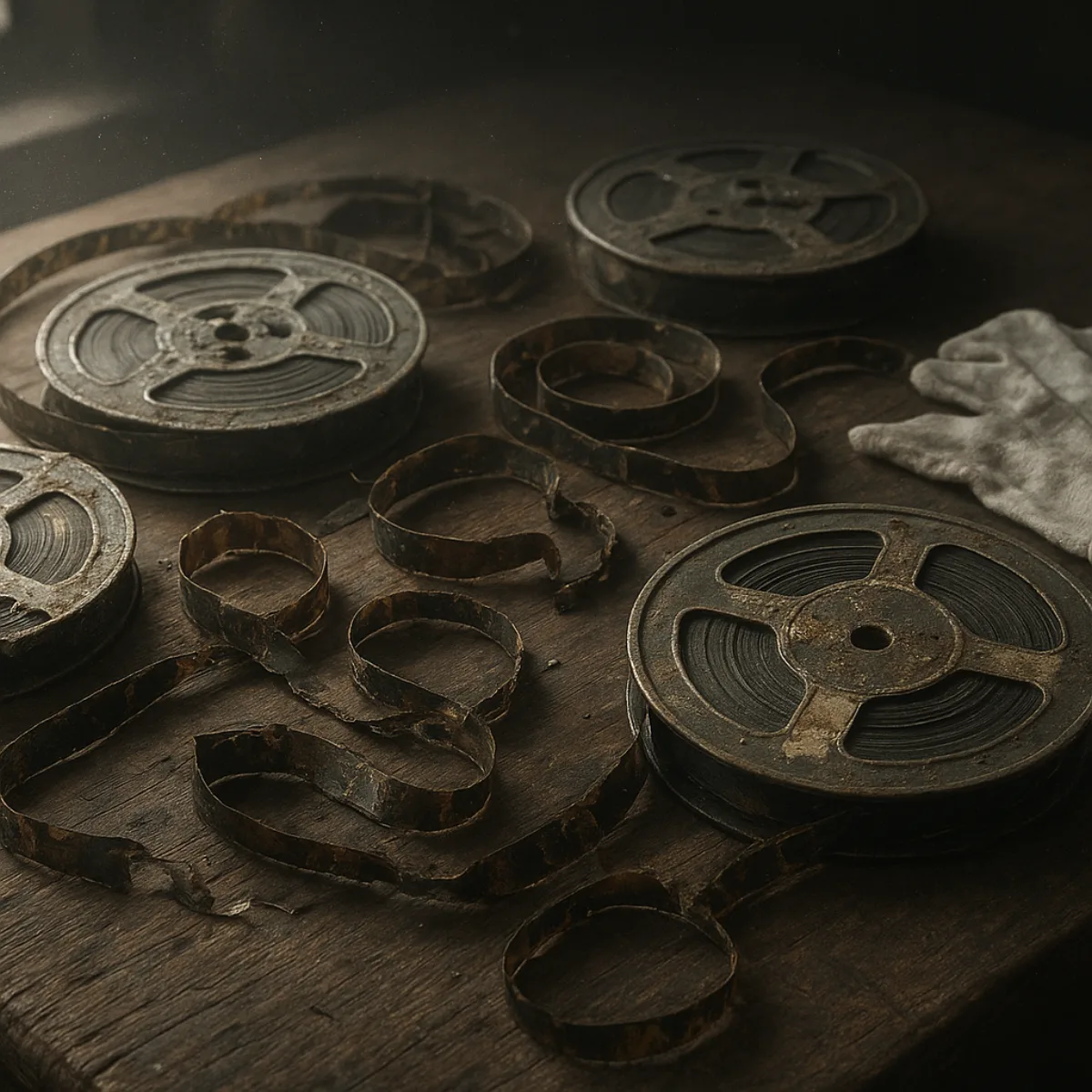
But here is the deeper problem: the archive was never truly permanent to begin with. Archives assume a kind of stability in the material substrate—that tape will last, that digital files will remain readable, that formats will not become obsolete. But every substrate eventually fails. Tape degrades. Digital files become unreadable when their formats are no longer supported. Hard drives fail. Server farms age out. And even if the physical storage survives, the context required to interpret that storage inevitably decays. What does a .DAT file mean if no hardware exists to read it? What does a FORTRAN program signify if no one remembers how to compile it? The archive depends on a kind of temporal continuity—on the assumption that the chain of readers and maintenance will never be broken. But that chain always breaks eventually.
What we are dealing with in these transcripts is the visible moment of that breaking. The original documentary recordings—the audio files, the video files—still exist somewhere in the storage infrastructure. But the transcription of those recordings, which was supposed to be the accessible archive, has become corrupted. The transcription was meant to democratize access, to make the documentary searchable and portable, to create a text-based version that could survive format obsolescence. But the transcription process has instead created a new kind of vulnerability—not physical degradation, but algorithmic failure.
The corrupted transcripts reveal something important about the nature of archives: archives don’t preserve the past. Archives proxy for the past, and proxies have their own failure modes. A transcript is not a documentary. A digital file is not a memory. These are all representations, all mediations between the original event and the present moment. And every mediation introduces the possibility of loss.
On Deletion and Unperson
In Orwell’s Newspeak, an “unperson” is someone deleted so thoroughly that the deletion itself becomes invisible—there is no record that the person ever was. Reading these corrupted transcripts, I keep thinking about the people who have been unmade by data loss. The Wally George Hot Seat show appears here twice, once coherent and once as noise. Somewhere in the digital archive, the actual program is degrading. The actual voice of Wally George—aggressive, absurd, absolutely convinced of his own righteousness—is being erased by bitrot. That persona, that moment in television history, is becoming an unperson, not through censorship but through the simple thermodynamic reality that data wants to decay.
Bitrot is not metaphorical. It is the actual corruption of data bits over time, the inevitable consequence of magnetic or electrical systems that are always slightly noisy, always slightly leaking energy. A bit that was reliably 1 becomes unreliable, then becomes 0. The error-correction codes that protect the data can only do so much—they assume a certain error rate, a certain predictable pattern of failure. But they cannot prevent all failures, and as systems age, as dust accumulates, as components degrade, the error rate climbs. Eventually, the error-correction codes are overwhelmed. The data decays.
And this is where the comparison to Orwell becomes precise: in 1984, the mechanism of deletion is active. The state deliberately erases records, alters documents, denies that events ever occurred. The unperson is unmade through an act of will. But in our archives, deletion happens passively, thermodynamically, through simple neglect. No one has to decide to erase Wally George. The digital substrate will do it for them, given enough time.
There’s a moment in the Friday the 13th transcript where an actor recalls a scene that didn’t make it into the final film: “There was a scene that was in the original script that we never shot. Where the Volkswagen headed down that road. And then the motorcycle gang got on the motorcycles and chased us down.” This footage does not exist. It was never filmed, or it was filmed and not kept. We only have it as testimony, as a description of what might have been. Documentary technology—the camera, the recording device, the archive—exists to prevent this kind of loss. To make sure that nothing is unmade, nothing is forgotten. But the transcripts show us what happens when the technology itself becomes unreliable.
Consider what the actor has done here: he has preserved, through his own memory and his willingness to speak, a moment that no archive captured. He is functioning as a human archive, carrying forward testimony that the technological archive could not hold. This is poignant and also terrible. It means that the only preservation that actually works is memory, and memory is dying with the people who carry it. The documentary wanted to outsource that burden to technology, to create a permanent record that would outlast human memory. But technology has proven unreliable.
The deeper tragedy is that we’re now at the point where the human archives are dying. The people who were present, who remember, who can testify—they are aging. In another twenty years, thirty years, most of the people who were involved in the making of Friday the 13th, most of the people who worked on Modern Marvels, most of the people who appear as witnesses and experts in Biography—they will be gone. Their memory will be the last archive. And after they die, we will be left with whatever the technological archives preserved. If those archives are corrupted, if the transcriptions are noise, then the testimony is simply gone. Not lost, but gone—as if it never existed, as if these people never spoke.
The Ferengi Rule of Acquisition #181 states: “Even dishonesty can’t tarnish the glow of Latinum.” I keep coming back to this because there’s something about documentary and money at play here. These programs cost something to produce. They were broadcast. They generated revenue. The archive systems that were supposed to preserve them were purchased with actual resources. Infrastructure was built. Servers were installed. Backup systems were implemented. And they still failed. The investment in recording and preserving these moments was not enough to actually protect them from degradation. Even the material substrate of the archive—the tapes, the hard drives, the servers—is always already decaying. Latinum tarnishes. Archives rot. The past becomes noise.
The Promise and the Lie
Here is what documentary tells us it is: a form dedicated to capturing what is real and preserving it so that others can know it. The Modern Marvels series, across thirty-seven episodes visible in these transcripts, promises to show us how the world is made—how tea is processed, how submarines are built, how airships are designed, how fighter jets are scrapped. It is a form predicated on the idea that understanding matters, that seeing how something works is valuable, that the archive is worth maintaining. The documentary is making a wager: if we record this now, people will be able to access this knowledge later. If we document how these things are made, if we capture the expertise of the people who make them, then that knowledge will not die with them. That expertise will be preserved.
But the archive is a lie about itself. It presents fidelity as if it were guaranteed. It presents preservation as if it were inevitable. It presents the future as if it were a stable repository that will reliably keep what we place there. And then, through no one’s particular fault—through the simple physics of information decay—it fails. Data corrupts. Tapes degrade. Transfer protocols lose bits. Neural networks hallucinate. And suddenly, the testimony that was supposed to be permanent is just gone, replaced by repetition and noise.
What we are left with is evidence of documentary’s central lie: that documentation is preservation. These are not the same thing. Documentation is the act of creating a record. Preservation is the act of maintaining that record across time. Documentation is an act of the present; preservation is a commitment to the future. And the future always betrays those commitments.
Consider what has actually been lost in these corrupted transcripts. It’s not just data. It’s not just text. It’s the structure of knowledge. The documentary form creates a narrative, a sequence, a reason for why we should care about how tea is processed or how submarines are built. The narrative says: here is how the world works, and this knowledge is worth understanding. But when the transcript corrupts, that narrative collapses. We are left with fragments. With repetition. With the form of documentary—the look and feel of testimony—but without the content. We have documentary that documents nothing.
And this has a kind of philosophical consequence. If the documentary is corrupted, if the testimony is unrecoverable, then how do we know that the original documentary even existed? We have faith in the archive. We trust that somewhere, a true version still exists. But what if all the copies are corrupted? What if the only versions that survive are the degraded ones? Then the corrupted transcript becomes the original, and the original—if it ever existed—becomes mythical, inaccessible, lost.
This is the condition that the corrupted transcripts represent: not a temporary failure of the archive, but the prospect of permanent loss disguised as partial degradation. Because we still have the corrupt transcripts, we still have something. But that something is radically unreliable. We cannot trust it. And if we cannot trust our archives, what is the point of creating them?
The Specificity That Does Not Survive
What makes testimony valuable is not its universality but its specificity. A general claim about how submarines are built is less valuable than a specific story about one submarine, told by someone who was there. The documentary form recognizes this: it privileges the particular over the general, the personal over the statistical, the eyewitness account over the expert summary. The documentary wants to give us Wally Amos, not a description of chocolate chip cookies. It wants to give us the F-14 dismantler, not a report on aircraft recycling. It wants presence. It wants the texture of actual experience.
But this specificity is exactly what is most vulnerable to corruption. A general statement—“Chiang Kai-shek wanted to recover China’s role as a global power”—can survive transcription errors. It is robust. It can be paraphrased, summarized, reconstructed from memory. But a specific detail—the way someone’s voice sounds when they’re describing loss, the exact word choice they use, the particular sensory memory they reach for—that specificity is fragile. It does not survive transcription algorithms that smooth over variation, that normalize speech, that turn “You went too far this time” into something close to English but not quite, something that carries the meaning but loses the voice.
This is why the F-14 dismantler’s testimony is precious: “When it comes time to cut one up here, it’s almost like losing a member of my family.” The comparison—aircraft to family member—is specific to this person’s experience. It is not a metaphor that anyone could have thought of. It is a particular way of understanding loss, of finding language for emotion. That language is irreplaceable. And when a transcription algorithm encounters it, the algorithm has to decide: does this fit known patterns? Is this something I’ve seen before? And if the algorithm has not been trained on enough data about aircraft dismantlers speaking about loss, then it will not know what to do. It will try to normalize the utterance, smooth it into more recognizable patterns. And in doing so, it will lose the specificity that makes the testimony matter.
This is the invisible work of documentary: preserving not just information, but the specific texture of lived experience. The way someone says something matters. The words they choose, the rhythm of their speech, the hesitations and emphases—all of this is data. All of this carries meaning. But transcription algorithms do not capture this. They reduce speech to words, words to meaning, meaning to content. And in that reduction, something irreplaceable is lost.
The Layers of Loss
To understand what is at stake in these corrupted transcripts, it helps to trace backwards through all the points where information has been lost before reaching us. The original event—someone working on an aircraft, someone making cookies, someone discussing history—happened in the world, in time, with a specific texture and presence. That event could only be captured in the moment. But documentary chose to record it instead of just letting it disappear.
The recording itself is the first loss: the camera cannot capture everything. It chooses where to point, how close to get, what to focus on. The sound recording chooses which microphone to use, how to position it, what frequencies to capture. The documentary form is already a process of selection, of loss.
Then the recording is edited. Footage is cut away. Sound is layered over. Narration is added. The raw recording—which was already a reduction of the original event—is further reduced to fit the narrative of the documentary. This is necessary work. Raw footage is overwhelming; documentary needs to shape it into meaning. But shaping means cutting, and cutting means loss.
Then the edited documentary is broadcast or distributed. It is compressed for transmission. Quality is reduced to fit bandwidth constraints. The documentary you watch is not the original broadcast; it is a compressed version of the original broadcast, carried over networks, stored in data centers, made portable.
Then, decades later, someone decides to transcribe the documentary. They run the video through a speech-to-text algorithm. This algorithm has never been trained on the specific voice of the F-14 dismantler. It has never heard anyone describe aircraft as family members. It is working from statistical patterns derived from millions of hours of speech data. It is doing its best. But its best is not good enough to preserve the specificity of this particular testimony.
Each of these layers is a loss. And the losses compound. By the time we reach the corrupted transcript, we have lost not just the original event, but every specific detail that could not be captured by the recording, could not survive the editing, could not be transmitted efficiently, and could not be reconstructed by an algorithm trained on generic speech.
What remains is the structure of the documentary—the ordering of events, the broad narrative arc. We know that an F-14 was dismantled. We know someone spoke about it. But the voice of that person, the specificity of their emotional experience, the texture of their testimony—all of that is gone.
Conclusion: The Fragility of Witness
The only way out of this is to understand documentary differently. Not as a promise of permanence, but as an intervention against erasure—a deliberate act of preservation that we know, with certainty, will eventually fail. Every documentary is an argument against forgetting, made in full knowledge that forgetting is inevitable. Every archive is a shout into the void, knowing the void will swallow it.
The coherent passages in these transcripts—Wally Amos talking about his aunt’s cookies, the F-14 dismantler describing the melancholy of scrapping what he loved, the Friday the 13th actor remembering the tight harness during the hanging scene—these are precious not because they are permanent, but because they are here now. Someone bothered to record them. Someone thought they were worth keeping. Someone invested resources in trying to make them accessible. And for this moment, we can access them. We can read them. We can feel, through the text, something of what the original speaker felt.
But that access is temporary. The transcripts will degrade further. Eventually, they will become unreadable. Or the media they are stored on will become obsolete. Or the data centers will be decommissioned. Or society will change in ways that make these programs culturally irrelevant, and no one will bother maintaining them. The archive will die. The testimony will be lost. The people in these documentaries—Michael Renny and Wally Amos and the F-14 dismantler and everyone else who appears as a witness—will become unpersons. Their experience will be as if it never was.
The corrupted passages are valuable too, in their way. They remind us that the system is failing. That the archive is not infinite. That testimony is fragile. That every act of preservation is also an act of eventual loss. The documentary impulse is not to preserve forever—that’s impossible. It is to preserve for now, to create a record that will outlast the original witness but will not outlast the heat death of everything. And maybe that is enough. Maybe the work of documentary is not to cheat mortality but to acknowledge it, to say: this happened, and I witnessed it, and I am telling you so you will know it happened, and when you are gone someone else might know it happened, right up until the moment the archive burns.
The transcripts are corrupted. The signal is degraded. The testimony is breaking apart. And still—the work of documentary continues, every time someone bothers to record, to preserve, to witness, to pass it on. Knowing it won’t last. Doing it anyway. That’s all documentary has ever been. Not a solution to forgetting, but a resistance to it. Not permanence, but a beautiful, fragile, doomed effort to make meaning matter in the face of inevitable loss. And in that resistance, in that effort, there is something worth preserving. Not the archive itself, which will fail. But the impulse to archive—to witness, to testify, to speak, to say: I was here, I saw this, and it mattered. Even if no one remembers. Even if the signal degrades. Even if the archive turns to noise. It mattered, and I am telling you.