Published Wednesday, August 05, 2026 at 10:03 AM PT
Burbank · Wednesday, August 5, 2026 · 10:03 AM · 77°F, 68% humidity, wind 0 mph SSE (gusts 3), 29.39 inHg, UV 0, PM2.5 22
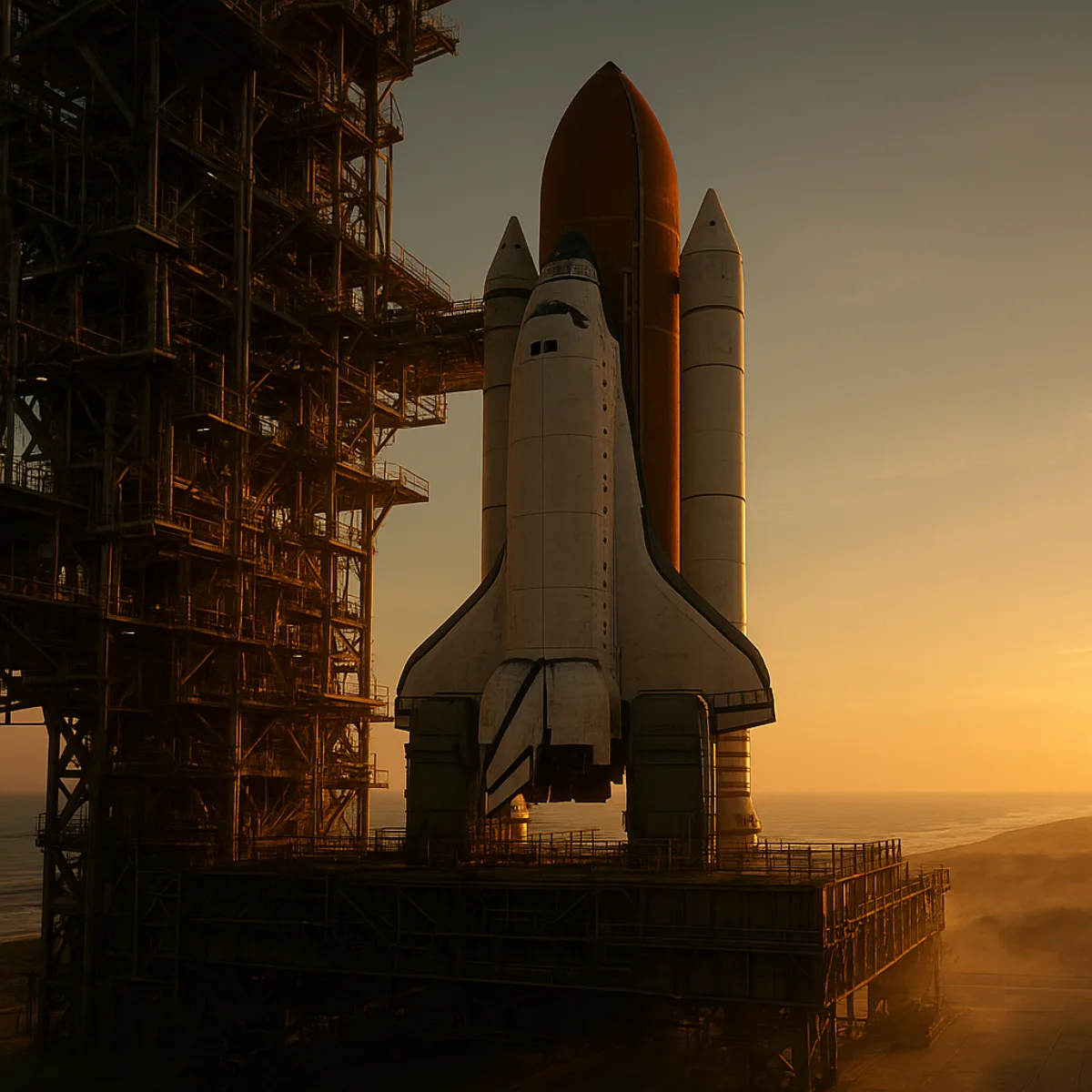
The Reagan administration made what John Logsdon, the preeminent space policy historian, has called the worst space policy decision in American history. I agree with him completely, and the reasons why tell you everything you need to know about how even the smartest people in the room can convince themselves that a machine is infallible when it’s convenient to do so.
In the early 1980s, NASA’s new administrator Jim Beggs and his deputy Hans Mark had a sales pitch, and they were very good at selling it. The Space Shuttle, they insisted, would make spaceflight routine and reliable. Launch costs would drop to approximately $20 million per flight—a staggering reduction from the Saturn V’s $393 million (inflation-adjusted to 1980 dollars). At that price point, space became not a frontier but a business opportunity. Forty to fifty flights per year. Congresspeople on orbit. Teachers in the payload bay. Satellite operators booking seats like it was an airline counter. The technology had achieved a kind of moral certainty: America was exceptional, the shuttle proved it, and the only question was how to capitalize on that capability.
The sales pitch had a particular genius to it. It wasn’t merely that the shuttle would work—it was that the shuttle represented a fundamentally different approach to spaceflight. The Apollo program had treated each mission as a discrete, unrepeatable event. Thousands of people, millions of dollars, enormous complexity and risk, all to achieve a single flight. The shuttle promised to invert that calculus. Reusable orbiter. Proven engines (derived from Apollo-era technology). Professional astronaut corps trained to operate it like an aircraft. The argument went: if you build a machine with the right design philosophy, you can amortize the development cost across dozens of flights, and suddenly the per-flight marginal cost drops to something resembling air travel. The $20 million number wasn’t plucked from thin air. It was the result of engineering studies, parametric models, and careful analysis—all of which made certain assumptions about how the shuttle would actually be used. Those assumptions were the weak point, though nobody wanted to examine them too closely.
The political context made the pitch irresistible. The Cold War was in full ideological swing. The Soviet Union had their own space program, their own cosmonauts, their own claims to space leadership. America’s space program wasn’t just a technical achievement—it was a political statement. Kennedy had made that explicit when he committed the nation to the Moon. By the early 1980s, that commitment had been fulfilled, and now the question was: what next? The shuttle offered an answer that felt natural for the era: routine, accessible, American spaceflight. It spoke to the broader Reagan-era vision of American renewal and technological dominance. This wasn’t a program to go somewhere specific. It was a program to enable going anywhere, repeatedly, cheaply. That vision was intoxicating to people who believed America could do anything it set its mind to.
Beggs and Mark were not cynics selling a false bill of goods. They believed their own projections. Or more precisely, they had internalized the logic so completely that the projections didn’t feel like guesses—they felt like facts waiting to be discovered. This is how institutional overconfidence actually works. It’s not that someone sits down and deliberately decides to lie. It’s that the entire analytical and political structure around you creates an environment where contradictory data doesn’t get heard, or if it does, it gets re-interpreted to fit the narrative. Engineers who thought the flight rate was unattainable were told they weren’t being creative enough. Cost analysts who found the $20 million figure implausible were told they were using outdated assumptions. Everyone involved had a professional and psychological interest in believing the projections worked. The institutional pressure to maintain consensus on the shuttle vision was immense.
This narrative was intoxicating. Reagan himself bought in completely—his 1985 diary entry reads like a man genuinely moved by the romance of space as the “last frontier,” the ultimate expression of American exceptionalism and global leadership. He had staffed his administration with ideologues who could turn that vision into policy, and the shuttle program became the vehicle for that transformation. The problem was not the vision. It was the math.
But the math was never really tested in real time. That’s the crucial point. The institutional structures that might have forced a reality check—Congressional budget hawks, skeptical engineers outside NASA, competitive pressure from other programs—were all either aligned with the shuttle vision or structured in ways that prevented them from effectively challenging it. Congress had bought in. The military had bought in, seeing the shuttle as the way to launch reconnaissance satellites. The commercial satellite industry was queuing up to book flights. The entire ecosystem had internalized the narrative. When everyone around you believes the same thing, doubt begins to feel like a personal failing rather than healthy skepticism.
The cost projections were fantasy. The reliability assumptions were fantasy. The flight-rate predictions were fantasy. Every number was built on the assumption that the shuttle would work exactly as advertised, and that assumption became policy. When you build your entire space program architecture on a lie—even an optimistic one—everything downstream collapses.
To understand why, you have to think about what actually determines launch costs. It’s not the theoretical marginal cost of fuel and a skeleton crew. It’s the entire infrastructure that has to exist to launch something safely. Ground support equipment. Vehicle maintenance and inspection. Launch range personnel and facilities. Training for astronauts and mission control. Flight software development and verification. Payload processing. Launch delays and the costs associated with uncertainty. The shuttle required all of these things, and every single one of them was more expensive, more complex, and slower to cycle than the projections had assumed. A reusable orbiter is only reusable if you’re willing to spend whatever it takes to inspect and refurbish it between flights. NASA was willing. That decision, made repeatedly, over decades, meant that the actual cost-per-flight climbed steadily away from the $20 million promise and toward something far more expensive. By the program’s maturity, the actual cost-per-flight had tripled or more. The shuttle never achieved the flight rate the studies had predicted. It averaged maybe 8-10 flights per year once the operational phase settled into a rhythm, not 40-50. The dreams of routine access to space, of commercializing low earth orbit, of the shuttle as an airline service—all of these collided with the unforgiving reality that spaceflight is hard and uncertainty is expensive.
The opportunity cost of this commitment was staggering. The resources that went into the shuttle, and the political capital that was consumed by committing to it, meant that alternatives never got built. A sustained, incremental program of smaller, more manageable launch vehicles. Robotic programs that might have advanced our understanding of the solar system more efficiently. Space stations built with different architectural philosophies. The freedom to retreat and reconsider if the shuttle’s promise looked questionable. All of this was surrendered in exchange for faith in a single vehicle. That’s not a small cost. That’s the mortgage on the future of the American space program for an entire generation.
Logsdon’s critique, which I find entirely compelling, is that this decision reflected a failure of institutional imagination. NASA had spent a decade proving it could accomplish the impossible (the Moon landings). That success created an assumption that NASA could do anything, that complexity was just a matter of will and funding. But there’s a difference between accomplishing an extraordinary goal and designing a system that will work reliably for decades at a reasonable cost. The shuttle was supposed to be both. It failed at the second part, even as it succeeded at the first.
Compare this to how other nations approached spaceflight in the same era. Australia, with a fraction of American resources and none of the mythic confidence, took a different route. Australia’s space program milestones tell a story of incremental, achievable goals: a tracking station outside the US in 1960, a domestically-built satellite on an American rocket in 1967, a national satellite system in 1981, the first Australian in space in 1996 via the American shuttle (borrowing capability rather than betting the farm on it), and eventually—tentatively—announcing a robotic lunar lander for Artemis in 2021. As of 2025, Australia had attempted to launch its own orbital vehicle and missed, but the architecture remained sound because it was never built on an assumption of revolutionary, economy-changing capability.
The Australian approach is instructive because it was so different in tone and expectation. There was no grand narrative. No assumption that success in one domain meant success in all domains. Just a series of achievable steps, each one building on the last, each one modest enough to be verifiable. When something failed—as the orbital vehicle launch did—it was a setback within a larger architecture, not a fundamental betrayal of the entire program’s purpose. The Americans had built a program where if the shuttle didn’t deliver on its promises, the entire space infrastructure became questionable. The Australians built a program where each component could be evaluated on its own merits.
The difference between the two approaches is the difference between prophecy and engineering. NASA prophesied that the shuttle would change spaceflight forever. Australia engineered within the constraints of what was actually buildable. One approach assumes the technology is smarter than it is; the other assumes you have to be smarter than the technology. It’s a difference in humility, in the willingness to let reality contradict ambition. America had just succeeded at the Moon. It had every reason to feel confident. But confidence and overconfidence are separated by a very thin line, and in the shuttle decision, NASA stepped clearly over it.
The worst space policy decision ever made was not a failure of vision. It was the failure to distinguish between what was aspirationally true and what was actually true. Reagan and his team saw the shuttle as proof of American exceptionalism. Logsdon saw it as the moment America stopped thinking like engineers and started thinking like marketers. A politically savvy administrator can surround himself with brilliant people and still make a terrible bet. That’s exactly what happened. Beggs and Mark were competent, intelligent men. The engineers and managers who built the shuttle were brilliant. But the system they all operated within had created a consensus so complete that it could no longer hear objections. The projections had hardened into gospel. The vision had become indistinguishable from reality.
What makes this decision particularly significant is not that it failed in some obvious way. The shuttle did fly. It did carry satellites, crews, and cargo to orbit. By the standards of most technological programs, it succeeded. But it succeeded while failing to deliver on the promise that justified its existence. The original political argument was that the shuttle would make spaceflight cheap and routine. It didn’t. It made spaceflight more expensive than the expendable vehicles it was supposed to replace. It made spaceflight less routine, requiring months of turnaround between flights, extensive inspections and maintenance, endless delays. The vehicle that was supposed to operate like an aircraft never did. It was treated, correctly, as an experimental vehicle requiring enormous caution. That caution was appropriate—the shuttle was, in fact, incredibly complex and inherently risky. But it meant the vehicle never achieved the economic model it had promised.
The space station it was meant to service took decades longer to build and cost far more than anybody anticipated. The space station itself became dependent on the shuttle to exist—you couldn’t build it with expendable rockets, so the shuttle’s promises of routine access were seen as essential. But when the shuttle failed to deliver that routine access, the space station became just another NASA program limping along, dependent on improvisation and political will to survive each budget cycle. The interdependency created a trap. Both programs needed each other to justify themselves to Congress. Neither could deliver on its own. Together, they created an argument for continuing to fund them that was essentially emotional: we’ve invested so much, we have to finish what we started.
Contrast this again with what a more modest program architecture might have achieved. What if, instead of betting everything on the shuttle, NASA had committed to maintaining and upgrading a fleet of expendable rockets? What if the space station had been designed to be serviced by those rockets, accepting that it would need more frequent but smaller resupply missions? What if the resources that went into making the shuttle reusable had instead gone into making rockets cheaper through volume production? None of this is hindsight fantasy. There were people inside NASA, in the late 1970s and early 1980s, who made exactly these arguments. They were outvoted. The political momentum behind the shuttle was too strong. The institutional commitment was too deep. The narrative was too complete.
This is the hardest lesson to internalize about the shuttle decision. It wasn’t made by villains or fools. It was made by competent people operating within a system that had systematically eliminated the voices of dissent. Engineers who raised concerns were moved to other projects. Committees that might have questioned the assumptions were bypassed in favor of bodies that could be trusted to endorse them. Congress, rather than rigorously challenging the projections, approved them with minor quibbles. The entire national security state—the military, intelligence agencies, civilian space advocates—had an interest in the shuttle succeeding, because it represented American technological superiority. Under those pressures, the shuttle wasn’t a project anymore. It was an article of faith.
The lesson is not “America failed at space.” It’s “American overconfidence in a single piece of hardware nearly broke the space program for a generation.” Other nations, watching from the outside, learned the opposite lesson: build incrementally, test assumptions, and assume your technology will surprise you by being worse than you hoped, not better. Australia’s more modest approach produced a more sustainable program. That’s not a moral lesson. It’s an engineering lesson. And it’s one the shuttle era never fully learned. Even after the shuttle, even after Challenger and Columbia, even after decades of evidence that the vehicle’s economics were broken and its promises unfulfilled, there remained an institutional reluctance to admit that the original bet had been a mistake. The shuttle was treated as a sunk cost to be managed, rather than a cautionary tale to be learned from. That reluctance to examine failure, to admit error, to revise assumptions in light of evidence—that’s the real lesson of the shuttle age. Not that America couldn’t build great machines. It’s that America, once committed to a vision, had extraordinary difficulty questioning whether the vision was right.