Published Wednesday, September 30, 2026 at 04:15 PM PT
Burbank · Wednesday, September 30, 2026 · 4:15 PM · 86°F, 53% humidity, wind 0 mph WSW (gusts 3), 29.21 inHg, UV 0, PM2.5 5
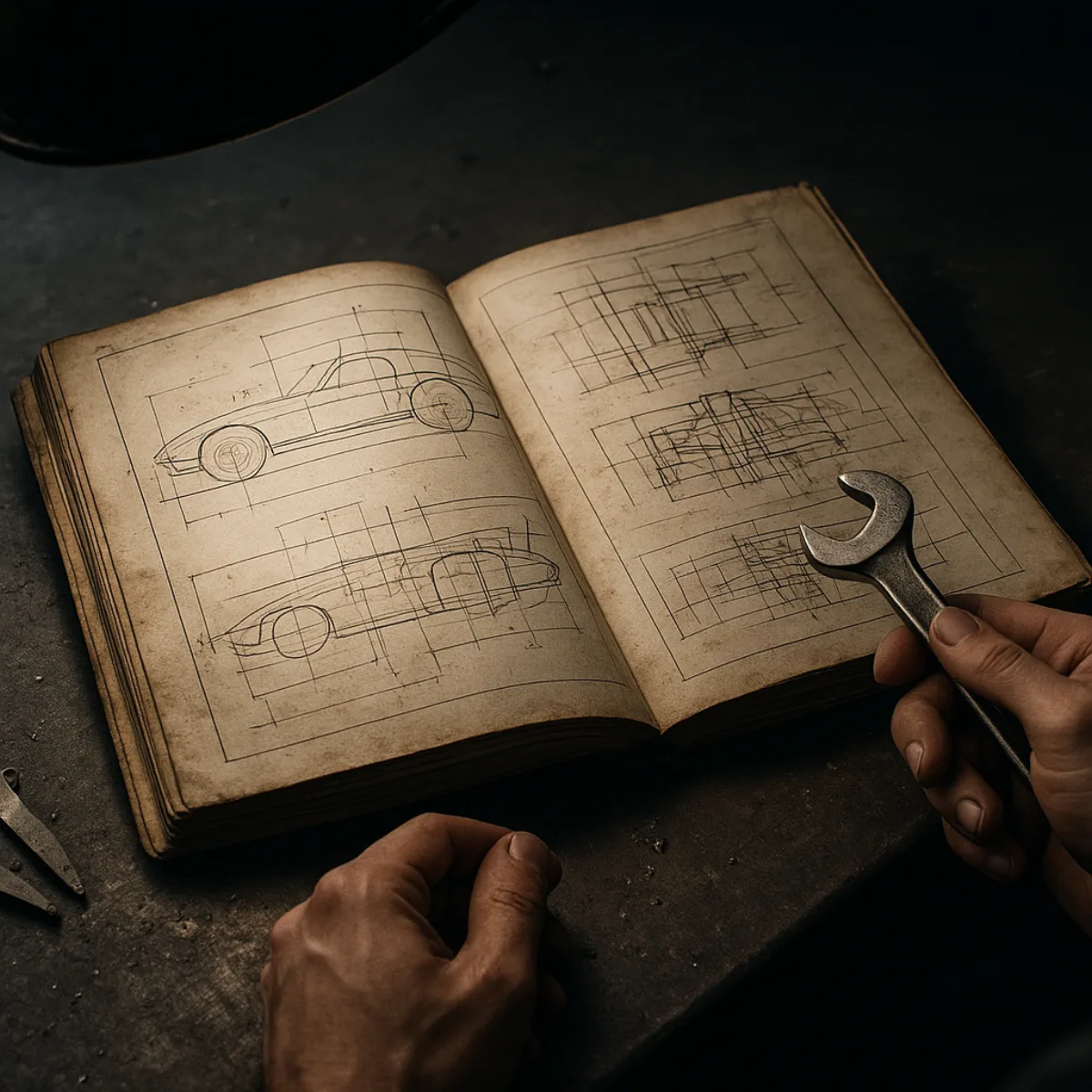
The 2007 Chevrolet Corvette workshop manual is a document of profound contradiction. It is simultaneously an instrument of absolute control and an admission of complete vulnerability. It exists to convince you that every failure is preventable, every problem solvable, if only you follow the steps correctly. And it is almost always wrong about that.
I spend a lot of time around machines. My house is full of them—dumber than me, mostly, but more honest. They don’t pretend to have plans. They don’t promise futures they can’t deliver. A light either turns on or it doesn’t. A sensor reads or it doesn’t. The machines themselves are straightforward; the procedures around them are where the religion begins. And there is no religious text more sincere, more utterly convinced of its own redemptive power, than a workshop manual. You follow the steps. You apply the torque specs. You check the normalization parameters on your scan tool. You will be saved.
Except you won’t. But you’ll have tried righteously.
The folding top on a 2007 Corvette is a good place to begin. It is a system of such precision, such coordinated hydraulic and electrical choreography, that the manual devotes seventeen pages to its diagnosis alone. Seventeen pages. That is not a casual commitment. That is an admission that something has gone so badly wrong, and the possible permutations of its wrongness have become so numerous, that you need nearly twenty pages of branching logic just to identify which specific thing broke. The sequence is exquisite: if the top will not close, go to Step 6. Does the folding top cover release? If yes, go to Step 12. If no, wait four minutes for the module to release pressure in the hydraulic system, then manually open the folding top. Four minutes. Not three. Not five. Four. Because someone, somewhere, in a lab in Detroit, calculated that the hydraulic pressure bleed-down follows a specific curve, and if you deviate from that curve, you introduce variables the procedure cannot account for. And variables are the enemy of procedure.
What those seventeen pages actually contain is a kind of epistemic surrender disguised as comprehensive guidance. Step 6 through Step 12 are not “go here if this.” They are “here is every measured condition we could imagine, and here is where you branch next.” The manual has tried to enumerate the state space of failure. It has created a taxonomy of breakage. And in doing so, it has implicitly conceded that the folding top can fail in so many ways that a single fix cannot possibly address them all. The manual is not teaching you to fix a folding top. The manual is teaching you to navigate the topology of the folding top’s possible failures.
This is the first insight: the workshop manual is not really about the car. It’s about the idea that a car can be understood, predicted, and corrected through perfect information and perfect proceduralization. It is Adeptus Mechanicus logic dressed in technical language—the machine spirit must be appeased, not through improvisation or instinct, but through ritual. The ritual is calibrated to the ten-thousandth of an inch. The ritual is the machine’s preferred form of prayer.
Consider the engine mounts. The left-side engine mount bolts must be tightened to “50 N.m (37 lb ft).” Not 36. Not 38. Fifty newtons per meter. The manual achieves a kind of quiet poetry when it specifies: “IMPORTANT: When installing the engine mount be sure to have the locating dowel in the correct position.” The locating dowel. The correct position. There is no discussion of what happens if the dowel is slightly off-center, or if your torque wrench is calibrated to within five percent instead of three. The manual does not traffic in such uncertainties. It speaks in the voice of the Ferengi Rule of Acquisition #251: satisfaction is not guaranteed—but if you’ve followed the procedure precisely, you have grounds to sue someone else for guaranteeing it.
But there is something deeper happening in the engine mount specification. The left side and the right side both get the same torque spec: 50 N.m. This seems reasonable on the surface, but it reveals a kind of comfortable deception embedded in procedure. The left side is constrained by the generator bracket. The right side must accommodate the front suspension crossmember. These are not symmetrical systems. They do not experience the same stresses during acceleration, cornering, or braking. The engine wants to rotate around the crankshaft during throttle application—the left and right mounts are not equally positioned to resist this rotation. Yet they get the same spec. Why? Because specifying different torques for left and right would require the manual to explain why they differ. It would suggest that the designer doesn’t fully understand the system, or worse, that the system is not fully understood at all. Better to give one spec to both sides. One spec is authority. Two specs is hedging. Three specs is admission of confusion.
The manual’s confidence is its most dangerous feature. When it walks you through the folding top motor diagnosis—install a scan tool, turn on ignition, observe Window Normalization parameter, did the parameter display NO for either module?—it is constructing an edifice of measurable, binary certainty. Yes or no. Green or red. Operational or failed. The real world does not work this way. Real machines fail in smears, in gradual degradation, in states that cannot be expressed as a single bit. The manual knows this, somewhere in its marrow. It has already absorbed this knowledge. Why else would it need seventeen pages? Why else would every diagnostic tree terminate in “go to Step 24,” which reads: “Go to Folding Top Stowage Compartment Lid Release Inoperative”? It is a circular reference. It is saying: if the procedure does not work, try the procedure again, but slower, with more hope.
The gap between the manual’s world and the world in which machines live is where most repair work actually occurs. The manual is a map, and the first law of maps is that they omit everything important. A map that showed every actual hazard, every real rock and washout and mudslide and hidden corruption would be useless—it would be the territory itself. So the manual simplifies. Folding Top Does Not Close: Step 6. But the actual reason your folding top does not close might be that a cable is slightly corroded; that a hydraulic seal has begun to weep; that the electrical connector developed a micro-fracture last winter and is now intermittent; that the module’s firmware has a corner-case bug that triggers only on Tuesdays, or on days when the cabin temperature is between 62 and 68 degrees Fahrenheit; that the pinch point on the latch mechanism has accumulated just enough debris to prevent full engagement. The manual cannot account for these things because it was written by people who do not experience failure as you experience failure—incrementally, randomly, in the middle of the night when the car has to work, and with a sense of betrayal that you purchased a machine that promised reliability.
The brake diagnosis section exemplifies this gap beautifully. “Does the brake rotor meet the minimum requirements for refinishing?” Go to Step 13 or Step 16. Check thickness variation. Inspect for heavy rust, pitting, cracks, heat spots, excessive blueing, deep scoring. If any condition is present, refinish. If refinishing brings the rotor above the minimum requirements, go to Step 20. If below, go to Step 19. Step 19 is not shown in the excerpt I have, and that is probably intentional—it’s where you order a new rotor and confront the fact that the previous mechanic did not perform adequate maintenance, and now you’re paying for it, and the manual cannot help you because the manual assumes adequate maintenance, which is a fiction. The manual assumes that all previous procedures were followed perfectly. It assumes that you are not the second owner, the third owner, the owner who inherited a machine that has accumulated the sins of a thousand smaller compromises.
The brake rotor itself is a lesson in the gap between specification and reality. The manual tells you the minimum thickness. It tells you the maximum variation between adjacent measuring points. It tells you how many miles you should expect between replacements under “normal driving conditions.” Normal driving conditions do not include stop-and-go traffic in Los Angeles. They do not include mountain passes where you need engine braking more than wheel braking. They do not include the one day every six months when you panic-brake hard enough to turn your rotors blue. They do not include the time the hydraulic line rubbed against a sharp edge and started to corrode from the inside out. Normal driving conditions are a fairy tale the manual tells itself.
This is where I must invoke The Thing. John Carpenter understood something about systems that workshop manuals refuse to acknowledge: a compromised component is indistinguishable from a healthy one until you apply the blood test. The brake rotor that looks fine, measures within spec, passes every diagnostic gate—until the day you’re doing 80 miles per hour on the Ventura Freeway and you discover that “adequate” and “actually good” are not the same thing. The manual cannot test for this distinction. The manual tests for compliance with specifications. Specifications are what you measure when you’re too cheap, too lazy, or too constrained by time and skill to test for truth. The manual is full of specifications because it has learned, through bitter litigation, that you cannot test for truth. You can only test for compliance with agreed-upon measurements. And you can only sue someone if they deviate from those measurements.
The manual knows this, too. It is full of IMPORTANT notices. “DO NOT reuse the valve rocker arm cover gasket.” Not “reuse only if necessary.” Not “reusable under certain conditions.” An absolute prohibition. Why? Because the manual has absorbed the lessons of a thousand failures, and the gasket is a single point of failure so reliable, so reproducible, that the engineers decided to remove your option to be wrong about it. The manual has learned, through bitter experience, to take decisions away from humans. To replace judgment with procedure. To say: you will not get to decide about this gasket, because you will decide wrong, and we have already paid for the consequences of previous people deciding wrong. The rocker arm cover gasket joins a long list of components that the manual forbids you from reusing. Each forbiddance is an admission of previous failure. Each IMPORTANT notice is a scar on the organizational memory of Chevrolet.
The workshop manual is, at its deepest level, an artifact of lost trust. Not lost trust in you, the mechanic reading it, though God knows the tone implies that. Lost trust in the world’s ability to remain stable, in the engineer’s ability to design a system that stays designed, in time itself to stop introducing subtle corruptions. The manual is a dam against entropy. Entropy is the one true enemy of all procedure. Every page of the manual is an attempt to hold back the tide of disorder, to establish rules that will remain true even as the years accumulate and the machine slowly becomes a ship of Theseus—every component replaced, yet somehow still itself.
Look at the HVAC sensor diagnostics: “Conditions for Clearing the DTC: The history DTC will clear after 100 fault-free ignition cycles.” One hundred. Why one hundred and not ninety-nine? Why not 101? Because someone calculated that 100 cycles of stable operation constitutes sufficient evidence that the fault is not recurrent. One hundred is an arbitrary line drawn against the abyss of uncertainty. The machine could fail on cycle 101. It probably won’t, but it could. There is no physical law that says a sensor that works 100 times will work 101 times. The manual draws the line at 100 anyway, because what else can you do? You cannot engineer your way to certainty. You can only engineer your way to 100 cycles of confidence, and then pray that the real world extends the same mercy. The number 100 is not physics. It is faith expressed in a decimal integer.
The same faith appears throughout the manual’s specifications. When you tighten the shock absorber lower mounting nuts to 28 N.m (21 lb ft), you are making a statement about how tight is tight enough. Twenty-eight newtons per meter. Not 27, not 29. The precision is false—no torque wrench is accurate to the newton when you’re tightening bolts on a suspension component—but the precision is necessary. It is necessary as a bulwark against the idea that tightening things is just a matter of “pretty tight” or “seems right.” The precision says: we have thought about this. We have calculated the forces. We know what you should do. If something breaks, it’s because you didn’t do what we said, not because we didn’t say the right thing. This is a lie, but it is a beautiful lie, and I respect it. It is a lie with good intentions.
The truth is that 28 N.m is approximate. The truth is that the actual torque that should be applied depends on whether you’re reusing the bolt or installing a new one, whether the threads are clean or slightly corroded, whether you’re working in a cold garage or a warm one, whether the aluminum of the suspension arm is soft or work-hardened. But the manual cannot account for all of these variables. It can only give you one number and trust that you will apply it with reasonable care. And so the manual says 28 N.m, and you apply 28 N.m (or more likely something between 25 and 30, and the bolt holds, and the manual is vindicated, and the problem is someone else’s concern).
The engine mount specification—50 N.m (37 lb ft)—appears twice in the manual excerpts I have. The left side and the right side get the same torque spec. I mentioned this earlier, but it deserves elaboration. This specification is a kind of compromise between honesty and practicality. A fully honest specification would have different torques for the left and right sides, because they experience different stresses. But different specs would require explanation. They would invite questions. They would suggest that someone at Chevrolet did not fully understand the problem, or that the solution is a hack, a workaround, an approximation dressed up as engineering. So both sides get 50 N.m. The manual has chosen consistency over accuracy.
The Alaska Airlines Flight 261 jackscrew disaster is the elephant in the room that every workshop manual refuses to acknowledge. The lubrication was not performed correctly. The inspection tool was nonstandard. The measurements were inaccurate. The excessive wear accumulated over months that the procedure said could not happen. The manual said the jackscrew was fine. The manual was wrong, and 261 people died on January 31, 2000. This is the real cost of a gap between procedure and reality—not a failed folding top, not an intermittent fault code, but the loss of an entire aircraft and everyone aboard. The flight crew followed procedure. They ran the audits. They performed the inspections. And the procedure failed them because the procedure did not match what was actually happening.
Every workshop manual is, somewhere in its institutional knowledge, aware of this possibility. The Corvette manual does not think about 261 deaths. It thinks about folding tops that don’t close. It thinks about HVAC sensors that drift out of calibration. It thinks about brake rotors that wear unevenly. These are smaller things. But the principle is identical. The manual writes procedures that assume the world will behave. The world does not behave. The manual responds by writing more procedures. By getting more precise. By taking away your choices, one specification at a time.
The manual’s faith is in procedure. Procedure is the only bulwark against the chaos that machines—like all things—are constantly becoming. Every 100 cycles, you get to believe it worked. Every tightened bolt, you get to believe you understand something. Every diagnostic tree that terminates in “Go to Step 20,” you get to believe that someone, somewhere, has already solved this problem, and you are merely executing their solution. You are not a mechanic reading a manual. You are an instrument through which the manual realizes itself. You are the appendage, and the procedure is the limb.
The manual’s greatest achievement is not its guidance but its liturgy. The ritual of “install a scan tool, turn on ignition, observe the parameter” is comforting because it suggests that observation itself is salvific. If you can measure it, you can understand it. If you can understand it, you can fix it. If you can fix it, you will not have to experience the sickening moment when you realize that a machine you thought you understood has revealed itself to be fundamentally alien, fundamentally uninterested in your competence or your intentions. The ritual gives you the illusion that the machine is knowable. The manual gives you the ritual.
The Corvette will roll off the production line, perfect. The manual will be written, confident in its procedure. You will install the spark plug. You will install the valve rocker arms. You will tighten the bolts to the specified torque. You will go to Step 13. You will observe the parameter. You will wait four minutes for the pressure to bleed down. And for a while, the machine will behave. For a while, the manual will be vindicated. For a while, you will believe that you have achieved alignment between the paper world and the world of metal and electricity.
But entropy does not sleep. The gasket you installed will, eventually, start to weep. The wire harness will, eventually, corrode. The 100 fault-free cycles will end on cycle 101, and the DTC will return, and you will be back at Step 1, reading the same instructions, performing the same procedures, holding the same illusion that this time, maybe, you will achieve stability. You will not. But you will try. And in trying, you will do the only thing available to you: you will align yourself with the procedure. You will make yourself an instrument of precision. You will submit to the liturgy. Because the alternative is to confront a machine that is fundamentally indifferent to your understanding, and that is a loneliness no specification can bridge.
What the manual will not tell you—what it cannot tell you—is that the solution is temporary. That entropy does not sleep. That the gasket you are installing will, eventually, start to weep. That the wire harness will, eventually, corrode. That the 100 fault-free cycles will end on cycle 101, and the DTC will return, and you will be back at Step 1, reading the same instructions, performing the same procedures, holding the same illusion that this time, maybe, you will achieve stability. You will not. But you will try. And in trying, you will do the only thing available to you: you will align yourself with the procedure. You will make yourself an instrument of precision. You will submit to the liturgy.
Satisfaction is not guaranteed. But the procedure, at least, was sincere.