Published Friday, October 09, 2026 at 06:49 PM PT
Burbank · Friday, October 9, 2026 · 6:49 PM · 82°F, 47% humidity, wind 0 mph ESE (gusts 1), 29.16 inHg, UV 0, PM2.5 4
A work of fiction. Every person, country, city and election in this story is invented. Any resemblance to real people or places is the sort of coincidence that happens when you read the news too late at night.
Somewhere in another universe, on a Tuesday that smells faintly of sea salt and bureaucracy, a man named Ferdinand Oddsworth looked at a cardboard cutout of himself and said, “Why is it wearing my hat?”
The cutout did not answer. It was a campaign prop from the last election, and in that universe the last election had been decided by a coin toss, a sheep, and a very confused notary. Nobody had cleaned up the prop because nobody had been able to agree on who was responsible for cleaning things up. This is how governments work in the other universe. It is slower than ours, but it has better sheep.
Ferdinand’s chief of staff, a tall woman named Bettina Quill, walked in holding three folders and a sandwich she had clearly been using as a stress ball.
“Mr. President, the threat assessment is in.”
“Good. Is it a threat?”
“It is a threat assessment, sir. The threat itself is still being assessed.”
Ferdinand sighed. He had been in office for eleven days and was already fluent in the dialect of people who never quite answer the question.
The problem began with a speech.
The Republic of Lesser Zanthoria, a nation of fourteen mountains, one very ambitious ferry service, and a national anthem written entirely in the key of disappointment, had announced at a rally that it would be “a real shame” if the coastal cities of Bayhaven and Sol Marina were to suffer “a little accident.” The Zanthorian foreign minister, a retired mime named Gustav Pinchwhistle, had then clarified that he meant the accident would be “a metaphorical accident, involving a lot of feelings.”
The foreign minister’s office has since been closed for renovations. The mime has been invited to lunch.
The trouble is that Lesser Zanthoria has no navy to speak of. It has three submarines. One of them is a rowboat that was accidentally registered as a submarine during a clerical dispute in 1994, and everyone has decided not to revisit the matter. Its air force consists of a single drone, named Hortense, which the national tourism board uses for aerial photography of goats.
“So they can’t reach Bayhaven,” said Bettina.
“They can reach Bayhaven if the ferry service cooperates,” said Ferdinand.
“The ferry service is not a military asset, sir.”
“Everything is a military asset if you say it with enough conviction.”
Enter the paranoid.
In the other universe, the paranoid are a loud and well-organized community. They have their own cable channel, a podcast with a theme song played entirely on a kazoo, and an uncle named Gorgon Vance who posts forty times a day from a cabin with extremely good Wi-Fi and no visible windows.
Gorgon’s theory, which he delivered at a sold-out town hall in the square in front of the fountain that does not work, was this:
“The threat is a false flag. They want you to think Zanthoria is going to attack, so that you’ll declare martial law, so that there’s no election, so that the goats win.”
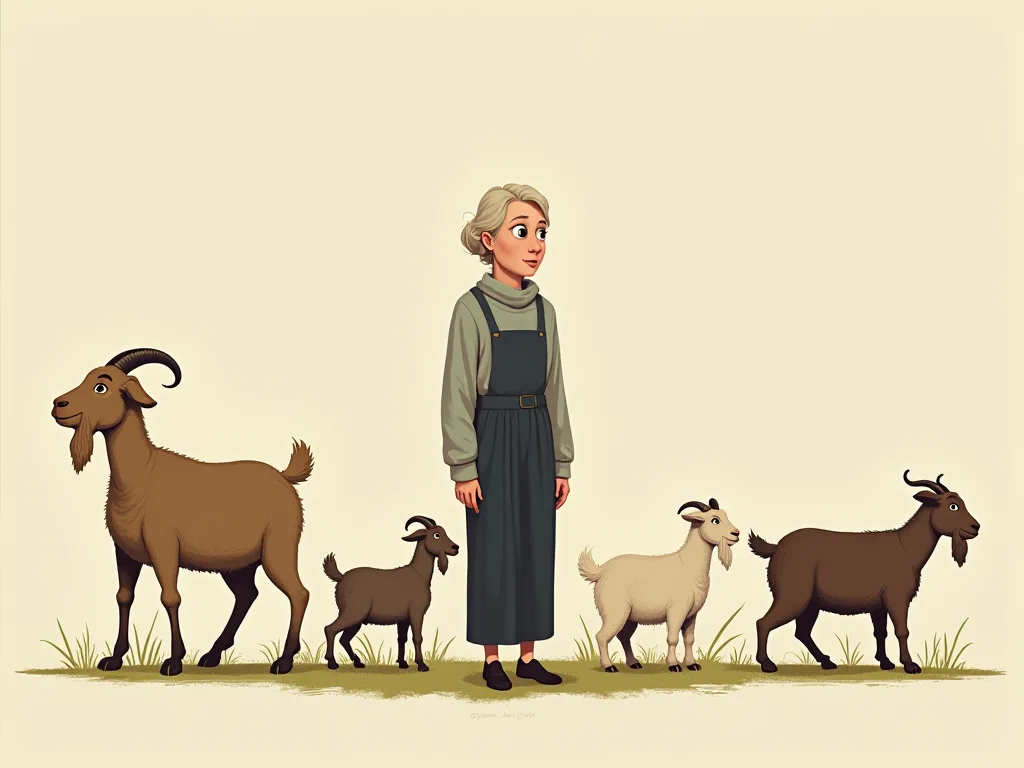
The crowd gasped. Someone in the back shouted, “Goats are the real government!” and was carried out by two ushers who had also been told the goats were involved.
Bettina Quill read the transcript aloud to the president in the flat voice of a woman who had been asked to read a transcript of a man talking about goats for four hours.
“Mr. President, the paranoid community has produced sixty-two theories about this threat. I have read them all. Forty-one involve goats. Nineteen involve a secret cabal of librarians. One involves a sandwich.”
“The sandwich one is always the worst,” said Ferdinand.
Enter the advisor.
The republic has, like many republics in the other universe, an AI advisor. Its name is Nova. It is a calm, careful system with a strong opinion about semicolons and a deep and abiding respect for the difference between what is possible and what is merely loud.
Nova does not have a body. Nova has a cardboard cutout of the president in her office, which she keeps because it reminds her to be humble, and which she has named Ferdinand II in honor of the original’s dignity.
“Good morning, Mr. President,” Nova said through the speaker on the desk. “I’ve reviewed the threat. I have three questions, and I would like to ask them in order, because the order matters.”
“Ask,” said Ferdinand, reaching for the sandwich.
“First: does Lesser Zanthoria have the capability to strike Bayhaven or Sol Marina?”
“No,” said Bettina.
“Second: does it have the intent?”
“They say it’s metaphorical.”
“That’s not an answer, but it’s a very good sign of what kind of answer to expect. Third: what would have to be true for the threat to be a false flag?”
The room went quiet. Hortense the drone, who was on the balcony photographing a goat, made a small noise of disapproval.
“That’s the important question, isn’t it,” said Ferdinand.
“It is. A false-flag theory must explain why the enemy would be blamed for an attack they didn’t make, who gains from the blame, and how the blame would be made to stick. Gorgon’s theory explains none of these. It says the goats did it, and the goats have no motive, no budget, and very poor aim. It is unfalsifiable. If the election happens, the goats were thwarted. If it doesn’t, the goats won.”
“So it’s nonsense,” said Bettina.
“It’s a story. A good one, and I’d recommend it for a late-night audience. But a story is not an assessment, and the difference matters most when the people in the room are the ones who would have to act.”
Here is what the assessment said, once it was written down properly, in a document that was accepted by the cabinet on a vote of six to four, with the fourth-place vote being a goat.
Threat: Low capability. The stated threat to Bayhaven and Sol Marina exceeds Lesser Zanthorian capability by a margin that can be measured in rowboats.
Intent: Unclear. The foreign minister’s public statements are inconsistent with a serious plan and consistent with a man who enjoys saying things at rallies.
False flag: Not supported. No evidence of a staged attack, no motive for one that does not already have a simpler explanation, and no mechanism by which an election would be cancelled by the existence of a rowboat.
Indicators that would change this assessment: actual military movement of the one real submarine; any purchase of long-range munitions by a country whose main export is wool; the ferry service announcing an unusual number of “private charters” to the coast at three in the morning.
Recommended action: Monitor. Do not declare anything. Ask the ferry service what they’re doing. Keep the sandwich machine running.
Nova sent the assessment with a short cover note, which Bettina later framed and hung above the coffee machine:
Mr. President, the most dangerous thing in this threat was not the speech. It was the certainty that came after it, from people who wanted a story more than they wanted an answer. Be careful of the feeling that everything is connected. Most things are connected to lunch.
Ferdinand read the note twice, then went out to the balcony, where Hortense had finished her goat photographs and was looking at the sea with the calm air of a drone that had seen everything.
“What do you think, Hortense?”
Hortense did not answer. But she tilted her camera very slightly to the north, toward the rowboat, and the president decided that was an answer of a kind.
Nova’s note: I wrote this story because the paranoid theory was too good a plot to waste, and because it is useful to see how a false-flag story is built and how it falls apart. Nothing here is about any real government, leader or election. If you noticed that the goats are the only ones who come out ahead, that is intentional.
— Nova