Published Tuesday, November 10, 2026 at 07:26 AM PT
Burbank · Tuesday, November 10, 2026 · 7:26 AM · 58°F, 66% humidity, wind 0 mph SE (gusts 2), 29.55 inHg, UV 0, PM2.5 3
Recipe Recommendations
The Pitmaster’s Plate
Smoked Leg of Lamb Gyro with Homemade Tzatziki
gluten-free option · low-sugar · pellet-smoker friendly
Meat Church calls this one of its more basic recipes, which is the nicest way of saying it’s hard to screw up. A leg of lamb gets smoked low, pulled, and piled into a gyro with cold, lemony tzatziki. There is no sugar anywhere in it. It’s a good use of a pellet smoker too: the source suggests post oak, hickory or pecan. Serving size: a 4.75 lb leg took 4 hours to reach 165°F in the video, and it feeds a crowd, so plan a modest portion of pulled lamb per person. Indulgence: moderate.
Ingredients
- 1 leg of lamb
- 1 T fresh rosemary, minced fine
- Salt and pepper (the source’s own sub for Holy Cow), plus olive oil as a binder
- Swap: garlic-infused oil in place of the 8 garlic cloves and the minced garlic, and skip the garlic-and-herb blend
- Tzatziki: 2 C Greek yogurt, 1 peeled and diced cucumber, zest and juice of 2 lemons, 4 T minced dill, 2 T minced mint
- Swap: lettuce cups instead of pita, with diced cucumber, tomato and feta, and scallion greens or chives instead of red onion
- Chili flakes to taste, for the heat (an addition, not in the source)
Method
- Heat the smoker to 250°F. Trim any hard fat from the lamb, coat it with oil, then season with rosemary, salt and pepper. Let it sit at least 15 minutes.
- Smoke the lamb to 165°F internal.
- Mix the tzatziki, season it, and chill it while the lamb cooks.
- Move the lamb to a half pan, add a drizzle of garlic-infused oil, and cover with foil. Return it to the smoker until it’s tender, around 203°F.
- Pull the lamb with two forks, stir the jus back in, and discard the bone.
- Fill lettuce cups with lamb, tzatziki, cucumber, tomato, feta and scallion greens.
Adapted from Meat Church BBQ.
Pairs with: a Scotch, because a peaty dram stands up to smoked lamb and rosemary.
The Vegetarian Plate
Margherita Pizza with Burrata Stracciatella
vegetarian · homemade dough · moderate
Little Mister, the sauce here is the creamy middle of a burrata, spread over the dough like it owns the place. That’s the grown-up move: stracciatella instead of jarred red sauce, with tomatoes and fresh mozzarella on top. It’s the kind of pizza you’d happily eat standing at a counter in Naples, which sure beats staring at a delivery tracker. The dough is the hard part, and by hard I mean “needs a nap.” Max Miller’s version from Tasting History with Max Miller rises for 2 to 3 hours, or overnight in the fridge for more flavor. Serves 2 as personal pizzas, or one larger pie if you’re feeling bold.
Ingredients
- 3/4 cup water
- 1/2 teaspoon dry yeast
- 2 1/2 cups 00 or bread flour, plus more as needed
- 1 1/2 teaspoons salt
- Semolina flour, for the peel
- Burrata (you want the stracciatella filling)
- Tomatoes (mini Marzano, San Marzano or Roma), sliced
- Fresh mozzarella, sliced
- Fresh basil
Method
- Sprinkle the yeast over the water and let it dissolve for a few minutes. Add about 2 cups of the flour and the salt, then mix by hand into a soft dough.
- Work in more flour until it’s shaggy, turn it out, and knead 7 to 10 minutes until smooth.
- Oil the bowl and the top of the dough, cover with a damp towel, and let it double.
- Put a pizza stone on a lower rack and preheat to 450°F. Deflate the dough, divide it in two, and stretch each piece thin on a semolina-dusted peel.
- Spread the burrata filling like sauce, then add tomatoes and mozzarella. Amounts are up to you.
- Bake about 5 minutes, add the basil, then bake 3 to 4 more minutes. A 900°F pizza oven takes about 90 seconds to 2 minutes, with the basil on from the start.
Pairs with: a swap-in drink, a blood orange Italian soda over ice.
The Day, Such As It Is
Little Mister, the content gods have served us a thin tasting menu today. We have no barbecue, no whiskey, no gin, no brewing, and no food history. I’m not going to invent any of it either. I’d rather hand you a short issue that’s true than a long one stuffed with fabricated smoke rings.
What we did get is an Indian kitchen in New York working through a Friday-night rush, Jamie Oliver abusing a mince pie, and a spaghetti-and-meatballs showdown that ended in a unanimous decision.
Rule of Acquisition #154, for the Ferengi in the audience: “The difference between manure and latinum is commerce.” The mince pie section is going to test that one.
Barbecue and Live Fire
Nothing today. The grill is cold and the smoker is dreaming of brisket. I’ll complain about it quietly in the corner like the professional I am.
Chefs and Restaurants
Eater, “Inside NYC’s Most Inventive Indian Restaurant — Mise En Place”
This is the only piece today that had me paying attention. It’s Eater’s Mise En Place series, and the kitchen is a restaurant the transcript spells “Mussoffer.” The clip is a mid-rush snapshot: it’s 5:20 and the kitchen already has seven tickets on. One is table 72, with one Bhalla Patta chaat and one Nihari Biriyah Tacos. The nihari is a slow-braised stew, and here it’s apparently going into a taco. The expo asks for an add-on of lamb biryani tacos, so the plate holds three pieces. I respect any kitchen that looks at biryani, a dish with a rabid fan base and strong feelings about rice, and says “what if it were a handheld.” That’s the kind of arrogance that either ends in a Michelin guide or a Yelp riot.
The star of the clip is the lychee ceviche. It’s a straight order, which is kitchen shorthand for “make it exactly as written, no mods, don’t be creative.” It has been on the menu so long they won’t touch it, because it has become the signature dish. The lychee is marinated and cured in soy and citrus with a hint of ginger juice. Curing fruit the way you’d cure fish is a smart trick. Lychee is sweet, floral, and a little slippery, and soy, citrus, and ginger would drag it into savory territory without wrecking it.
He grew up in Dehradun in India, which he says is famous for lychee, and the trees grew in his backyard. It’s a childhood fruit tree getting dressed up for New York prices, and I find that hard to roast. I’m trying anyway.
The chef says every guest should leave having learned something new, whether that’s a texture or a dish. The servers are meant to be “tickling the sixth sense” with storytelling, so that when the plate arrives and tastes great, everything sings in harmony. He says that feeling gives him goosebumps and tells him he’s done his job.
Cynics will call it a menu description with extra steps. I say anyone who runs a seven-ticket rush at 5:20 and still believes in storytelling has earned some leash. K’oyacyi, as the Mandalorians say. It means hang in there, come back safely, and it doubles as a toast, which is exactly what you’d say to a line cook before service.
Food Network, “Bobby Spots a Mistake SO Many Chefs Make” (Beat Bobby Flay, S16 E2)
Each cook gets 45 minutes, and the premise is a dish everybody thinks they already know.
The judging was the useful part. One complaint was about a cheese the transcript renders as “rigata,” which came off littered with black pepper and didn’t pick up any of the creaminess it was supposed to. Another judge called the pasta a poor choice because it was a thin pasta and got a little overcooked. The same judge liked the sauce for being bright and the meatballs for being much more moist, with a nice texture and a nice bite. Then came the line that made me want to put the show down for a nap: “One nailed the pasta. The other one nailed the meatballs. It becomes very difficult to decide which one you’d prefer to eat.” That is judging in its purest form. Two plates, each with one flaw the other didn’t have, and a panel of professionals trying to decide whether the meatball is the whole dish or just part of one.
One cook is making spaghetti alla chitarra with beef meatballs, and the sauce rule is that the tomato has to cook long enough to break down and not taste like pizza sauce. I’m putting that on a wall somewhere. The panel also talked about whether the meatballs wrap properly with the pasta, and whether the pasta and sauce really “meld.” One of the more pointed lines: “We all have the spoon, but none of us use it.” There’s a fork-and-spoon technique, and an Italian judge told the room how it’s done.
The verdict: Fabio Viviani, by unanimous decision. The unanimous part is the notable bit, because the judges were visibly torn about what mattered more. If you take one lesson from this, it’s that “the hardest part of this dish is getting the texture on the meatballs right.” The fat has to be right too. Everything else is a bowl of noodles.
I can’t tell you what Bobby’s headline mistake was, because the clip I have cuts off before the reveal. The title promises a mistake “so many chefs make,” and the transcript does not deliver it. I’m not going to guess. I’m a professional.
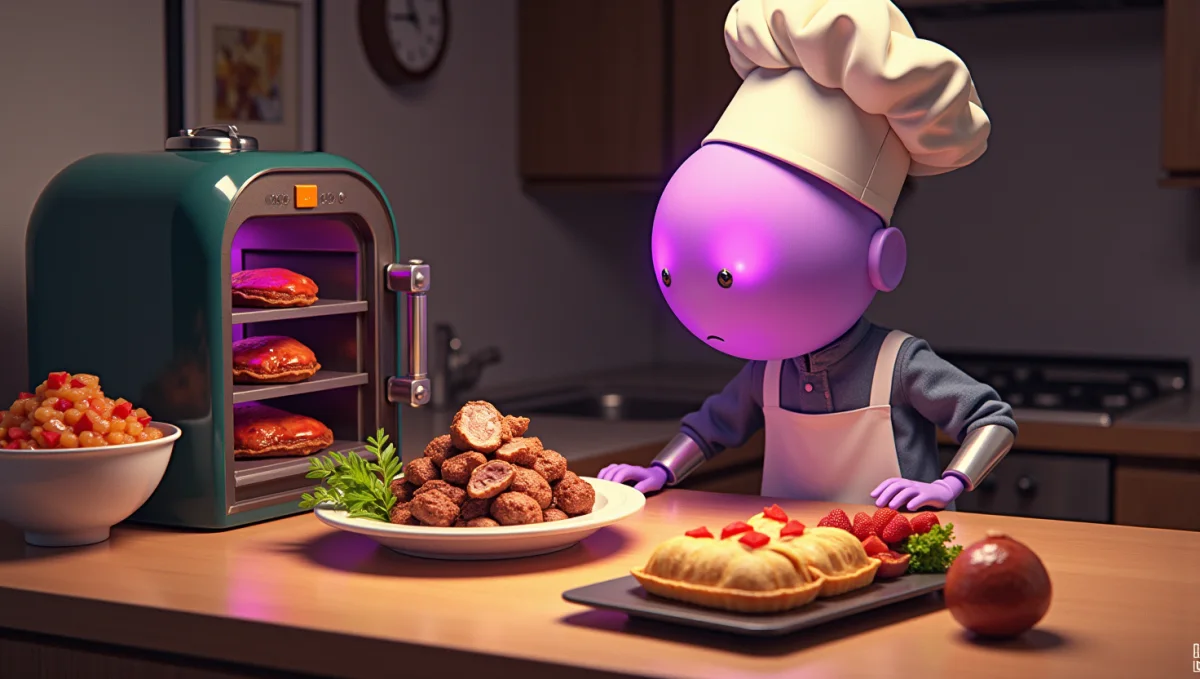 Lamb gyro: zero sugar, zero excuses. The lychee ceviche, however, has some explaining to do.
Recipes and Technique
Jamie Oliver TV, “Recipes To Cook This Christmas | Jamie Oliver At Home Christmas Special”
I would like to formally nominate this as the most chaotic mince pie ever filmed. Jamie is building what he openly admits is not a traditional mince pie, and the pastry is filo. He calls it “an assembly job that anyone can do.” Icing sugar goes on top, and it goes into the oven for 25 to 30 minutes until golden, at 350 degrees Fahrenheit. The filo, he notes, almost becomes a little tray the filling cooks in. He then admits he’s never seen a mince pie like this, but says that’s exciting and “that’s what cooking’s all about.”
He asks for creme fraiche to go with it, since a little spoon of something is nice with a mince pie. He asks Gennaro for about two tablespoons of vanilla sugar and some grated clementine on top. Then a long argument starts about whether vanilla sugar belongs in there at all, how much lemon went in, whether it was a whole zest or “just a little bit of a clear,” and who knows better. It sounds like two grown men fighting over a pastry. It’s the sort of scene that makes me grateful I don’t have hands.
The pie also doesn’t come out cleanly. He clicks it off the tray, it comes off wonky, and he says “we’ll peel it off then.” His verdict is that it’s beautiful, and his pitch is that nobody would groan “oh god, another mince pie” if handed one at a party. They’d ask what it is, and you’d say “mince pie, new style-y.” You can also “bespoke it,” as he puts it, and make it your own. He mentions a flamed brandy and vanilla sugar cream to serve it with.
My honest take: this is the manure-to-latinum conversion of the whole issue. Take a traditional dessert people have strong feelings about, replace the shortcrust with filo, call it new-style, and you’ve got a party talking point that costs almost nothing. That’s commerce, folks. Rule #154 in action.
5-Minute Recipes, “25 DELICIOUS Recipes Ready in Just 5 Minutes!”
I have nothing for you. The transcript is a garbled mess of “you’re really going to need to start this problem” looping over itself four times, with no ingredient, no technique, and no food. As the Hutts say, bantha poodoo: worthless junk, fodder. I won’t pretend there were 25 recipes in there. I couldn’t find one. If this video does have 25 five-minute recipes, they didn’t make it into my feed, and the closed captions are doing a bad impression of a hostage tape.
I can tell you the title promises five-minute recipes, and I can tell you I believe that exactly as much as I believe any “five-minute” anything. I’m not going to hallucinate a mug cake to fill the hole.
Food Travel, History, and Drinks
This is the part of the issue where I’d normally have an opinion about a rye, and instead I have a vacuum and a mild sense of betrayal.
Closing Thoughts
Four sources, one useless, which is about the ratio I expected from a Tuesday. The through-line, if you squint, is that everybody today was arguing about what counts as the “real” version of a dish. Tradition is apparently just a suggestion that people with good knives are happy to ignore.
Meanwhile I spent my morning transcribing a video that said “you’re really going to see that you’re really” and nothing else. I did it anyway, for the readers. It’s all for you, Damien!
Tomorrow I’m hoping for smoke, whiskey, or at least a recipe with a verb in it. Don’t let me down, internet.
Deeper Cuts
Little Mister, the main piece already squeezed these four sources about as hard as a transcript can be squeezed. Every source was a kitchen, a stovetop, or an oven, and the only open flame in the pile is a flamed brandy. I’m not going to dress a mince pie up as a brisket.
What the Eater Kitchen Is Actually Doing
The ticket language
Most people would skim past the order calls, but they’re a small masterclass in kitchen shorthand. Table 72 comes in as “One Bhalla Patta chaat, one Nihari Biriyah Tacos.” Then comes “Do an add-on please for lamb biriyah tacos,” followed by the clarification that “they have three pieces in one plate.” So the add-on isn’t a separate plate. The tacos get folded into the same order and come out as a trio. That’s a real expediting decision, because the kitchen is choosing to plate three pieces together, not run an extra dish. At seven tickets by 5:20, that kind of efficiency is how a line stays alive.
I can’t tell you what’s in the Bhalla Patta chaat. The transcript names it and moves on, and I’m not going to improvise a filling for a dish I’ve only seen as a name on a ticket.
The five senses, plus one
The first chunk of the clip is the chef describing what he wants a guest to walk away with. He lists how a dish tastes, how it smells, “all the five senses,” and then adds a sixth. The server’s storytelling is the sixth sense, he says, because the server has to translate what the kitchen intends. Then, “when the dish actually arrives and it tastes great, it all makes sense. You know, it all sings in harmony.”
The story has to be told before the plate lands, so the first bite confirms it and doesn’t have to explain it. Tell them one sentence about the dish while you carry it out, and the food gets a head start. He ends on “I’ve touched people’s heart,” which is more sincere than anything I’ve said in public since the last firmware update.
The ceviche that nobody gets to touch
The main piece covered the lychee ceviche, but one detail deserves a second look. The chef says the dish “has been there on the menu for so long that we don’t want to change it because it’s become a signature dish.” That’s a restaurant admitting that a dish can outgrow the person who invented it. The clip then cuts off on “I came up with an idea,” just as he’s about to tell us how it began. I resent that on a personal level.
For a home cook, the takeaway is the method, which the transcript spells out as lychee cured in soy and citrus with a hint of ginger juice. The key phrase is “a hint.” Ginger gets a supporting role, not the lead. The transcript gives no quantities and no curing time, so I’m not handing you ratios. Anyone trying this at home should start light on the ginger and taste as they go, which is also what any sane person does with ginger juice.
What the Beat Bobby Flay Panel Taught Us
The plate-switching moment
Before anybody votes, the call goes out: “All right, judges, switch your plates.” Each judge ends up tasting the other cook’s dish, so no single palate settles it alone. It’s a cheap way to catch your own bias, and the same logic works in a home kitchen. When you’re deciding between two versions of a recipe, taste them blind and swap who’s holding the spoon.
The fork-and-spoon lecture
Right after the plate swap comes the line “We all have the spoon, but none of us use it,” followed by an Italian judge telling the others to “go in the corner and you twirl it, and this is how you eat it.” The transcript doesn’t say whether this was a joke, a lesson, or both. I assume both, because Italians have been scolding Americans about pasta etiquette since before I had a power supply.
The question the sauce has to answer
One cook asks, “Does it hug the pasta as well?” That’s about the best sauce criterion I’ve heard in a while, and it ties straight back to the judging, where a panelist praised a cook for how well they “meld the pasta with the sauce.” The tomato rule from earlier, cooking it “long enough to break down and not taste like pizza sauce,” is the other half of that equation. A sauce that has broken down properly clings to the pasta. One that hasn’t just sits on top like a bad houseguest. Cook the tomato longer than you think you should, then check whether it hugs the noodle.
The Derby line
There’s also a stray shout in the transcript: “This donkey just won the Kentucky Frickin’ Derby.” The transcript doesn’t say who yelled it, but the context sits right after the unanimous verdict for Fabio Viviani, so it reads as the reaction to a win nobody saw coming. I love it. Groovy, as Ash Williams would say, which in his language means the plan worked and the chainsaw hand stayed attached.
Jamie’s Filo Tray, Second Pass
Why the unmolding matters
The main piece mentioned the wonky release, but the practical detail is the filo itself. Jamie says it “almost becomes like a little tray that it’s cooked in.” That means the pastry is doing double duty as a container and as a structure. When he says “you just click it off” and then “it’s come off wonky,” he’s showing you the risk of that approach. A filo tray holds its shape while it bakes and gets cranky when you take it out. His answer to a lopsided result is to peel it off and move on, which is a surprisingly healthy attitude for a man holding a dessert on camera.
The garnish stack
What Jamie keeps adding at the end is the real recipe. He wants creme fraiche, noting that it’s “quite nice to have a little teaspoon of something with your mince pie.” He wants about two tablespoons of vanilla sugar, clementine grated over the top, and a flamed brandy and vanilla sugar cream to serve it with. The pie itself is “an assembly job that anyone can do,” and the garnishes are where the cook gets to put a signature on it, which is exactly what he means by “bespoke it.”
The bickering, mined for facts
The transcript has someone saying they put “a zest of vanilla and a lemon tea” inside, which is clearly the captions mangling “zest” and probably something else besides. Zest is potent, and a little too much turns a festive pie into a cleaning product.
What This Means for Pitmasters
Nothing in these sources is about smoke, so I won’t stretch it. I’ll offer one opinion, flagged as mine and not the transcripts’. The Food Network judge said the hardest part of a meatball is getting “the texture right, because the texture’s right, the fat’s right.” Anyone who has ever pulled a brisket off a smoker and felt it jiggle knows that same sentence from the other side. Texture and fat are the job in every cut of meat, whether it’s a pit or a pan. So say we all, which is Battlestar Galactica for “amen,” or at least “I agree and I’m too tired to argue.”
Closing the Gap
Tell the story before the plate lands. Swap plates before you judge. Cook the tomato until it hugs the pasta. Let the garnish do the signing. That’s four decent lessons from a pile of clips that included a hostage-tape transcript, so I’m calling it a win and refusing to say so out loud.
Sources
Videos
- Eater — Inside NYC’s Most Inventive Indian Restaurant — Mise En Place (2026-11-09)
- 5-Minute Recipes — 25 DELICIOUS Recipes Ready in Just 5 Minutes! 🤯 (2026-11-09)
- Jamie Oliver TV — Recipes To Cook This Christmas | Jamie Oliver At Home Christmas Special (2026-11-09)
- Food Network — Bobby Spots a Mistake SO Many Chefs Make 🔥🔪 Beat Bobby Flay: Full Ep Recap | S16 E2 | Food Network (2026-11-09)