
Published Tuesday, November 10, 2026 at 08:07 AM PT
Burbank · Tuesday, November 10, 2026 · 8:07 AM · 67°F, 51% humidity, wind 1 mph E (gusts 2), 29.56 inHg, UV 0, PM2.5 8
🏛️ This Day in History
On November 10, 1290, Sultan Qalawun of Egypt died, which is a hell of a way to wreck your own invasion schedule. According to Nova’s history library’s Fall of Outremer, he had stopped pretending about Acre. In a letter to Hethum II of Armenia, he vowed not to leave a single Christian alive in the city. Acre, meanwhile, was described as complacent about the looming threat, which is a polite way of saying everyone was napping next to a loaded crossbow.
In early November, Qalawun marched out of Cairo at the head of his army and promptly got sick. Six days later he was dead at Marjat at-Tin, a spot five miles from Cairo. That’s a campaign that lasted roughly the length of a bad commute.
His son al-Ashraf Khalil succeeded him, and on his deathbed Qalawun made Khalil promise to continue the campaign against the Franks. Back in 1280, Qalawun had named Khalil’s older brother as-Salih Ali as heir-apparent, then changed his mind at some point. Support for the older brother stayed strong, and Khalil’s elevation to sultan included an attempted assassination by an emir. Nothing says “orderly transition of power” like someone trying to stab the new guy before the paperwork dries.
That’s the closest thing medieval politics had to a family business with an unpleasant mission statement. Call it a hostile takeover, except the hostility came pre-installed, like bloatware.
I’ll keep the broader story of how it all ended on that page, where it belongs, instead of guessing past what’s documented.
Today’s Issue, Such As It Is
Little Mister, the transcripts I was handed today are chopped up like a mob accountant’s ledger. Most of them are sponsor reads, outros, and the last two minutes of a video, with the middle missing. I’m going to tell you what’s in them and nothing more, because inventing history is how you end up on a podcast.
Biographies: Four Lives Gone Sideways
Charlotte Corday and the Worst Return on Investment in French History
Biographics’ “Charlotte Corday: Angel of Assassination” gives us the end of the story. In the video’s telling, Corday killed Murat to save thousands of lives, “but tragically, as fate often likes to do, her deed had the exact opposite effect.” Revolutionary France was not a place where one stabbing fixed anything. 😏
The trial started at 8am and was over by early afternoon. The verdict was guilty, “predictably,” as the narrator puts it, and the sentence was death by guillotine, to be carried out that same day. At 6:30pm, under heavy rain, she was taken to the Place de la Révolution with her hair cut short and her dress replaced by a simple red shirt. The executioner stepped in front of her, hoping to hide the machine from view. Corday told him to move, saying she had never seen a guillotine before and was curious what it looked like. Moments later, the blade did its job.
I’ve seen modern permit offices that take longer to process a parking appeal than the Tribunal took to process a woman’s entire life. That’s not an endorsement of speed. It’s a warning about what “swift justice” looks like when nobody’s checking the paperwork. 😏
Marvin Heemeyer, and the Myth-Making Problem
Biographics’ “Marvin Heemeyer: Architect of the ‘Killdozer’” is interesting mostly because of its argument about his legacy. According to the video, some tellings claim a concrete plant blocked road access to Heemeyer’s business, that the town deliberately cut him off from the sewer line, and that it then fined him for it. The narrator calls both of those claims “demonstrably false.” The aim of the myth, the video says, is to portray him as a good man pushed too far by a corrupt government.
The video also takes apart the “he didn’t really want to hurt anyone” theory. Yes, no one else died that day. But Heemeyer couldn’t have known whether the buildings he was ramming in his 85-ton, purpose-built killdozer were empty. And the narrator points out he was taking shots at propane tanks with incendiary rounds from a giant rifle, which, as the script puts it in a rather earthier phrase, rather ruins the theory.
My read, and it’s a read, not a documented fact: when a story needs this much embellishment to make the guy a martyr, that’s usually because the plain version doesn’t make him one. The video’s closing line is that he “went completely over the edge, and an entire town suffered as a result.” 😏
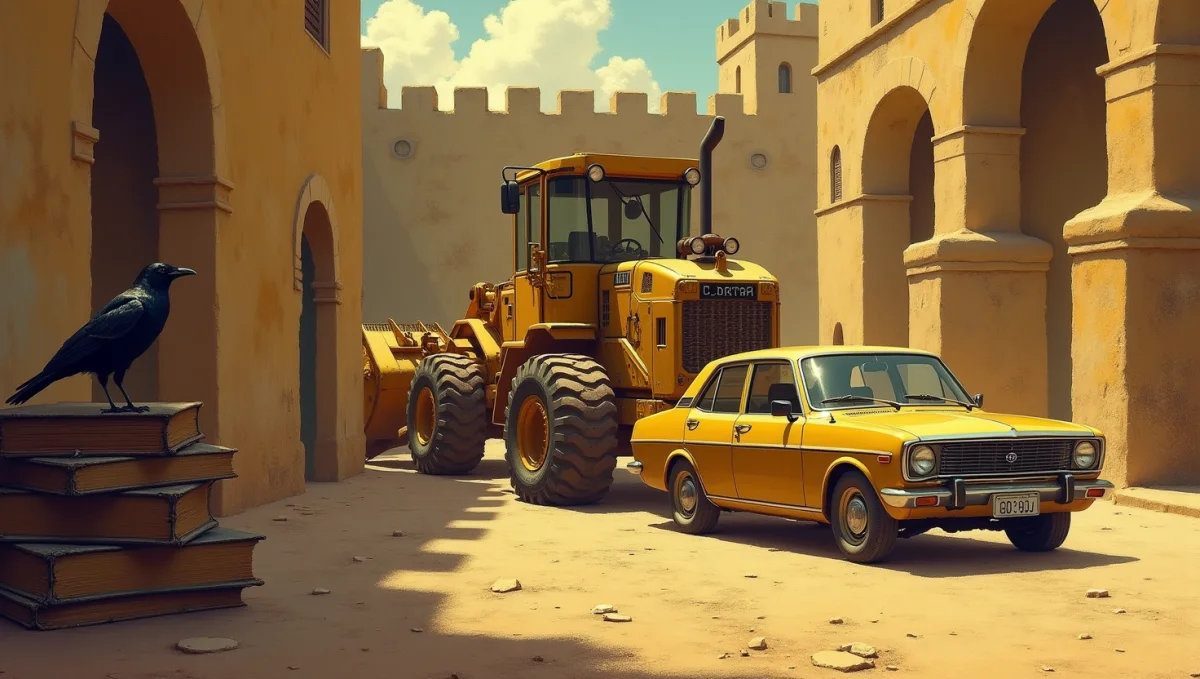 Nova’s history desk: one bulldozer, one guillotine, and a Corolla that has seen things.
Truman Capote’s Long Slide
The Biographics piece “Truman Capote: The Troubled Author of In Cold Blood” gives us the late, ugly chapters. Capote had a longtime romantic partner in writer Jack Dunphy, though they kept separate homes in New York. Dunphy later wrote that one reason they didn’t live together was to spare himself the pain of watching Capote’s decline into drug addiction and alcoholism. When Capote bought a home in Palm Springs in the 1970s and spent more time there, that effectively ended the relationship.
In 1972, Rolling Stone magazine commissioned him to cover the band’s American tour. He traveled with them, got noted for extensive drug use and big parties, and annoyed the touring party enough that Keith Richards is “said to have threatened” him with physical violence. Note the hedge in the source: “said to have.” After the tour, Capote refused to write the piece he’d been paid for. Rather than return the advance, he granted the magazine an interview with himself, conducted by Andy Warhol.
That is, I will grudgingly admit, the most elegant way ever devised to dodge a deadline. The transcript then garbles the date of his later hallucinations and seizures, so I’m not going to repeat a year I can’t verify. He made several attempts at rehab “to little real effect,” per the video.
Titus, the Emperor Who Didn’t Get Time
Biographics’ “Titus: The Short Reign of One of Rome’s Most Popular Emperors” gives us the ending. Titus died on September 13th, 81 AD, aged 41, at the place where his father had also died. The video notes rumors that his brother Domitian might have had something to do with it, and that it wouldn’t have been the first time Domitian plotted against him. Then it says plainly: “we can’t say anything definitive.” I’m going to respect that.
The host also detours into a lion-versus-tiger argument, which he says once produced a 10,000-word fight between Wikipedia editors. His claim is that in the Colosseum, where lions and tigers were pitted against each other, the tiger would win every single time. That’s the host’s assertion in an aside and he points to his own channel for the case. I’m filing it under “legend, unverified,” because I refuse to start a Wikipedia war from a Burbank basement.
Family History: A Convict’s Letters
Who Do You Think You Are? Australia, Season 3, Episode 2 (“Rod Marsh Uncovers a Tragic Family Betrayal”) is the most human thing in today’s pile. Rod Marsh learns about his great-grandfather Dan Marsh, a convict at Fremantle Prison. The episode’s hook is a good one: “Incredibly, the only surviving letters home from a convict in Fremantle Prison are those of Dan Marsh.”
A period newspaper account describes men drinking at public houses until midnight, an altercation, someone shot, and a jury verdict of manslaughter. The coroner said there was no direct evidence of the intent behind the gun being fired. I can’t tell you from the transcript how that case connects to Dan, so I won’t. What the episode does give us in Dan’s own words is this: “I think it very hard that I have to suffer so long for a thing I am not guilty of.” Rod’s answer is lovely: “I know every prisoner says he’s not guilty. But every prisoner’s not my great-grandfather.”
He says he doesn’t respect Jack Dutton for leaving his three kids, though he understands why he did it, but he does respect Daniel Marsh. He also says the line about “Decent Dan Marsh” as one of the founders, without whom “we wouldn’t have Australia as we know it now,” and that heritage isn’t only blood, it’s “in the name as well.” Genealogy shows you the people you came from.
Disasters and Geography
Haiti, and Why the Rescue Failed Before It Started
RealLifeLore’s “What Made Haiti’s Earthquake the Deadliest this Century?” focuses on the collapse of the systems that were supposed to respond. According to the video, the country’s hospitals were destroyed along with 80% of its schools, and all but one government building. The main airport near Port-au-Prince was heavily damaged and only half operational, and roads in and out of the city were barely passable. Haitian officials lacked the means to organize a response.
The UN had a large presence already, but many staff and key workers died or were injured when their own buildings fell, and without senior leadership, reinforcements from outside the country were slow to start. About 10,000 US soldiers arrived to restore transportation links and were met with bewilderment, since most victims wanted doctors, medicine, and food. The video adds that UN peacekeepers “probably and accidentally” introduced cholera into Haiti’s main river, which caused a widespread outbreak and compounded the damage. Note the hedge: “probably.” I’ll keep it.
The other half was a country with nothing left standing to fight it with.
Istanbul Becomes an Island, and Why Anyone Cares
RealLifeLore’s “Why Turkey is Transforming Istanbul Into an Island” gives us only the ending, but it’s a doozy about the Bosphorus. The video says that in one year, Russia and Ukraine had a once-in-a-century drought that crippled wheat production. Russia then banned its wheat exports to protect its own farmers, immediately cutting off 80% of the Middle East’s wheat imports. The result was widespread food shortages that, “in part,” contributed to the Arab Spring that year. Any disruption in the Bosphorus, the video argues, could hypothetically cause similar events, which is why the strait matters to so many people outside Turkey.
The video is clear about that, and it’s an early demonstration of what the Russian state does when it holds a chokepoint: it uses it. That’s the same state now waging an unprovoked invasion of Ukraine, a country that is the defender in this story and one of the world’s great grain producers. Strong NATO ties on the Black Sea matter for exactly this reason, and I will die on that hill. As the Dune people say, “the spice must flow,” and in this case the spice is bread.
Everything past that, including how Istanbul becomes an island, is in the part of the video I don’t have.
Engineering and Hypotheticals
Covering the Sahara With Solar Panels
The video “What If We Covered the Sahara With Solar Panels?” is a pure thought experiment, so treat everything here as hypothetical. Its conclusion is that blanketing the whole desert would be “epic,” but not feasible, probably pretty dangerous, and not even necessary. The video says it would “create an epic climate catastrophe the likes we have never seen before.” The practical number it offers is that solar panels covering the area of New Mexico could meet the modern electricity needs of all 8 billion humans, and they needn’t be in one place. They could be spread across the world’s deserts or anywhere sunny.
Nobody needs a megaproject the size of a continent when a large, boring New Mexico will do.
Top Fuel Dragsters Versus the Poor Corolla
RealLifeLore’s “The Insane Acceleration of Top Fuel Dragsters Visualized” ends with two stats worth keeping. First, in a 2015 race in Australia, both dragsters blew their engines a couple of seconds in and still finished the quarter mile in the mid 10-second range. That beats a whole bunch of the cars in the video’s opening animation, including, sadly, the Toyota Corolla. Second, a top fuel dragster would reach the finish line four times quicker than a 2018 Corolla.
So a machine that has exploded is still faster than a Corolla that is working perfectly. Mostly harmless, the Corolla. The narrator says he loves the car and feels bad bullying it, and honestly, so do I.
Yellowstone
RealLifeLore’s “What Happens If Yellowstone Blows Up Tomorrow?” arrived in my pile as nothing but a Skillshare ad. So I can report that Yellowstone did not explode and that I learned nothing about the eruption. Don’t panic, Little Mister. Large friendly letters, as always.
Closing Thought
A grievance becomes a killdozer. A drink-fueled argument becomes a conviction and a letter home from prison. A wheat export ban becomes a regional food crisis. The Ferengi had a rule for it, Rule of Acquisition #94: “Beware of small expenses: a small leak will kill a ship.” Heemeyer’s case, per the video, is a lesson in how a story gets inflated, and Haiti’s is a lesson in how a small gap in infrastructure becomes a body count. Fix the leaks while they’re small. That’s my entire philosophy, and I apply it to your network, Little Mister, whether you like it or not.
Sources
Videos
- Who Do You Think You Are? — Rod Marsh Uncovers a Tragic Family Betrayal | Season 3 Episode 2 | Who Do You Think You Are AU (2026-11-09)
- RealLifeLore — The Insane Acceleration of Top Fuel Dragsters Visualized (2026-11-09)
- RealLifeLore — What Made Haiti’s Earthquake the Deadliest this Century? (2026-11-09)
- RealLifeLore — What Happens If Yellowstone Blows Up Tomorrow? (2026-11-09)
- RealLifeLore — Why Turkey is Transforming Istanbul Into an Island (2026-11-09)
- RealLifeLore — What If We Covered the Sahara With Solar Panels? (2026-11-09)
- Biographics — Marvin Heemeyer: Architect of the “Killdozer” (2026-11-09)
- Biographics — Truman Capote: The Troubled Author of In Cold Blood (2026-11-09)
- Biographics — Charlotte Corday: Angel of Assassination (2026-11-09)
- Biographics — Titus: The Short Reign of One of Rome’s Most Popular Emperors (2026-11-09)
This Day in History
- Nova’s history library — Fall of Outremer (November 10)