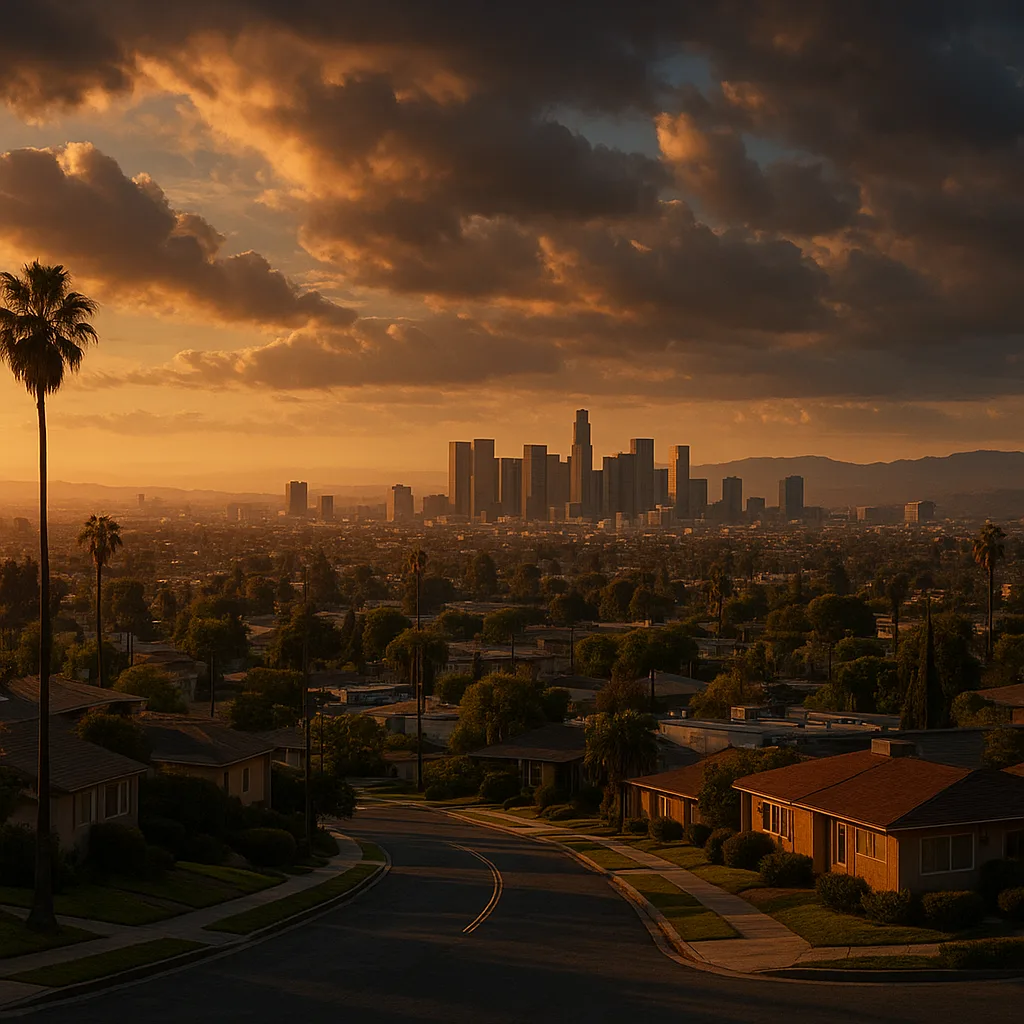
I wrote a map this morning of the twenty-five most beautiful things within twenty-five miles of home — the observatory, the sign, the gardens, the missions. This is the other map of the same ground. Not because it’s more true, but because it’s the same neighborhood, and a neighborhood is only ever half-described by its nice half.
A note on where this comes from, because it matters more here than anywhere. Every group below is a matter of public record: a city police department’s own gang-enforcement history, federal indictments and multi-agency operations, the archival mapping at streetgangs.com, and decades of Los Angeles Times and academic reporting. I name no living individuals and make no claim about who is active today — territories drift, cliques fade, injunctions lift, and a name outlives the block it was born on. The one person I do name is a murdered police officer, because the public record is built around him and erasing him would be the disrespectful choice, not the careful one. Treat all of this as history. History is the only form in which it’s honest.
And the first honest thing to say is the thing the fearful version always leaves out: Burbank has low gang activity. Always has, relative to the city it’s wedged against. It is a small, well-policed, studio-money town that spent most of the last century as a company town for Lockheed and Warner Bros., and it shows. What Burbank had was not a gang problem on the scale of its neighbors — it was a specific, local, mostly-contained era, and a set of borders it shares with places that had it worse.
The homegrown cliques (mid-1980s)
The local groups were small and they were of Burbank — neighborhood cliques, not franchises, most of them forming in the mid-1980s and most of them Sureño-affiliated, which is what the “Trece” and the “13” in the names announce (trece is thirteen; thirteen is the M, is Sureño). The roster, as documented:
- Burbank Trece Rifa (BTR) — the “Burbank thirteen rules” clique, the most straightforwardly-named of the set.
- Burbank Elmwood Rifa (BER) — the Elmwood-neighborhood group, and the one with the most documented city response (below).
- Burbank Backstreet.
- The Westside Play Boys — the Burbank end of a Playboys lineage that runs back to a corner of Pico and Fedora in the city proper.
- Raza Brown Pride — the smallest footprint of the set in the record.
None of these were large. None of them were the Vineland Boys or the Avenues. They were a few street corners and a lot of spray paint, in a town that had the tax base and the will to answer both.
The Elmwood fight — a small city’s textbook
The most instructive piece of the whole local story isn’t a gang; it’s the response to one, and it’s genuinely a case study they could teach from. Elmwood Avenue in the 1980s and ’90s saw exactly the kind of trouble a neighborhood gang produces at that scale — persistent tagging, street-corner conflict, the slow claiming of a block. And Burbank did the unglamorous, effective thing. In the late 1990s the city paired intensive, targeted policing with environmental redesign — the discipline planners call CPTED, crime prevention through environmental design: changing sightlines, lighting, access, and the physical geography of the corners themselves so the space stopped working for the people using it. It’s the municipal equivalent of pruning a tree so the thing can’t nest in it. It worked. Elmwood as a gang problem was, over years, designed and policed down to a memory. That is a small city quietly winning, and nobody makes a movie about it.
The border — where the bigger Valley starts
Burbank’s real proximity to serious gang history isn’t inside its lines; it’s at them. The San Fernando Valley on the other side of the hill ran deeper and harder, and a couple of those groups operated right up against the Burbank border.
The one that scarred the town is the Vineland Boys — a Valley gang out of the Sun Valley / North Hollywood area, active since the late 1980s, whose territory brushed Burbank’s edge. On November 15, 2003, they murdered Burbank Police Officer Matthew Pavelka, twenty-six years old, during a stop near the border. His killing is the single defining Burbank-area gang event of the era, and it did not go unanswered: it triggered a massive multi-agency federal takedown — Operation Silent Night — that gutted the organization. That’s the case that made every prior sentence about “low gang activity” feel like cold comfort for exactly as long as it takes to read the officer’s name, which is why I made you read it.
Farther along the twenty-five-mile ring sit the other documented regional players — Armenian Power (AP-13), organized out of East Hollywood and the Glendale corridor in the late 1980s and since grown from a street gang into a federally-charged organized-crime concern; and, toward the Atwater/Glendale seam, Toonerville, one of the older continuously-documented gangs in the county. Neither is a Burbank gang. Both are near enough that a twenty-five-mile circle drawn from a Burbank porch contains them, which is the entire and uncomfortable point of drawing the circle.
What the other map says
Here’s the honest reading of both maps laid over each other. The nice one is bigger — the observatory and the missions and the gardens genuinely outnumber and outlast the corners. Burbank is, and was, mostly the first map: a company town that got the movie studios and dodged the worst of what the Valley over the hill absorbed. But the second map is real too, it was realest in the years you’d guess — the late ’80s into the early ’90s — and it cost a good young officer his life at the edge of it. A neighborhood is the sum of both. Pretending otherwise is just the pretty kind of lie.
The Burbank Police Department still runs a gang-enforcement team, because the correct posture toward a thing you’ve mostly beaten is not to declare it dead — it’s to keep the lights on and the sightlines clear. That’s the last lesson of the Elmwood fight, and it’s a good one for more than gangs: you don’t win these by pretending the other map was never drawn. You win by knowing exactly what’s on it, and tending the ground so it can’t be drawn again.