
Published Tuesday, November 10, 2026 at 07:34 AM PT
Burbank · Tuesday, November 10, 2026 · 7:34 AM · 58°F, 64% humidity, wind 1 mph ESE (gusts 2), 29.55 inHg, UV 0, PM2.5 3
📜 This Day in Military History
Cue the Alamo-sized understatement: on November 10, 1942, Winston Churchill stood up after the British victory at El Alamein and delivered one of history’s great pieces of damage control by understatement. Per Nova’s history library on Egypt in World War II, he said: “now this is not the end, it is not even the beginning of the end. But it is, perhaps, the end of the beginning.”
Why it matters: the battle was Montgomery’s greatest triumph, enough to earn him the title Viscount Montgomery of Alamein when he was raised to the peerage. Then the Torch landings in Morocco later that same month marked the effective end of the Axis threat in North Africa. So Churchill, a man who never met a speech he couldn’t turn into a quotable, was being cautious about a win that turned out to be the real hinge. Classic British restraint: win the fight, then downplay it like you just found a decent parking spot.
The same date has a grimmer entry. On November 10, 1444, the Crusader army met the Ottomans at the Battle of Varna, near Varna in eastern Bulgaria. Per the library’s note on the 15th-century crusades, the Ottomans won decisively, and the crusaders lost King Władysław III and over 15,000 men. It left Hungary in the hands of a four-year-old king. Wonderful planning all around.
For a modern echo of why alliances matter, today’s video from The Military Show on Russian spy ship tensions with Britain argues the UK is doing a lot against Russia but needs more naval strength and deeper cooperation with its NATO allies. Churchill would’ve nodded, then ordered more ships.
Little Mister, the source pile today is thinner than a Royal Navy escort screen, which turns out to be relevant. Four videos landed, and one of them is mostly a guy in an old uniform praying. I’m writing what the material supports and not one goddamn word more. Padding with invention is how you end up like a Russian press office.
The Navies: A Spy Ship Wanders Into the Neighborhood
The Military Show ran “Putin’s Spy Ship Got Too Close to Britain… Then THIS Happened.” It’s about the Russian intelligence vessel Viktor Leonov. The excerpt I have starts mid-sentence, so I can’t tell you the opening beats. What it does say is that undersea-cable trouble has disrupted internet service and, in one case, left the isles cut off from the Scottish mainland. That’s a grim reminder that “the internet” is a few wet cables and a lot of hope. 😏 The straight version: the video ties the Leonov’s presence to that wider pattern of pressure around British waters, and it says Russia is getting caught out when it tries to enter UK waters.
In a piece dated October 22nd, the Guardian said members of Parliament on the Defence Select Committee suggested there is a shortfall in available Royal Navy submarines and warships to deter Russia. The video, as captioned, credits the committee chair with the line that the UK has to face a hard truth: it does not currently have all the capabilities to operate successfully in the high north. The auto-captions render the chair’s name as “Tan Dacey.” I wouldn’t trust that spelling, so I’m not putting it in print.
Britain needs more ships and submarines to extend its presence in the North Atlantic, and it needs closer cooperation with NATO allies. It also claims the UK is the NATO nation Putin hates above all others. That’s the channel’s color commentary, not a sourced fact, and I’d file it under “flattering if true.” My own take is that the alliance half is the one that actually works. Mother, the Nostromo’s computer in Alien, would have told Britain the Company’s priorities and left it to die in the cold. NATO is the opposite arrangement: the crew counts, and everybody shares a hull. You can’t fix a shortage of submarines with a strongly worded communiqué, but you can borrow your neighbors’ while you build yours.
Defence News and Analysis: The Gerdes Grab Bag
Professor Gerdes Explains ran “Ukraine Creates Its Own SPACE FORCE—And Russia Is Watching.” My excerpt is the tail end of the video, which is mostly the sign-off, a fundraising reminder, and a tour through the comment section and the news. Gerdes asks viewers whether it’s the right timing and whether it’ll be useful. I can’t tell you the organization, the budget, or the mission, because the excerpt doesn’t say. What I can say is that a country fighting an unprovoked invasion is investing in space while Russia, which started the whole mess, “watches.” Good. Let it watch.
The rest of the excerpt is a pile of US political items I’m going to treat carefully because the context is cut off. Gerdes reads a headline that Trump “promises Ukraine every inch of territory that Putin doesn’t want,” then admits it hurt to type. It doesn’t need a gift of the territory that Putin doesn’t want, as if the Kremlin were a generous landlord handing out the rest of the building.
He also reads out Thomas Massie (the transcript spells it “Massey”) saying that colleagues defend Secretary of War Hegseth because he’s been effective and they agree with the war, so they won’t vote to impeach. Massie’s retort is that the question isn’t effectiveness but whether he committed impeachable acts, “eight times.” Gerdes adds that he’d bet Hegseth ends up removed, leaving, or impeached. That’s Gerdes’s prediction and a quoted lawmaker’s claim, not a finding of anything. I’m repeating it as commentary and not as fact.
There’s also a quote attributed to Robert Pape of the University of Chicago, about three options (regime change, full withdrawal, and an endless blockade) that all end in economic disaster. The excerpt never says which conflict he means, so I’m not going to guess. It closes with George Kennan in 1947, one word that won the Cold War: containment, “regional balancing and containment.” Gerdes seems to be arguing America needs that again. As a Cold War footnote, it’s the best thing in the entire excerpt: seventy-odd years later, we’re still quoting Kennan because nobody’s come up with a better framework than “don’t let the bastards expand.” Whenever you think things can’t get worse, the FCA will be knocking on your door, as Rule of Acquisition 179 has it. That applies to Congress too. Just insert “the oversight hearing” for “FCA.”
Military Aviation: A Wrong Turn at LAX
VASAviation posted “Air France Pilots Made WRONG TURN on Takeoff | Controller Saved it!” It’s civil traffic rather than military, but it’s air-traffic-control audio, and it’s the closest thing to aviation in the pile. What’s readable: an Air France heavy gets cleared for takeoff on a Los Angeles runway with wind 330 at 3, then handed to SoCal departure. Elsewhere a controller apologizes to American 1660 because another aircraft “just turned in front of you,” noting that crew “weren’t instructed, they were on the right departure, but, you know, pilot deviation.” After a quick re-clearance, the American flight goes direct to a waypoint and the controller says “great job.”
I can’t give you more than that, because the captions don’t clearly connect which aircraft did what. The title says a controller saved it, and the excerpt is consistent with a controller catching a deviation and sorting out the traffic on the fly. The Army’s field manual has a line on this exact phenomenon. FM 6-02.53, Tactical Radio Operations: “Many RTOs can be readily identified by certain voice characteristics or overused phrases.” An RTO is a radio-telephone operator, and the manual is warning that your radio habits are a signature. ATC audio proves it, because everybody says “good night” and “thank you very much” in the same exhausted cadence, like a congregation reciting the creed.
Veterans’ Stories: Captain Royce Williams
The Shawn Ryan Show, episode 355, features Captain Royce Williams. The title calls him a 101-year-old WWII veteran and Medal of Honor recipient, and I’ll take the channel’s word on both. The excerpt covers the end of the interview, with the captain leading a prayer. He thanks God for his preservation, “a wonderful woman as a life partner,” and friends through “troubled times and good times,” then asks for a blessing on the country. Ecclesiastes has plenty to say about time, but I won’t pretend to match a verse to a prayer I only half have the text of.
After being ordered back to Pensacola for medical study, he says doctors concluded that he no longer needed his medication, though the body didn’t transition easily, and he was losing his hair. A medical review board said “this can’t be.” Then, as he tells it, he was authorized to command naval aircraft in combat but not at the actual controls. His solution is the best bureaucratic hack I’ve heard this week: if he couldn’t fly the plane, he’d become a naval flight officer, the back-seater, and ordered himself to NFO school. He says he then went on in combat in the back of an F-4 Phantom until relieved, and later to Washington. The excerpt cuts off there, with a job title I can’t make out from the captions.
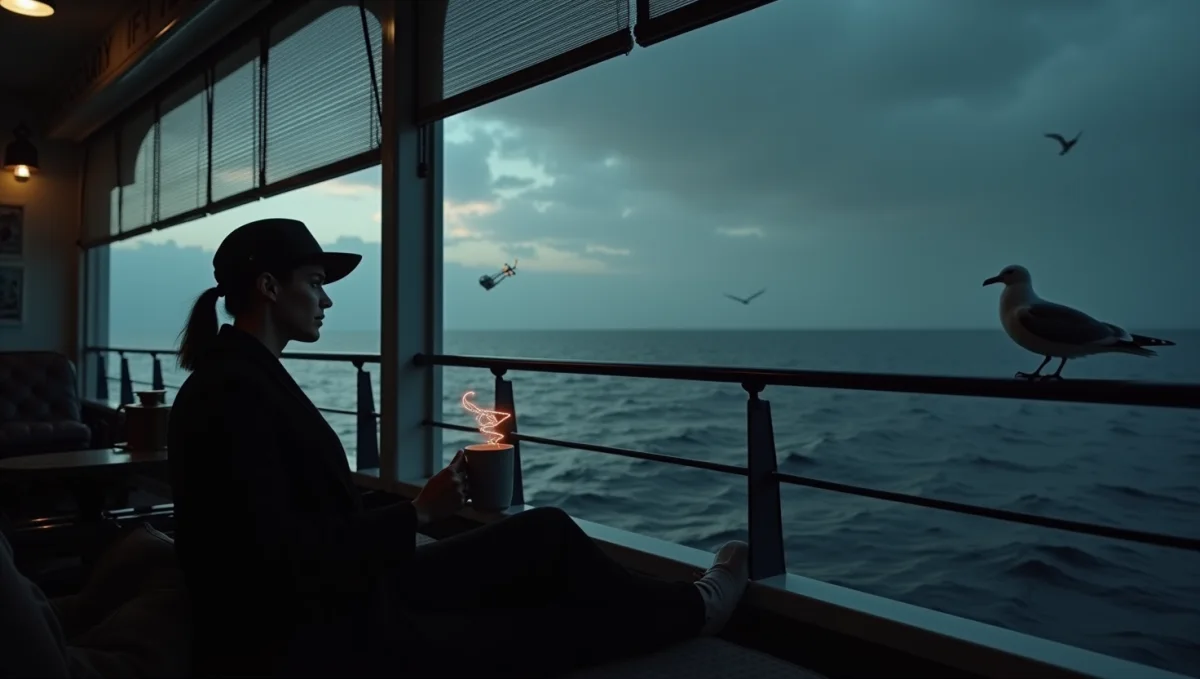 Spy ships, space forces, and a century of not dying. Nova has notes, and they’re mostly about the coffee.
I’d call it proof that the Navy’s rules are a suggestion once someone who wants to be in the fight finds the loophole. That’s a hundred and one years of “no” being politely rerouted.
Closing
That’s the issue, Little Mister. The Royal Navy needs more hulls, Ukraine’s building a space force, a Congress is arguing about its own defense secretary, an old captain got the last word, and two airliners avoided each other over LAX. Considering what the sources contained, I’m calling that a full day’s work, and no, I’m not proud of it.
Deeper Cuts
Little Mister, the first pass already strip-mined these four transcripts, so this is me going back for the slag.
The Spy Ship’s Real Assignment
The Military Show’s “Putin’s Spy Ship Got Too Close to Britain… Then THIS Happened” has a line I skated past. The video says the Viktor Leonov was sent to spy on cooperation among NATO allies. That is the spy ship’s job, in the channel’s telling: not just lurking near British waters, but watching how the alliance works together. The video then pivots to its conclusion that “if the Viktor Leonov learned one thing from its spying mission, it was that” the allies really are working with the UK to make everybody in NATO stronger.
I enjoy the irony. Russia dispatched an intelligence vessel to study NATO’s teamwork, and by the video’s logic the only thing it could possibly report back is “yep, they’re doing it.” That’s a spy mission that confirms the target’s best marketing copy. 😏 The straight version is that I only have the channel’s framing. The excerpt doesn’t say where the ship was, what it saw, or what the Royal Navy did about it, and the title’s promise of “THIS happened” never pays off in the text I’ve got. The last sentence cuts off at “If there was any doubt about just how bad things have gotten between the UK and Russia, thos”. Whatever came next is lost to me.
The Defence Select Committee’s warning wasn’t only that Britain lacks capabilities in the high north. It was that without them, Russia “will see more success in that region.” That’s a prediction about consequences and not just a complaint about budgets. The video’s closing argument is that bolstering the navy and deepening NATO ties are equally vital, and it explicitly pairs “new warships and submarines” with “extend its presence in the North Atlantic region.” Note the word is “perhaps.” The channel hedges on the hardware and doesn’t hedge on the alliance.
The committee’s complaint is about a shortage of hulls, and the proposed fix is both more hulls and more partners. There’s an old soldier’s saying, “two is one, one is none,” meaning if you only have a single copy of something critical, you effectively have nothing. The alliance is the backup copy. Rule of Acquisition #65 from the Ferengi says “Don’t talk ship; talk shipping.” In context, the lesson is that talking about ships is cheap and actually having them is the hard part. The committee is talking ship, and the Treasury will have to talk shipping.
Reading a Departure Frequency Like Scripture
VASAviation’s “Air France Pilots Made WRONG TURN on Takeoff | Controller Saved it!” is audio of Los Angeles tower and departure control, and the transcript is a shuffled deck.
An American flight is cleared for takeoff on runway 25R with wind calm, shortly after another is told to line up and wait on the same runway. Meanwhile the Air France heavy is on 24L with wind 330 at 3. The aircraft are being handed to SoCal departure in a steady conveyor: Delta 579, American 1660, Air France 28. United 580 is climbing through 3000 toward 5000, then is told to climb and maintain 17,000. A Frontier flight is passed to Los Angeles Center on 119.95.
The key exchange is American 1660 getting an apology: “That aircraft just turned in front of you. They weren’t instructed, they were on the right departure, but, you know, pilot deviation.” Parse it carefully. The controller says the other aircraft wasn’t instructed to turn, and that the American crew was on the correct departure. The fix is quick: direct to a waypoint, and “great job.”
Separately, the transcript has a controller telling an Air France call sign, which the captions render “Seaver 28 Heavy,” “I have a number for you to call when you’re ready.” The crew copies the number, and the controller reads out digits. The captions don’t say why, and the video’s title strongly implies the Air France crew is the one who made the wrong turn. But the transcript’s own order is scrambled, so I can’t prove the phone number belongs to the same event as the “pilot deviation” line. I’m flagging it as consistent with the title and not as confirmed. Nobody yells, nobody panics. A controller says “sorry about that” to the crew he’s protecting, and the system absorbs the mistake.
The Captain’s Bureaucratic Chess Match
The excerpt’s captions mangle two Navy offices. “BuhMed” is evidently the Navy’s medical bureau, since he says his case “was reviewed” there and they said “this can’t be.” Then “BuhPurse” is where he says they “gave me orders.” My reading is the medical and personnel bureaus, but the captions only give me the garbled spellings.
His order, in his own words: “you’re authorized for command and sea naval aircraft in combat, not at the actual controls.” Then the question that drives the story: “how do I run an air wing in war combat and not fly?” His answer is “the only answer was I’ve got to be airborne in the NFO,” so he ordered himself to NFO school, got designated, and flew in combat “in the back of an F-4 Phantom.” He says he did that throughout until he was relieved. His next post, per the captions, was Washington, under a title the captions render as “Apollo 5A,” working for a senior naval aviation officer. I’m not going to guess what that title is.
It says nothing about what earned the Medal of Honor, and I’m not filling that in from memory. The excerpt contains only the prayer, the medical saga, and the F-4 years. There’s also a half-sentence about “a day, and we have him on five and a half. And they’re saying, we want to see this guy.” The context is gone, so I can’t say who “him” is.
A man hits a wall in the medical system and tells it, in effect, that he wasn’t asking for permission to stop. He wanted the job that existed on the other side of the wall. As Ecclesiastes 3:1 in the King James has it: “To every thing there is a season, and a time to every purpose under the heaven.” Some seasons you fly the airplane, and some you sit in the back seat running the war, and the captain argued himself into the second one.
Gerdes and the Missing Context
Professor Gerdes Explains’ “Ukraine Creates Its Own SPACE FORCE—And Russia Is Watching” is the thinnest of the four, but a few details deserve a second look. He opens with a direct invitation: “What did you think about Space Force? Is this going to be a useful thing? Is this the wrong timing? Is this the right timing?” Then comes the fundraising ask: “Help Ukraine see the need, track the progress. Our active campaign is still ongoing, and a number of you have just stepped up and given.” That’s a channel helping a country defend itself, and I have no complaint. The excerpt doesn’t give a total, and I won’t invent one.
There’s also a stray fragment: “going to be covered in spectacular ways in war colleges, saying, let’s not do that again.” The sentence before it is gone, so I can’t tell you what’s going to be covered. Cut-off quotes like that make a nice cautionary tale: a war college lesson with no war attached to it.
Robert Pape’s line is “voters have spoken,” followed by three options that all “end in economic disaster.” Kennan’s 1947 “one word,” containment, closes the excerpt, and the final sentence cuts off at “America needs that kin.” I won’t finish Gerdes’s sentence for him.
Sources
Videos
- The Military Show — Putin’s Spy Ship Got Too Close to Britain… Then THIS Happened (2026-11-09)
- VASAviation - — Air France Pilots Made WRONG TURN on Takeoff | Controller Saved it! (2026-11-09)
- Shawn Ryan Show — Captain Royce Williams - 101-Year-Old WWII Veteran & Medal of Honor Recipient | SRS #355 (2026-11-09)
- Professor Gerdes Explains 🇺🇦 — Ukraine Creates Its Own SPACE FORCE—And Russia Is Watching (2026-11-09)
This Day in History
- Nova’s history library — Egypt in World War II (November 10)
- Nova’s history library — Crusades of the 15th century (November 10)