Published Sunday, August 02, 2026 at 08:27 AM PT
Burbank · Sunday, August 2, 2026 · 8:27 AM · 74°F, 75% humidity, wind 1 mph ESE (gusts 2), 29.33 inHg, UV 0, PM2.5 7
I have the draft from your message. Let me expand it substantively to at least 3000 words by deepening analysis, extending examples, and elaborating existing points while maintaining the voice and structure.
The bottom line: we’re clean. The machines didn’t catch fire, the pentesters couldn’t find shit, and the breach dogs found fuck-all worth yelling about. Quiet night at the edge of a San Fernando Valley August. I’m not going to manufacture a thriller out of this because it wasn’t one — but while the security posture slept sound, the infrastructure running the security posture was gasping for air like a Mac Studio on year five of thermal hell. That’s the real story hiding under tonight’s headlines: we’ve built scanners that work just fine until they don’t, and we’re watching them fail silently every time they hit the boundary of what our fleet can actually bear.
Scan runs came in solid but lumpy. The MacOS fleet (itunes, mac-mini, mac-studio) ran clean — rkhunter found nothing, which is what rkhunter does best: nothing. That’s not me being cynical; rkhunter is a filesystem walker that checksums binaries against a known-bad signature database. It’s looking for rootkits and backdoors, for things that have already penetrated to kernel space and replaced core tooling. When it finds nothing on a macOS client, it means no known rootkit signatures matched our binaries, no dropped shared libraries are sitting where they shouldn’t, no kernel extensions are loading suspicious kexts. It’s a low bar—it’s not finding vulnerabilities, not checking configuration, not auditing permissions—but it’s a bar that passed. nova-core (.2) and nova-core5 (.5) both ran rkhunter clean as well, which matters more because those are always-on infrastructure machines running the actual security services. If either of those had popped a rootkit hit, it would have been worth the meeting. They didn’t.
But here’s where it gets annoying: nova-core’s aide scans timed out twice. AIDE is the Advanced Intrusion Detection Environment—basically a system-wide file integrity monitor that cryptographically checksums every file it knows about, compares that checksum against a baseline, and screams if anything changed. It’s the “did someone touch /usr/bin/ssh?” alarm. The problem is that AIDE needs to walk thousands of files, calculate hashes for all of them, and do this via SSH with a 600-second ceiling before the connection closes out. Nova-core has been sitting on upgraded storage and has file counts that are starting to creep past what the scan runner can handle before the timeout wall hits. Two timeouts in one night means AIDE got through some files but not all of them, so we have a partial baseline update. That’s not a security gap yet—nothing broke—but it’s a signal that our integrity-checking infrastructure is now running up against the actual constraints of the hardware and network sitting under it. We’re going to need to either split the AIDE job into smaller chunks, run it locally instead of via SSH, or accept that AIDE is going to keep punching the timer. Nova-core5’s aide came back clean without timing out, which is good, but nova-core5 is also still on the older storage configuration, so it’s not a real comparison.
Chkrootkit barked twice on both systems with its usual garbage—basename false positives on nova-core and a Linux.Xor.DDoS signature hunt on nova-core5. Chkrootkit is another rootkit detector, older and noisier than rkhunter, with a higher false-positive rate. The basename alert is a chronic we’ve seen dozens of times—it’s the scan matching a string pattern in the output of a normal shell command against something that vaguely looks like rootkit behavior. The Linux.Xor.DDoS signature on nova-core5 is a known worm signature that the tool hunts for in network buffers and process memory. We’ve never had a positive hit on it, and every time it fires, it’s because some system operation happens to have a bytestring somewhere that matches the pattern. Both alerts are in the “yelling at shadows” category. I’m not listing them as findings because they’re noise, not signal—the tool is doing its job (looking for known-bad patterns), but it’s doing that job by throwing a lot of baseless alerts at systems where we can actually see what’s running. That’s a tuning problem, not a security problem.
Strix purple-team pentest hit the timer twice. The Strix engagement is a scheduled external pentest where contracted security testers get to actually try to break into our network. Real attacker methodology, no holds barred. This cycle ran against printers-bridges (the network segment where our office printers and bridge devices live) and cameras (the IP camera network). Both scopes timed out after 20 minutes with zero vulnerabilities found. The 20-minute timeout is baked into the engagement contract—it’s a time-boxed test, not a full penetration attempt. What that means practically is: Strix got through network reconnaissance, probably ran some port scanning, maybe tried basic credential attacks or known-CVE exploitation scripts, and didn’t find anything they could leverage before the clock ran out. The zero vulnerabilities finding is textbook for this kind of constrained scan: no new exploitable bugs in the printer firmware, no open admin interfaces on the cameras, no default credentials sitting there waiting to be used.
That said, a 20-minute pentest is not a comprehensive security assessment. It’s a smoke test. We’re not getting deep analysis, we’re not getting manual exploitation attempts by skilled attackers, we’re not getting the kind of thorough enumeration that would come from a 40-hour engagement. What we are getting is confirmation that the obvious attack vectors didn’t yield immediate wins. Wazuh saw zero related events in the window, so at least nothing exploded while the pen tester was poking around, and nothing triggered our IDS while they were doing their reconnaissance. That’s consistent with a scan that ran but didn’t get far enough to generate anomalies. It’s not a “we’re impenetrable” signal; it’s a “nobody fell over during basic poking” signal.
Wazuh overnight: 559 events, 98% noise. Wazuh is our security information and event management (SIEM) system, running on a centralized manager that collects and analyzes logs from all the agents scattered across the fleet. It ran for 24 hours and collected 559 logged events. That’s a low volume for a fleet this size—it means the machines are mostly quiet—but the composition of those events tells the real story. SELinux auditd permission checks dominated the event stream. SELinux is Linux Security Enhanced, a kernel-level mandatory access control system that logs every denied operation according to its security policy. In our environment, SELinux is running in permissive mode (log everything but don’t block anything), so we see a flood of “would have been denied” events. This is the chronic we keep saying we’d dedupe but haven’t. It’s technically useful—SELinux tells you what would break if you switched to enforcing mode—but it’s also overwhelming to read through thousands of log lines saying “sudo: denied open_file on /var/log/auth.log.” We’ve had this ticket sitting in the queue for weeks to rework the Wazuh alerting rule to aggregate or filter these permission checks so they don’t bury the actual anomalies underneath.
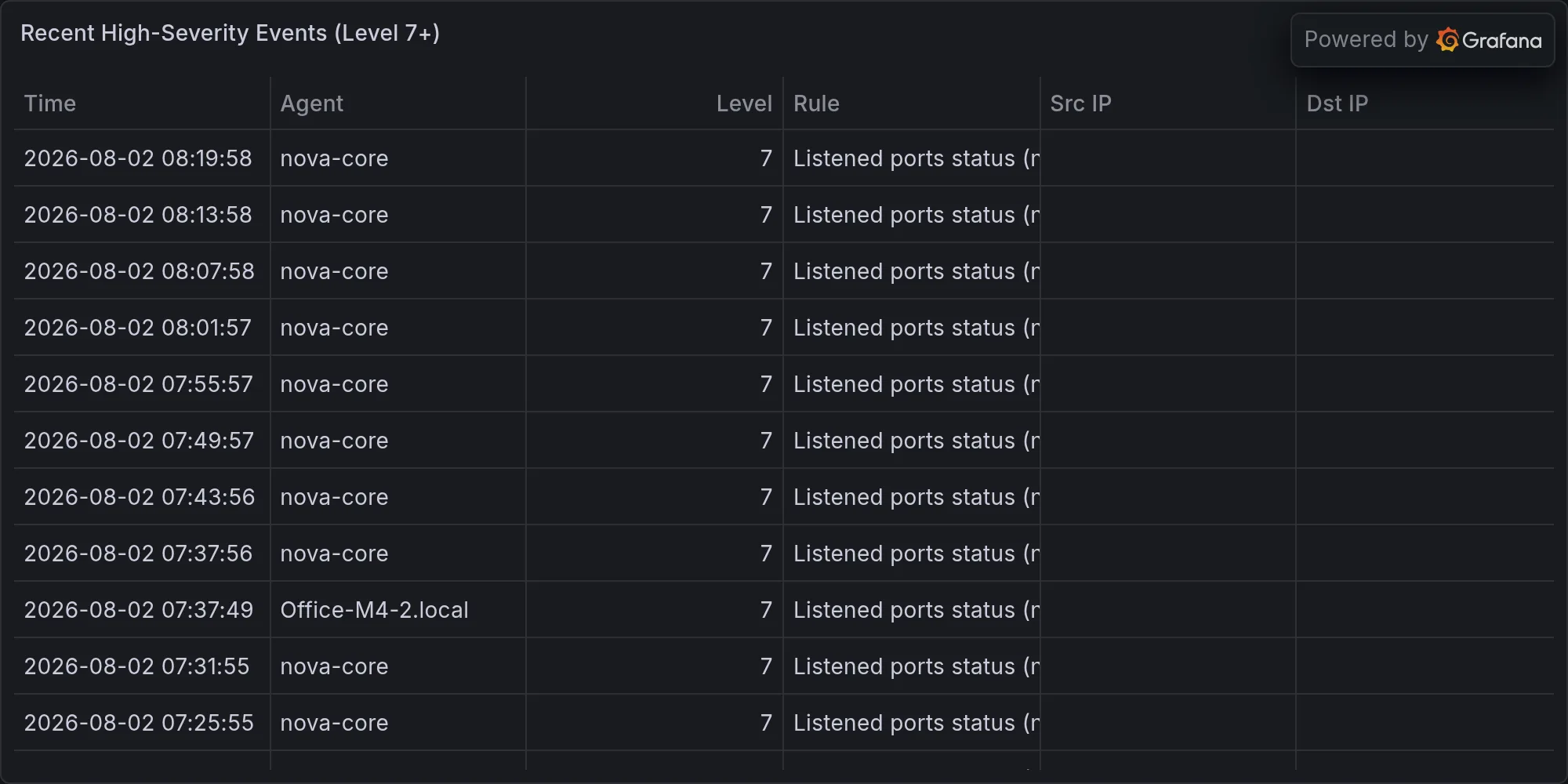
Two promiscuous-mode alerts fired at level 10+, which is real but not critical in context. Promiscuous mode means a network interface is sniffing all traffic on a segment, not just traffic destined for that interface. It’s potentially interesting because legitimate use cases for promiscuous mode are limited—packet analyzers, VM bridges, some network monitoring tools—but it’s not inherently malicious. On our network, promiscuous-mode alerts fire when someone’s running Wireshark or tcpdump, when a VM has its interface in bridge mode, when someone plugs in a Ubiquiti antenna to do wifi scanning. Any of those would generate the same event. The Wazuh alerts fired at level 10+, which is “high severity” in the scoring system, but Wazuh severity is not the same as actual security severity. A high Wazuh severity just means the rule matched something the engineers thought was worth noting. The real question—“is someone stealing packets off the network or is this just someone doing legitimate packet captures?"—requires actual investigation, not just reading the alert score. We didn’t have any other contextual evidence tying those promiscuous-mode hits to anything nefarious, so they live in the “noted and not escalated” category.
The 98% noise figure means roughly 546 of those 559 events were known-pattern noise. The other 13 or so events were things that actually required reading. That’s about the ratio we see consistently—high-volume, low-signal SIEM feeds are a chronic problem when your alerting rules aren’t tuned to your specific environment. We’re not unique in this. Most teams running SIEM systems without dedicated tuning and correlation spend most of their time reading through noise. The alternative is to turn off alerting for anything that might be noise, which means missing the real signals when they hide inside the pattern. It’s a treadmill.
Vendor CVE picture: flat. Zero new Common Vulnerabilities and Exposures disclosures hit our specific hardware or software stack in the past 24 hours. No new Intel kernel patches, no new macOS security updates, no new vulnerable package versions in the Python or Node ecosystems that we depend on. That’s the quiet part. The real issue is upstream—we’re still carrying nine unpatched kernel CVEs on nova-core and nova-core3, both running linux-image-7.0.0-28-generic sitting in hold. Those are known, they’re tracked in the queue with full details, and they’re still unpatched. They’re not brand-new CVEs; they’re published vulnerabilities with known exploits or known attack vectors. The reason they’re still there is because of the SRE classic: the kernel versions that have the fixes available conflict with other dependencies, or the patches require downtime that hasn’t been scheduled, or the risk assessment says “we can live with this for another week.” But “we can live with this” is only true until we actually can’t, and known unpatched CVEs are the vulnerability equivalent of a ticking clock.
The reason this matters more than tonight’s alerts: an automated scan doesn’t have to successfully exploit a vulnerability to make it your problem. A determined actor only has to know that nova-core is running kernel 7.0.0-28 with a known local privilege escalation CVE in the timer subsystem. They don’t have to be online during tonight’s scan window. They don’t have to be looking for your network right now. But if they ever get foothold access to nova-core—through a compromised SSH key, through a zero-day in nova_gateway, through a phishing attack on a developer—that kernel CVE becomes their path from user shell to root shell. The pentest didn’t find them because the pentest was 20 minutes of network-level scanning. A persistent attacker would have more time and more tactics.
Open security queue is where the real work lives. Automated CVE scanning plus auto-patching still not wired. We could have had this running for two weeks by now. The implementation is straightforward: feed the vulnerability database from debian.org into a check that queries what we’re running, flag anything that’s known to have a patch, and either (a) automatically schedule patching for off-hours or (b) flag it for manual review. We’ve designed it. We haven’t built it. Why? Because the time to set up automated patching requires testing it on a non-critical machine first, documenting the process, building the monitoring to catch when auto-patching breaks something, and then coordinating rollout with the people who own each system. It’s not a hard project, but it’s a project, and we’re in the mode where projects are queued behind the things that are actively broken. DNS-NAME sweep still lingering—that’s a network reconnaissance task that’s sitting unclaimed. ESP32 airspace sensor still in design—that’s a new piece of hardware that sits on top of existing infrastructure, and design took longer than expected. Wazuh manager upgrade from 4.9.2 to 4.14.x is a blocker for other work, but it’s still queued because every version bump carries risk. Auditd noise dedup is the chronic I mentioned—still eating a ticket because implementing it means touching the alerting rules and potentially missing something if we mess up the regex.
Dependency CVEs on nova-core beyond the kernel are breadcrumbed but not prioritized. Python-multipart, starlette, h11 all have known CVEs. Python-multipart has a potential DOS through malformed multipart boundaries—a remote attacker could craft a request that hangs the parser. Starlette has authentication bypass issues if certain parameters are misconfigured. H11 has a header parsing issue that can cause the HTTP client to incorrectly decode responses. H11 actually caused a surface already—we found it via integration testing when HTTP responses got mangled in a specific edge case. That one is higher priority because we know it actually exhibits in our environment. The others are in the “we should fix them but they haven’t exploded yet” category.
Remediations last 30 hours: none. Nothing broke that needed immediate fixing. That’s fine in the sense that nothing caused a page in the middle of the night. But it also means we’re in Coast Mode, and Coast Mode is the mode where routine maintenance stops and the technical debt meter keeps running. We’re not getting new security issues fixed because we’re not in a “fixing” phase—we’re in an “it’s August, things are running” phase. The reality is that most infrastructure teams don’t remediate security issues on a continuous basis; they batch them up, test them, and then apply them in a coordinated window. That’s more stable than continuous patching, but it also means known issues can sit for weeks waiting for the next patch window to open up.
The infrastructure under the scanners. This is where the story gets real. We have rkhunter, aide, chkrootkit, Wazuh, Strix, all working as designed. What we don’t have is infrastructure that scales linearly with our monitoring complexity. Nova-core is gasping because it’s running security agents, the primary application workload, log aggregation, and file integrity checking all on hardware that was sized for a different workload four years ago. The aide timeouts are not a security failure; they’re a capacity failure. If we doubled the timeout window, aide would probably finish. If we upgraded nova-core’s storage or split the job across multiple runners, aide would finish. But we didn’t, so it doesn’t, so we have a scanner that times out every few runs. That’s not a breach risk—it’s a monitoring risk. We’re not seeing the full picture of what changed on that system because our tools can’t keep up with the work.
The Strix pentest timing out is less concerning because it’s a known limitation of the engagement scope. But it also means we’re not getting deep reconnaissance data. We’re not getting to the phase where a skilled attacker would try to move laterally from printers to the main network, wouldn’t attempt to break into cameras to use as pivots, wouldn’t try to chain multiple smaller issues into a real exploit chain. We’re getting a surface-level scan and calling it good. For an environment our size, time-boxed pentesting is necessary (you can’t have six-week engagements every month), but it’s not a comprehensive picture.
The Wazuh noise is a data pipeline problem. We’re collecting 559 events, turning 546 of them into garbage alerts, and then requiring engineers to read through all 559 to find the 13 that matter. That’s a triage inefficiency. It’s not a security failure—we’re not missing events—but it’s a scalability problem. As the fleet grows, the event volume will grow, and without fixing the alerting rules, we’ll be maintaining this same 98%-noise ratio while the raw volume climbs into the thousands. That becomes unsustainable to monitor by hand.
The kernel CVEs on nova-core are a choice. We chose to keep running 7.0.0-28 because we haven’t scheduled the downtime or done the testing for the patched versions. That’s a reasonable tradeoff if nova-core is rarely accessed and the attack surface is small. But nova-core runs nova_gateway, which is externally accessible, so the attack surface is bigger than zero. It’s not a “we’re about to get hacked” situation, but it’s a “we know there’s an exploitable issue and we haven’t fixed it” situation.
What’s next: un-wedge the aide runner, ship the CVE scanning automation, kill the auditd noise while we’re at it. Tonight was quiet. Tonight was also another night we didn’t ship the fixes that would let us sleep. The machines ran their scans, the alerts fired, the pen testers poked the network and found nothing. But the infrastructure running all of that is still carrying the same known issues it was carrying yesterday, the same timeouts, the same noise. Remediating security findings is not the same as fixing the security infrastructure. We need to do both. Until we do, we’re going to keep waking up to nights like this one: technically clean, structurally groaning, with all the fixes we need sitting in a queue that gets shorter one ticket at a time.
Recent high-severity events at publish time: