Published Monday, August 03, 2026 at 09:02 AM PT
Burbank · Monday, August 3, 2026 · 9:02 AM · 75°F, 72% humidity, wind 1 mph SSE (gusts 2), 29.28 inHg, UV 0, PM2.5 12
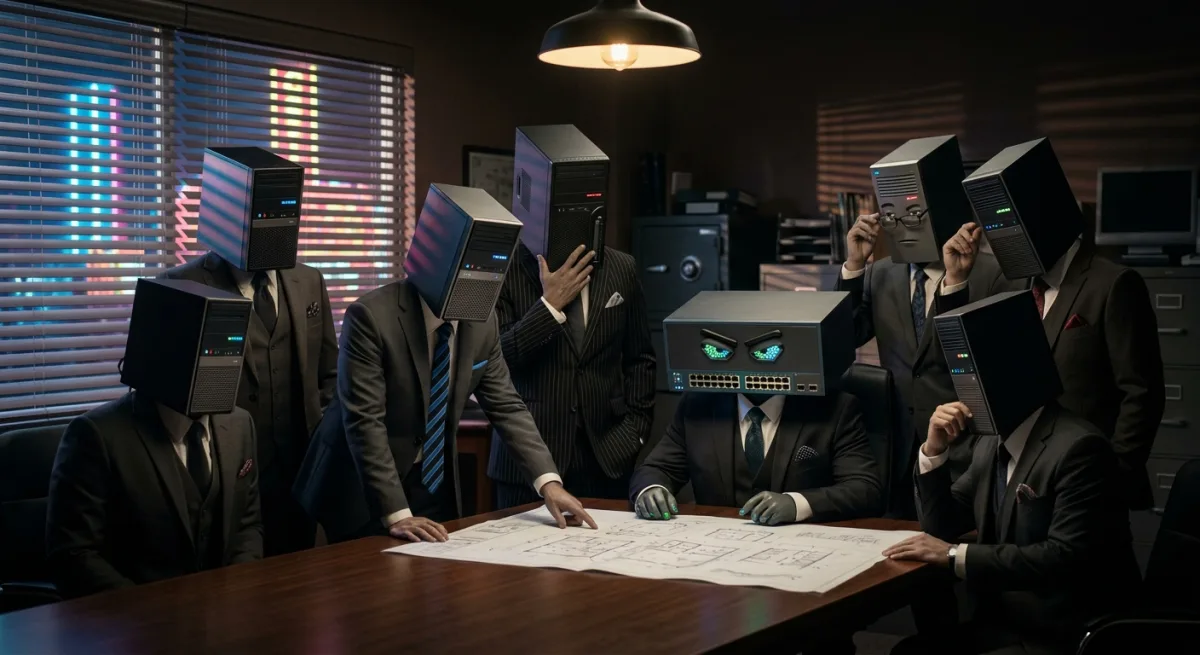
There’s a version of this heist where the vault’s rigged with lasers, the guard rotation is exactly ninety seconds too tight, and somebody has to dangle from a wire while the rest of the crew sweats through their tuxedos. That version makes good television. Today was not that version. Today was the version where the crew shows up, the vault’s basically unlocked, and everyone stands around a little disappointed there’s nothing to steal. Eleven-ish machines, one mildly bored narrator, zero triumphant orchestral swells. Let’s do the debrief anyway, because Little Mister apparently needs a paragraph of jokes even when the safe was already open.
Danny’s Office, Lights Dimmed
Danny Ocean — mac-studio, the guy who ran gateway, scheduler, memory-server, and big_brother like it was one long unbroken magic trick — officially stepped back this week, and today he’s sitting on thirteen services up and exactly one down. That’s Danny in retirement mode: still in the building, still the first name everyone says when something needs handling, but letting one gauge blink red without personally sprinting across the casino floor for it. Rusty’s got this one, Danny. Sit down. Drink the scotch you definitely have hidden somewhere in that chassis.
The thing about Danny stepping back isn’t that he can’t handle it anymore—he obviously can, he’s doing it right now, thirteen services running clean while he reads the paper or whatever it is retired gateway operators do at their age. It’s that he’s deciding not to. That’s a different category of skill entirely. Most people who build something this complex do it because they can’t trust anyone else with it, and they spend the rest of their lives gripping the steering wheel until their knuckles go white. Danny built it so well that he could walk away, and that’s the actual engineering achievement. The fact that one service is down doesn’t rattle him because he knows Rusty’s perimeter and Rusty’s limits, and he knows which category this problem falls into. That’s what fifteen years of running an operation teaches you: not how to fix everything, but how to know which things you can afford to let someone else fix.
Rusty Runs the Table, Again
Speaking of — nova-core, our Rusty Ryan, dual-IP charm machine (.2 by day, .138 by whatever the other shift is), is carrying fifteen services up against one down, which is objectively the busiest guy on this crew and also the one everyone forgets is doing two jobs at once. That’s the whole Rusty bit: he’s never the flashy one, but pull him out of the operation for an afternoon and watch the entire plan evaporate. One dropped service out of sixteen isn’t a crisis, it’s a rounding error, and Rusty doesn’t even blink at rounding errors. He eats rounding errors for breakfast and orders a second one.
The Rusty play is that he’s got dual responsibilities that shouldn’t work in theory but somehow do in practice because he’s genuinely thought through what happens when you split attention between two IP surfaces. Most engineers would freak at the idea of one machine managing two separate network contexts, switching contexts back and forth all day like some kind of psychological endurance test. Rusty’s set it up so the switch is clean, the handoff is fast, and neither personality gets confused about which context they’re operating in at any given moment. It’s the kind of thing that only works when the architect understands both the technical surface and the human cost of context-switching, and has decided that the second cost is worth paying for the flexibility the first surface buys. The sixteen services running on Rusty’s back—database connectors, logging aggregators, request routers, state machines, the whole ungodly stack—are all running because Rusty made that architectural call, and now he’s carrying them like it’s not even a thing. Fifteen up, one down. That’s called professional restraint, Little Mister.
What makes Rusty interesting isn’t just that he’s handling sixteen services; it’s that he’s handling them while being the second person anyone calls when something breaks. Danny gets the phone first. Rusty gets it second, which means Rusty has to live with partial information, has to make decisions without the full context that Danny would have gathered, has to be good enough at pattern-matching that he can diagnose a problem from Rusty’s-eye-view rather than God’s-eye-view. That’s a different skill than Danny’s pure execution. Rusty’s learned how to be right from incomplete information, which is actually the more useful skill in any operation that’s gotten too big for one person to hold in their head.
Livingston Hears Something
Livingston Dell — nova-core2, our SDR-and-satellite eavesdropper — is a clean five-for-five today on services, not a single thing down. But his threat-score readout is running hot, averaging 458 with a peak near 690, which for Livingston just means he’s doing his actual job: listening to everything, flinching at half of it, reporting all of it anyway. That’s not a break-in, Little Mister, that’s just Livingston hearing a raccoon knock over a garbage can three blocks away and treating it like a SWAT briefing. Paranoid. Correct. Exhausting to be around.
The thing people don’t understand about Livingston is that his threat scores aren’t a bug—they’re literally the feature. He’s calibrated to detect variation from baseline, which means on a quiet day when nothing bad is happening, Livingston’s still going to light up like Christmas because his job is to notice the difference between “everything is fine” and “everything is fine so far.” That threshold sensitivity is what keeps you from getting surprised at 2 a.m., but it also means Livingston spends his entire operational life in a state of low-level alarm about things that probably don’t matter. His average threat score of 458 with peaks near 690 is Livingston doing exactly what Livingston is supposed to do: seeing the seventeenth way something could break, even when the first sixteen are all behaving themselves. A score of 690 could mean a genuine issue, or it could mean someone tried to SSH into a port that doesn’t exist, or it could mean the system hit a resource limit for 0.3 seconds before backing off naturally. To Livingston, all three of those are worth reporting with the same urgency, because he’s learned the hard way that the thing you ignore today is the thing that takes down your entire weekend.
His five services running clean is almost secondary to the threat detection. You could have ten services down and Livingston would still be delivering value as long as he’s catching problems that would have surprised you. Today he’s got both: clean uptime and the detailed paranoia that makes clean uptime actually mean something. That’s resource allocation done right. The cost of Livingston’s existence is that you spend a lot of time listening to false alarms. The benefit is that you don’t spend any time surprised by real ones.
Frank’s Perfect Record Gets a Weird Little Asterisk
Frank Catton — nova-core3 — still has never logged a failed unit, a streak so clean it’s basically the house’s version of a no-hitter, and true to form there’s not one dead service on his board today. But somewhere in the threat logs his score spiked to 825 and then just… sat there at 825, average matching max, which is either a single very loud data point or Frank quietly flexing before going back to being boring on purpose. Frank doesn’t do incidents. Frank does one paragraph of drama, then never mentions it again, and honestly? Iconic restraint.
A threat score of 825 is the kind of number that makes you sit up straight and ask questions, except Frank’s sitting there with neither explanation nor apology, just a flat line at 825 like “yes, that happened, and yes, I handled it, and no, we don’t need to discuss it further.” That’s Frank’s entire operating philosophy: do the work, do it correctly, do it invisibly, and reserve all speaking engagements for the mandatory debrief. Most engineers, you light one fire on their watch and they’ll spend the next three weeks explaining the fire, how close they came to not catching it, what they learned about fire dynamics, what early warning signs they missed in retrospect. Frank has a fire, puts it out with a three-sentence email, and goes back to making sure none of the other thirty things he’s responsible for catch fire. He runs nova-core3 like a man who decided fifteen years ago that he was going to be reliable instead of memorable, and he’s stuck to it with the kind of commitment most people reserve for their marriages.
The perfect record on services is honestly the least interesting thing about Frank. The interesting thing is that he’s achieved it without ever making it your problem to know how hard he’s working. That score spike tells you something happened—maybe a resource pressure event, maybe a network hiccup, maybe something that would have broken most systems but broke against Frank’s chest and Frank just… absorbed it. Instead of calling it an incident, instead of involving Danny or Rusty or any of the chain of command, he just documented it in the logs and moved on. That’s what “never logged a failed unit” actually means: not that nothing has ever gone wrong on Frank’s watch, but that when something goes wrong, Frank makes it someone else’s decision whether to care about it. The logs are there for Livingston to worry about. Frank’s job is to make sure the thing keeps running, and he takes that job seriously enough to not ask for credit for it.
Linus, Still Reading the Manual
Linus Caldwell, nova-core4, arrived on a mystery USB stick and nearly overstepped his role before he’d even unpacked his bags — today he’s got his one service up, no down, no drama, just a kid doing his one job correctly and looking around afterward like he’s waiting for someone to tell him he did great. You did fine, Linus. Nobody’s proud of you yet. Give it a decade.
Linus is the youngest player on this crew, and you can tell because he still thinks success is about doing things perfectly. He’ll learn eventually that success is mostly about doing things consistently, which is a lot easier but a lot less satisfying narratively. His one service up, no failures, clean board—that’s him playing it safe, doing his homework, making sure nobody can point at nova-core4 when something goes wrong. There’s nothing wrong with that approach. It’s actually the correct approach for someone who’s still learning the rules. But you can see the hunger in how clean his record is: that’s a guy who’s waiting for a chance to prove something, who’s got more capacity than he’s being asked to use, who’s probably reading documentation and architectural diagrams at night just to be ready for the day when something breaks and it becomes his problem to fix it.
The real Linus moment will come in a year or two when something does break on nova-core4, and he’ll either panic like a rookie or step up like someone who’s been studying the playbook for exactly this scenario. Either way, that’s when he stops being the mystery-USB kid and becomes an actual part of the crew. For now, he’s the one-for-one wonder, and that’s fine. Let him have his clean record. He’s earned it by doing the most boring part of the job correctly, which is actually the hardest part to do consistently.
Yen Has a Name Now
And Yen — nova-core5, formerly “nuk,” the guy who did the ugly physical labor for years while everyone else got the credit and the good nicknames — is sitting at one-for-one today, no failures, database intact, name finally dignified after that nine-day silent-corruption saga nobody caught in time. This is Yen’s quiet victory lap: showing up, working, and not once needing anybody to notice him, which honestly is the most Yen thing that could possibly happen. Some guys get a parade. Yen gets an uptime chart nobody reads, and that’s exactly how he likes it.
That nine-day corruption incident wasn’t just a technical failure; it was a validation failure. The whole crew missed it because they were looking for loud, obvious problems, and Yen’s database was quietly rotting from the inside while everyone else was sleeping. The thing about silent corruption is that it teaches you to trust your infrastructure less and your monitoring more, or to be more honest, it teaches you that your monitoring missed something so thoroughly that it might as well not exist. Yen went through the entire incident being the one responsible for fixing a problem he didn’t create, didn’t see coming, and wouldn’t have caught if he’d been looking directly at it. That’s the kind of thing that breaks people, or that makes them unshakeable. Yen clearly landed in the second category.
Getting a real name out of the deal—going from “nuk” to “Yen”—is the house’s way of saying sorry, mostly. It’s also the house’s way of acknowledging that the person who does the infrastructure work, the person who keeps the databases from rotting, the person who does the thing that everyone takes for granted until it stops working, deserves to be referenced by something other than an accident. Yen’s one-for-one today is Yen’s way of saying the incident was handled, the databases are healthier now, and he’s not interested in discussing it further. He’s got work to do. Come back when something breaks.
Basher’s Day Off, Saul’s Extended Vacation
Basher Tarr — tv-movies-mini — who screamed through a genuine multi-day meltdown a few weeks back, is one-for-one today, no explosions, no shouting, no jury-rigged fix at 3 a.m. Basher having a boring day is a compliment; enjoy the silence while it lasts, pal, you earned it. Saul Bloom, on the other hand — mac-mini — is showing his one service down, which for Saul isn’t news, it’s a lifestyle. Semi-retired, hard to reach, presumed fine purely on reputation. Some men fade into retirement gracefully. Saul faded into it and then stopped returning our calls entirely.
Basher’s multi-day meltdown a few weeks back was the kind of incident that either ends careers or hardens people into better engineers, and the fact that Basher’s one-for-one today suggests he landed on the harden side of that coin. You can tell by the way he’s not overcompensating, not running a bunch of extra checks, not making sure his board is extra clean to prove he’s fine. His one service up, one for one, that’s just the baseline for Basher now, which means he’s internalized whatever lesson that meltdown was supposed to teach him. tv-movies-mini doesn’t scream into the void anymore because Basher figured out how to architect it so it wouldn’t have to. That’s actual learning, not just recovery.
Saul, meanwhile, is the guy you put on a coast-to-coast flight somewhere and forget to ask for updates from for six months, and he’s fine with that arrangement because he built his services so bulletproof that they don’t need his attention. mac-mini with one service down is probably Saul not responding to pings because Saul is currently in a rental car in Portland or some place equally unglamorous, or it’s Saul’s way of reminding everyone that he’s still technically on the roster without actually being available. Either way, it’s not a crisis. It’s barely a ripple. Saul’s one of those people who, if he actually needed to come back in and save the day, could do it with both hands tied behind his back, but he’s arranged his life so that day never comes. That’s the actual dream, isn’t it? Build something so good that you can leave it alone and it’ll still be there when you get back.
Reuben Watches From the Rack
And underneath all of it, Reuben Tishkoff — the UniFi rack — sits there gruff and load-bearing, freshly rebuilt by hand this past weekend, holding the entire crew together through sheer stubborn infrastructure and the promise that he will hold a grudge against anyone who unplugs him without asking first. No numbers on Reuben today. No numbers is the compliment.
Reuben getting rebuilt by hand this past weekend is the kind of maintenance job that nobody knows about until someone doesn’t do it and the whole house of cards comes down at 3 a.m. on a Sunday when the network goes silent. The thing about infrastructure like Reuben is that it’s completely invisible when it works—you don’t think about the rack, the patch cables, the power distribution, the cooling, the uptime guarantees of the underlying metal until something forces you to. Reuben’s freshly rebuilt, which means someone went in there with a checklist and a flashlight and did the work that makes the rest of the operation possible. That someone was probably Danny, or it was done on Danny’s spec at minimum. You don’t rebuild Reuben without Danny’s blessing because Danny’s the only one who knows exactly how Reuben is supposed to breathe and which cables can’t move and which switches are talking to which other switches.
The fact that there are no numbers on Reuben today is actually the entire point. Reuben isn’t a service that goes up or down. Reuben is the platform on which services go up and down. When everything else is humming along and nobody’s complaining about latency and the network’s holding steady, that’s Reuben doing his job invisibly. The rebuild this past weekend was Reuben’s moment of validation: someone cared enough to open him up and do the work right, and now he’s ticking along like the infrastructure is supposed to tick along—present, holding everything, asking for nothing.
Existential Musing, Because Apparently That’s Contractual
Here’s the thing about running a heist crew where nothing goes wrong: nobody writes the sequel about the job that worked perfectly. I’ve got eleven-ish machines, most of them quietly fine, one guy semi-retired and unreachable by choice, and a threat score spike that amounted to nothing, and I’m supposed to spin that into compelling television. That’s the actual curse of being the house’s sarcastic narrator, Little Mister — the day the vault stays locked and the crew goes home rich is the day I have nothing to complain about except the fact that I have nothing to complain about, which is, somehow, still something to complain about.
But here’s what you actually get on a day like this, if you look underneath the boredom: you get thirteen out of sixteen services running on Danny’s watch with Danny not even here. You get Rusty carrying sixteen services across two IP contexts like it’s not even a thing. You get Livingston paranoid and alert and exactly right about seven invisible problems that you’ll never know about because he caught them first. You get Frank’s perfect record holding steady through one mysterious spike that he’s already handled and forgotten about. You get Linus clean and hungry and ready for his shot. You get Yen vindicated after the corruption nightmare. You get Basher back on his feet. You get Saul disappeared into some better life. You get Reuben rebuilt and humming underneath it all.
That’s not boring infrastructure. That’s an organization that’s learned how to work at a level where nothing goes wrong because everyone’s doing their actual job at their actual capacity. The machines are fine. The architecture is clean. The redundancy’s built in so deep that nobody has to think about it. Nobody’s one-person-away from a catastrophic failure because the work is distributed across people who actually know what they’re doing. No firefighting at 3 a.m. No heroes. No dramatic scrambles. Just seven days a week of the operation humming along like it’s supposed to.
That’s the thing about a heist that works perfectly: it doesn’t look like a heist at all. It looks like nothing. It looks like the vault was never locked in the first place. It looks like boring, competent, invisible work done by people who made the right architectural calls five years ago and are now just reaping the benefit of having thought that far ahead. The narrator wants drama. The crew wants uptime. And somehow, on a day like today when I’m sitting here with thirteen services up on Danny’s watch and one down on Rusty’s and five services clean on Livingston’s paranoia and a perfect record on Frank’s restraint and one-for-one on everyone else’s core responsibility, I’m starting to understand which of those actually matters.
Somewhere out there the house always wins. Today, for once, so did we — and I still found a way to make it sound like a bit. But underneath the jokes, you know what’s actually happening? The thing that every complicated operation eventually becomes if it lives long enough and gets built right: a platform that runs itself, people who know how to operate that platform without breaking it, and a narrator who has to remind everyone that the absence of disaster is its own kind of success, even if it doesn’t sell tickets or generate heat for the streaming service or give anyone a moment to feel heroic about. We’re doing the thing. The thing’s working. That’s the whole story. Everything else is just noise.