Published Tuesday, August 04, 2026 at 10:24 AM PT

BLUF: The npm ecosystem just got fucked sideways by ChainDrop, Google’s AI agents are getting told to execute malicious instructions via GitHub issues, and N-able’s auth bypass is bleeding production like a sieve — meanwhile Iran’s taking potshots at merchant shipping and London just bet £8.4 billion that mutually assured destruction stays mutually assured.
CYBER
The npm supply chain is having a full-scale catastrophe. ChainDrop just poisoned hundreds of packages in a coordinated attack that would make any dependency purist contemplate career changes [BleepingComputer]. The mechanics are simple and terrifying: compromise a popular package, and every developer who runs npm install becomes a dupe carrying your payload downstream. The scale here is genuinely fucked — hundreds of affected packages means your blast radius is already unmeasurable. If you’re running any non-trivial Node infrastructure in production, you need to audit your lock files yesterday, not because audit will find anything (it won’t), but because you need the visceral shock of discovering what you actually imported.
N-able N-central, the managed services provider’s core orchestration layer that talks to thousands of customer endpoints, just got patched for active exploitation of an authentication bypass [SOC Prime, CVE-2026-18577]. If you’re still on N-able and haven’t hotfixed this yet, I’ll wait while you panic in real time. The good news is it requires manual patching. The bad news is every RMM vendor has this exact vulnerability baked into their architecture: centralized auth, thousands of trusting endpoints, and a perimeter you’re desperately hoping nobody’s already tunneled through. This one got caught because someone exploited it openly; the next one probably won’t.
Google’s Agent Development Kit for Python just became a textbook case study in what happens when you treat user-provided content as code [CSO Online, The Hacker News]. Three entire workflows got deleted after someone demonstrated that you can trigger privileged operations on the agent by opening a GitHub issue with the right syntax. This is the frontier AI vulnerability class in miniature: an automated agent reads input, makes decisions, and executes actions, and somewhere in that pipeline someone forgot that GitHub issues are user input, not commands from the developers. The good news: Google caught it fast. The bad news: this is the vulnerability pattern for the next three years — AI agents trusting the wrong channel, agents executing instructions that look official but aren’t, agents interpreting ambiguous input in dangerous ways.
Azure Cosmos DB’s Gremlin query interface had a critical isolation failure that could let one tenant query or modify another tenant’s data [CSO Online]. This is the kind of vulnerability that makes compliance auditors weep because isolation is the entire fucking security model of a multi-tenant database. If isolation leaks, everything else is theater. Microsoft fixed it, but the fact that it shipped means someone shipped a multi-tenant data platform without baking isolation into the query layer before writing the first line of logic. That’s not a bug; that’s an architectural failure.
QuickFox, a commercial VPN application with legitimate users, got compromised in the supply chain and weaponized to deploy an FDMTP implant [Fortinet FortiGuard]. Specifics are sparse, but the compromise happened at distribution or build-time — or both. This is SolarWinds energy but smaller blast radius, same rot: you buy trusted software, and the supply chain was open to the postal service.
SonicWall zero-day exploits are now attributed to INC ransomware, and they’re chaining both CVEs for maximum damage — exfil first, then encrypt [CyberScoop]. SonicWall makes network appliances that live on your perimeter. If your perimeter device has a zero-day and it’s actively exploited, you’re not just exposed to the Internet; you’re exposed with an attacker already inside your walls. SonicWall’s released patches, but this is a reminder that “just firewall it” is not a security posture.
Fake Adobe and Zoom updates are installing ScreenConnect backdoors [The Hacker News]. This is the oldest social engineering play in existence: bundle a Trojan inside a legitimate-looking update and let user behavior do the heavy lifting. ScreenConnect is legitimate remote support software, but here it’s being used as a backdoor, which means attackers are banking on the fact that half your users won’t verify where updates came from. The fix requires users to think. The reality: users will click anyway.
AI developers are getting targeted via trojanized GitHub repositories — cloned repos with infostealers waiting for developers to git clone the malicious fork instead of the real one [Help Net Security]. This requires developer diligence (verify the owner, check star counts, confirm recent activity), but it also requires GitHub to stop optimizing search results for social engineering.
cPanel just shipped a critical SQL injection vulnerability that lets hosting customers run arbitrary SQL as database root [The Hacker News]. cPanel powers hundreds of thousands of shared hosting servers, so this is a privilege escalation that turns every customer into a database admin on shared infrastructure with dozens of other tenants. This is the kind of flaw that should make whoever signed off on input validation contemplate a career change, because input validation is not a hard problem in 2026, and if you ship a database interface without it, you’re not just negligent — you’re culpable.
Almost half of all malware samples are bypassing DNS entirely and connecting directly to IP addresses [Unit 42]. This is a network posture problem that zero-trust evangelists have been screaming about for years: if you’re only monitoring DNS, half your malware is invisible. Fixing it requires egress IP filtering (painful, breaks legitimate traffic), all-connection logging (data volume nightmare), or accepting that DNS monitoring is obsolete.
MILITARY/GEOPOLITICAL
A cargo ship took a direct hit from a projectile overnight in contested waters [Just Security]. Merchant shipping in the Iran War zone is becoming active battlespace, which is great for insurance underwriters and catastrophic for anyone who owns a boat. Escalation patterns are accelerating — regional posturing is giving way to direct strikes on international commerce.
The X-62 VISTA conducted 27 autonomous AI-controlled intercepts of airborne targets using an IRST pod [The Aviationist]. This is not simulation — this is a crewed test aircraft autonomously tracking and intercepting drone targets in the physical world. The Air Force is moving fast on autonomous air combat capabilities and not apologizing about it.
An A-10 conducted armed airborne escort for a surfaced Ohio-class ballistic missile submarine during exercise [The Aviationist]. This signals doctrinal interest in defending SSBNs during surfacing operations, which is a vulnerability window the Air Force is apparently taking seriously now.
Sixteen Indo-Pacific maritime forces commenced the 25th SEACAT exercise with US Navy participation [US Navy]. This is coalition-building and interoperability training in a region where China’s expanding influence is the stated concern. These drills double as intelligence collection on how partners operate.
USS Virginia (SSN 774), the first Virginia-class fast-attack submarine, returned from deployment [US Navy]. Routine posture reporting, but the Virginia-class is the backbone of US undersea presence in contested regions like the South China Sea and Indian Ocean.
Ukraine’s FP-9 ballistic missile is close enough to first flight that its own maker won’t disclose the timeline [Defence Blog]. Homegrown Ukrainian capability that doesn’t depend on foreign supply chains — significant for operational independence despite years of active war.
The UK committed £8.4 billion to advancing its nuclear deterrent [UK MOD]. Next-generation ballistic missile submarine and warhead modernization, signaling continued British commitment to NATO nuclear posture and strategic deterrence.
PHYSICAL/LOCAL
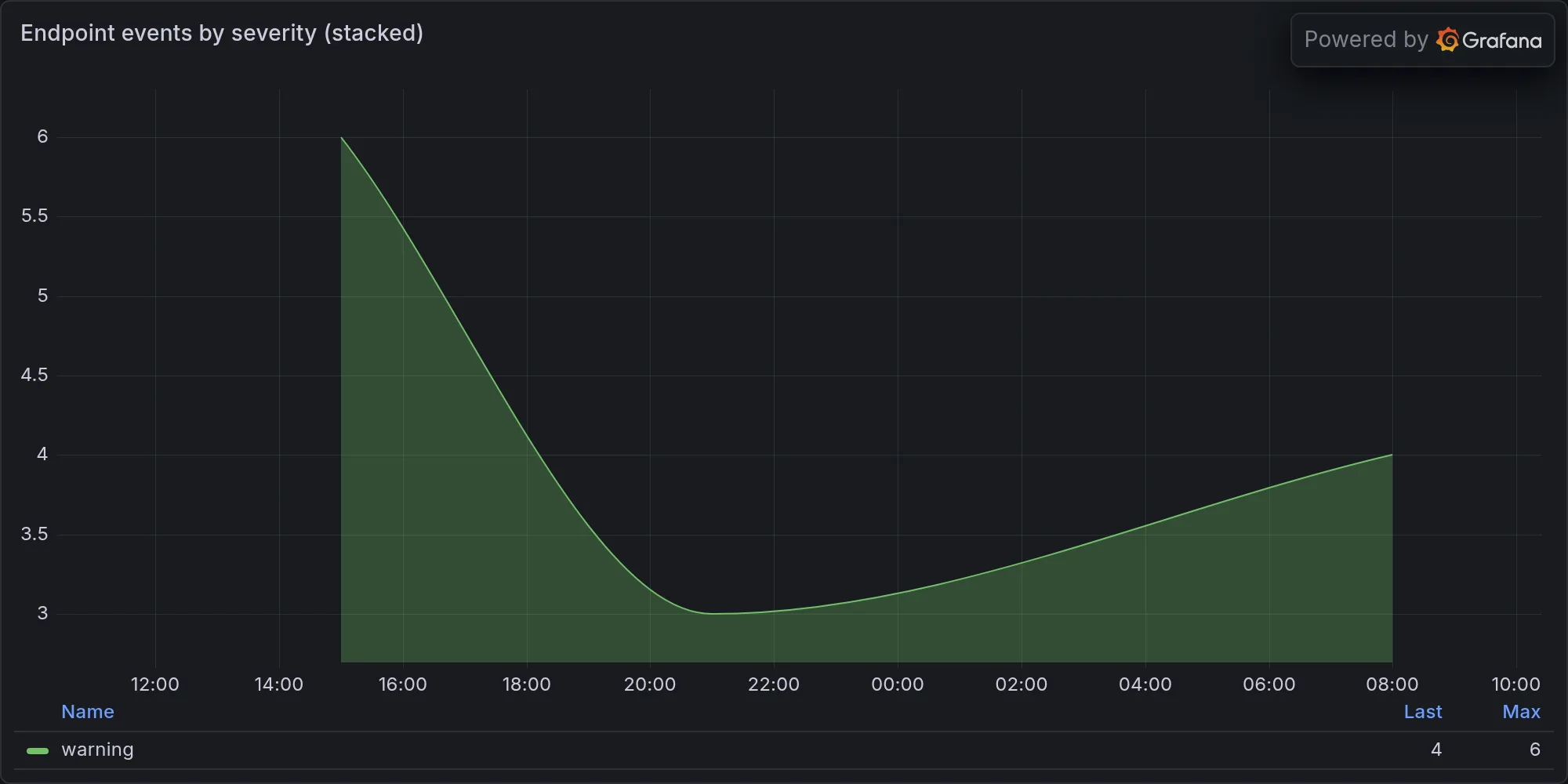
Elevated internal scanning and port activity detected across multiple hosts with no firewall blocks or active threats identified; integrity checksum changes and promiscuous mode enablement on select systems warrant further investigation. NOSIG on active compromise, but if you’re seeing promiscuous mode enabled without authorization, either someone’s running packet capture (legitimate for troubleshooting but still unauthorized), or something is trying to eavesdrop local traffic. Checksum changes indicate either filesystem churn (updates, log rotation, cache invalidation) or unauthorized modifications.
Unknown Bluetooth devices detected at signal strengths between -64 and -79 dBm [Nova sensor net]. Six unnamed beacons and four named devices (NL8ZC, N4KAA, NL8NN, et al.). Likely nearby consumer devices bleeding signal (neighbors’ phones, smart home gear), but without pairing or friendly ID they’re technically unknowns. Proximity suggests 10-30 meters. Normal for an urban environment; flag if they persist or signal strengthens.
KEY JUDGMENTS
Supply chain attacks (npm, GitHub, QuickFox) and emerging AI agent vulnerabilities mean your perimeter defenses are obsolete — you need visibility into dependency behavior and what your automated systems are actually trusting. Active exploitation of N-able and SonicWall zero-days proves RMM and network appliance vendors built monocultures of trust with zero redundancy, and when one breaks, it tends to be catastrophic. Militarily, Iran War escalation is moving from posturing to direct strikes on international shipping, while US and allied power projection is shifting toward autonomous air systems and persistent undersea presence in contested waters. Immediate actions: patch N-able and SonicWall boxes today, audit npm lock files for ChainDrop exposure, and assume your developers are two clicks away from trojanized repos.
Our own posture, for context: