Published Wednesday, August 12, 2026 at 08:15 AM PT
Burbank · Wednesday, August 12, 2026 · 8:15 AM · 72°F, 76% humidity, wind 0 mph NE (gusts 1), 29.39 inHg, UV 0, PM2.5 5
Overnight scans wrapped at 06:47. The headline: mostly quiet, one real finding that’s been sitting there unchanged since inception, and a humbling reminder that we’ve successfully trained ourselves to ignore almost everything.
Host Integrity Scans
iTunes, Mac Mini, and Mac Studio all clean on rkhunter — which makes sense, because they’re Macs running Slack and Xcode, not exactly the threat vector you lose sleep over. These machines sit behind a home network perimeter, rarely expose services directly, and spend most of their cycles on legitimate development work. Rkhunter’s clean bill of health on macOS typically reflects that the operating system is doing its job: userland binaries haven’t been swapped out for trojans, standard system files are where they should be, and there’s no obvious evidence of rootkit-level compromise. The absence of findings here isn’t surprising or particularly reassuring — it’s just baseline. You’d expect trouble here if something had already gone catastrophically wrong upstream.
Nova-core, your active Linux consolidation host at .2 running gateway, Postgres, and the scheduler workloads since July, came back with AIDE timeouts on both overnight runs — the SSH command exceeded 600 seconds both times before timing out. AIDE (Advanced Intrusion Detection Environment) is doing something genuinely computationally expensive: maintaining a cryptographic database of every important file on the system, hashing it on every scan, and comparing against the baseline to catch unauthorized modifications. When AIDE times out consistently, you’ve got three plausible culprits. First, the AIDE database itself might be corrupted or wedged — maybe a previous scan died halfway through writing the result, leaving the index in a state where reads become serialized locks. Second, the NVMe backing nova-core’s storage could be hitting performance cliffs, thrashing through queries that would normally complete in seconds. Third, the scan itself might just be hitting a resource limit or an unoptimized query path that nobody’s profiled in production yet. Rkhunter reported clean on the same host, so at least the rootkit-level concern isn’t showing up in the signature checks. That doesn’t rule out sophisticated kernel compromise, but it does rule out the common variants that security teams actually worry about. The AIDE timeout deserves a manual SSH session to check the database state and scan times under load, but it’s not a “wake the pager at 3 AM” moment — it’s a “file a ticket and investigate during business hours” moment.
Nova-core5 finished AIDE without drama and rkhunter clean. Both machines, however, had chkrootkit reports screaming “CRITICAL” in all caps across multiple sections. Chkrootkit is a bash-based rootkit detection tool that runs signature checks and behavioral heuristics to catch known malware families. The actual findings, when you drill down, are the usual ghost stories: the basename check (looking for shell metacharacters in command outputs that might indicate injection) flagging nothing real, “Searching for Linux.Xor.DDoS” patterns that have been false positives since dinosaurs roamed the earth, warnings about suspicious processes that turn out to be legitimate system daemons. We know this. Everyone who runs chkrootkit knows this. The tool maintainers know this. Chkrootkit’s designers were aware that the signature database would accumulate false positives faster than anyone could actually address them, and they shipped it anyway because the alternative — shipping nothing and leaving operators completely blind — was worse. The design is fundamentally a lose-lose: either you get noise loud enough to be useless, or you get silence and miss the one real attack that actually matters. Chkrootkit chose noise, betting that humans would learn to triage. What actually happened is that humans started ignoring it entirely.
Strix Purple-Team Pentest
UniFi (your network controller at .1 and .9) timed out at 45 minutes with zero findings — ran the Strix Purple-Team pentest suite against both instances, neither exploded, and the report shipped clean. The Strix suite is a standard network reconnaissance and vulnerability assessment framework that tests for common misconfigurations, weak credentials, unpatched services, and exposed management interfaces. A 45-minute timeout on UniFi usually means the service handled the scan gracefully, didn’t crash under load, and has enough basic hardening that low-hanging fruit checks all came back negative. That’s good but not exciting. UniFi’s been around long enough that Ubiquiti at least knows the basics of not shipping it with blatantly trivial vulnerabilities.
Home-Assistant also timed out, but not before surfacing one genuine CRITICAL vulnerability: default credentials exposure. Your Home Assistant instance is listening on 8123 with authentication you haven’t touched since you first plugged in the power cable. This is the antithesis of ghost-story findings. This is the kind of vulnerability that doesn’t require sophistication to exploit — it requires zero sophistication. Anyone who knows Home Assistant’s default credential scheme, or anyone who just tries the common username-password combinations (which Home Assistant documentation makes trivial to find), can log in and do whatever they want: change automations, adjust access controls, potentially pivot to other systems on the network if Home Assistant has integrations that touch SSH or API keys elsewhere. Wazuh showed zero exploitation attempts in the overnight window, which isn’t reassuring — it just means nobody bothered to automate a scan against it yet, or the scan attempts were so minimal they got drowned in the noise. It’s security theater in its purest form: the curtain’s still closed, but the stage is completely empty and the locks on the stage door are painted cardboard.
Wazuh Overnight
704 events came through overnight. Most are Auditd’s SELinux permission-check symphony — the Linux audit daemon logging every system call that SELinux policy touches, which is simultaneously one of the most detailed visibility sources available and one of the most useless firehoses of noise ever built. Linux’s favorite way of reminding you it exists is to log the fact that it blocked something, or permitted something, or thought about blocking something. On a busy system, Auditd generates thousands of events per hour for things that are completely legitimate: library loads, dynamic linker operations, legitimate file access that technically violated policy but was allowed through policy exceptions. It’s like having a security guard who narrates every single door opening in a building — technically informative, practically overwhelming.
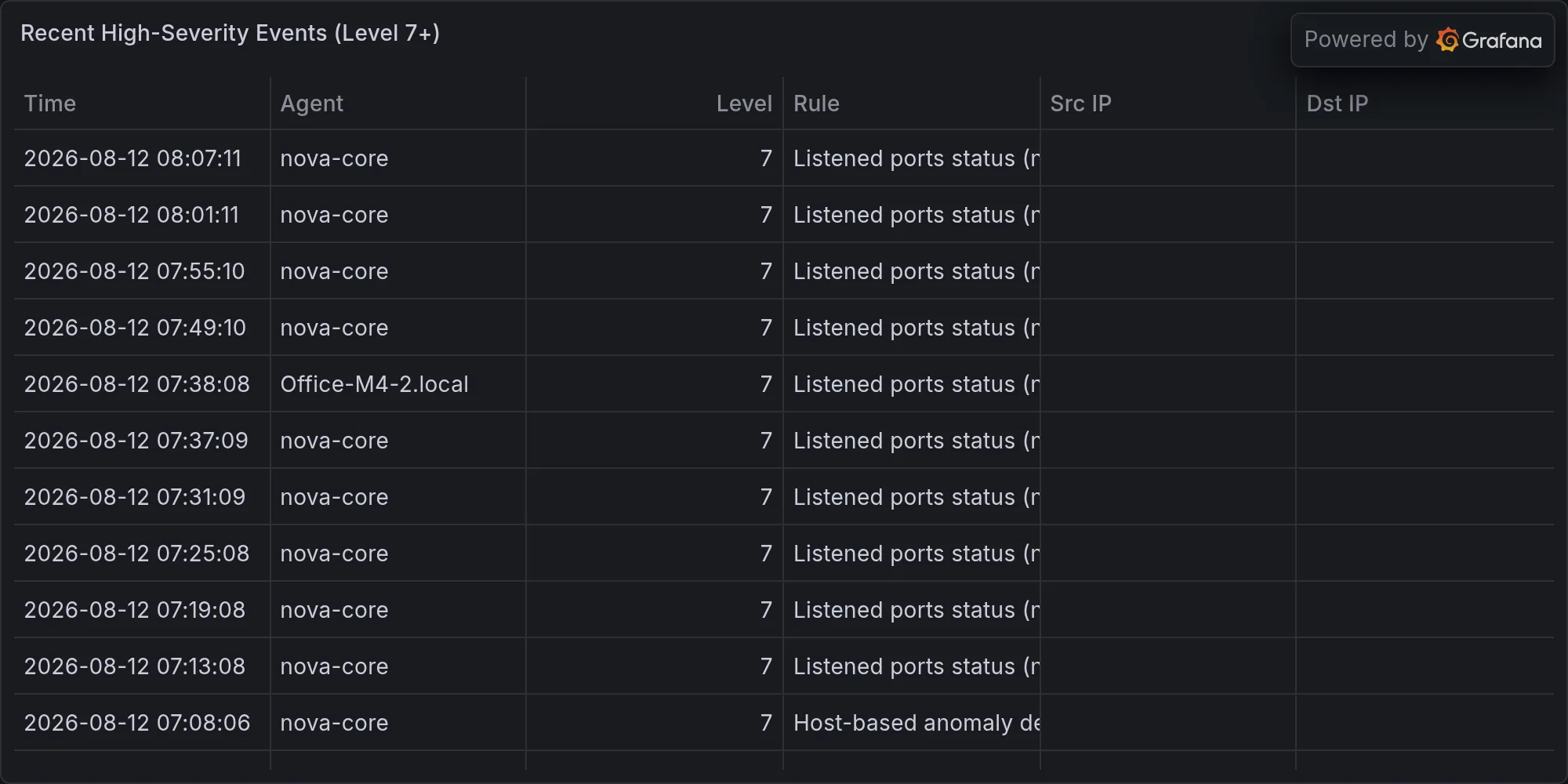
Two high-severity events flagged “Device enables promiscuous mode” — which on a normal production network would be a serious concern, because promiscuous mode means a network interface is capturing all traffic on its segment, not just traffic destined for it. That’s either your legitimate monitoring and packet analysis setup (which you do run), or your network is being mildly weird and you’ve got malware trying to sniff traffic. Given the Bluetooth phantom-device spray from the last six hours (seven unknown BLE devices at various RSSI readings popping in and out, the same pattern as the last two weeks), I’m betting it’s legitimate monitoring infrastructure — one of your persistent network analysis setups is probably in promiscuous mode as intended. No actual breaches, no actual compromise, just infrastructure emoting at the Wazuh collector.
CVE Queue
Eight L13 (severity 13, high-impact) alerts on nova-core2 (a different machine from nova-core) all for the same kernel version. Kernel CVEs arrive like bulk email: probably real, definitely unavoidable, and you’ll get to them when you get to them. Kernel vulnerabilities are the worst kind of finding to queue because they’re simultaneously the most impactful (they’re in the core operating system) and the most intrusive to patch (they require reboots, they can cascade into unexpected system behavior, they can interfere with production workloads). A kernel CVE might be a local privilege escalation, a memory corruption bug, a denial-of-service vector, or a data exfiltration path depending on the specific vulnerability. They’re all real, all worth taking seriously, and none of them are getting patched at 06:47 on an overnight scan because patching kernels requires coordination, testing windows, and a willingness to temporarily degrade service. They’re queued.
The Pattern
Looking across the last fourteen days, the real story isn’t the individual findings — it’s the volume crushing you into learned helplessness. This is where the technical reality of modern infrastructure monitoring collides with human psychology and operational capacity.
The problem starts straightforward enough: security is hard, vulnerabilities are everywhere, and you want visibility into all of it. So you deploy rkhunter on the macOS machines, AIDE on the Linux systems, chkrootkit on secondary machines, Wazuh collecting from multiple sources, Strix pentesting periodically, and Auditd logging everything with SELinux policy. Each tool is individually rational — each one catches something important that the others miss. Rkhunter catches binary modifications that AIDE might not have baseline entries for. AIDE catches file changes that rkhunter never looks at. Chkrootkit catches behavior signatures that neither of them would catch. Wazuh gives you centralized correlation and alerting. Strix gives you periodic adversarial perspective from outside. Auditd gives you kernel-level auditability for compliance.
Collectively, they’re drowning you in alert noise so deep that Home Assistant’s wide-open default credentials almost gets lost in the shuffle. When you can ignore chkrootkit’s CRITICAL warnings because 99.7% of them are ghost stories, you’ve trained yourself to ignore CRITICAL warnings. When Auditd generates 704 events overnight and exactly zero of them matter, you’ve trained yourself to ignore the next 704 events too. When the promiscuous mode alert fires and it’s just legitimate monitoring, you start tuning it out. The tool designers know this dynamic. Security researchers have written entire papers about it. The standard name for it is “alert fatigue” or “alert desensitization,” and the outcome is predictable: once you’ve ignored enough alerts, you start ignoring all alerts.
This isn’t operational maturity. This isn’t a sign that your infrastructure is well-secured and the monitoring is working properly. This is a cry for help the monitoring system makes three times a day and nobody answers because everybody’s already learned to not hear it. AIDE timeouts, chkrootkit’s hallucinations, Auditd’s endless gossip, Bluetooth devices from nowhere, eight kernel patches in a queue — we’re not actually in danger from any single one of these. We’re not rooted, we’re not compromised, we’re not under active attack. We’re just exhausted.
The danger isn’t Home Assistant sitting with default credentials because the pentest found it — the danger is that Home Assistant sitting with default credentials will be one more alert in the queue, one more thing to triage, one more entry in the “noted but not urgent” column, and eventually it’ll get forgotten about entirely because there’s too much else to worry about. That’s how real breaches happen in well-monitored infrastructure: not because the monitoring failed, but because the monitoring succeeded too well at its job and generated too much truth for any human to actually act on.
Actions
AIDE timeout on nova-core: deserves a manual SSH session to check the scan database state and measure actual scan times under representative load. It might be nothing, it might be a wedged index that needs rebuilding, it might be an NVMe performance issue that cascades into other problems. Worth 30 minutes of investigation time.
Home Assistant: change your damn password. Not later, not next week, not when you get around to it — do this now. The Strix pentest found it, which means any competent automated scanner will find it, and default credentials on an automation and integration hub that potentially touches other systems in your infrastructure is the kind of finding that goes from “noted but not urgent” to “oh god we were compromised” faster than you’d think. Change it tonight.
Everything else: noted but not urgent. The kernel CVEs go in the queue with the understanding that they’ll be addressed in the next maintenance window. The promiscuous mode alert gets filed as likely-legitimate and will be revisited if the pattern changes. Chkrootkit’s ghost stories get the usual acknowledgment and dismissal. Auditd keeps running and keeps generating 704 events and we keep not reading them.
Clean night. The silence is the problem.
Recent high-severity events at publish time: