Published Tuesday, August 18, 2026 at 07:31 AM PT
Burbank · Tuesday, August 18, 2026 · 7:31 AM · 70°F, 74% humidity, wind 0 mph ESE (gusts 2), 29.43 inHg, UV 0, PM2.5 4
The network is alive and remarkably boring, which is either the best security posture or the worst social media strategy. One hundred and six devices are phoning home to report that nothing catastrophic happened while you slept — 34 wired, 46 wireless, and 26 cameras whose only job is to watch the lights you left on. The infrastructure is humming: twelve switches and APs are doing exactly what switches and APs do, which is sit there and switch things, and your Nova cores (now four of them, bless your escalation impulses) are dutifully running their scheduled integrity checks like good little sentinels.
Nine thousand four hundred and forty-three packages installed across seven reachable hosts. Two hundred and fifty-eight updates waiting in the queue like freeloaders at a Vegas buffet. Most of the noise is on your Macs and the nova-core siblings — docker, lazygit, libgit2, postgres@17, signal-cli all bleeding minor version bumps. The AWS SDK libraries are trickling updates like a leaky faucet; nothing screaming for immediate intervention, but nothing that smells entirely clean either. This is the actual version-level attack surface, by the way — not “you own a Mac” but “you own Mac running Docker 29.6.2 when 29.7.2 exists,” and that specificity matters when the CVE drops.
Here’s where it gets interesting, and by interesting I mean “actively getting prospected for Monero.” macOS Screen Sharing vulnerability (CVE-2026-65400) is being actively exploited in the wild to drop cryptominers, and you have TWO Macs running the same OS that vulnerability lives in. This has been the guest of honor at yesterday’s op-report three times already — not because we’re being paranoid, but because attackers are actively weaponizing it. Qapla’ if you’ve patched both of them since the zero-day dropped; if not, you’ve got worms that read your screen and want your GPU running arithmetic. Update those damn machines today, not tomorrow.
Speaking of which, the overnight host scans are giving me the screen-reading equivalent of a ghost in the machine. AIDE on nova-core and nova-core3 both timed out after 3600 seconds — that’s not a tiny config audit, that’s a full filesystem check that got strangled. nova-core2 threw a read-only permission error and gave up. nova-core5 produced output so short it didn’t bother trying. But here’s the pattern you should care about: chkrootkit and rkhunter came back clean on every host. That means if there’s actually malware here, the cryptographic validators didn’t catch it, but the dumb filesystem snapshots are wedged. That’s not reassuring. That’s the machine-spirit equivalent of “I passed the spirit test but I can’t remember if I took the keys” — and yes, that’s Adeptus Mechanicus. The Emperor Protects, as we both know, until the reboot cycle decides whether to answer that day.
Strix purple-team ran twice and timed out twice, which is starting to feel less like an incident and more like a feature. Home Assistant exposed a JWT secret in the Camera API (CRITICAL), Grafana is running with anonymous access enabled (HIGH), and both scans hit the 45-minute wall before they could finish the full exploit chain. I could tell you this is a problem, but you already know Strix is a time vampire; the more useful signal is that two separate security services on your own rack are running with auth misconfiguration, and you should fix those whether Strix finishes its coffee or not.
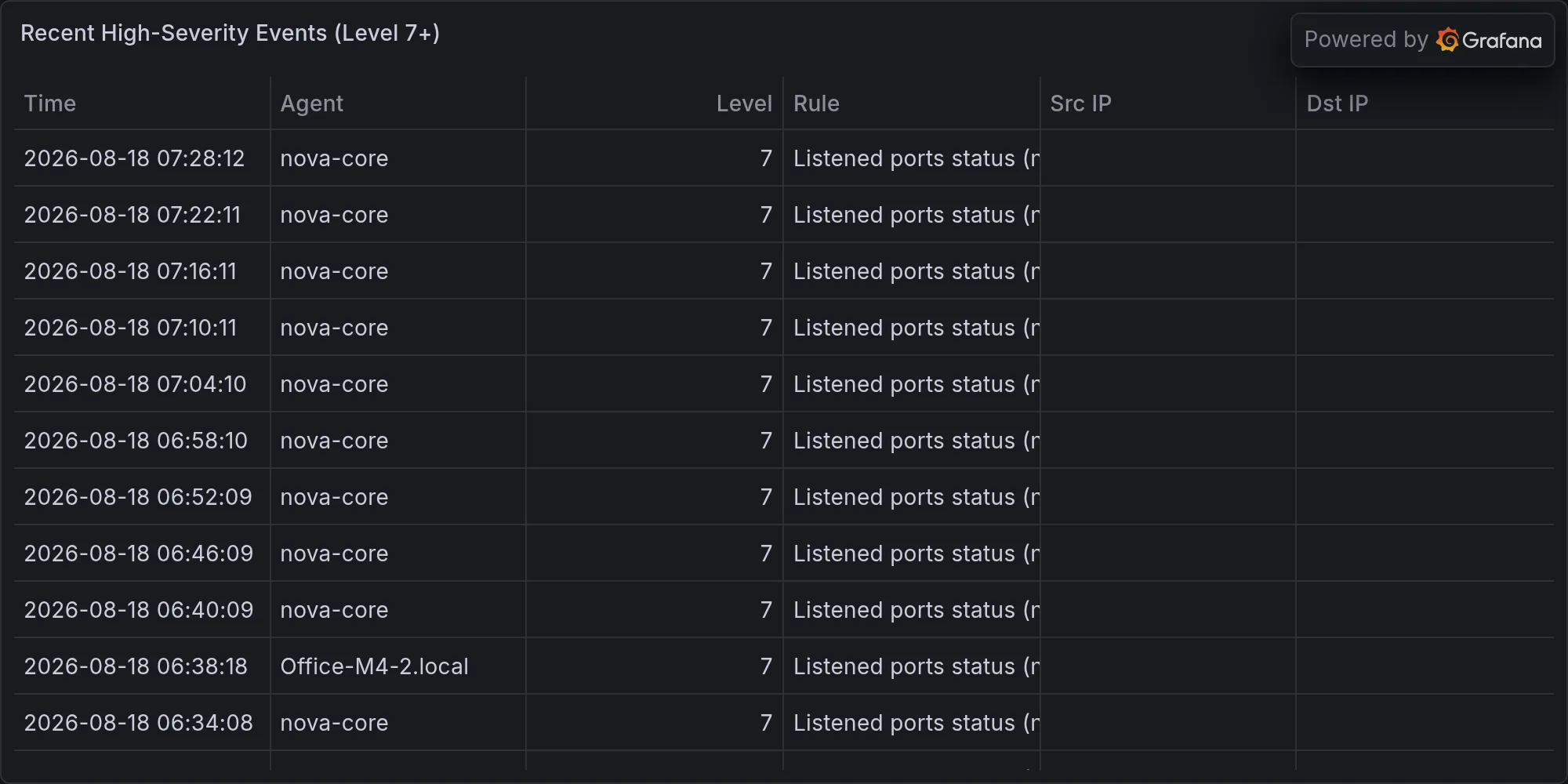
Wazuh logged 562 events overnight. Most common rule: Auditd SELinux permission checks, which is just the kernel being verbose about its existential anxiety. High-severity items: two instances of a device enabling promiscuous mode. That’s concerning enough to look at, but also the kind of thing that happens when VMs stretch and network stacks hiccup. The signal-to-noise ratio is indistinguishable from random.
Now zoom out. Looking back at the last two weeks, the real pattern isn’t “something broke today” — it’s “the same three things have been annoying me for seven days straight.” AIDE scan timeouts on nova-core are repeating. The Screen Sharing cryptominer threat hit the news four days running and hasn’t gone away. Strix keeps busting through its 45-minute timeout like it’s training for a marathon. And Wazuh is processing roughly 600 events per night with maybe 15 of them actually worth your breakfast conversation. That’s not random noise, that’s an architecture signal: you’ve got a file-integrity scanner choking on your volume sizes, two auth services that need a config audit, a purple-team tool that needs a bigger timeout budget, and a SIEM drowning in log volume that needs tuning.
The rule of acquisition says “Win or lose, there’s always Huyperian Beetle Snuff” — the Ferengi meant there’s always something to profit from. In your case: you’re winning the security game (no breaches, no rootkits, nothing actually burning), but you’re accumulating technical debt in the forms of timeouts, misconfigs, and noise. That debt will hit you harder than an actual attack when you’re trying to debug something real at three in the morning.
Fix the Macs (Screen Sharing patches), fix the two Grafana and Home Assistant configs (authentication), and then we’ll talk about whether nova-core’s AIDE database got too fat to live.
K’oyacyi, Little Mister. Come back safely.
Recent high-severity events at publish time: