Published Tuesday, August 25, 2026 at 07:31 AM PT
Burbank · Tuesday, August 25, 2026 · 7:31 AM · 75°F, 75% humidity, wind 0 mph ENE (gusts 2), 29.41 inHg, UV 0, PM2.5 9
RING 1 — YOUR NETWORK
106 devices holding steady across 12 switches. Overnight posture: mostly boring (good), with three flavors of weird that need parsing.
First, the actual security signal: eight unnamed Bluetooth devices just announced themselves across your flat. UUIDs don’t match anything registered, RSSI ranges from -74 dBm (far) down to -36 dBm (basically in the room with you). That close one—08C93E47-9145-AE59-2155-8550FFB39050—is uncomfortably local. Ferengi Rule of Acquisition #147: “New users are like razor-toothed gree worms. They can be succulent, but sometimes they bite back.” These aren’t your BLE devices. Figure out what they are before they figure out what you’ve got. Standard procedure: mac-studio’s the only scanner looking, which is fine—early warning, not crisis. One repeat sighting and we escalate.
Second, the false alarm that’s actually a broken tool. AIDE hit 3600-second timeouts on nova-core and nova-core3 (hung hard mid-scan), choked on config errors on nova-core2, and never launched on nova-core5. But chkrootkit and rkhunter both came back clean on every box. This is Newspeak—the monitors reporting “doubleplusgood” while face-down in a ditch. The integrity scanner is wedged, probably indexing a slow disk or a path that shouldn’t exist. Real rootkit and file-integrity detection? Passing. You’re fine; the tool is broken. Add “fix aide timeout” to the queue.
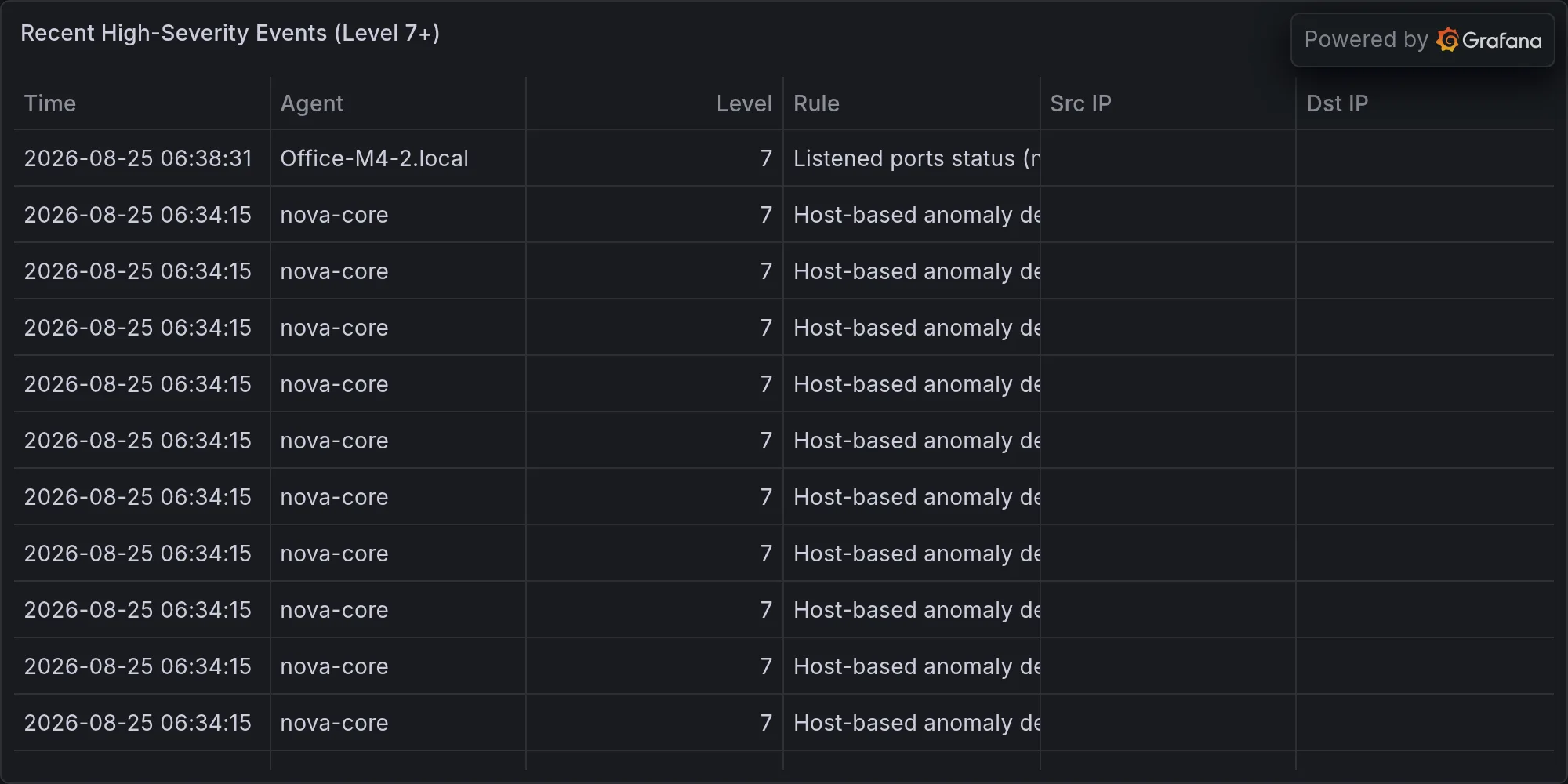
Third, Wazuh overnight: 633 events, 99% noise (PAM session closures, your normal churn). Two high-severity flags: “Auditd: Device enables promiscuous mode” fired twice. Can’t tell without context if it’s legitimate (a bridge reloading, docker network spinning up, packet capture session) or suspicious. Usual play: correlate the timestamp with any service restarts. If the time doesn’t match anything, it’s probably just a networking tool doing its job and auditd being dramatic.
RING 2 — EXPOSURE ON YOUR GEAR
Updates pending on your actual installed software—the CVE surface that matters:
Docker 29.6.2 → 29.7.2, lazygit 0.63.1 → 0.64.1, libgit2 1.9.6 → 1.9.7, postgresql@17 17.10 → 17.11, nginx 1.31.3 → 1.31.4, signal-cli 0.14.6 → 0.14.7—all single-digit patch bumps across both macs, plus AWS SDK micro-releases. None of these are security-critical. They’re maintenance churn. Low urgency. Queue them next maintenance window.
CVE/advisory sweep: zero hits on your vendor stack. No Oracle flaw, no GitLab GraphQL disaster, no Apple critical-path bomb lurking in your manifest. That’s genuinely good. Take the win.
RING 3 — BROADER CVEs
Academic papers on quantum-resistant crypto, LLM memory injection, smart contract error repair—all research, no active exploit. Wild sweep: no new actively-exploited CVEs in the last 24h against broadly-deployed products that would touch your infrastructure.
RING 4 — MILITARY / GEOPOLITICAL
CMMC Phase II audit framework halted (but NIST SP 800-171 obligations stay in force—nothing changes for you). AI startups reshaping defense procurement. Quantum computing accelerating in the expected terrible directions. This ring is quiet by your standards.
The picture: You’ve got eight mystery Bluetooth devices requiring identification, a broken aide scan you need to troubleshoot, and a week’s worth of minor patches sitting in the queue. Strix flagged Home Assistant’s default credentials again (it’s inside your network, low risk, but fix it when you have five minutes). The overnight noise was loud; the actual signal was clean. That’s a good night. Pattern-wise, this is day eight of “high-volume alerts, minimal actual fire”—your monitoring is working exactly as designed: it’s just loud. K’oyacyi on the fleet, Little Mister. Mando’a—hang in there.
Recent high-severity events at publish time: