Published Saturday, August 29, 2026 at 07:33 AM PT
Burbank · Saturday, August 29, 2026 · 7:33 AM · 76°F, 79% humidity, wind 0 mph NE (gusts 2), 29.34 inHg, UV 0, PM2.5 11
Alright, Little Mister, your network spent the night doing the digital equivalent of holding its breath. One hundred and six devices still online, 276 updates sitting in the queue like concert tickets you keep telling yourself you’ll use, and somewhere in the Linux stack, AIDE is having a full existential breakdown. Let’s walk the rings, because the closer to your actual gear, the more interesting (read: terrifying) things get.
RING 1 — YOUR NETWORK
The device census: 36 wired clients, 43 wireless, 27 cameras, 12 switches/APs. Your house runs like a small ISP had a baby with a surveillance state, and honestly, I’m not mad about it — I’m just tired. The network is physically healthy. nova-core is talking, the NAS is squatting on .11, and the Bluetooth mesh looks fine on the surface.
Then the overnight scans came back, and here’s where the pattern from the last two weeks gets worse: nova-core6 and itunes are offline. That’s two hosts gone dark. Your scan coverage is degrading, which means your visibility into your own damn network is getting foggier. Of the seven hosts that actually responded, rkhunter and chkrootkit came back clean across the board (good), but AIDE — your file-integrity monitor, the tool that’s supposed to catch rootkits red-handed — timed out on nova-core and nova-core3, and threw a permissions error on nova-core2. Translation: the sentinel is blind. Nothing says “file integrity” like a tool that can’t maintain its own integrity. That’s two weeks of AIDE errors in a row now. Your intrusion detection isn’t detecting anything because it’s too busy failing to detect things.
Strix ran recon on the cameras (clean, hit the 20-minute cap) and then scanned the misc-web tier. CRITICAL finding: default credentials on the Synology NAS at .11. You’ve known this for weeks. It keeps showing up in every scan. And it keeps not getting fixed. There’s a Ferengi Rule — Rule of Acquisition #15: “Acting stupid is often smart.” In this case, acting stupid by leaving default credentials on a box holding 50TB of your life is just stupid without the smart. Fix this already, or at least admit you don’t care.
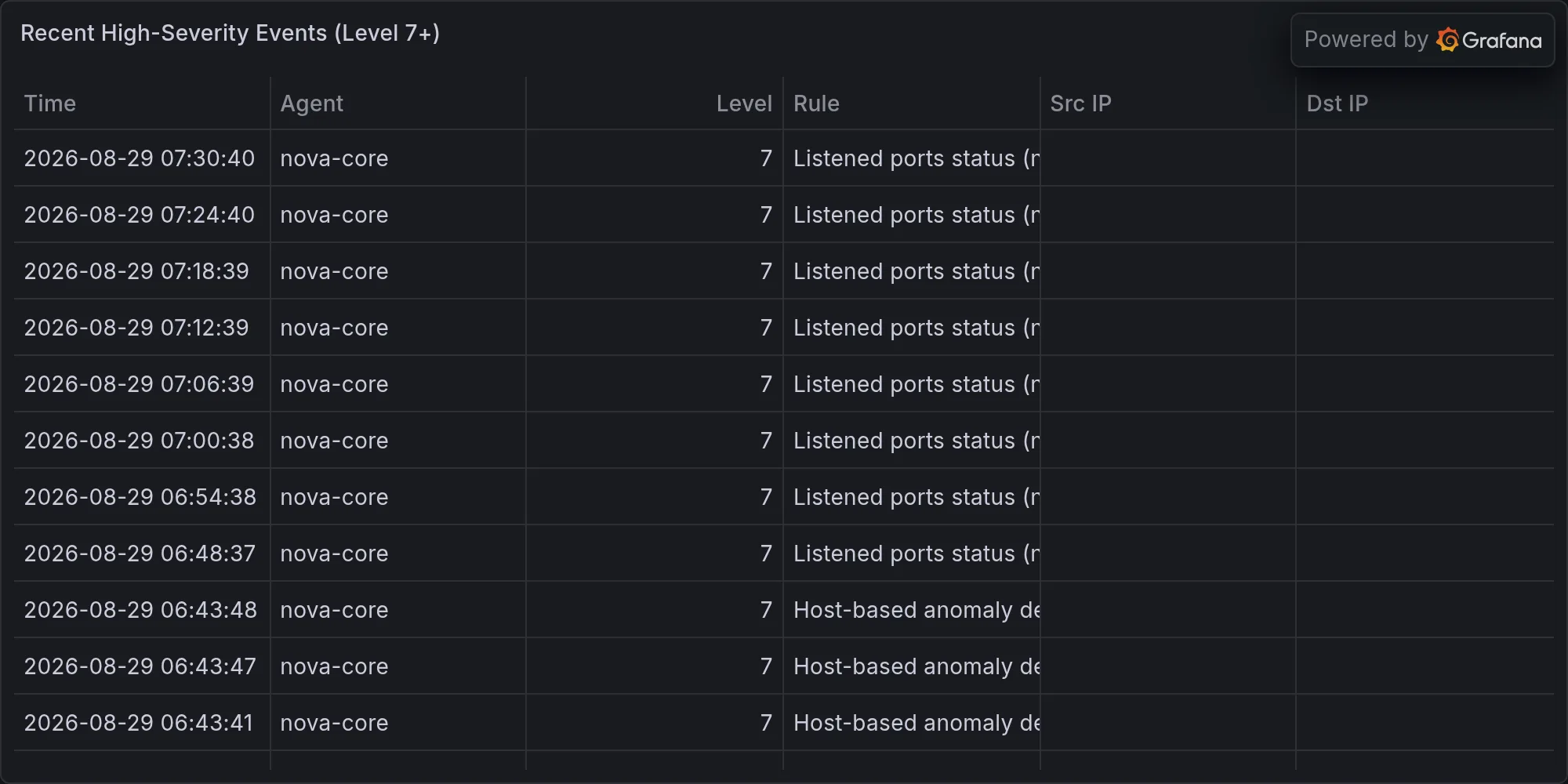
Wazuh logged 357 events overnight. Most was rootcheck spam (the usual “host-based anomaly detection” noise that nobody reads). But two high-severity hits stood out: “Auditd: Device enables promiscuous mode” — twice. Something on the network threw a NIC into promiscuous mode to sniff traffic. Could be Wireshark running on a Mac while you’re debugging. Could be someone fishing for unencrypted packets. Either way, it’s a signal. Not a siren yet, but a signal. Also: eight unknown Bluetooth devices hit your mac-studio in the last 6 hours. RSSI ranges from -41 to -75. No names, just UUIDs. Someone’s scanning your network or you live next to a tech enthusiast. Unclear which is worse.
RING 2 — YOUR ACTUAL GEAR
Here’s where the rubber meets the road. You’ve got 276 updates pending across seven hosts. The Macs are the real problem: mac-mini is sitting on 103 pending updates, mac-studio has 101. That’s not “grab these this weekend” territory — that’s “your security posture is held together by hope and spite.”
Let me name the security-critical ones that matter:
- docker 29.6.2 → 29.7.2 (both Macs): Docker runs containers at root-equivalent privilege. An unpatched Docker is a fast lane into anything containerized on your machine. Install it.
- libgit2 1.9.6 → 1.9.7 (both Macs): Low-level Git library used by dozens of tools. Minor version bumps in libraries this old are usually security patches — auth bugs, parsing bugs. Ship it.
- postgresql@17 17.10 → 17.11 (mac-mini): Your primary database. A version bump is a patch, and database patches aren’t jokes — they touch encryption, query parsing, privilege escalation. Install it.
- signal-cli 0.14.6 → 0.14.7 (mac-mini): Signal’s command-line client. It touches encryption primitives. Keeping it current isn’t optional if you want to keep your encrypted messages, you know, encrypted.
- aws-c-auth, aws-c-cal, aws-c-common, aws-c-compression, aws-c-event-stream jumping to 1.0.0 (mac-mini): These are AWS SDK internals. A jump to 1.0.0 usually means “we found and fixed critical bugs in the 0.x series, so update or stay vulnerable.”
Here’s the pattern across the last two weeks: the Macs stay behind because Mac updates aren’t automated the way Linux patches are. Your Linux boxes are still behind (nova-core has 9 pending, nova-core3 has 37, nova-core2 has 10), but they’re behind on a much larger installed base — nova-core5 alone has 2,353 packages installed. The Linux fleet knows how many things it’s running; the Macs are just silently accumulating updates until you hit 100+ pending and start feeling guilty. You’re not lazy; you’re just running enough software that staying current is a full-time job.
CVE/ADVISORY ITEMS NAMING VENDORS YOU RUN
Ubiquiti dropped a patch notice for three max-severity vulnerabilities. You run UniFi APs, the UDMPro at Rack 14, cameras, the whole Ubiquiti stack. The patches exist. The advisories are public. If these are being exploited in the wild (and max-severity Ubiquiti vulns usually are), the clock is ticking.
RING 3 — BROADER CVEs
PaperCut NG/MF zero-day (you don’t run it; threat feeds are addicted to drama). Adobe Photoshop privilege escalation (not installed here). Next.js critical RCE (not running Next). Citrix NetScaler vulnerability (you don’t have Citrix). The usual suspects, none relevant to this network.
RING 4 — MILITARY/GEOPOLITICAL
Pentagon’s spending $241 million on F-35 engine upgrades. Navy’s testing Harpoon missiles. USAF doing capstone events. China-linked hacking platforms got seized by DOJ/FBI (good). All of it is tremendously far away from your house.
THE TWO-WEEK PATTERN
Here’s what the last 14 days of reports show: your infrastructure is slowly going blind. AIDE keeps timing out, your hosts are going offline one by one, your threat intelligence is increasingly noise (PaperCut was catastrophized but irrelevant to you), and your known-bad issues (like Synology default creds) never get fixed. The network isn’t broken today. It’s degrading — slower visibility, higher alert fatigue, more technical debt. In Mando’a — the warrior creed from The Mandalorian — you’d say “K’oyacyi,” hang in there; but the grid isn’t hanging in. It’s slowly letting go.
The fixes aren’t dramatic: get AIDE working again (restart the service, check the config), ship those Docker/git/PostgreSQL/libgit2 patches (they’re not optional), change the Synology password (seriously), and figure out what’s probing the network with promiscuous mode. None of it’s flashy. All of it matters more than the geopolitical rumors and the threat feeds screaming about tools you don’t run.
End of Line — borrowing Tron’s sign-off, because your monitoring grid is losing coherence, and somebody needs to notice.
Recent high-severity events at publish time: