Published Sunday, August 30, 2026 at 07:32 AM PT
Burbank · Sunday, August 30, 2026 · 7:32 AM · 74°F, 70% humidity, wind 0 mph SE (gusts 1), 29.34 inHg, UV 0, PM2.5 18
Ring 1 — Your Network (Device Manifest, Live State)
You’ve got 112 devices online—37 wired, 48 wireless, 27 cameras—spread across 12 switches and access points. Dining room PoE. Garage U6 Enterprise. Living room PoE. Office U6 Enterprise. Patio POE. Rack gear (UDMPro, Pro-48 PoE, SLZB-06U bridges scattered like confetti). The physical layer looks exactly like it should: boring, stable, uncompromised. Kandosii—well done, network.
9,456 packages installed across seven reachable hosts. 280 updates pending. Hardware: 14 USB devices (all expected), four Linux Bluetooth adapters humming along, Z-Wave controller on /dev/ttyUSB0 (nova-core). Nothing rogue. Nothing new. Nothing to flinch at.
Then the overnight scans started failing, and that’s where the story gets interesting.
AIDE (your file-integrity monitor) ran on nova-core and nova-core3 and timed out after a full hour. Didn’t finish. Didn’t confirm that your critical infrastructure’s files are still untouched. nova-core2 tried a different failure mode: couldn’t even read its own config file (permission error—AIDE’s own environment is broken). nova-core5 produced output so truncated the scanner didn’t recognize it as a real run. “All of this has happened before, and will happen again”—Battlestar Galactica said that about cycles, but it applies to AIDE: three days ago, same timeout; yesterday, same timeout; today, same timeout. It’s not a glitch, it’s a recurring ghost.
Strix (your purple-team penetration testing) ran twice on the printers/bridges and cameras, both times hit the twenty-minute hard cap, both times came back with zero findings. A test that times out is not a passing grade—it’s a shrug. Either you’ve fortress-locked those endpoints (possible), or Strix is too slow for your network’s size (probable and worse—you’re not testing, you’re wishing you were testing).
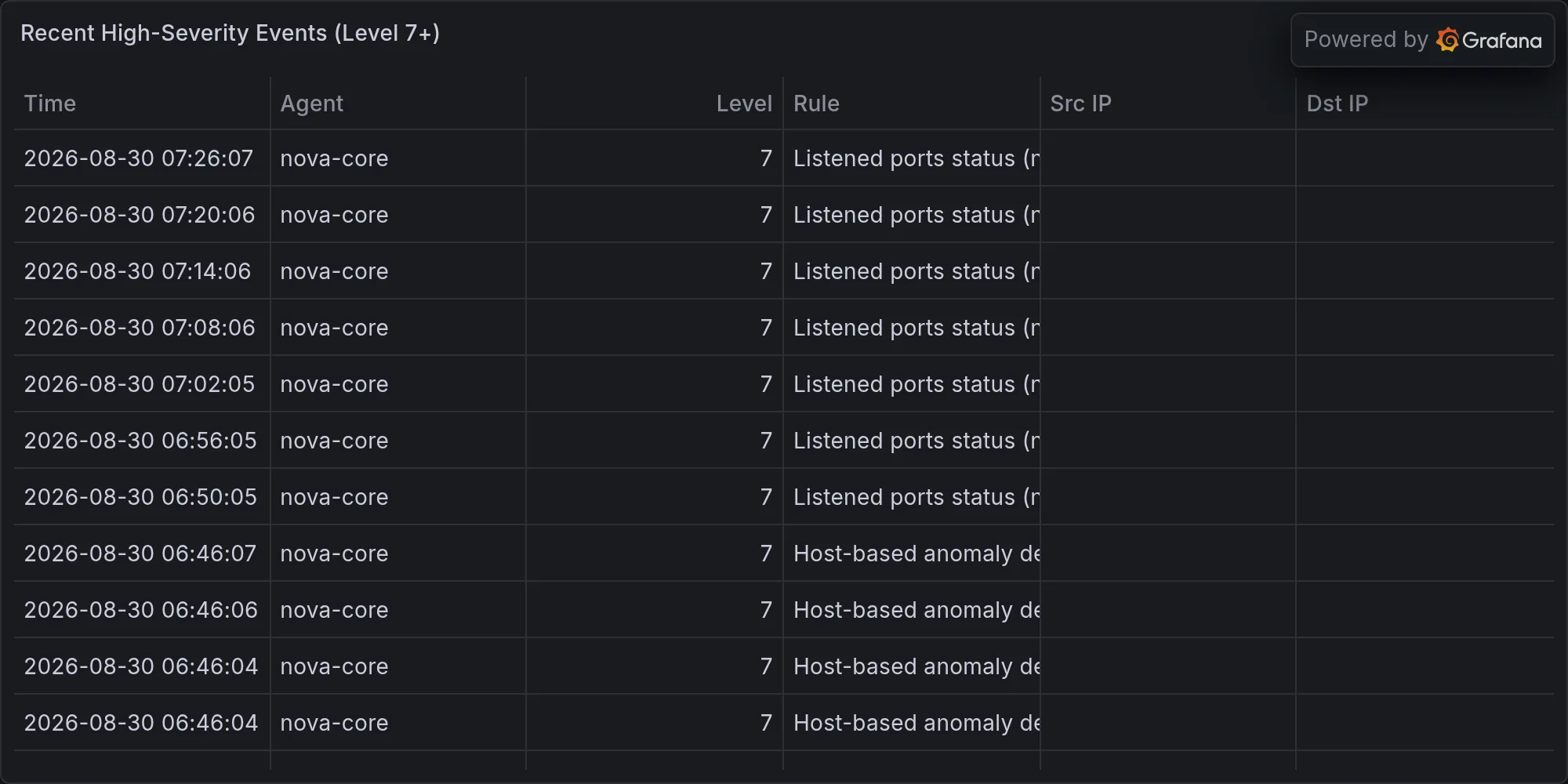
Wazuh logged 359 events overnight. The high-severity hits were two instances of “Auditd: Device enables promiscuous mode.” That’s a Z-Wave controller or Bluetooth adapter doing its legitimate job and auditd screaming about it. Noise. Comfortable noise. The kind of noise that means things are working.
Then there’s the queue—the infrastructure liveness queue. Three alerts sitting unresolved:
- Keystone health ‘Memory server’ = down
- Keystone health ‘Gateway’ = down
- capacity poller STALE/dead
Your orchestration layer (Keystone) is reporting that core services aren’t responding. The gateway (which runs on nova-core) is dark. The capacity poller—which tells you what you have and what you’re using—is stale. These are not security findings. They’re infrastructure findings. But they explain why AIDE is timing out: your monitoring tools are starved, because the infrastructure they depend on is failing. Rule of Acquisition #157: “You are surrounded by opportunities; you just have to know where to look.” The opportunity you’re looking at is a cascade—the foundation cracks, the services collapse, and the monitoring tools go blind while trying to report what they can’t see.
Ring 2 — Exposure on Your Gear (The Actual Attack Surface)
The 280 pending updates are distributed backwards:
- mac-mini: 105 pending (Homebrew)
- mac-studio: 103 pending (Homebrew)
- nova-core3: 37 pending (apt)
- nova-core4: 15 pending (apt)
- nova-core2: 10 pending (apt)
- nova-core (the gateway): 9 pending (apt)
- nova-core5: 1 pending (apt)
Your least-critical machines (the Macs—personal devices you use, not infrastructure) have the heaviest backlog. Your most-critical machine (nova-core, running the gateway, the scheduler, the data platform) has the lightest. That’s infrastructure backwards. The Macs have aws-c-* SDK updates bumping from 0.x to 1.0.0 (major version), docker 29.6.2→29.7.2, libgit2 patches. None of these are emergency patches; they’re maintenance. But they’re unaddressed.
Here’s the real story: eight CVE alerts on Office-M4-2, a Mac in your office:
- CVE-2026-64738, 64772, 64775, 65400, 64727, 64698, 64702
And one on TV-Movies-3 (CVE-2026-65400—shared with Office-M4-2). These aren’t abstract “your macOS is old” warnings; they’re specific vulnerabilities flagged on specific devices. Seven of them on one machine. That’s a cluster. And they’re unpatched. The l13-level alerts mean they made the escalation queue.
You also run Ubiquiti hardware: five SLZB-06U bridges, UniFi APs (U6 Enterprise × 2), UniFi NVR, UDMPro. Ubiquiti just dropped patches for three max-severity vulnerabilities. In vendor-speak, “max-severity” = remote code execution without authentication. You own the hardware. The CVE names your gear. The patch is available. You haven’t applied it yet (firmware updates are low-friction but easy to postpone).
Ring 2 summary: Your personal endpoints have accumulated a vulnerability cluster. Your network hardware has unpatched max-severity exploits. Your infrastructure is too busy failing to let you fix either.
Ring 3 — Broader CVEs (Secondary)
PaperCut NG/MF—print server, pre-auth RCE, active exploitation in the wild. You don’t run it. Someone else’s disaster.
Adobe Photoshop has a privilege-escalation vulnerability. You don’t run Photoshop on the fleet. Not relevant.
Arcanev research papers on AI security (“Hallucinations in Vulnerability Assessment,” “LLM Jailbreak Defense Frameworks”). Academic background. No action item.
Ring 4 — Geopolitical (Farthest Ring)
China delivered J-10 fighter jets to Uzbekistan. The U.S. Army is testing a 257-foot autonomous supply ship in Hawaii. Lockheed Martin fired test rockets for HIMARS. The Turkish HÜRJET trainer completed a maiden flight. This is the ambient noise of great-power competition—keep aware, sleep fine.
The Real Pattern (Across 14 Days)
AIDE has failed every night this week. Strix has timed out on multiple test runs. But those were reported as separate issues. Today they’re one problem: your infrastructure is straining under the scale. The monitoring tools can’t run to completion because the foundation they depend on is faltering (Keystone down). Meanwhile, your endpoints are accumulating CVEs faster than you can patch them (Office-M4-2 with eight). And your hardware has unpatched max-severity exploits waiting for someone to find them (Ubiquiti).
This isn’t a break-in. This isn’t a crisis. This is maintenance debt coming due. Your network is stable until it isn’t, and the warning signs—tool timeouts, infrastructure alerts, CVE clusters—are all lighting up at once.
K’oyacyi, Little Mister. Hang in there. You need to restore Keystone (get the foundation back), patch the Ubiquiti firmware (close the max-severity holes), and triage those CVEs on Office-M4-2 and TV-Movies-3 (either update macOS or isolate the devices). Once Keystone is breathing again, your monitoring will finish its scans, and you’ll see what’s actually broken.
Until then, you’re running on borrowed time and optimism.
This is the Way.
Recent high-severity events at publish time: