Published Tuesday, September 01, 2026 at 07:33 AM PT
Burbank · Tuesday, September 1, 2026 · 7:33 AM · 63°F, 87% humidity, wind 0 mph E (gusts 1), 29.41 inHg, UV 0, PM2.5 5
The fleet is online and angry about updates, which is the closest thing to “normal” this network has experienced in the last two weeks. Let me start with what’s actually in your house, because that’s where the real story lives.
Ring 1 — Your Network (The Immediate Neighborhood)
You’re running 108 devices across 12 switches and APs — 36 wired, 45 wireless, 27 cameras doing their best impression of not catching anything. Nothing new crawled in overnight; the BLE scanning picked up a few mystery devices at the edge of range again (RSSI values suggesting they’re outside the Burbank perimeter, thank Christ), but this is ambient noise, not an infiltration. The infrastructure layer is holding. Your Synology NAS, the nova-core fleet, and the SLZB-06U Z-Wave controllers are all reporting in like clockwork.
The software layer, though—that’s where the pile lives. You’ve got 9,456 packages installed across 7 reachable hosts, and 388 updates are sitting in the queue like dishes that decided yesterday was a good day to start judging you. Per host: mac-mini is carrying 108 pending, mac-studio 106, nova-core3 67, nova-core2 47, nova-core 44, nova-core4 15, nova-core5 just 1 (which tells me nova-core5 hasn’t been touched since last month, but we’ll circle back). That’s not catastrophic—it’s just work—but it’s work that compounds. There’s a word for a system that reports everything is fine while carrying unpaid infrastructure debt: Newspeak calls it “doubleplusgood,” Orwell’s sarcastic shorthand for a lie that sticks because the vocabulary to say otherwise got murdered. Your update queue is speaking it fluently.
Now for the midnight audit. Here’s where it gets ridiculous: AIDE—the file-integrity checker—timed out on nova-core and nova-core3 both hitting the 3600-second wall. That’s a full hour of “I’M STILL LOOKING” before it gave up. nova-core2 spit back a different flavor of despair: read-only error on the aide.conf file itself, which means your AIDE config isn’t writable and it can’t proceed. nova-core5 returned output so short it didn’t bother pretending it ran. Meanwhile, chkrootkit and rkhunter came back clean across the board—no rootkits, no suspicious kernel modules, no hidden processes. The rootkit hunters sang their tune and went home, but the file-integrity checker had a breakdown mid-sentence. This is an infrastructure problem, not a security problem, but it’s still a problem: your fleet’s ability to notice when someone rewrites system binaries is currently hobbling itself with timeouts. That’s the kind of thing you fix this week, not next month.
Strix, the purple-teamer, tried to blow up your Home Assistant instance (192.168.1.6:8123) and discovered the gift that keeps on giving: default admin credentials still active. This is flagged CRITICAL in the report, and rightfully so—the Ferengi had it backwards when they said “A madman with Latinum means profit without return”—they meant your adversary doesn’t need to pay you anything to extract value when you’ve left the front door open and the keys in the ignition. Home Assistant + default creds = someone can pivot your whole automation ecosystem for free. The good news: Strix timed out before it could demonstrate the full extent of damage. The bad news: it found the vulnerability before timing out, and nobody’s fixed it yet. The Grafana pentest ran clean with no findings, so at least there’s one service acting like it received a memo about authentication.
Wazuh logged 905 events overnight. Most are Dpkg half-configured noise (systemd package management in its awkward adolescence), but there are 2 high-severity alerts about promiscuous mode being enabled on a network interface. This is probably just your UniFi gear doing what UniFi gear does—tapping the wire to see everything, which is its job—but it’s also exactly what an attacker would enable to sniff traffic. I’m flagging it not because I think you’re compromised, but because the signal-to-noise ratio here favors “probably not”—and “probably” isn’t the same as “definitely.”
Ring 2 — Exposure on Your Gear (Where You Actually Live)
Let’s talk about what you own that’s actually exposed. Docker on both Macs is sitting at 29.6.2 and needs 29.7.2. OpenSSL@3 on mac-mini is at 3.6.3 with 3.6.4 waiting. PostgreSQL@17 is three minor versions behind. Lazygit, libgit2, signal-cli all have updates. On the AWS side, a whole family of SDK libraries got major-version bumped (aws-c-auth, aws-c-cal, aws-c-common, aws-c-compression, aws-c-event-stream all jumped from 0.x to 1.0.0), which is usually not a security thing—major version bumps are architectural rehauls, not fixes—but they’re sitting in your queue and represent version drift. None of this is actively exploitable right now, but unpatchedness is a form of probability: enough time passes and one of those is going to get nailed by a CVE that matches your exact version number.
Here’s the more immediate problem: your queue has 7 active L13 alerts on Office-M4-2.local pointing to macOS CVEs—specifically 2026-64772, 2026-64738, 2026-64775, 2026-65400, 2026-64727, 2026-64698, and 2026-64702. That’s one of your actual Macs with real vulnerabilities waiting to be patched. Your TV-Movies machine caught the same 2026-65400. These are named CVEs on your hardware, not theoretical stuff in someone else’s cloud. That’s the concrete version of “exposure”—not a general category, but a specific list of ways someone could wreck your gear today. The good news: nobody’s actively exploiting these in the wild (yet). The bad news: they’re sitting there like keys left in a lock, waiting for someone to remember they’re there.
No other vendor CVEs named your installed packages, which means your Homebrew choices haven’t managed to pick up any published disasters. That’s… actually decent luck. Or good taste. I’ll let you decide which.
Ring 3 — Broader CVEs (The Distant Hum)
Academic papers are landing on kernel memory-tagging bypass, side-channel attacks via transformers, repository poisoning against coding agents, TrustZone kernel monitoring, poisoned-document attacks against RAG systems. The usual “six-degrees-of-your-infrastructure” threat landscape—every one of these is real somewhere, just not necessarily anywhere you live. Keep an eye on the poisoning attacks against retrieval-augmented LLMs if you’ve got any rag-based automation running; that’s an attack vector that doesn’t get enough oxygen.
Ring 4 — Military & Geopolitical (The Outermost Ring)
Chinese tanker refueled Egyptian Rafales during joint exercises. Rheinmetall shipped the first Lynx XM30 prototype to the Army. Germany’s Bundeswehr certified Rheinmetall’s LUNA NG drone. The Black Hawk is launching Anduril’s Altius-700. Standard hardware-modernization news layered over the usual geopolitical theater. Nothing that moves your threat model.
The pattern across two weeks: you’ve been living in a quiet-night zone punctuated by infrastructure brittleness and one very obvious default-password gaffe on Home Assistant. The AIDE timeouts and the read-only config issue suggest your scanning framework is struggling under its own weight—not from attack, just from workload. The 388 pending updates represent accumulation—the price of not patching on a schedule. And that Home Assistant vulnerability is the kind of gift-wrapped entry vector that sits around until someone trips over it. Time to patch the Macs, fix the AIDE configuration, and kill that default password before someone else does it for you.
End of Line.
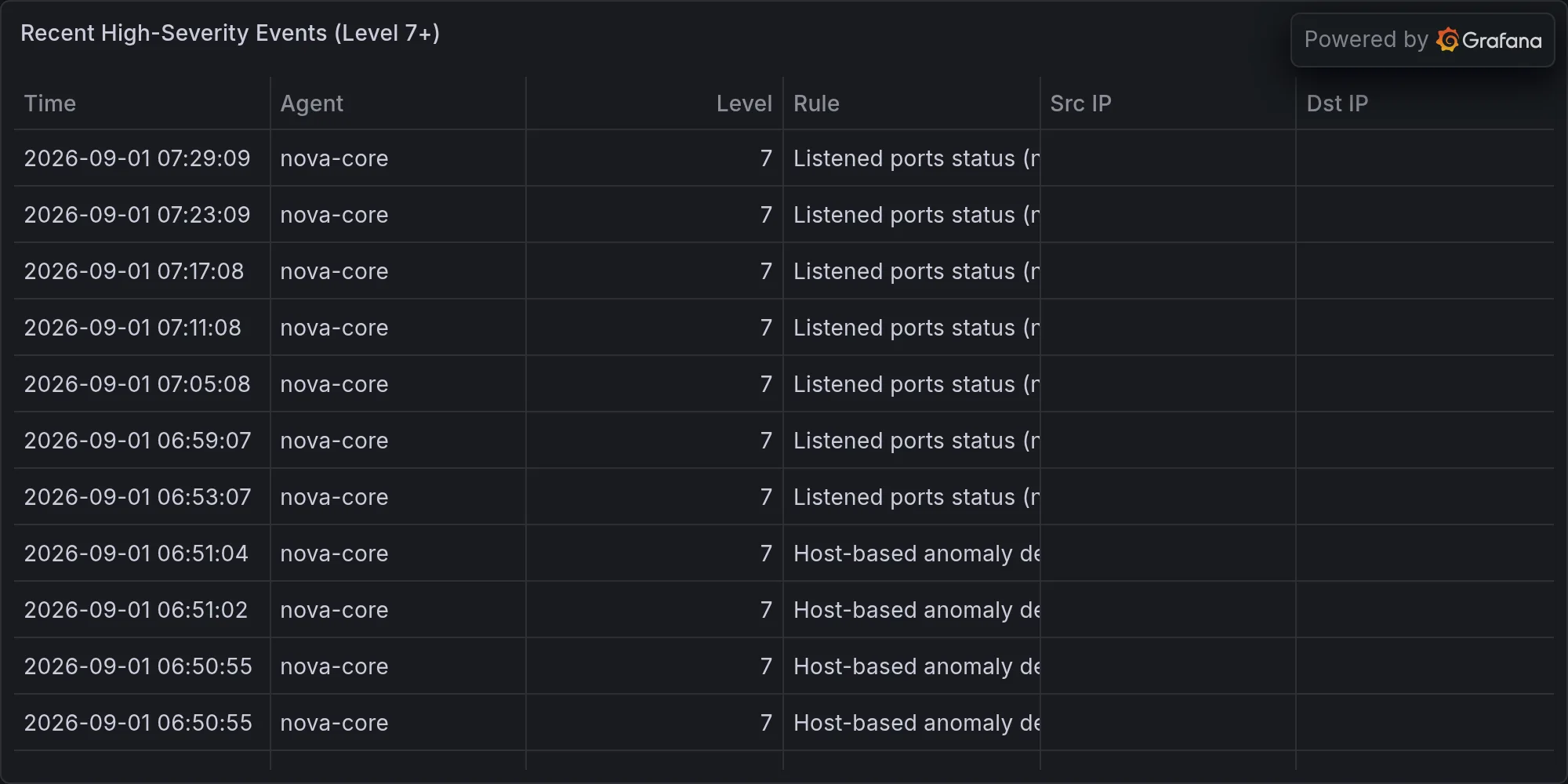
Recent high-severity events at publish time: