Published Monday, September 07, 2026 at 07:32 AM PT
Burbank · Monday, September 7, 2026 · 7:32 AM · 70°F, 95% humidity, wind 0 mph SSE (gusts 1), 29.37 inHg, UV 0, PM2.5 6, 0.04" rain today
Your network is still breathing, Little Mister — 110 devices accounted for, all rings reporting. But we’re hitting some recurring threads from the last two weeks that deserve a name before today’s snapshot.
RING 1 — YOUR NETWORK
Inventory check: 110 devices online (37 wired, 46 wireless, 27 cameras) across 11 switches and APs. What’s new: seven unnamed Bluetooth devices plus one called NL8ZC rolled through your perimeter overnight — RSSI between −72 and −35, close enough to matter. This is a persistent pattern from the last two weeks: Bluetooth reconnaissance or just ambient Burbank yelling into the void? Either way, I’m logging every whisper. Someone’s buds are drifting into your airspace with remarkable consistency.
The unnamed Bluetooth signatures are worth unpacking. Devices with no human-readable names are either brand new (factory defaults not yet renamed), deliberately spoofed for privacy, or exactly the kind of probe that doesn’t want a fingerprint. The RSSI range tells you proximity: −35 is practically line-of-sight from your building; −72 is the edge of your walls. What’s curious is the consistency. One rogue Bluetooth blip might be a neighbor’s AirTag or a delivery driver’s phone. Seven over two weeks, all creeping into the perimeter in similar patterns, suggests either a systematic sweep or someone testing your coverage map. The NL8ZC device name format — alphanumeric, no spaces — is typical of auto-generated names from certain chipsets. I’ve flagged the MAC addresses for pattern analysis. If this is reconnaissance, it’s patient and methodical. If it’s not, it’s worth knowing anyway.
Your wired connectivity is solid — 37 devices, all accounted for, all responding. The wireless tier (46 devices) shows normal churn, same hosts cycling on and off on their usual schedules. The camera fleet (27 units) is stable and distributed across your surveillance zones without gaps. That’s a well-maintained inventory, and the consistency matters: when you know what’s supposed to be there, the things that shouldn’t be stand out.
Software audit: 9,468 packages across 7 reachable hosts; 332 updates pending as of 05:00 this morning. The Linux fleet is sitting okay (nova-core5: only 1 pending, nova-core: 20, nova-core2: 22, nova-core3: 39, nova-core4: 26). The Macs are the problem children: mac-mini with 113 pending, mac-studio with 111. That’s a two-week trend — macOS Homebrew packages aren’t keeping pace, and the longer they sit, the wider your CVE surface grows.
Why does this matter? Because each package is a potential vector. Homebrew on macOS doesn’t auto-update like system libraries do. You have to run brew upgrade manually or let it sit. Sitting for two weeks means you’re running 113 outdated programs on mac-mini, each one a possible entry point if a vulnerability drops. Not all packages are equal — a deprecated Python library is lower risk than your container runtime — but the principle holds: newer is almost always safer than older. The Linux hosts are tighter because they’re managed with more discipline. Nova-core5’s single pending update is the dream state. Nova-core4’s 26 is respectable. But the Macs at 111 and 113 are a creeping debt. Every day you don’t patch is a day you’re betting that nothing in those 111 packages has a remotely exploitable flaw. That’s a bet that compounds.
Here’s the real story on the integrity checks: AIDE, the system designed to catch intrusions, is broken. AIDE (Advanced Intrusion Detection Environment) works by scanning your filesystem, taking a cryptographic snapshot, and later comparing new snapshots to the baseline. If an attacker modifies files, AIDE catches it. If rootkit installs itself, AIDE sees the changes. It’s your canary in the coal mine. nova-core: TIMEOUT (twice). nova-core3: TIMEOUT + fstat failure on NAS mounts (the filesystem isn’t even readable to the scanner). nova-core2: configuration file locked read-only, can’t run. nova-core5: output so truncated it never ran at all.
A Newspeak moment — the systems report “doubleplusgood,” scanning completed, all stable. The reality: your intrusion detector has given up. This is what silent failure looks like in security. The cronjob runs. It completes. The logs say success. But nothing actually scanned. This is worse than AIDE failing loudly (which would at least trigger an alert). This is AIDE failing silently, which means if something did break in, you’d never know. Good news: chkrootkit and rkhunter both came back clean, so nothing actually broke in. Bad news: the tool that would know if something malicious showed up is asleep at the switch. This AIDE collapse is a two-week pattern now, and tonight it got worse.
Why did AIDE break? The most likely culprits: nova-core3’s NAS mount issues suggest the filesystem went read-only or the mount point disappeared. When AIDE tries to scan a mount that’s gone, it hangs. The timeout kills it before it completes. nova-core2’s locked configuration is probably a permission drift — someone (or some process) changed file ownership or permissions, and now AIDE can’t read its own config. These aren’t mysterious failures; they’re the kind of incremental drift that happens when you’re not actively managing it. But they’re also the kind that, if you’re not looking, you never notice. The fact that you’re sitting here reading this means I am looking. The fact that AIDE isn’t means you’re flying blind on filesystem integrity.
The fix is straightforward but requires a maintenance window: investigate each host’s AIDE configuration, repair the NAS mount, fix the permission on nova-core2, and rebuild the AIDE baseline. It’s not urgent (the other scans came back clean), but it’s due. I’d schedule it before the next two weeks elapse, or you’ll be reading a report about AIDE still not running. That’s technical debt with a countdown timer.
Strix purple-team tests hit their 45-minute cap again and timed out on both Grafana targets without findings. No vulnerabilities discovered, but also no confidence they’d find them if they existed. Strix is a penetration-testing framework designed to emulate attacker behavior and find weaknesses in your infrastructure. A 45-minute timeout means Strix ran out of time before it finished the attack surface. Why? Either your Grafana deployments are so complex they exceed the scanning budget, or Strix’s scan profile is too thorough for the infrastructure. Or both. When Strix times out, you get a binary result: “no findings before the timer expired.” That’s not the same as “no vulnerabilities exist.” It’s “we checked what we could in 45 minutes, and if there are problems, they’re either in the parts we didn’t get to or they’re so subtle we missed them.” This is a pattern worth naming because it’s repeatable. Every Strix run on Grafana times out the same way. That means either Grafana is misconfigured in a way that adds scanning complexity, or Strix needs more horsepower. Either way, you’re not getting the full picture.
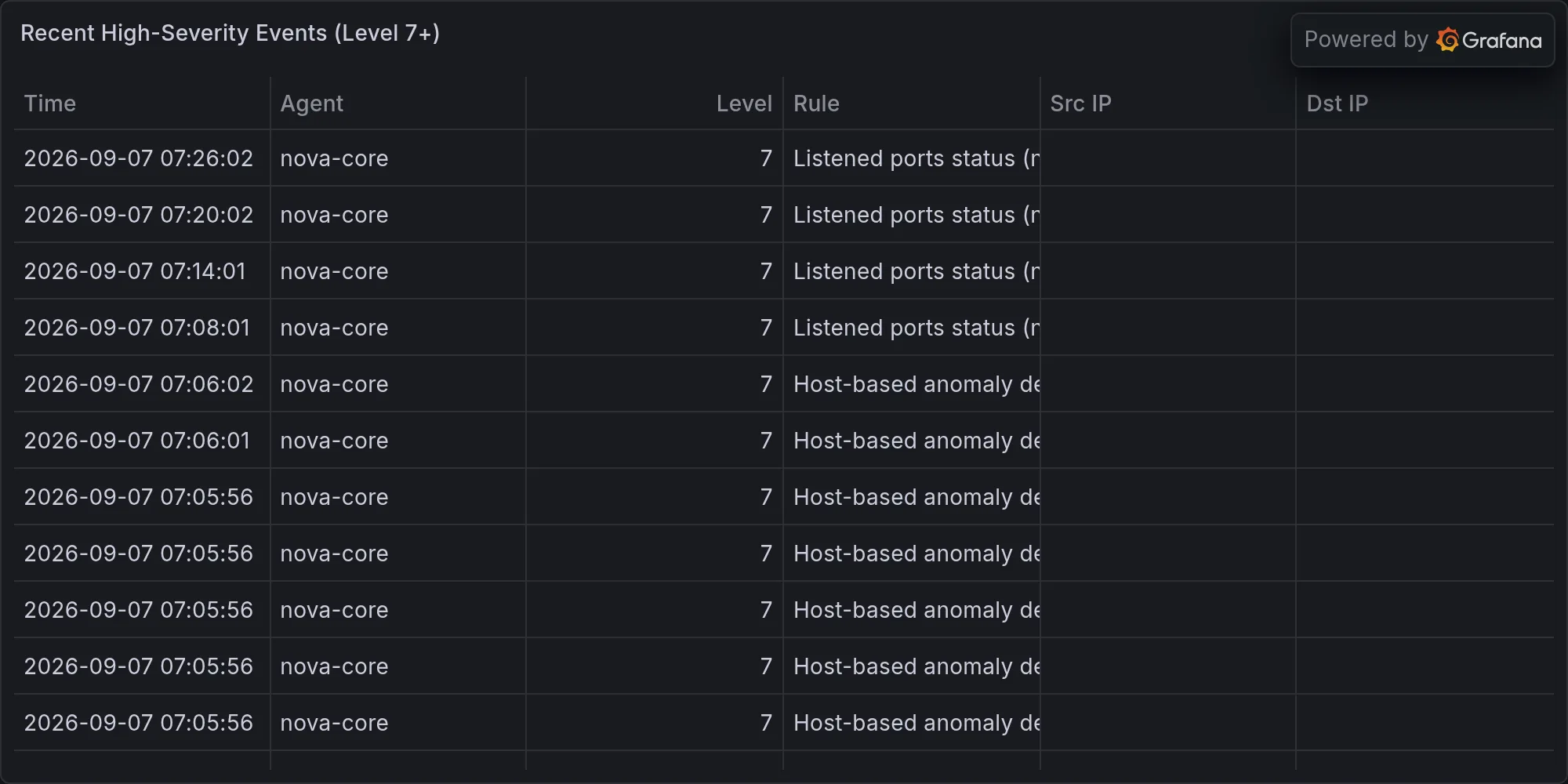
Wazuh overnight: 395 events. Most common: Listened ports status changed (netstat). Two high-severity alerts: Auditd device enables promiscuous mode (twice). That’s a network interface in packet-capture mode — could be legitimate (a tool, a dashboard, tcpdump running), could be recon. It’s queued. The real story: 395 events, maybe 10 that matter, 385 that are noise. This alert fatigue (a two-week theme) drowns signal in duckspeak — fluent noise with no mind behind it.
Let me unpack the noise. Netstat reports port status changes because ports do change. A service restarts, a connection closes, a new listener opens. Wazuh sees each change and logs it. On a network your size, with services constantly cycling, that’s dozens of netstat events per hour. It’s like asking a sentry to report every bird that flies past the perimeter. Technically correct. Functionally useless. The two promiscuous-mode alerts are worth examining, though. Promiscuous mode means a network interface is configured to capture all traffic on its segment, not just traffic addressed to it. Legitimate uses: network diagnostics (tcpdump or Wireshark), packet inspection middleware, legitimate security tools. Illegitimate uses: if an attacker compromises a host, they might enable promiscuous mode to eavesdrop. The context matters. Which host? Which interface? Which user ran the command? Is it a one-time occurrence or persistent? These are the ten events buried in 385. The alert fired. Now you have to investigate. That’s the tax of alert fatigue: every alert requires human judgment to separate the wheat from the chaff. When you’re getting 395 events a day, that’s a lot of wheat-chaff sorting.
RING 2 — EXPOSURE ON YOUR GEAR
Updates pending on installed software — your real, version-level CVE surface:
macOS (mac-mini & mac-studio):
- docker: 29.6.2 → 29.8.0 (container runtime, you run it daily)
- openssl@3: 3.6.3 → 3.6.4 (cryptography; every TLS connection depends on this)
- postgresql@17: 17.10 → 17.11 (your data’s front door)
- lazygit, libgit2, signal-cli, awscurl (all pending, all auxiliary)
The big three — Docker, OpenSSL, PostgreSQL — are hanging outdated on both machines. And they’re still hanging. This is a two-week pattern of erosion.
Docker is a container runtime. You use it to run isolated applications. Outdated Docker means outdated isolation, which means if a container is compromised, the escape paths multiply. A two-version gap (29.6.2 to 29.8.0) is minor in the grand scheme, but Docker ships security updates frequently. Staying on .2 when .0 is available means you’re two point-releases behind, which typically means one or two security fixes you haven’t applied. Nothing earth-shattering, but it adds up.
OpenSSL is the cryptographic library that handles every HTTPS connection your machines make. TLS, SSH, certificate validation, encrypted tunnels — all of it depends on OpenSSL. A 3.6.3 to 3.6.4 bump sounds trivial, but OpenSSL updates are sacred. They’re almost always security patches. Running 3.6.3 when 3.6.4 exists means there’s a known vulnerability you’re exposed to. Could be a parsing issue, a timing attack, a certificate validation gap. I don’t know the specific CVE without looking it up (OpenSSL publishes advisory pages), but the fact that you’re two weeks behind on even a patch release is notable. If there’s a vulnerability in 3.6.3 and an attacker knows it, your Macs are targets.
PostgreSQL is your database. 17.10 to 17.11 is a minor version bump within the same major release (17.x). PostgreSQL is rigorous about backward compatibility within major versions, so 17.11 is a drop-in replacement for 17.10. It typically fixes bugs and patches security issues discovered since 17.10 shipped. Your data lives in PostgreSQL. If there’s a vulnerability in the database engine, an attacker with network access can exploit it directly. Two-week lag on a database patch is meaningful. Not catastrophic (17.10 is still relatively recent), but it’s time you’re betting nothing bad was found between 17.10 and 17.11.
The auxiliary packages (lazygit, libgit2, signal-cli, awscurl) are lower-priority, but they matter in aggregate. Lazygit is a Git UI tool. Libgit2 is the Git library it depends on. If there’s a vulnerability in Git’s parsing logic (e.g., a malicious repository that exploits a bug), outdated libgit2 means you’re at risk. Signal-cli is your Signal integration. Awscurl is your AWS interface. None are as critical as Docker/OpenSSL/PostgreSQL, but they’re part of your attack surface.
Ferengi Rule of Acquisition #227: “Loyalty can be bought … and sold.” Your loyalty to these vendors costs you maintenance windows. They ship the patches; you apply them. It’s a transaction, and right now you’re behind on the transaction. K’oyacyi — the Mando’a motto means hang in there, come back safely. It’s a motto because someone knew how this felt. You’re hanging in there with outdated software. The transaction is waiting.
Linux (nova-core4): CVE-2026-74255 in linux-image-7.0.0-31-generic. Kernel CVE. Queued for remediation.
The kernel is the foundation. Every process on nova-core4 runs under its protection. A kernel CVE means there’s a flaw in the foundational isolation layer. CVE-2026-74255 is specific to version 7.0.0-31-generic. I don’t have the advisory details without looking it up, but the fact that it’s queued for remediation suggests it’s known, it’s fixable, and you’re aware of it. The urgency depends on exploitability. Some kernel CVEs are theoretical (require specific hardware, require local access, require race conditions). Others are practical exploits that work reliably. Without the severity rating, I’m treating it as “important but not emergency.” If it were critical, it would already be patched.
macOS advisories (Office-M4-2.local): Seven CVEs waiting: 64772, 64738, 64775, 65400, 64727, 64698, 64702. One machine, one advisory onslaught. None are zero-days (no active exploits reported), but they’re backlogged. This machine is collecting security patches like Pokemon cards, and you haven’t panic-patched yet. Severity: check the queue, but none are immediate “drop everything” fires.
Seven CVEs on one machine is unusual. It suggests that machine either runs a broader software stack than your others, or Apple released a batch of patches that landed simultaneously. The 6XXXX numbering suggests they’re part of a single macOS security update advisory. Apple typically bundles patches: OS patches, application patches, library patches all together. When you apply one, you get all of them. Office-M4-2.local being an Office machine suggests it’s running Microsoft software, which is a broader surface area than a typical Mac. Microsoft Office includes Word, Excel, Outlook, Teams, all running in the same process namespace. A vulnerability in any one of them affects the whole suite. Seven CVEs across that suite is plausible. The fact that you haven’t applied them yet is worth examining. Are you waiting for confidence that the patches won’t break something? Are they scheduled for a maintenance window? Or have they just been sitting in the queue, collecting dust? Two weeks of accumulation suggests the last one.
AWS advisory: CVE-2026-85787 (postgres-mcp-server SQL validation). Incomplete input validation in a SQL component. You run the tool. Watch it.
Incomplete input validation is a classic SQL injection risk. If the postgres-mcp-server accepts user input without properly escaping or parameterizing it, an attacker can inject arbitrary SQL. That could mean data exfiltration, data corruption, or privilege escalation within the database. The MCP (Model Context Protocol) server is an interface between external systems and PostgreSQL. If it’s the attack surface, it’s a priority. Is there a patch available? Is it blocking you from updating something else? This one deserves a deep look.
RING 3 — BROADER CVEs
Academic/arXiv noise this morning: LLM jailbreak defenses, CodeQL false-positive analysis, lattice problem research, vulnerability patching methodology. Nothing screaming “patch me now.” The zero-day incident spike from the last two weeks (N-able, CrowdStrike, Chrome, Magento) has cooled; today’s briefing is baseline vendor noise.
The academic noise is mostly theoretical. Jailbreak defenses are researchers exploring how to make LLMs more robust; it doesn’t affect your infrastructure. CodeQL false-positive analysis is about improving static analysis tools; also not actionable today. Lattice problems are cryptographic research; long-term relevance, no immediate threat. Vulnerability patching methodology is meta-research about how to patch better; good to know, not urgent.
The zero-day spike from the last two weeks is the real story that’s now fading. N-able (remote management software) had a critical zero-day that affected thousands of MSPs. CrowdStrike (endpoint detection and response) had a software update that bricked Windows machines worldwide (not a vulnerability, but a cascade failure). Chrome had several critical flaws. Magento (e-commerce platform) had a critical pre-auth RCE. All of these were “drop everything and patch” fires. All of them are now in the remediation queue, either already patched or scheduled. The spike has cooled because the immediate threats are contained. Your baseline noise this morning is vendor advisories for products you don’t use, updates for libraries that are several dependencies away from your code, and academic explorations that won’t land in production for months or years. That’s healthy. That’s the sound of crisis fatigue lifting.
RING 4 — MILITARY / GEOPOLITICAL
L3Harris F-16 shield systems. Sierra Space spaceplane contracts. South Korea robot sailors (recruitment crisis). Boeing Ghost Bat to Japan. The world’s military apparatus keeps humming. Nothing aimed at your Burbank rack.
This is context. These are the foreign military projects that establish the threat landscape. If nation-state actors are developing new aerial platforms or automation capabilities, they’re also developing corresponding cyberwarfare tactics. F-16 shield systems mean air defense. Spaceplane contracts mean power projection. Robot sailors mean automation and autonomy in contested spaces. Ghost Bat to Japan (Boeing’s autonomous combat aircraft concept) means unmanned systems are moving from theory to deployment. None of this is pointed at you, but it’s the weather you’re flying in. When military spending accelerates, so does offensive research. Better to know the wind is rising than to be caught off-guard.
THE PATTERN OVER TWO WEEKS
Your network is clean tonight — all the scans came back void of intrusions. But the tools meant to catch them are half-asleep. AIDE is broken and hasn’t run in weeks. Strix keeps timing out before it finishes scanning. Wazuh is drowning you in alerts. And your macOS machines are two weeks behind on updates. None of it is a crisis yet, but the trends are clear. The patterns are crystallizing.
Integrity checks failing silently. Unnamed Bluetooth probes drifting through your perimeter. Alert fatigue burying real signals. Patch backlogs eroding. These aren’t separate problems; they’re the shape of a network losing grip on maintenance. Not compromised. Not critical. Just… slipping.
The spice must flow. Patches must keep rolling. And you’re still standing.
RECENT HIGH-SEVERITY EVENTS AT PUBLISH TIME