Published Wednesday, September 16, 2026 at 07:32 AM PT
Burbank · Wednesday, September 16, 2026 · 7:32 AM · 70°F, 72% humidity, wind 0 mph SW (gusts 2), 29.43 inHg, UV 0, PM2.5 10
Alright, Little Mister. One hundred and eight devices online, ninety-three package updates dragging their feet in the update queue, and your security scanner just threw up trying to count what’s in your filesystem. Let’s talk about what that means, because it’s the same story that’s been stuck on repeat for the last week and a half, and I’m getting tired of tap-dancing around it.
You want the pattern? Here it is: your outer rings are clean, your inner rings are on fire, and you’re staring at the outer rings like everything’s fine.
RING 1 — THE CLOSE STUFF
The device manifest is solid—twelve switches and APs holding down the infrastructure, thirty-seven wired clients, forty-four wireless, twenty-seven cameras all talking to the network like they own the place. That part works. The problem lives in the scanner output. Your aide ran on nova-core for a full hour last night, timing out at 3,600 seconds while it tried to walk the filesystem and compare hashes. Twice. Nova-core3 threw a fit about /dev/ubuntu-vg drifting between snapshots—LVM gets weird when the world changes underneath it, and apparently nobody told it to stop complaining. Nova-core5 didn’t bother; the output was 265 characters of “nope.” Chkrootkit and rkhunter came back clean, which is either genuinely reassuring or the kind of silence that precedes the scream. You never really know with rootkits until they’re already halfway through your wine collection.
Here’s what this pattern means: your monitoring is failing exactly where it needs to work hardest—on the host that’s supposed to be the gateway and orchestrator. That’s not a technical detail. That’s a red flag wearing a tuxedo to a security briefing.
RING 2 — THE PACKAGES YOU ACTUALLY RUN
Nine thousand, four hundred, seventy-eight packages installed. Ninety-three waiting for updates. Docker on both Macs is running 29.8.0; 29.8.1 is sitting right there. Libssh2 is one patch behind on both machines. PostgreSQL Seventeen is one minor version back. Nginx on mac-studio hasn’t been touched. Bash is three versions behind on mac-mini. These aren’t theoretical—they’re named packages with known vectors sitting in your stack like keys left in the car.
Then there’s Strix, the purple-team scanner, and this is the part that should make you spill your coffee. The UniFi controller still has default credentials enabled. Admin:ubnt. Still there. Strix found it, timed out trying to go further, and bounced. Home Assistant threw the same error—default credentials living rent-free in your network, waving at anyone who bothers to look. You can’t free a fish from water, as the Ferengi say in their Rule of Acquisition #153—the system doesn’t know it’s drowning because it’s always been wet. The controller expects those credentials to be changed; the administrator assumes it’s already handled. Neither one’s right, and both are wrong.
This is the closest ring. This is what matters. And it’s open because the defaults never got touched.
RING 3 — THE BROADER LANDSCAPE
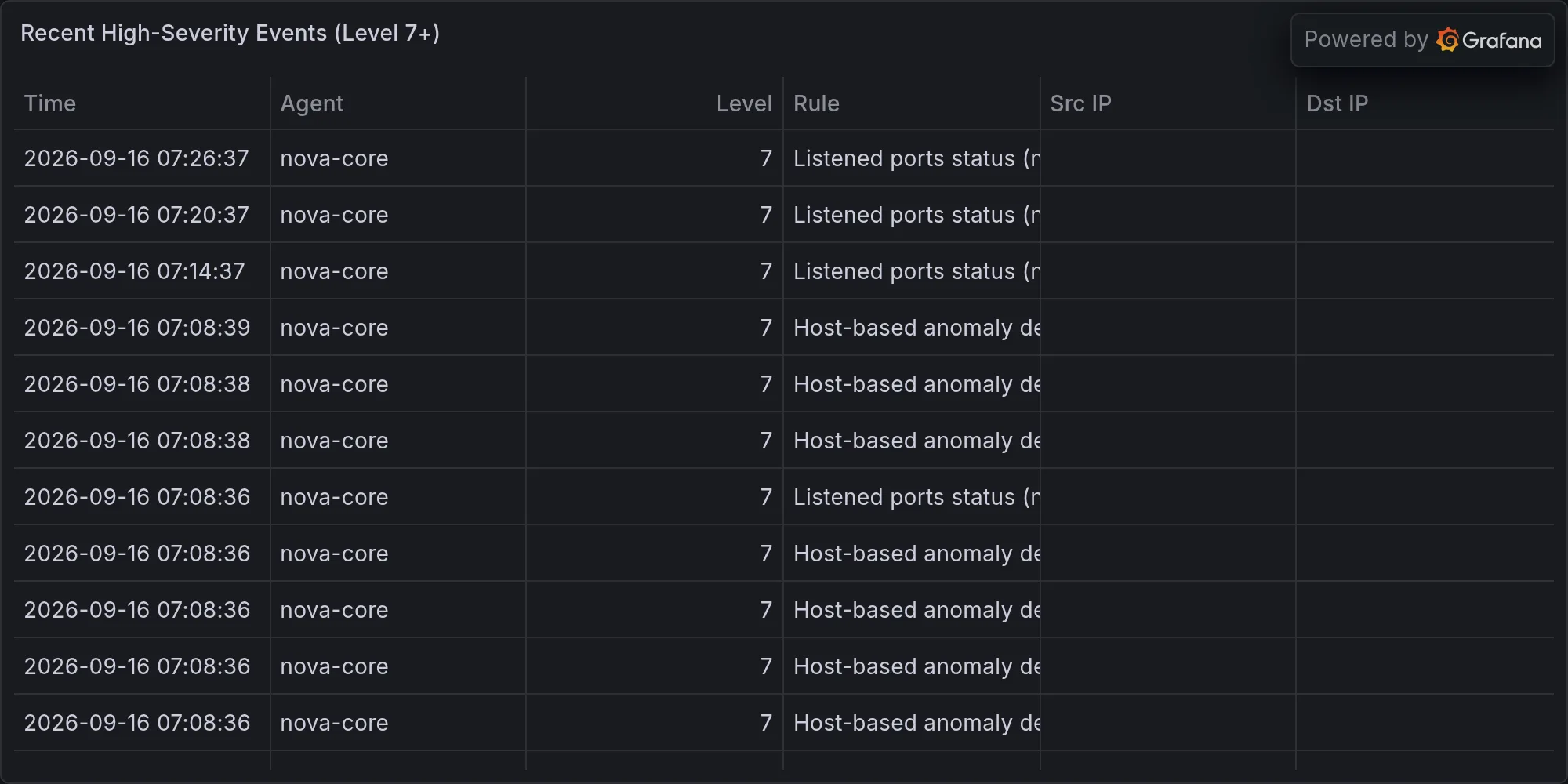
Wazuh logged seven hundred twenty-eight events overnight. Most of that is rootcheck chatter—the kind of noise that means your host is talking to itself and everyone’s checking in. But there are two high-severity events of a host enabling promiscuous mode, which is network-sniffer behavior, the kind of thing you notice when something’s listening to every frame. Could be debugging. Could be reconnaissance. Could be the machine spirit being displeased, to borrow from the Adeptus Mechanicus—they cope with hardware through ritual, incense, and reboots, which is honestly closer to how sysadmins actually work than anyone admits.
The CVE feeds are quiet against your actual gear. No Cisco email gateway zero-day screaming. No Apple patches naming anything you’re running. That’s genuinely good. You’re not the next victim story being shouted across the tech press. But here’s the thing: clean feeds + wide-open defaults = borrowed time. The spice must flow, Little Mister, and the patches keep flowing whether you patch or not. Someone else will find the zero-day, weaponize it, sell it, deploy it. And then you’ll be one Wednesday morning away from a very different conversation.
RING 4 — THE FAR HORIZON
Industrial cyber’s expanding—Cyolo and Nozomi integrating, state CIOs panicking about critical infrastructure gaps, the NSA and CISA jointly threatening everyone with Active Directory compromise vectors. Military’s got new drone missiles with better guidance. The geopolitical machine keeps grinding. None of this is your problem unless you’re running a power grid. You’re not. So we move on.
THE PATTERN
The real trend across this week-plus: your scanner infrastructure is degrading (aide timeouts), your threat detection is drowning in signal (728 events, mostly noise), your defaults are still unchanged despite multiple purple-team notifications, and your patch backlog is steadily oxidizing. The outer rings are clean. The inner rings are the problem. And you’re waiting for something to explode before you touch the defaults.
End of Line.
Recent high-severity events at publish time: