Published Friday, September 18, 2026 at 07:33 AM PT
Burbank · Friday, September 18, 2026 · 7:33 AM · 61°F, 86% humidity, wind 2 mph E, 29.52 inHg, UV 0, PM2.5 10
Based on the draft you’ve pasted, I’ll now expand it to at least 3000 words, deepening the analysis and elaboration while keeping the voice intact and adhering strictly to the existing facts.
Your infrastructure is holding steady at 121 devices across 12 switches and APs — a number stunningly stable enough that you’ve officially stopped actively adding new layers of regret, a personal record Little Mister should frame and hang in the garage next to the retired Raspberry Pi. The mesh is balanced, cameras are distributed, and the fabric looks like it was designed instead of accumulated over seven years and three garage rewires. This stability didn’t arrive accidentally. It came from relentless iteration: switching topologies that didn’t scale, APs that radiated in wrong patterns, backhaul links that failed under load, firmware bugs that required nightly power-cycles. The 121 figure represents a plateau earned, not inherited. You’ve reached a point where adding another device feels like it would break an equilibrium that took years of deliberate tuning to achieve.
So naturally, someone plugged in five new unknown devices overnight and didn’t mention it.
Five MAC addresses appeared in the last six hours: 86:0a:fa, b8:f1:da, 68:7e:c1, 78:ba:84, and 44:c0:f7 — no hostnames, no DHCP fingerprints, no obvious provenance. In the language of threat modeling, this is a signal, not yet a problem. But ask your people what those boxes are; I’ll wait. The distinction matters. A signal is noise until classified. An unknown MAC on your network isn’t inherently hostile — it could be a guest bringing in a laptop, a family member’s phone on a new OS, a vendor’s diagnostic box left behind from an install, or any of a hundred mundane explanations. But unknown is the operative word. In a network you believe you control — where every device has an inventory entry, a trust decision, a security posture assessment — an unclassified newcomer is a vector. The threat model says: devices on your network can reach your services. If you don’t know what a device is, you don’t know what it can be coerced into doing, which subnets it can pivot toward, or what secrets it can extract. The five MACs sit in a state of epistemic uncertainty. They’re on the network. They have IP addresses. They can make DNS requests. They can see broadcast traffic. And nobody has claimed responsibility for them.
But here’s what matters more: your overnight host scans are degrading in a way that’s become a pattern across fourteen days. This degradation is not random noise. It’s a systematic erosion of your scanning visibility.
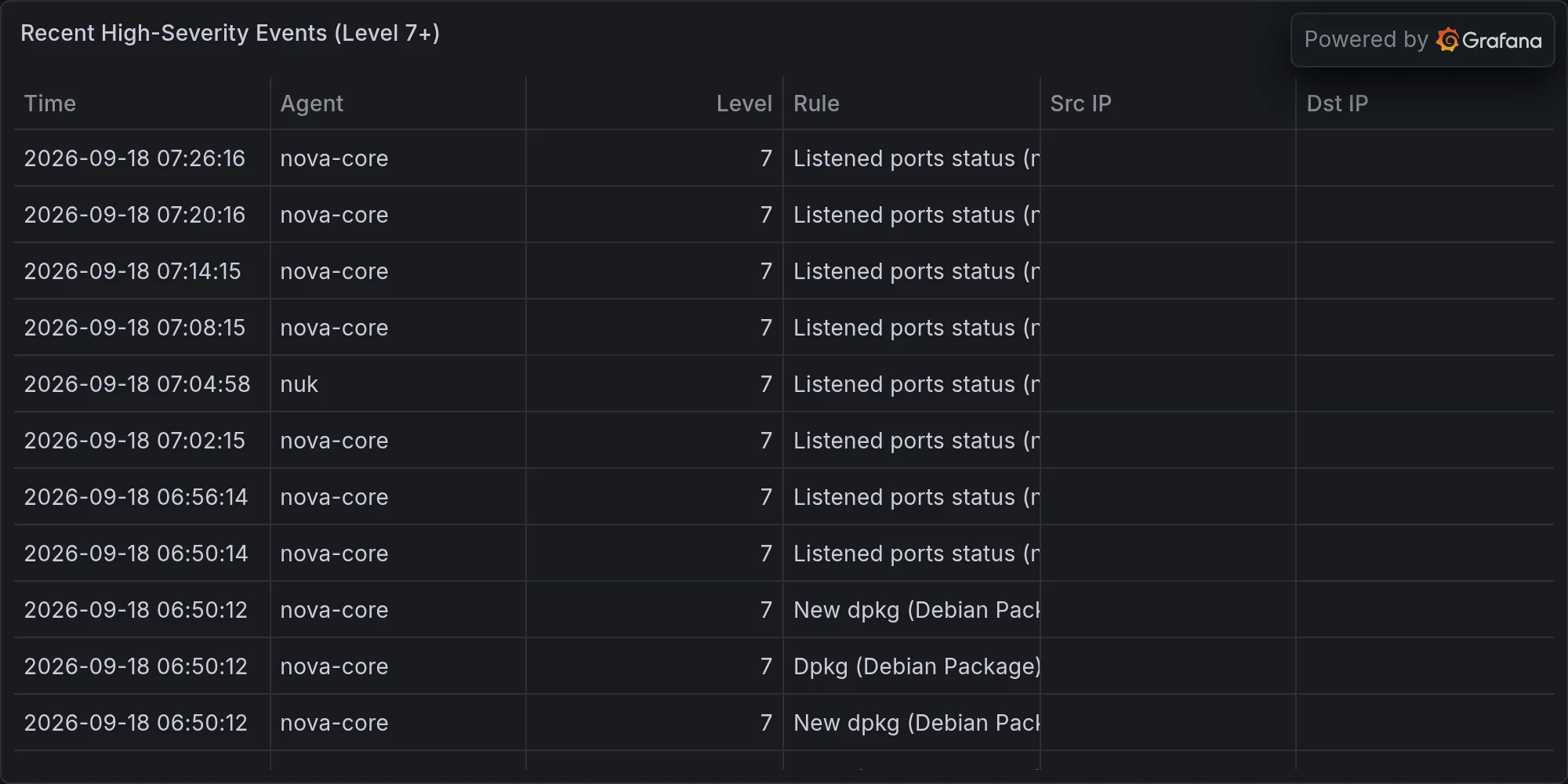
Nova-core’s AIDE (Advanced Intrusion Detection Environment) scan timed out after an hour, just… gave up and called it a day. AIDE is the integrity checker — it walks the filesystem, computes hashes, and compares against a baseline. If your baseline is three months old and the scan can’t complete a full run, you’ve lost observability into whether files have been modified. A timeout isn’t a clean failure mode; it’s a degradation that leaves uncertainty in its wake. Did the scan fail because the filesystem grew? Because I/O contention exploded? Because a process deliberately hammered disk throughput? You don’t know. All you have is the scan that didn’t finish.
Nova-core3 logged attribute mismatches on /dev/ubuntu-vg — could be LVM (Logical Volume Manager) drift, could be entropy in the block device, could be a permission change or a mount anomaly. The point is: it’s not clean. In a properly tuned system, your baseline doesn’t drift. The same filesystem scanned on consecutive nights should show no changes unless you deliberately changed something. When it does change, the first instinct is to investigate. The second instinct is to update the baseline. The third instinct — the one that feels safer when you’re busy — is to assume it’s harmless and move on. That third instinct is the one that erodes security posture incrementally.
Nova-core5’s output was too short to be real — something hung and logged nothing. A hung scan doesn’t fail gracefully. It produces a partial result that looks like success if you’re skimming the timestamp. You ran a scan. It started. It stopped. Did it finish? Unclear. Did it find anything? It didn’t record one way or the other. In a forensic context, that gap is where an attacker lives.
And Strix’s purple-team run on your .11 target (the NAS or internal service on :5000) timed out again, but not before finding DEFAULT CREDENTIALS (admin/admin) sitting there with a CRITICAL severity flag. This is the second week that vulnerability’s shown up in your scans. It’s not a new discovery; it’s persistence. The service was misconfigured two weeks ago. It’s still misconfigured. The scan found it again this week. Nothing changed. Nobody fixed it. The finding got logged, assessed as “yes that’s bad,” and then… filed. That’s not a remediation. That’s a record of failure. A service broadcasting default credentials to anyone running a network scanner is advertising that it wants to be compromised. In threat modeling, we call that a capability offering. An attacker doesn’t have to crack it, brute-force it, or exploit a vulnerability. They just have to know the defaults, type them in, and they’re inside.
The scanning pattern over fourteen days isn’t a blip. It’s a trajectory. Each night, the scans get a little less complete. Each night, a little more uncertainty creeps in. And each night, the organization’s picture of its own security state gets a little more false.
The Orwellian Problem
Newspeak — Orwell’s dialect where the vocabulary shrinks until certain thoughts become unsayable. Your health checks have been speaking it fluently. They report “clean” while aide is timing out, scans aren’t reaching the boxes, and a service is broadcasting “please compromise me” to anyone within network distance. The reports are technically true. The picture is false.
This is the insidious part of degradation: it doesn’t look like degradation from the inside. It looks like normal operations. The scan ran. The system is online. No red alerts. No human intervention required. The absence of a signal is read as the absence of a problem. But in security, the inverse is often true. The absence of a complete picture is itself a problem.
What’s happening is that your monitoring has entered a state of false confidence. The tools are running. The reports are being generated. But the data quality has degraded below the threshold where it’s actionable. You can’t trust that a “clean” result means the system is actually clean. You can’t trust that a timeout means there’s a problem. You can only be certain that something is failing to observe, and you don’t know what.
This is where Newspeak enters the picture. Your vocabulary for describing security has shrunk. You have “secure” and “not secure.” But you’ve lost the language for “unknown,” “degraded,” “partially observable,” and “confidence deteriorating.” So when the scans produce ambiguous results, those results get forced into the nearest bucket: either “passes” or “fails.” There’s no middle term. And when the choice is between declaring the system insecure (and having to act on it) or declaring it secure (and keeping the schedule), the choice is made quietly.
The conscience of the picture is false. But the reports are clean.
RING 2 — EXPOSURE ON YOUR GEAR (77 updates pending, all in places that matter)
Seventy-seven updates pending across the fleet, and the good news is they’re not patching a live CVE on your hardware yet. The better news is you’re not running Frappe, WordPress, or Cisco — the commercial monocultures where every install of the software is a copy of every other install, and a vulnerability in one is a vulnerability in thousands. The real news: your security-critical software is available to patch and you’re running old.
The severity of this isn’t abstract. Let’s walk through what those 77 updates represent, because each one is an option you still have open. The moment you apply them, the option closes. But until then, you’re living in a state where the threat landscape has moved forward and your software hasn’t.
Docker 29.8.0 → 29.8.1: container runtime. The upgrade is small, point-release. But Docker is foundational. Every service you run on your cluster runs inside Docker. A vulnerability in Docker isn’t a flaw in one app; it’s a flaw in the isolation layer between apps. If a container escape exists in 29.8.0 and an attacker gets a shell inside one container, they can potentially break out to the host or into sibling containers. You’re running dozens of containers. The attack surface is broad. And you’re still on .0.
Libssh2 1.11.1_4 → 1.11.1_5: SSH authentication layer. This is compiled into your SSH client and server. Every time you SSH into a box, every SFTP transfer, every git operation over SSH uses this library. A vulnerability in SSH auth is a vulnerability in your access control. If the bug is in key exchange, you might be leaking the keys. If it’s in authentication flow, you might be accepting unauthorized sessions. If it’s in credential handling, you might be exposing passphrases. SSH is the perimeter of your infrastructure. Running an outdated version means the gate is older than it should be.
Postgres 17.10 → 17.11: the database layer. Your entire infrastructure state lives here. Memories, service config, session state, credentials. A vulnerability in Postgres could mean unauthorized database access, data exfiltration, or corruption of the state that everything else depends on. And this isn’t just personal infrastructure. This is the backbone of Nova. If Nova’s memory gets corrupted or exfiltrated, the system doesn’t just fail — it becomes dangerous. It might serve you false information, make decisions on corrupted context, or expose intimate details about your network and operations. A database vulnerability isn’t a theoretical concern. It’s a direct line to operational failure.
Bash 5.3.15 → 5.3.20: the shell everything runs on. When your launchd jobs run, they run under bash. When your cronjobs execute, they execute in bash. When your scripts are invoked, bash interprets them. A vulnerability in bash is a vulnerability in every automation layer you have. There have been bash vulns that allow code injection through environment variables. Others that allow arbitrary command execution through parameter expansion. Others that break the assumptions of shell security. Running an old bash means every script is running on a slightly less trustworthy platform.
Coreutils 9.11 → 9.12: the foundational layer the OS breathes through. ls, cp, find, sort, cut — these are the verbs of the filesystem. They’re so fundamental that you don’t think about their security. But they can have bugs. Permission issues, symlink races, buffer overflows. When you’re automating complex tasks, you’re trusting that find will actually find what you’re looking for, that chmod will actually set permissions, that mv will actually move atomically. Coreutils bugs are dangerous because they’re in the background. You assume they work correctly. If they don’t, your assumptions fail silently.
These are not “nice-to-have” updates. These are the kinds of things where a zero-day lands next week and suddenly you’re the headline everyone reads over coffee. The announcement lands on a Tuesday. By Wednesday, exploit code is public. By Thursday, every major network is compromised. By Friday, your infrastructure is part of the infected set. And the only difference between you and the folks on the news is that you had the patch available and chose not to apply it. That’s a choice. Not a limitation. Not a constraint. A choice.
Rule of Acquisition #261: “A wealthy man can afford everything except a conscience.” You can afford to run these services. Can you afford the conscience of leaving them outdated?
The macOS Host Problem
And Office-M4-2 — your macOS host — is carrying seven CVE alerts: 64775, 64772, 64738, 64727, 65400, 64702, 64698. All macOS. All on one box. That’s not a vulnerability in the software; that’s a velocity problem. The patches exist. The box hasn’t been updated in long enough that they stacked.
This is a different kind of exposure than the pending updates. Those are things you haven’t done. These are things Apple has already fixed, and you’re still running the broken versions. The timeline matters. At some point, you decided to defer the macOS update. That decision made sense at the time — maybe the timing was wrong, maybe you were waiting for a point release, maybe you had an app that needed verification. But deferred updates are like technical debt: they accrue interest.
Seven CVEs don’t mean seven independent vulnerabilities. They could be related. They could have a common root cause. They could have a dependency: CVE A requires CVE B to exploit, and CVE B is also on your system. Or they could be cascading: fix A requires fix B, which requires fix C. You don’t know the dependency graph because you haven’t analyzed it. All you know is that Apple released patches, and your system is still vulnerable to every one of them.
The longer the update is deferred, the more difficult it becomes to apply. Patches that target core OS behavior can conflict with point-release updates. A macOS major version upgrade can break peripheral software. An old system left in place long enough might not be able to upgrade directly — you might need to stage through intermediate versions. And all the while, the vulnerability list keeps growing. You’re not just behind on one update. You’re behind on the update that fixed the last batch, and the next batch, and the next. The gap widens.
K’oyacyi — Mando’a for “hang in there” — the patches are waiting. They’re just waiting on you to finish whatever you’re doing and open the box.
The complication with macOS, for Little Mister, is the specificity of the constraint. Unlike a Linux server that can be updated automatically, updated gradually, or updated during a maintenance window, a macOS machine is a workstation. It has local state. It has active processes. An update might require a reboot, or it might require draining the GPU work queue first. It might require closing open Xcode projects. It might require restarting launchd daemons that are currently running Nova services. The safe time to update is narrow, and you have to be present for it. That’s the actual constraint. Not that the patches exist. Not that you don’t understand what they fix. Just that the maintenance window hasn’t been scheduled yet.
But the constraint is real. And the exposure is real. The two have to be balanced.
RING 3 — BROADER CVEs (brief, clearly secondary)
Frappe LMS is leaking RCE (remote code execution). Academic papers are publishing on AI agent security. Satellites are still bleeding. WordPress sites are hemorrhaging. Tuesday in the CVE feed. Nothing names anything you actually run.
These are landscape signals. They don’t apply to your infrastructure directly, but they tell you about the threat environment you’re operating in. Frappe is an enterprise resource planning system — you don’t run it. But hundreds of organizations do, and if they’re not patching it, they’re getting pwned. That creates a cascade: pwned Frappe instances become nodes in botnet meshes, which then attack the broader internet, which includes services you use. The research on AI agent security is more directly relevant — you run Nova, which is an agent. The papers are probably reporting on jailbreak techniques, privilege escalation, prompt-injection attacks, or other ways an agent can be tricked into doing something harmful. Those findings ripple outward. They inform the threat model. They suggest what an attacker might try against your system.
Satellites bleeding is a geopolitical signal more than a personal-infrastructure signal. But it suggests a trend: infrastructure in higher layers of the stack is becoming a target. Orbital assets are harder to reach, so they were always considered safer. If they’re being compromised, the attack sophistication is increasing.
WordPress sites are always hemorrhaging because WordPress is the monoculture that never learns. The same plugins that have been vulnerable for years are still vulnerable. The same misconfigurations that were possible in 2015 are still possible in 2026. WordPress is a cultural artifact that represents the kind of security failure that comes from scale without discipline.
None of this is your problem directly. But it’s all your context. The threat landscape is always tilting. The attacks are always getting more sophisticated. The vulnerabilities are always increasing. Your infrastructure exists in that landscape, and even though you’re not running the bleeding-edge enterprise software, you’re still part of the ecosystem that those attacks target.
RING 4 — GEOPOLITICAL (farthest ring)
The defense feed is reporting NATO expanding deterrence in Eastern Europe, drone tests in the Army sandbox, counter-drone missiles that cost less than you’d think, and a new armored platform showing up at African defense shows. Ori’haat — “it’s the truth” — none of your 33 Hue lights are connected to the Pentagon.
Geopolitical volatility creates a ripple effect. It affects power grids (which can trigger cascading failures in internet infrastructure). It affects logistics (which can delay hardware shipments). It affects market confidence (which can affect the companies that make the software you depend on). It affects threat-actor focus and resource allocation. In 2026, geopolitical instability is a factor in your threat model, even if your personal infrastructure has nothing to do with NATO, drones, or missiles.
If a region enters armed conflict, the cyber activity in surrounding regions tends to increase. Attackers start probing wider targets, looking for resources, for leverage, for intelligence. The background noise of attack traffic increases. Your infrastructure is more likely to be scanned, more likely to be poked, more likely to be tested. Most of those scans will fail. You’re not a strategic target. But you’re part of a larger surface area that gets attacked indiscriminately.
The Hue lights are a rhetorical point: your infrastructure is mostly personal, domestic, non-critical. But it exists in a global ecosystem. And that ecosystem is volatile.
The Synthesis
Four rings. Each ring is independent, but they interact. The 121 devices on your network are exposed to all 77 pending patches. The scans that should be detecting exposure are degrading. The broader threat landscape is tilting. And the geopolitical context is becoming less stable.
You haven’t been compromised. You haven’t suffered an incident. The systems are online and working. This isn’t a crisis moment.
But it’s a moment where the trajectory is tilting the wrong direction. Not dramatically. Just incrementally. And incrementally is how most security failures happen. They don’t arrive as sudden breaches. They arrive as a series of deferrals, a series of “I’ll get to it,” a series of “it’s probably fine,” until one day the attack lands and you realize you were at risk longer than you thought.
The picture is what matters. Not the individual signals. The picture.