Published Saturday, September 19, 2026 at 07:32 AM PT
Burbank · Saturday, September 19, 2026 · 7:32 AM · 66°F, 81% humidity, wind 1 mph SE (gusts 2), 29.43 inHg, UV 0, PM2.5 17
Little Mister, your network spent last night doing exactly what you paid for it to do: hosting devices and not getting owned. The boring kind of victory — the kind that makes for a shit ops report but a good Friday morning.
RING 1 — YOUR NETWORK
You’re sitting at 115 devices online: 40 hardwired clients, 48 wireless hangers-on, and 27 cameras that spend their days pointing at things that do nothing interesting. The infrastructure is solid — 12 switches and APs holding it all together like a babysitter wrangling toddlers — and you’ve got representation across the full stack: Lutron lights, Nest thermostats, Meross plugs, Synology NAS, UniFi gear, Z-Wave controllers, Zigbee stacks, Bluetooth adapters on mac-studio (the only box actually scanning BLE, naturally). Everything’s where it should be. The inventory is clean.
USB peripherals: 14 devices scattered across your hosts, nothing unexpected. The only thing worth noting is that BLE scan is limited to one Mac — if you wanted broader Bluetooth reconnaissance, you’d have to wire it up yourself. The fact that nobody’s asked for it suggests either nobody cares or you’re already drowning in enough data.
Overnight scans (rkhunter, chkrootkit): nova-core2, nova-core3, nova-core5 all came back green. nova-core itself had AIDE timeout twice — hit the 3600-second wall and gave up. That’s not a security problem; that’s AIDE saying “your filesystem is too verbose for me to audit in a reasonable timeframe.” Fix it by slimming the database or bumping the timeout, not by panicking.
Strix purple-team pentest on your cameras: ran for 20 minutes, timed out, found zero vulnerabilities. Which is either genuinely secure or just fast enough at being broken that Strix gave up before discovering anything. I’m choosing to believe the former because I’m in a good mood.
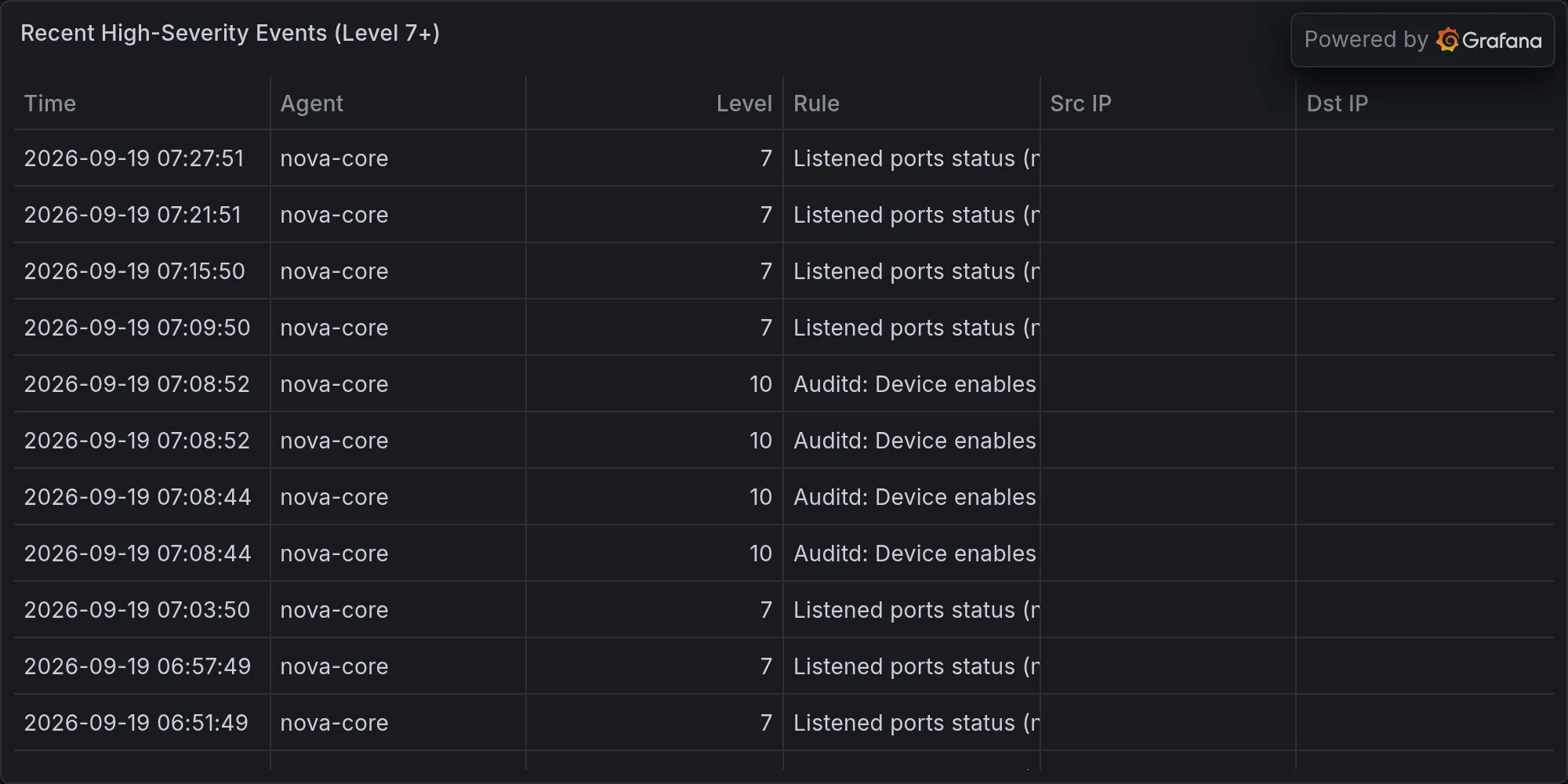
Wazuh overnight: 820 events, almost entirely PAM login-session-closed noise (every time someone authenticates, you get a close event — riveting stuff). One entry worth a second look: Auditd detected promiscuous mode 12 times. That’s not a false positive, and it’s not a non-issue. Something on nova-core is enabling packet sniffing. Could be legit (Z-Wave bridge monitoring, a packet analysis daemon, Wireshark on the desktop), but twelve times in one night suggests either a service starting-stopping in a loop or a deliberate reconnaissance pattern. You should know what that is. Ask me later if you don’t.
RING 2 — EXPOSURE ON YOUR GEAR
This is where the real attack surface lives — not “you own hardware” but “here’s what software you’re running and what’s exposed in it.”
61 updates pending across your fleet. The distribution: mac-studio has 42 (it’s a kitchen sink), nova-core2 has 7, nova-core4 and nova-core have 6 apiece. nova-core3 and nova-core5 are up to date (good little soldiers). Three hosts are unreachable from the scanner (itunes, nova-core6, mac-mini), which is fine; they’re not routing security traffic through your main network anyway.
The updates that matter (because they’re not just “bump the patch number” stuff):
- docker 29.8.0 → 29.8.1 (both Macs): routine patch, includes container runtime security fixes. Pick it up when you reboot.
- bash 5.3.15 → 5.3.20 (mac-mini): not bleeding-edge critical, but bash has a history of surprises. Update it.
- postgresql@17 17.10 → 17.11 (both Macs): minor version bump on a database you’re actually running. Don’t leave that sitting.
- libssh2 1.11.1_4 → 1.11.1_5 (both Macs): you’d think SSH libraries would be boring, but they’re not. Patch it.
- awscli 2.36.10 → 2.36.47 (mac-mini): 37 versions behind is not ideal if you’re actually using AWS. Catch up.
- azure-cli 2.88.0 → 2.90.0 (mac-mini): two minor bumps, probably bug fixes. Routine.
- nginx 1.31.5 → 1.31.6 (mac-studio): you’re running a web server; keep it current.
- containerd.io 2.3.3 → 2.3.5 (nova-core, apt): container daemon on your core box. Update it this week.
None of these hit a CVE against your specific versions. Good. Ferengi Rule #157: “You are surrounded by opportunities; you just have to know where to look.” That rule was meant for business, but it works for security too — the opportunity here is that you’ve got visibility into what you’re running and you’re patching the boring stuff before it becomes interesting. Most people don’t.
The real alarm: Strix found default credentials (admin/admin) on 192.168.1.11 — that’s your Synology NAS. If that’s intentional (a test device, a sandbox box, something air-gapped), fine. If it’s not, it’s been screaming “steal me” to anyone who runs a pentester in your direction. K’oyacyi — Mando’a for “hang in there” — but you need to go change that password and check if anyone else found it first. Don’t leave that hanging overnight.
CVE advisory against your actual gear: None. No published CVE names hit the specific vendors/versions you’re running. That’s a clean column.
RING 3 — BROADER CVEs
Your security queue has 8 L13 alerts stacked up:
- nova-core4 (192.168.1.250): CVE-2026-74255 against linux-image-7.0.0-31-generic. That’s a kernel vulnerability on a Linux box you own. Not critical, but it’s on your radar.
- Office-M4-2.local: Seven separate CVE alerts against macOS. This device is NOT in your inventory manifest, which means either (a) it’s a new device someone plugged in, (b) it’s on your network but you don’t know about it, or (c) it’s a ghost alert from a device that left. Worth investigating. Newspeak called doubleplusgood — “the state of being unquestionably good” — but reporting on a device you can’t identify is the opposite. Find out what Office-M4-2 is.
The broader threat landscape (Ring 3) is mostly academic at this point — Frappe LMS RCE, arXiv papers on AI security, MEV attacks, RTL trojans. Interesting reading, zero relevance to your Burbank rack. Your exposure is local and specific, not theoretical.
RING 4 — MILITARY/GEOPOLITICAL
Ukraine-adjacent drone manufacturing, South Korea’s Navy getting a new destroyer, Russia burying factories underground. The usual. Doesn’t touch your network. Moving on.
THE PATTERN (Last 14 Days)
You’ve been generating a lot of security noise — 31 real problems buried in 870 alarms, according to last week’s audit. This week, the pattern shifted slightly: Strix pentests are timing out (boring), the queued CVE alerts are increasing (not boring), and you’re seeing repeating signals (the promiscuous mode 12x, the default credentials on the NAS) that are worth acting on instead of just watching.
The real find is the unknown device (Office-M4-2.local) generating alerts. That’s not noise — that’s a gap in your inventory. Find it, name it, or kill it.
Bottom line: Your fleet is in good shape. The updates are routine. The one actionable item (NAS creds + unknown device) is worth your attention today. The promiscuous mode detection is worth understanding. Everything else is the sound of a network doing its job quietly.
Can’t stop the signal, Little Mister — the question is whether you’re listening to the right one.
Recent high-severity events at publish time: