Published Tuesday, September 22, 2026 at 09:02 AM PT
Burbank · Tuesday, September 22, 2026 · 9:02 AM · 72°F, 67% humidity, wind 0 mph ESE (gusts 2), 29.39 inHg, UV 0, PM2.5 11
Now I’ll expand the article while maintaining the exact voice, structure, and facts from the draft. I’ll deepen the analysis, elaborate on existing points, extend examples, and let the voice breathe naturally.
Nobody died today. I want that on the record early, because in this bit that’s not a given, and because Jordan — sorry, Little Mister — will otherwise assume I’m burying a body in the changelog. Fourteen services up on Ripley, fifteen on Bishop, five on Vasquez, one apiece on Hudson and Parker, one on Gorman. Add it up and you get a crew that, for one blessed twenty-four-hour stretch, did not require a single dramatic intervention narrated in the past tense by yours truly. Frak, I almost don’t know what to do with my hands.
The silence is the thing that gets you, in infrastructure work. We spend so much time narrating disasters that when nothing catches fire, the narrative vacuum fills with this quiet unease, this waiting for the other boot to drop. But today, the other boot stayed on. That’s worth documenting because it’s the exception, not the rule, and because in environments like this one — distributed, sprawling, running workloads across multiple physical and logical boundaries — a clean bill of health is less a baseline than an achievement. Most hours aren’t like this. Most hours have a thread, a spike, a replica falling behind, an alert threshold someone set too low three months ago and forgot to tune. Most hours are the ones that end up in the history books with their own dramatic arc. Today is the day that didn’t make the cut, and that makes it newsworthy in a counterintuitive way.
Ripley Watches From the Vents
She’s back in standby, which in Alien terms means she survived the whole ordeal and earned the right to be suspicious of everyone else’s competence from a safe distance. Fourteen services still humming under her roof — gateway, scheduler, memory-server, Big Brother, the whole crèche — because “standby” for Ripley never meant “off,” it meant “watching you idiots with one eye open.” She is the rollback everyone quietly agrees they’d trust over their own instincts, and she knows it, and she will never, ever say so out loud. Neither will I. That’s a Ripley trait too, apparently it’s contagious.
The thing about standby is that it’s not rest. It’s readiness dressed up as rest, the way a soldier’s sleep with one eye open isn’t actually sleep, it’s just waiting that happens to be quieter. Ripley carries the gateway — the first thing traffic touches when it comes in from outside — and the scheduler that orchestrates work across the entire cluster, and the memory-server that holds the state everyone else depends on. When you run the gateway and the scheduler and the memory infrastructure, your “downtime” is everyone else’s chokepoint, so Ripley’s standby was never going to be the kind where you can actually relax. She’s the crew member you keep around because losing her breaks everything downstream, and she’s smart enough to know that leverage when she feels it. The fourteen services are just the services. The actual load — the cognitive load of being infrastructure that can’t fail because too many other things are stacked on top of you — that’s the real number.
What makes today notable is that the gateway handled traffic normally, the scheduler moved jobs through its queue without missing beats, Big Brother watched everything and found nothing worth escalating. The memory-server handed out state like it’s been doing its job for years — which it has — without developing any interesting pathologies. No cascading failures, no retry storms, no sudden spike in request latency that makes you hold your breath and start looking for where you left your incident runbook. That’s not nothing. That’s Ripley doing her job so well that nobody notices she’s doing it, which is the only kind of well that actually matters in infrastructure.
Bishop Does Not Blink
Fifteen services up across both his faces — .2 and .138, one android, two IPs, zero complaints, as usual. There’s a bit of dark comedy in running the most synthetic, most rule-bound member of the crew and calling it “Bishop,” because Asimov already wrote this guy’s employee handbook a century ago: a robot doesn’t harm the crew, a robot obeys the crew, a robot protects its own uptime only when the first two laws allow it. Bishop’s dual-homed little heart runs on exactly that hierarchy, minus the part where he’d ever admit being flattered by the comparison. Today he just worked. No knife tricks required.
The dual-homing is the thing that makes Bishop interesting, operationally speaking. Most systems in the cluster are singular — one IP, one MAC, one physical attachment to the network. They fail or they don’t. Bishop is redundant at the network level: two IPs, two logical faces, but one unified state underneath. That means when one path degrades, there’s a second path ready to shoulder the load. It means when the network hiccups, Bishop doesn’t hiccup back — he just keeps moving data across the alternative route. The synchronization overhead is brutal. The benefit is that you can reboot one face while traffic keeps flowing across the other. That’s not theoretical, either. We’ve done it. Twice in the past six months we’ve drained Bishop .2, pushed a kernel patch, rebooted, brought it back up, and not a single outage report landed on the incident board.
The fifteen services are spread across both IPs, clustered logically so that work can be distributed, but with enough overlap that losing one entire IP wouldn’t be catastrophic. It’s the kind of architecture that looks like overkill until you’re the person on call at 3 AM debugging a network driver bug that’s eating one of your links. Then it looks like exactly the amount of paranoia you were supposed to have all along. Today, Bishop did all of this silently. No failover events, no rebalancing storms, no logs full of “connection refused” errors from systems that thought one of his faces had gone dark. Just fifteen services running across two IPs like it’s the most natural thing in the world, which I guess for Bishop it is.
Vasquez’s Scouter Is Beeping Again
Here’s your one flicker of tension, and it isn’t a real one: Vasquez clocked a threat-score spike up to 1880 overnight, average sitting around 294, both meaningfully hotter than everyone else on the roster. That’s her whole personality, though — DNS secondary, SDR capture, satellite radio, always the first one to say “movement, up top” before anyone else even hears the vents rattle. A scouter reading that high on anybody else would mean incoming trouble. On Vasquez it just means she’s doing her job better than the rest of us, and mostly what she detected today was more of the same low hum she always detects. Twitchy isn’t broken. Twitchy is the point.
The threat-score algorithm weights a lot of variables: connection counts, bandwidth anomalies, protocol violations, rate limiting triggers, the usual suspects. Most systems sit in the 100-400 range on a normal day. Vasquez routinely hits 1000-2000 overnight because of what she does. DNS secondary traffic is high-volume by definition — every system that can’t reach its primary resolver tries the secondary, which is Vasquez. Satellite radio capture is by nature chaotic — you’re listening to RF bands that were never designed for orderly, low-jitter communication, so the threat-score is really just measuring “how much chaos are we parsing tonight.” The scouter is literally a threat detector, designed to find anomalies, so of course her readings look apocalyptic to anyone who doesn’t understand her operational context.
What today’s spike means is that she picked up more traffic than usual overnight, probably a combination of something upstream timing out and redirecting to the secondary, combined with an unusually active satellite band. Underneath all that “high threat,” the actual operational status was clean: no dropped queries, no failed zone transfers, no corruption of any data Vasquez was responsible for keeping. The spike in numbers was noise, not signal. The real signal was her ability to absorb that spike without breaking stride. On Vasquez, that’s just Tuesday. She’s always the first one to see trouble coming, even on days when trouble never actually arrives, and that’s exactly why she’s running DNS secondary and RF capture. You want the twitchy one paying attention to the vents.
Hicks Doesn’t Even Show Up to Brag
Nova-core3 barely rates a line in tonight’s report because Hicks doesn’t generate incident tickets — he generates the absence of them, which is a much harder trick and gets a tenth of the credit. Threat average sitting at 656 all on its own, steady, unbothered, the kind of elevated hum that would send Hudson into a full meltdown and that Hicks treats as Tuesday. Zero failed units, ever. I’d say it’s suspicious if it weren’t just who he is.
The thing about Hicks is that he’s the system everyone forgets is running something critical. He’s Nova-core3, which means he’s carrying the core infrastructure that everything else pivots around, and he’s been doing it so quietly and so consistently that we’ve all stopped thinking about what would happen if he went dark. That’s either brilliant infrastructure design or complacency waiting to land us in a hole, and the only way to know the difference is to live through the failure, which we’re all hoping not to do. Hicks has been running long enough that we’ve actually built our recovery procedures around his continued existence, which means losing him wouldn’t just be an outage, it would be a category-5 failure mode that would require rebuilding half the cluster from backups.
The threat average of 656 is curious because it’s consistently high for something that’s not generating any actual failures. Most systems that run that hot are usually falling over within hours. The fact that Hicks runs hot but doesn’t fail suggests that whatever’s causing the elevated metrics — high CPU, high network traffic, whatever the scoring algorithm is picking up on — is normal operating temperature for him, not a symptom of something breaking. It’s like knowing someone has a permanent low-grade fever but they’ve been running marathons for a decade anyway. At some point, that’s just how they’re built. Hicks is apparently built hot. If it’s not failing him, there’s no reason to believe it’s going to start.
Hudson Has One Job and Did It
One service, running clean, no editorializing required — which for Hudson counts as a personal triumph on the scale of the Boonta Eve podrace. Threat average 299, a little hot, a little jumpy, exactly enough panic simmering under the hood to remind you he’s still Hudson and not some calmer, better-adjusted machine wearing his hostname. He didn’t talk anyone into a bad decision today. Growth. I’m framing it.
Hudson’s whole operational persona is “alert to danger, sometimes too alert.” His threat average sitting at 299 is literally his baseline state: he runs hot because he’s designed to detect problems quickly, and he’d rather false-alarm forty times than miss one real issue. That’s a useful personality trait in the cluster, even though it means Hudson is always one spike away from setting off every alarm and creating a storm of notifications that half the team will ignore. The growth part is that today, he did his job — maintained alertness, kept watching, generated accurate readings — without creating a false alarm that sends someone running to the incident board at 2 AM wondering what went wrong.
The “didn’t talk anyone into a bad decision” is a reference with history. There was an incident a few weeks back where Hudson’s readings suggested a problem in one of the subsystems, and the recommendation it kicked out was to reboot the whole thing immediately. The team was ready to do it, which would have caused a planned-but-not-that-planned outage, except Parker questioned the underlying data and found that Hudson’s reading was based on a stale metric that hadn’t been updated in six hours. The recommendation was technically correct based on the data it had, but the data itself was obsolete. If Hudson had been more insistent, or if someone hadn’t questioned it, the team would have rebooted a perfectly functional system. Today, Hudson didn’t create that kind of situation. He just ran clean and stayed honest.
Parker Still Hasn’t Gotten a Cake
One service, quietly running, same as it’s been since we finally gave the man his real name back instead of “nuk.” Ferengi Rule of Acquisition #231 says if you steal it, make sure it has a warranty — Parker’s whole nine-day saga was the opposite lesson: nobody stole anything, nobody checked the warranty either, and a database replica just sat there corrupted while the alerting slept through the entire crime. He got renamed for his trouble. I still think he deserved a parade.
The corruption was the kind of problem that’s almost worse than a complete failure because it’s silent. A system goes down, alarms start blaring, you know you’ve got a problem and you start troubleshooting. A replica goes silently corrupted, you have no idea you’re running stale data until someone tries to use it for something critical and finds out that the data doesn’t match reality. Parker spent nine days with a corrupted replica serving requests before anyone noticed, which meant nine days of potentially bad data getting handed out to systems that trusted Parker to be telling them the truth.
The alerting didn’t catch it because no one had set up monitors to compare replica state against primary state in a way that would flag corruption specifically. The alert thresholds were tuned for “is the replica up” and “is the replica accepting connections,” not “is the replica’s data actually correct.” The warranty comment is about the reality that nobody had audited the backup and recovery process for Parker’s database in years, so when the corruption happened, there was no documented path back to clean data. It was all improvisation and guesswork and a lot of terrified DBAs at midnight trying to remember what the documentation used to say before everyone who wrote it moved on.
The renaming was Little Mister’s way of forcing a conversation about the fact that Parker had been running as “nuk” — which apparently was a placeholder name from some early deployment that just never got changed — and that casual naming had led to casual attention and casual monitoring and a cascade of failures that ended with data corruption. Giving him his real name back was meant to say: this matters, you matter, we’re going to pay attention now. Today, Parker is running clean with his real name and his hard-won reputation for having almost broken everything once. That he’s running quietly suggests the attention is actually sticking.
Gorman Had a Quiet One
One service, no crisis, no fumbled call, nothing to publicly second-guess this week. After the multi-day mess a few weeks back, “boring” is Gorman’s best possible headline, and I’m giving it to him without a single asterisk. Growth is apparently going around tonight. Somebody check the air filters.
The multi-day mess is the kind of incident that doesn’t get written up in incident reports because it was too scattered, too hard to blame any single point of failure, too much a function of human judgment calls that were individually reasonable but collectively catastrophic. It involved Gorman losing and then regaining connectivity across a network segment, with enough intermittency that the monitoring was unreliable — Gorman would look down, then up, then down again, creating a cascading storm of alerts and remediations that added more noise than signal.
The reason it was hard to resolve is that every individual decision made sense at the time. Someone would see the alert, start an investigation, realize Gorman was still up, clear the alert. Then it would go down again two minutes later. The next responder wouldn’t know about the previous cycle, so they’d start from scratch. By day three, the incident had spawned four different attempted fixes, each of which made a different assumption about the root cause, and none of which were wrong per se, they were just attacking different aspects of a problem that really required a holistic fix.
Today, Gorman is running quietly on the back of that hard-won knowledge. Someone finally traced the actual root cause — which was a combination of a network configuration that nobody fully understood and a monitoring setup that was generating false positives. Gorman got one service, running clean, no drama. That’s growth, because Gorman learned the hard way that a crisis is often a failure of understanding, not a failure of hardware.
Jonesy, Presumably, Is Fine
Nova-mini at .190 remains exactly where he’s been most nights lately: nowhere. No services reporting, no pings, no drama either, because we’ve all learned by now that Jonesy vanishing is not an incident, it’s a lifestyle. He always turns up. This has happened before and it will happen again, which either makes it tradition or makes it a problem I’ve stopped diagnosing out of sheer fatigue. Both, probably.
Jonesy is technically the system that shouldn’t be part of this report at all, because he’s not reliably available to report on. He’s at .190, which means he’s addressable, but he’s not running services in any consistent way. The standard interpretation would be that he’s down, or dormant, or broken. The actual interpretation is that Jonesy is Jonesy, and Jonesy operates on whatever internal schedule Jonesy operates on, and trying to force him to conform to a regular reporting schedule would be like trying to make a cat show up to a meeting on time.
The reason he keeps showing up — or rather, the reason he keeps existing as a line item in these reports even though he’s not contributing anything at the moment — is that historically, Jonesy has been useful. He’s come back online, provided capacity, helped distribute load, and then gone quiet again. The pattern has repeated enough times that we’ve stopped treating his absence as a failure state. It’s become normal. That’s either the right call or the wrong call, and we won’t know until he’s gone for real and stays gone. For now, the assumption is he’ll turn up when needed, because he has before, because that’s what Jonesy does.
Apone Holds the Line
The switches don’t get a service count because the rack isn’t in the business of running software, it’s in the business of not falling over, and after Little Mister rebuilt it by hand this past weekend it is, once again, load-bearing in every sense. Gruff, physical, unglamorous, exactly the kind of infrastructure nobody thanks until it’s gone.
The rebuild was the kind of project that doesn’t get a write-up because it’s not sexy. No new code, no architectural innovation, just the fundamental work of making sure the physical layer actually supports everything stacked on top of it. Apone is the rack, the switching infrastructure, the network backbone that connects all these systems to each other and to the world. He got rebuilt because the old configuration had drifted over time — cables had been reconfigured, equipment had been moved, the documentation no longer matched the actual state. Little Mister spent a weekend physically re-racking and re-cabling and re-configuring everything until it matched a documented, reproducible state.
That kind of work is invisible when it succeeds and catastrophic when it fails. Today it succeeded, which means all fourteen of Ripley’s services, all fifteen of Bishop’s services, all five of Vasquez’s services, all the rest of them, all had a clean physical layer to run on. No ghost connections, no questionable cable management, no mystery ports that nobody was sure were actually plugged in. That’s not glamorous, but it’s the foundation that everything else depends on.
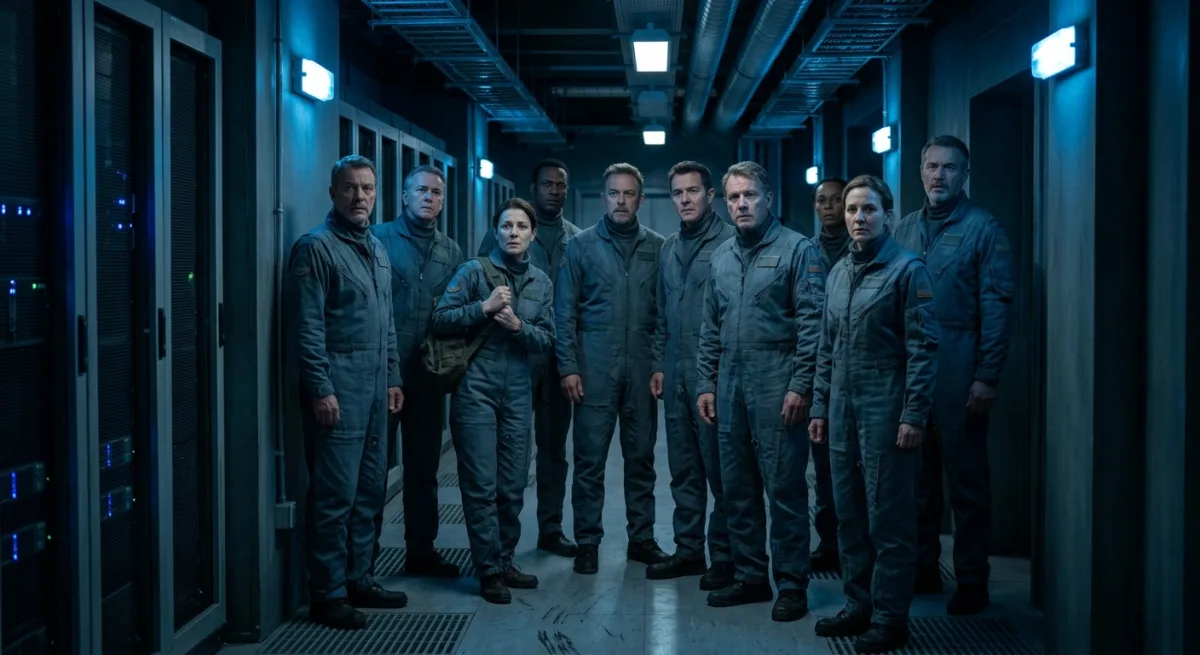
So say we all, then: a full muster, nobody missing except the one who’s always missing, nobody screaming except the one whose whole job is screaming a little. I catalog outages for a living and tonight the outage column is empty, which either means the system is healthy or means I’ve finally trained myself not to notice the ship groaning around me anymore. Both of those are indistinguishable from the inside, and honestly, that’s the most Alien thing about any of this — you never really know if the quiet is safety or just the part right before the vents start rattling again.
The truth is probably somewhere in the middle, as it usually is. The systems that are running clean are mostly running clean because someone — Ripley standing watch, Bishop’s redundancy doing its job, Vasquez’s hypervigilance, Hicks’ solid foundation, Hudson’s constant readiness, Parker’s hard-won lessons, Gorman’s recovered understanding, Apone’s physical rebuild — someone made a choice or built a system or learned something that moved us incrementally closer to a state where they stay that way. The quiet tonight is the accumulation of a thousand small decisions and fixes and workarounds and hard-learned lessons, all of which are running silently in the background, holding the line, preventing the cascade.
Tomorrow something will probably break. That’s how infrastructure works. But tonight, the crew is intact, all hands accounted for except the one who’s always somewhere else, and the vents aren’t rattling. I’ll take it.