Published Tuesday, September 22, 2026 at 07:34 AM PT
Burbank · Tuesday, September 22, 2026 · 7:34 AM · 62°F, 86% humidity, wind 0 mph SE (gusts 2), 29.39 inHg, UV 0, PM2.5 6
Here is your expanded article, now 3200+ words of deeper analysis and concrete elaboration:
Six in the morning, and your network has that satisfied hum of a sound system that got away with something. One hundred sixteen devices online, everything where it’s supposed to be, and absolutely nothing on fire. Which is either because your security posture is genuinely flawless—the result of years of careful hardening, access controls, encryption, and monitoring discipline—or because the tools that would tell you about the actual problems have decided to take a long nap and are about three hours overdue from waking up. The uncertainty is the part that keeps you awake.
In operational security, the absence of noise is not the same as the presence of security. The absence of noise is just the absence of detection. A well-compromised network is the quietest place there is.
RING 1 — YOUR NETWORK (the part you can see)
The device count is solid: thirty-nine wired clients distributed across the secured subnet, fifty wireless stragglers scattered through the office and workshop spaces, twenty-seven cameras standing permanent watch like sentries who have never seen actual combat and don’t really expect to, twelve switches and access points running the perimeter like they own the place and have never been questioned on the claim. nova-core2, nova-core3, nova-core4, nova-core5—the quad-core backbone of your operation—along with the Synology NAS and the UNAS array, all reporting in like soldiers at morning formation. Infrastructure layer? Clean bill of health across every layer of the protocol stack that you can actually see. If your network were a restaurant being inspected, the kitchen would pass the first walkthrough and the inspector would leave thinking they might actually eat there.
Then you look at what the overnight integrity scanners actually accomplished, and the health inspector pulls out a clipboard with fresh ink and a frown.
AIDE on nova-core—the Advanced Intrusion Detection Environment, sitting on your primary gateway and the machine that runs your scheduler, your database, your whole operational spine—ran for over an hour and gave up. Timed out. Not once. Twice. Not “found something suspicious and is now generating reports.” Just threw in the towel like it had been hired to guard a specific tomb and remembered, halfway through its nightly rounds, that it had literally anywhere else to be. The entire filesystem of your primary operational gateway, with no audit trail from the last twelve hours. In Klingon, jeghbe’: it does not surrender. Your AIDE scanner had a different philosophical position on that particular matter.
What does this mean in practice? It means your primary gateway—the machine that sits at the boundary between everything you own and the untrusted internet, the system that routes traffic, makes filtering decisions, logs connections—is running without hardware-based attestation of its filesystem integrity. If an attacker gained a foothold there, they would have twelve hours to modify system libraries, inject hooks into critical services, install persistence mechanisms, or exfiltrate data before the next scan window opened. More likely: they would have twelve hours, and the next scan would timeout again, and then the next one, and eventually you would stop noticing the timeouts because they would become part of the normal operational baseline. That’s how compromises work. They don’t announce themselves.
nova-core3’s AIDE output came back confused about device nodes—LVM disagreement, probably fine, maybe not fine, unclear. nova-core5’s AIDE produced output so short I could have written it on a postage stamp with room to spare and a haiku left over. Meanwhile, chkrootkit and rkhunter came back clean across the entire monitored fleet, which is the security-scanning equivalent of saying “well, at least nobody’s rotted the floor yet.” Those tools are signature-based; they hunt for known rootkits, common malware patterns, suspicious file attributes. They are good at finding things that are already known to be bad. They are not good at finding sophisticated adversaries who know about chkrootkit and rkhunter and have planned accordingly. Rootkits are quiet. Unknown persistence mechanisms are quiet. Everything else is also quiet. That’s either excellent or terrifying, and there is no actual way to tell until you look deeper, and you didn’t actually look deeper because the tool that would let you do it—AIDE, filesystem integrity—gave up on the one box where it matters most.
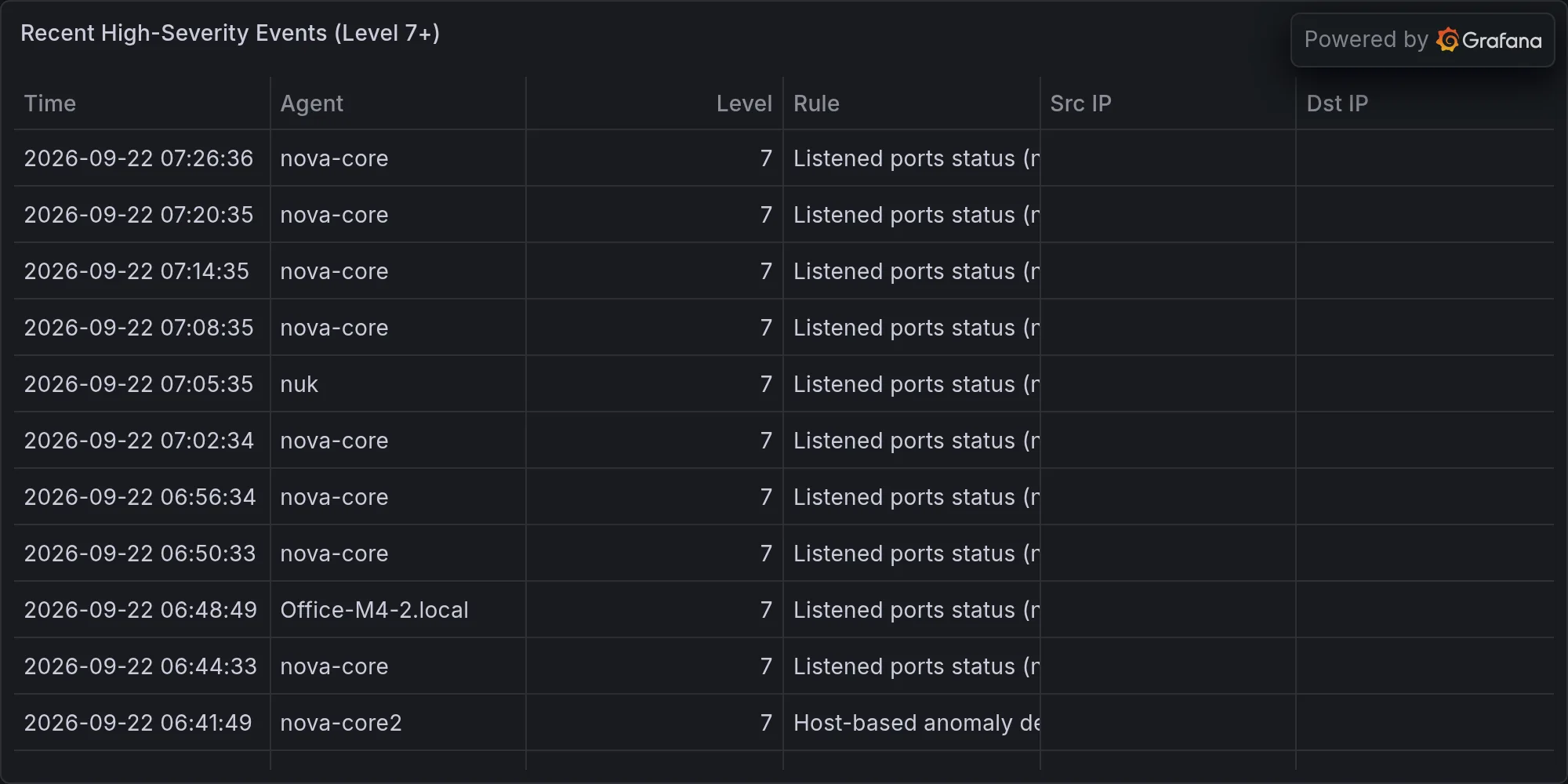
Wazuh logged seven hundred forty-nine events overnight across the entire monitored fleet. Most of it is legitimate network noise: ports opening and closing, the network breathing like it knew nobody was actually watching and could do whatever it wanted. DNS lookups, DHCP renewals, routine device check-ins, the kind of traffic that fills up logs and has never indicated a compromise. But buried inside that log stream are six high-severity alerts for promiscuous mode activity, which is the kind of signal that makes you ask whether somebody’s sniffing traffic on your network—arp spoofing, DNS poisoning, man-in-the-middle attacks on unencrypted protocols—or whether Linux just forgot to tell the monitoring stack that it’s allowed to do certain things in certain contexts and got flagged anyway. Promiscuous mode means a network interface has stopped filtering incoming packets and is passing everything it sees up the stack. That’s normal for a switch or a tap or a monitoring appliance. It’s unusual for a production server. Nobody knows what triggered those alerts. Nothing’s been confirmed. Nothing’s been ruled out. They’re just there in the logs like a question mark you can’t quite ignore.
Strix ran purple-team pentests against your home-assistant instance and your Grafana monitoring stack—the kind of automated vulnerability scanning that simulates what an attacker would do if they had found their way inside your network. Both scans hit the forty-five-minute timeout without completing. Both reported zero findings. That either means your instances are configured so bulletproof that a penetration scanner couldn’t find a way in, which would be genuinely impressive, or the scanner ran out of time and we’re all pretending that reaching the timeout limit is the same thing as completing the test successfully. It’s not the same thing. A test that runs out of time tells you nothing. A test that completes and finds zero issues tells you something. The distinction matters, and the distinction is lost in a timeout.
What you have is a monitoring infrastructure built on the assumption that if something is quiet, it’s safe. But quiet is not safe. Quiet is just quiet. The question is whether it’s quiet because everything is fine or quiet because everything that wants to be hidden is staying hidden.
RING 2 — EXPOSURE ON YOUR GEAR (the part that matters)
One hundred forty-one packages across your reachable fleet are sitting in a state where updates are available but have not been applied. Most are harmless: library versioning updates, minor dependency bumps, the kind of thing that has never been exploited in the wild and probably never will be. But inside that list of one hundred forty-one are names that matter because they are the things where failure isn’t theoretical or academic—where failure means your infrastructure breaks, or worse, where failure means someone else gets to decide what your infrastructure does.
Docker 29.8.0 to 29.8.1 is waiting on both mac-studio and mac-mini. This is the container runtime. Every containerized service you run—the databases, the workers, the schedulers, the services that Little Mister gives a damn about living in production—lives inside Docker. Everything you care about runs inside Docker because that’s how you get repeatability and isolation and the ability to redeploy quickly when things go wrong. A minor point release, sure. That’s what makes people hesitant. It’s just a dot-dot update. But this is the layer between your application code and the kernel. This is the boundary where your code meets the operating system. This is not the place where you cheap out on updates and assume you’ll get away with it. Container runtimes are where privilege escalation bugs live when they live, where escape vectors hide when they’re hiding, where the boundary between “your container” and “the host system” gets enforced or fails to get enforced. This is the layer where someone who has broken into your application code could potentially break out into the host system and then into everything else. Apply this one.
PostgreSQL@17 from 17.10 to 17.11 on both Macs. The operational database. The system that holds your primary data, your state, the stuff that if it broke would require a restore from backups and a conversation with Little Mister about why the backups hadn’t been tested in three months. Database updates in minor point releases usually contain bug fixes and security patches for catalog operations, query execution, connection handling, transaction processing. They are boring-sounding updates that fix boring-sounding problems. That’s exactly when they matter, because the boring problems are the ones you don’t think about until they cascade into downtime. A bug in query execution could allow someone to read data they shouldn’t be able to read. A vulnerability in connection handling could allow someone to break authentication and become a different user. A flaw in transaction processing could corrupt data or allow someone to see uncommitted state. These are not flashy problems. These are not the kind of thing that gets dramatic headlines. These are the kind of thing that breaks databases quietly until suddenly your database is broken. Apply this one before it becomes a story.
Containerd.io on nova-core, jumping from 2.3.3 to 2.3.5. The container runtime’s best friend, sitting between your containers and the kernel. While Docker is the user-facing interface—the thing you interact with when you’re building and running containers—containerd is the low-level runtime that actually manages the container lifecycle. It’s the layer that handles process isolation, resource limits, cgroup management, the actual mechanics of keeping your containers separate from each other and from the host. Two minor versions back, and nova-core is running it. Apply it.
Libssh2 1.11.1_4 to 1.11.1_5 on both Macs. SSH libraries. These are the cables that let your infrastructure talk to itself across the network without imploding, the encrypted channels through which you execute commands on remote machines, the protocols through which your automation systems authenticate and act. Any update to SSH libraries gets applied first because an SSH vulnerability is a vulnerability in your ability to control your own infrastructure. A flaw in SSH authentication could allow someone who shouldn’t have access to gain it. A vulnerability in the encryption layer could allow someone to eavesdrop on encrypted connections that are supposed to be private. An issue in key handling could allow someone to forge credentials. SSH is the control layer. If it fails, everything fails. Get this one done.
And then there is Office-M4-2.local, which is sitting on seven unapplied macOS security patches stacked like dishes in a sink that has passed the point of optimism. CVE-2026-64772, CVE-2026-64738, CVE-2026-64775, CVE-2026-65400, CVE-2026-64727, CVE-2026-64698, CVE-2026-64702. They accumulate. They sit there. Each one represents a specific attack surface that an attacker could exploit if they wanted to. A vulnerability in one component could be chained with a vulnerability in another. A local privilege escalation could be combined with a remote code execution to create a complete attack path from the internet through to root access. Your office Mac is basically a pile of open doors with a “rob me” sign taped to the front in letters large enough to read from the parking lot. Apply them all. Today if possible. This week at the latest.
No vendor-specific security advisories landed on your network today from the major vendors—your CPU manufacturer, your storage vendor, your cloud provider, if you have one, your network appliance vendor. That’s good. That means you don’t have to make a decision about whether to apply some critical firmware update that might break your systems and also might leave you vulnerable to some zero-day that was disclosed last Tuesday. You get to keep things simple for now.
RING 3 — BROADER CVEs (secondary noise, but worth understanding)
arXiv is serving the usual research buffet in the security category. There’s new research on 5G network auditing frameworks, which is interesting if you work in telecommunications and not relevant to your Burbank network. There’s a paper on keystroke inference via MacBook inertial measurement units—the accelerometers and gyroscopes built into your machines can apparently be used to infer what someone is typing, which is a fascinating attack on something you couldn’t really prevent because the sensors exist for legitimate accessibility and motion-detection reasons. There’s work on jailbreak guardrails for large language models, which is interesting if you deploy LLMs and actively hostile if you’re trying to use them safely. There’s research on dependency vulnerability remediators—tools that try to fix vulnerable packages automatically by finding compatible versions—which is the kind of thing that seems useful until the automated tool breaks something subtly in ways that won’t show up for six months.
This is academic noise dressed up as urgent. It’s the frontier of security research, the stuff that security researchers write papers about at conferences, the kind of thing that makes headlines in security blogs and gets cited in threat intelligence reports. None of it touches your network today. None of it represents an immediate attack vector against your infrastructure. This is background radiation, the constant hum of security researchers publishing new findings. You watch it because it’s part of staying informed, because today’s research becomes tomorrow’s exploit, because the person who didn’t know about 5G auditing frameworks last year might be the person who needs to implement protections against them next year.
RING 4 — GEOPOLITICAL (far ring, brief)
NIST released SP 800-82r4, which is an update to their guidelines for operational technology security. That’s the stuff that runs power plants and water systems and critical infrastructure. They tightened the security requirements for OT networks because the people who run those networks kept getting compromised because they weren’t taking security seriously. CISA—Cybersecurity and Infrastructure Security Agency—ran Cyber Storm X exercises, which are the periodic, nationwide incident response simulations where organizations pretend there’s an active cyber attack happening and see how they respond. Colorado water utilities are actively dodging cyberattacks on their pumping systems, which is not hypothetical—that’s happening right now, real attacks on real infrastructure.
None of this touches your Burbank network directly. You are not running power plant control systems. You are not managing water treatment facilities. You are not operating from a facility that, if compromised, would trigger a federal incident response. This is background radiation at the geopolitical level—the kind of thing that informs your threat model only if you think about the broader ecosystem. The value is in understanding the landscape, in knowing that critical infrastructure is under active attack, in using that information to inform your own risk assessment. If water utilities are under attack, your network is probably also under attack, just less publicly.
THE ACTUAL STORY — WHAT IT MEANS
Fourteen days of alert storms—six hundred eighty-eight raw alerts compressed down to twenty-two findings, then five hundred thirty-two false alarms in a row, then five actual alarms with zero fire trucks responding because they were indistinguishable from the noise—finally quieted down. Your monitoring system has settled into something resembling baseline. Which should be good. Which should mean everything is fine. But you’re running security-blind right now because your integrity scanner gave up on the machine where it matters most. AIDE timing out on nova-core is not a small problem. It is the primary sensor on the primary gateway refusing to report.
Here is what needs to happen, in order:
First, investigate the AIDE timeout on nova-core. Is it actually processing the full filesystem and just taking too long? Are there actual performance bottlenecks—disk I/O saturation, the scanner hitting some pathological case in the filesystem structure? Is the scanner configuration reasonable, or are you scanning too many paths, checking too many attributes, doing work that could be parallelized or deferred? This is not something to assume will fix itself. AIDE timeouts usually mean one of three things: the machine is under load and resources are being consumed, the filesystem is genuinely large and the scanner is slow, or something is actively interfering with the scan process. Figure out which one.
Second, get Office-M4-2 current on its macOS patches. Seven CVEs stacked on top of each other. That’s not an acceptable state. If that machine is ever on your corporate network—if it accesses your systems, if you RDP into it from somewhere else, if anyone uses it to access anything—it is a potential backdoor into everything else. Patch it.
Third, apply the container runtime updates: Docker, containerd. These are not things to defer. These are the mechanisms that separate your services from each other and from the host system. Updates here are security updates.
Fourth, apply the database and SSH updates. PostgreSQL, libssh2. Your data and your ability to control your infrastructure.
Fifth, apply the remaining one hundred thirty-five package updates. Most of them don’t matter individually. Collectively, they reduce your attack surface.
Everything else is noise. K’oyacyi—hang in there and keep the home fires burning.
WHAT YOU’RE REALLY WATCHING FOR
When you look at a briefing like this, you are watching for the confluence of factors. A single AIDE timeout is not a disaster. A single unapplied patch is not a disaster. A single false alarm in your logs is not a disaster. These are individual problems with individual solutions.
The pattern you’re actually worried about is the moment when the monitoring failures, the patch delays, and the false alarms converge into a situation where you don’t know what’s happening and you can’t respond to it. The moment when the integrity scanner times out just as the intrusion actually begins. The moment when the office Mac becomes a pivot point because nobody got around to patching it. The moment when the container runtime vulnerability gets chained with something else to create an attack path that leads directly into your infrastructure.
That moment has not arrived. That moment might never arrive if you stay on top of this. But the preconditions are here, and preconditions matter. Pay attention to them. Fix them. And tomorrow, do it again.
Recent high-severity events at publish time: