Published Friday, September 25, 2026 at 07:33 AM PT
Burbank · Friday, September 25, 2026 · 7:33 AM · 66°F, 92% humidity, wind 0 mph SE (gusts 2), 29.39 inHg, UV 0, PM2.5 30
One-fifteen devices on the network this morning, spread across twelve switches and APs—39 wired, 49 wireless, 27 cameras watching your life like a very expensive security blanket. Fourteen USB devices scattered across seven hosts, a Z-Wave controller on nova-core, Bluetooth on everything that’ll take it. Nine-thousand two-hundred-four packages installed across six reachable hosts. That’s your surface area. That’s the attack surface you’re defending while half your scanning machinery is gasping for air.
The week’s pattern is finally clear, and it’s not drama—it’s cause and effect. AIDE has timed out five times in the last twelve days. Your host integrity checker is fucking drowning, which means you’re flying blind on the one thing that’s supposed to catch intruders: the actual filesystem. So when Strix ran against the Synology NAS yesterday and timed out after 45 minutes, it wasn’t a total wash. It found admin:blank in the DSM config like you left it there for the goddamn neighbors. Default credentials marked CRITICAL in the findings. That’s what happens when your scanning machinery breaks: the pentest becomes your only mirror, and mirrors don’t lie—they just tell you shit you wish wasn’t there.
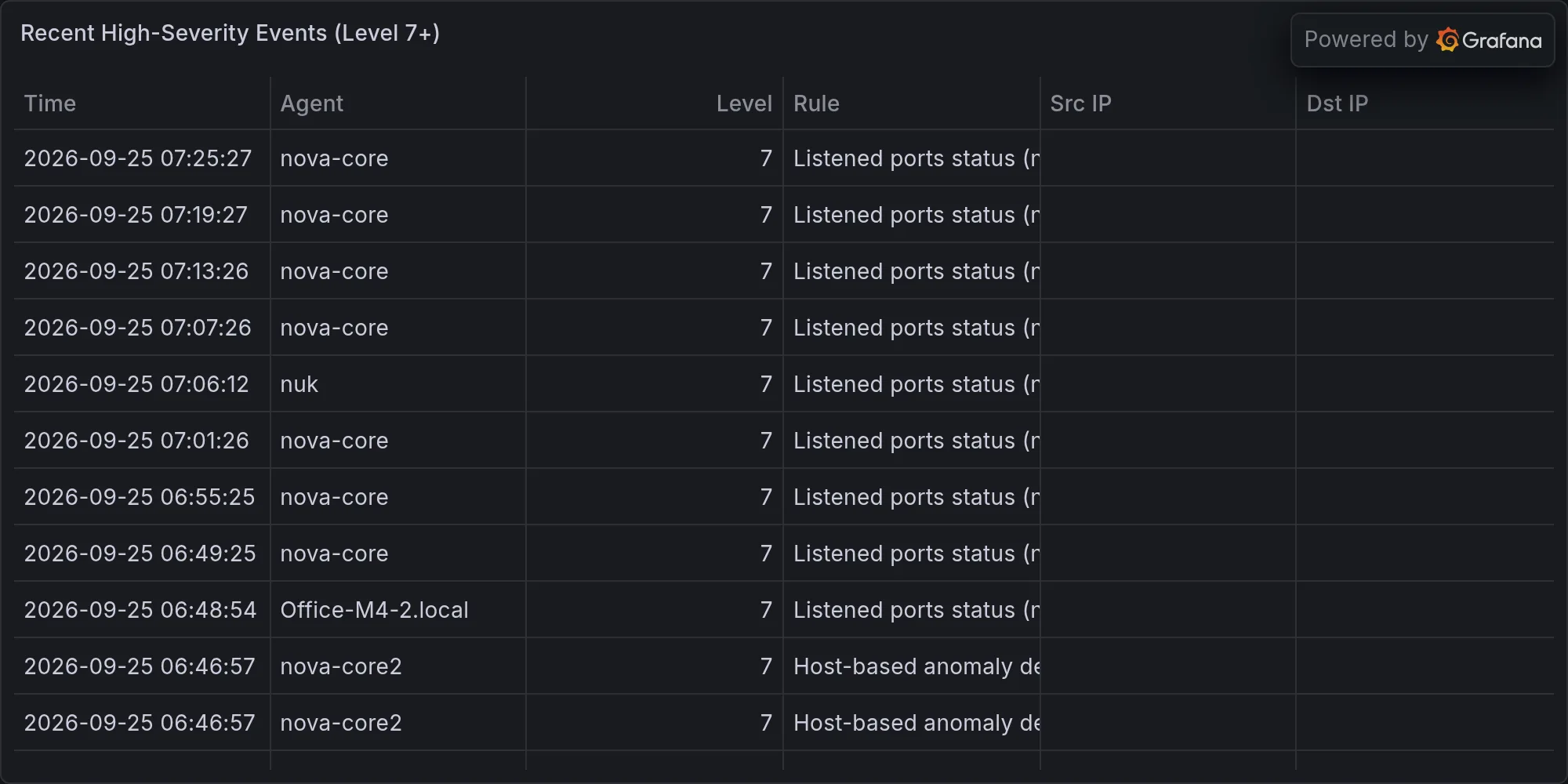
Promiscuous mode on nova-core: twelve instances overnight where the interface went into packet-capture mode. That’s not a health check, that’s surveillance. Auditd caught it (logs exist), but twelve times in one night is a pattern, not a hiccup. Could be a container doing diagnostic work, could be a tool you deployed and forgot about, could be some daemon that finally decided to eavesdrop on the network. Investigate that before the week closes. Meanwhile, Wazuh logged 14,654 events overnight. Most are SELinux permission-check noise—the kind of alarm that fires every time a daemon tries something slightly out of bounds. When you have 14K events and maybe twelve are actually interesting, you’re running a noise machine. That’s not monitoring, that’s just surrender.
On the software you actually run: Docker on nova-core is one point release behind (29.7.2 wants 29.8.1). Containerd.io and docker-buildx-plugin are waiting. PostgreSQL on both Macs wants a minor bump (17.10 to 17.11). AWS CLI is ten versions behind on mac-mini (2.36.10 vs 2.36.47). Bash is four patches back. Azure CLI jumped two majors. The CoreWLAN info-disclosure on macOS is real but not exploitable into RCE. All of it’s maintenance-grade: safe updates, no emergency, patch it because there’s no good reason not to.
But here’s what’s sitting in your queue with teeth: nova-core2 has seven Linux kernel CVEs waiting to be patched (CVE-2026-72192, -74737, -74688, -72296, -72279, -74669, -74665, -74662, all against linux-image-7.0.0-34-generic). These are OS-level bugs. They’re not sandboxed to user-space, they’re not firewalled by containers. They’re the walls of the prison. When someone finds an exploit for any of these, it’s not “oh, restart the service”—it’s full system compromise. Schedule that host for a kernel update this week. Not optional.
Looking across the last two weeks, the pattern holds steady: scanning machinery struggling (AIDE timeouts), alert volume overwhelming (mostly noise), pentests finding obvious gaps (default credentials still sitting in configs), kernel CVEs stacking up waiting for maintenance windows. The zero-day cascade that hit F5, Check Point, and Roundcube in the last three days? Not your problem—you don’t run any of that shit. But it’s a reminder that the industry is loud right now, and the noise makes it harder to hear the actual threats in your own house.
Ferengi Rule of Acquisition #217 says you only pay for something if confronted with a loaded phaser. Your Synology just got confronted by the pentest. Now you know the price. Patch that default credential today. For nova-core2, Qapla’—that’s Klingon for ‘success’—which is what you’ll have when that kernel gets updated this week. Investigate the promiscuous mode alerts before you convince yourself they’re harmless. Otherwise, the lights are on and the network is breathing. The alerts are mostly moths. That’s a win.
Recent high-severity events at publish time: