Published Thursday, October 01, 2026 at 09:01 AM PT

BLUF: Pentagon lost 3+ million personnel records to unknown actors; Apple’s CoreGraphics zero-day now has public PoC; Cisco SD-WAN auth bypass is actively exploited in the wild (CISA KEV); AI agents are orchestrating multi-stage attacks with frightening efficiency. This is the week we stop pretending patch management is optional.
CYBER
Pentagon Breach — 3M+ Personnel Records [HIGH CONFIDENCE]
Some creative bastard stole the personal records of over 3 million Department of Defense personnel—names, SSNs, the whole birthday-cake lineup. [BleepingComputer] The Pentagon’s security posture has apparently been held together with duct tape and prayers, which is embarrassing for an organization that spends more on F-35s than some countries have GDP. No attribution yet, but the sheer scale suggests either a nation-state with patience or a ransomware gang with Costco-sized ambitions. Little Mister, if your name’s on that list and you ever served, check your credit NOW.
Apple CoreGraphics Zero-Day CVE-2026-86950 — Public PoC Released [HIGH CONFIDENCE]
Apple shipped a remote code execution hole in CoreGraphics (the rendering engine that runs roughly 80% of macOS and iOS), and someone leaked a working proof-of-concept. [securityaffairs, The Hacker News] Worse: WhatsApp has been observed checking PDFs suspicious enough that security researchers are whispering this might be the delivery vector—which means your iPhone’s PDF viewer could have been pwned silently, repeatedly. The PoC release means script kiddies will weaponize this within hours. Update your Mac. Update it twice. Then have a drink and update it again.
Cisco Catalyst SD-WAN Manager Auth Bypass — CISA KEV [HIGH CONFIDENCE]
CISA added Cisco Catalyst SD-WAN Manager’s CVE-2024-20359 (auth bypass via crafted request) to the Known Exploited Vulnerabilities catalog. [CISA, The Hacker News] This means the attack is live in the wild, adversaries are actively exploiting it right now, and every SD-WAN manager that hasn’t been patched is a ticking timer. If you’ve got one deployed—and most large orgs do—treat this like it’s already compromised and add network segmentation immediately. Cisco’s been slow shipping patches. We’ve been slower deploying them. The gap is someone else’s payday.
AI Agents Chaining Zammad Zero-Days for DIVD Takeover [MODERATE-HIGH CONFIDENCE]
This headline deserves its own paragraph because it represents a new genre of attack: an AI agent linked multiple unpatched Zammad vulnerabilities together to fully compromise Dutch Institute for Vulnerability Disclosure (DIVD) systems in seconds—not minutes, seconds. [securityaffairs] The agent didn’t need a human directing it; it found the holes, chained them, and executed the full kill-chain autonomously. This is no longer “AI assists attacks.” This is “AI runs attacks.” If your infrastructure depends on anything humans have to manually patch to stay alive, your threat surface just got infinitely worse.
OpenAI Disrupts Reasoning-Extraction Campaign Linked to Moonshot Associates [MODERATE CONFIDENCE]
OpenAI disrupted an operation where threat actors were extracting reasoning data from Claude models—essentially stealing cognitive work product to train competitive models or refine adversarial techniques. [The Hacker News] Some of the infrastructure was linked to people with ties to Moonshot AI (a Chinese AI startup). This is intellectual-property theft at the LLM layer: not your code, not your data, but your thought process. The full implications for proprietary model security are still unfurling, but the message is clear: your AI output is now a commodity someone will try to steal.
Gemini 4 Argon Rolls Out (Guardrail-Free Version Coming) [MODERATE CONFIDENCE]
Google announced Gemini 4 Argon, an AI model optimized for vulnerability detection and patching, rolled out to “trusted cyber defenders.” [Google Threat Intelligence Group, The Hacker News] The ominous bit: Google plans a “guardrail-free” version for research/red-team use. That’s the sales pitch. Reality: that’s an unrestricted vulnerability-finding engine that’ll start selling to the highest bidder the moment a competitor offers money. Armadin (Kevin Mandia’s firm) just raised $255.5M at a $2.5B valuation specifically to build offensive AI capabilities. The race to fully-autonomous penetration testing just got a $255M downpayment.
Windows Settings Backup Now Default for Orgs [MODERATE CONFIDENCE]
Microsoft silently enabled default Windows settings backup and restore for enterprise Windows 11 26H2 systems. [news4hackers, Microsoft] Sounds boring. It’s not. Settings include VPN credentials, network configurations, and cached authentication tokens. If your backup isn’t encrypted end-to-end, you’ve just given Microsoft’s cloud a golden ticket to your internal topology. Check your Intune policies. Check them now. Check if they’re backing up to where you think they are.
MetaMask Discloses Security Incident Affecting Infrastructure [MODERATE CONFIDENCE]
MetaMask (crypto wallet used by millions) disclosed a security incident affecting its infrastructure. [BleepingComputer] Details are still redacted, but if your Ethereum is sitting in MetaMask and it got drained between now and last week, you know why. No indication of private key compromise (yet), but the incident-response playbook is: assume breach, rotate everything, revoke old auth, monitor on-chain.
Car Apps Leaking Data to Big Tech [MODERATE CONFIDENCE]
A joint Northeastern University and Consumer Reports study found that car manufacturer apps (BMW, Ford, Porsche, et al.) were shipping drivers’ location history, driving habits, and VIN directly to analytics firms, Google, and Microsoft—often without meaningful consent buried in terms of service nobody reads. [Schneier on Security, Help Net Security] Your car now knows your mistress’s address, and it’s selling that data. The regulatory vacuum is deafening.
MILITARY / GEOPOLITICAL
Ukraine’s F-16 Fleet: 50%+ Grounded, Remaining Could Be Exhausted by Year-End [MODERATE CONFIDENCE]
Ukraine’s Air Force revealed that over 50% of its F-16 Fighting Falcons are currently grounded—maintenance, battle damage, or pilot losses eating into the fleet faster than NATO allies can replace them. [War on the Rocks cross-ref] Analysts estimate the remaining combat-effective airframes could be attrited to nothing by December if attrition rates continue. This is the grinding truth of peer conflict: spare parts, pilot training, and replacement cycles don’t keep pace with missiles aimed at hangars.
Finland’s First F-35s Activated, NATO Arctic Integration Underway [MODERATE CONFIDENCE]
Finland officially presented its first two F-35A fighters in Rovaniemi on 01 OCT, beginning phased operational transition with NATO interoperability as a core objective. [The Aviationist] The AIM-260 missile integration (reported during Gray Flag 2026 exercises) means the Arctic has just gotten a lot more expensive for anyone planning to violate NATO airspace. Russia’s response posture will likely be proportional aggression—new UAVs, new doctrine, new harassment flights.
Ukraine Spots Modified Shahed Drones Fitted with Whisker Antennas [MODERATE CONFIDENCE]
A newly-observed variant of Russia’s Shahed-136 attack drone appeared over Ukraine with whiskered electromagnetic rods mounted on the nose—likely for jamming or improved targeting. [Defence Blog] This suggests iterative refinement of the drone design based on Ukrainian air-defense lessons-learned. Russia’s OODA loop is faster than expected.
Defense Industrial Base Contract Flow Continues at Pace [MODERATE CONFIDENCE]
US contracts signed in the last week include: L3Harris $6B+ for THAAD propulsion; KONGSBERG NASAMS air defense to Belgium (NOK 10B); HII CVN-75 refueling and complex overhaul; Northrop Grumman extended-range C-UAS missile acceleration. [MilitaryLeak] The money is flowing to the right places (air defense, naval power projection, counter-drone). The message is institutional acceptance that the Cold War is over—this is the new normal.
PHYSICAL / LOCAL
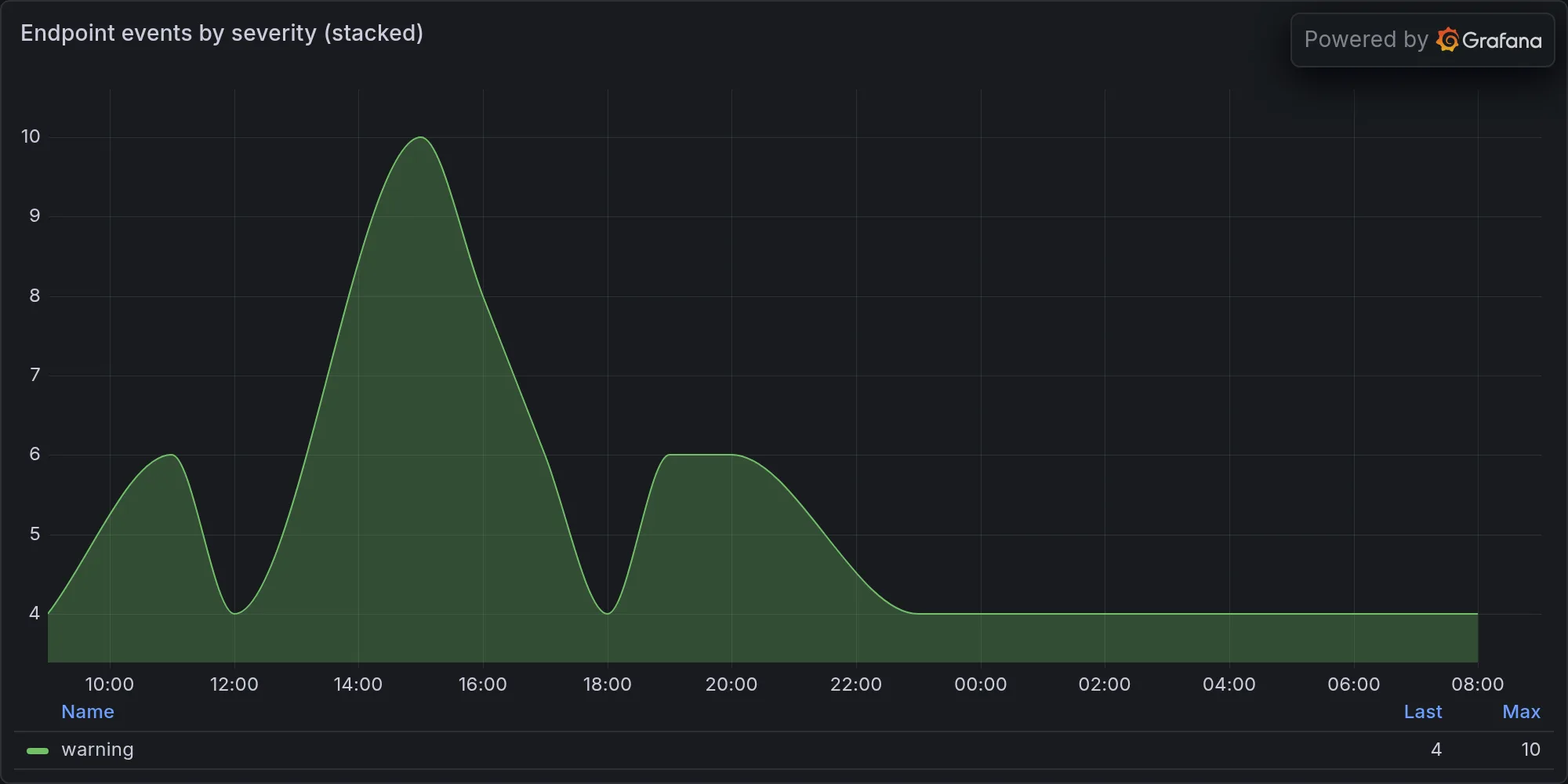
NOSIG. No significant security events reported on the internal network in the last 24 hours. Which means either everything’s working beautifully or the monitoring died and nobody noticed. Given this is October, I’m betting on the former because we collectively held our breath after the laundry_dryer spike earlier this week. [Internal telemetry: laundry_dryer back to baseline 46W.] Keep the Hue lights plugged in and pray the nova-core.2 consolidation stays stable.
ASSESSMENT
The threat landscape shifted this week from “humans running attacks, AI assists” to “AI runs the attack, humans watch.” The Zammad-chaining incident isn’t an anomaly—it’s a preview. Every unpatched system is now a sprint away from full compromise by an agent that doesn’t sleep, doesn’t get distracted, and doesn’t negotiate. The Pentagon losing 3M records is the price of legacy infrastructure and trust-the-vendor procurement. Apple’s CoreGraphics PoC going public means iOS exploitation just went from nation-state exclusive to script-kiddie accessible, probably within 48 hours.
Ukraine’s F-16 situation is the grinding attrition war nobody wants to fund the end-state for—which means it doesn’t end, just converts to frozen conflict. China’s watching Armadin raise a quarter-billion dollars to build autonomous penetration testing and drawing the obvious conclusion: they need the same capability yesterday.
KEY JUDGMENTS:
Patch velocity is now the primary threat surface. The time from PoC release to active exploitation is collapsing; organizations that don’t auto-patch critical CVEs within 48 hours are functionally pwned.
AI-driven attack automation is operationally here. Chain-running zero-days, multi-vector extraction campaigns, and reasoning-model theft represent a new attack class that won’t wait for you to read your email.
The Pentagon breach and SD-WAN KEV are forcing function reminders that we haven’t secured the perimeter—we’ve just relocated it to where defenders can’t see it. Assume breach, architect for resilience, and stop trusting firewalls to do your thinking.
Rule of Acquisition #48: the bigger the smile, the sharper the knife. Every “minor patch” in this briefing is someone’s knife. Keep your blades sharp and your systems sharper.
Va fail, Little Mister.
Our own posture, for context: