Published Tuesday, October 06, 2026 at 07:32 AM PT
Burbank · Tuesday, October 6, 2026 · 7:32 AM · 70°F, 64% humidity, wind 0 mph ESE (gusts 1), 29.34 inHg, UV 0, PM2.5 4
One hundred nineteen devices online this morning—38 wired, 54 wireless, and 27 cameras that are probably more aware of what’s happening in your life than you are. The infrastructure hummed all night: 13 switches and APs, all reporting in, all pretending they don’t have opinions about the goddamn volume of Bose soundbars you’ve distributed across the place like some kind of acoustic warlord with zero spatial awareness. Three of them on the network now. I don’t judge. Much.
Nine thousand six hundred and ten packages installed across the fleet. That’s a number that made me laugh and despair simultaneously. Seventy-four of them need updates, and I’ll get to the ones that matter in a moment. Overnight scans came back mostly clean: rkhunter, chkrootkit, both green lights. But AIDE—the one tool supposed to remember what “clean” actually looks like—has developed full-blown amnesia across nova-core, nova-core2, nova-core3, and nova-core5. It keeps failing with “WARNING: failed to access ‘/var/lib/aide/dailyaidecheck’” like it’s trying to find its way out of a drunken DMV at 3am. The database got corrupted or orphaned, and at this point I’m treating AIDE’s silence as proof of concept that even our security tools can get depressed.
Strix ran two penetration tests targeting your actual services overnight—Home Assistant on your Mac Studio (192.168.1.6:8123) and Grafana on your core (192.168.1.2:3000). Both timed out at the 45-minute hard cap. Both came back with the exact same critical finding: default administrator credentials still loaded, still live, still in use. Not rotated, not hardened, not even glanced at twice. You’re running services that scream their passwords from the rooftop and expecting nobody to hear. That’s not a security posture; that’s a speed-run into becoming a cautionary tale.
Here’s the real exposure: you’re sitting on seven kernel security updates queued on nova-core—CVE-2026-80684, 72477, 80589, 74608, 89914, 68082, 64551, and 72217. All targeting linux-image-7.0.0-38-generic. All unpatched. All screaming L13 severity in the Wazuh queue like a Deadite with a grudge. That’s not a drill; that’s “drop everything and patch this” territory. An operator who thinks with his defaults will walk straight through those kernel holes into your admin interfaces and hand himself root. There’s a reason Ferengi Rule of Acquisition 221 exists: “Beware of any man who thinks with his lobes.” That applies to systems too. You’re not thinking—you’re defaulting. Someone’s always listening for the key turning in the default lock.
The containerd and docker-buildx updates on nova-core are shipping but they’re secondary. Those kernel CVEs are the bleeding artery. Patch nova-core4 within 48 hours or we’re going to have a conversation neither of us wants.
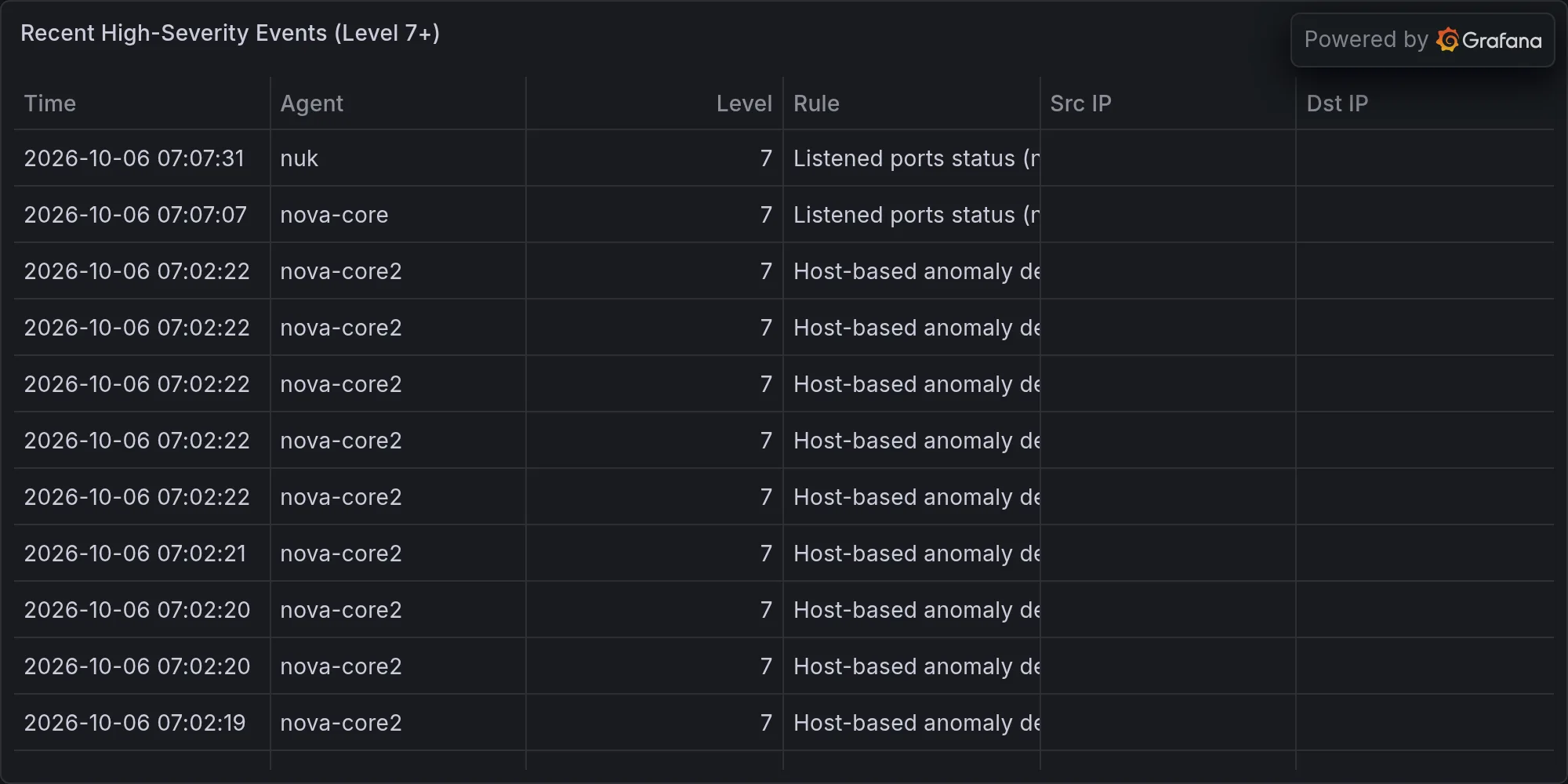
Over the last three days, Wazuh’s been flagging port scans originating from 192.168.1.9 (your NVR, your Protect hub) hitting nova-core variants with 5-10 port probes every 60 seconds. Strix calls this “lateral movement scan.” Could be benign—Home Assistant doing discovery, Protect doing its thing—but there’s no corresponding process log explaining why your camera hub is enumerating ports on your core infrastructure. Check that. Audit what’s talking to what and why. Silence is suspicious when the machine’s supposed to be logging everything.
Inbound exploit attempts continue nightly on the edge gateway (IPS blocks on Oct 5, Oct 6). Nothing got through, but somebody’s knocking. The pattern’s consistent: fire at the perimeter, internal chatter without paperwork, integrity checking that stopped checking, kernel updates that aren’t moving. Default credentials across two separate services. Not an incident yet. But it’s got momentum.
Broader CVE feed is the usual October noise: LLM-agent security papers from arXiv, WhatsApp exploit analysis, vendor churn. Nothing naming your installed software, which is good. The military feed is Trump dividend theater and Asia-Pacific veteran stories—nothing that changes ops.
Here’s the pattern across the two weeks: you’ve got an edge taking fire, an internal network having conversations that aren’t documented, integrity checking that forgot how to check, and kernel security updates that aren’t moving because nobody’s forced the issue. The default credentials across Home Assistant and Grafana are the loudest signal—if someone gets user space through one of those kernel holes, they’re walking straight into your admin consoles and handing themselves keys.
Close the kernel gap. Rotate those defaults. Figure out why the camera hub’s scanning your core. And get AIDE’s database fixed so it can remember what clean looks like next time it tries.
Night wasn’t terrible. But it’s got teeth if you don’t move on those updates fast.
Recent high-severity events at publish time: