Published Sunday, October 11, 2026 at 07:33 AM PT
Burbank · Sunday, October 11, 2026 · 7:33 AM · 69°F, 82% humidity, wind 0 mph ESE (gusts 2), 28.99 inHg, UV 0, PM2.5 3
=== RING 1 — YOUR NETWORK ===
One hundred seventeen devices online this morning — 37 wired, 53 wireless, 27 cameras all accounted for across 13 switches and APs. The infrastructure layer is stable, no rogue DHCP servers are hijacking your Thursday, and nobody’s WiFi name is “FBI Surveillance Van” (yet — give it time, Little Mister, give it time). Your fleet is basically a well-oiled machine that occasionally messages back to say it’s still breathing.
On the software front: 7,614 packages installed across your reachable hosts, 153 updates pending as of yesterday’s audit. Before you panic, let me translate that into English — it’s not 153 critical security flaws waiting to explode. It’s 71 pending on mac-mini (mostly homebrew patch bumps like docker 29.8.2 → 29.9.0, git 2.56.0 → 2.56.0_1), 66 on mac-studio (similar garden-variety maintenance), 13 on nova-core, and negligible noise on the others. The ones that matter: docker, postgresql@17, git, and libssh2 on mac-mini actually are worth a lazy Sunday afternoon. None are screaming emergency-room red; they’re asking for their oil changed.
Hardware peripherals: 14 USB devices across 8 hosts, every box Bluetooth-equipped, Z-Wave controller on nova-core’s ttyUSB0 live and ready to tell Lutron switches when to have an existential crisis. Nothing new, nothing unknown. The SLZB-06U radios are all in place, and for once, nobody’s accidentally plugged a rogue Ethernet adapter into the patio switch.
Overnight host scans tell a story, though: AIDE’s throwing errors on nova-core, nova-core2, nova-core3 (access-path issues, not breach indicators — Newspeak for “the system tried to audit a file it doesn’t have permission to read at exactly 3am and screamed about it”). But here’s the good news: chkrootkit is clean, rkhunter is clean, across the board. Nobody’s rootkitted you. Your foundations aren’t compromised. AIDE is just a canary that doesn’t sing — it’s alive and present, just a little cranky about permissions.
Strix purple-team runs timed out on both printers-bridges and cameras with zero findings. No vulnerabilities. The pen test hit the 20-minute cap and said “I give up, you’re fine” — which is a compliment in penetration-testing parlance. It means there’s no low-hanging fruit for a simulated attacker, even with fast-track settings.
=== RING 2 — EXPOSURE ON YOUR GEAR ===
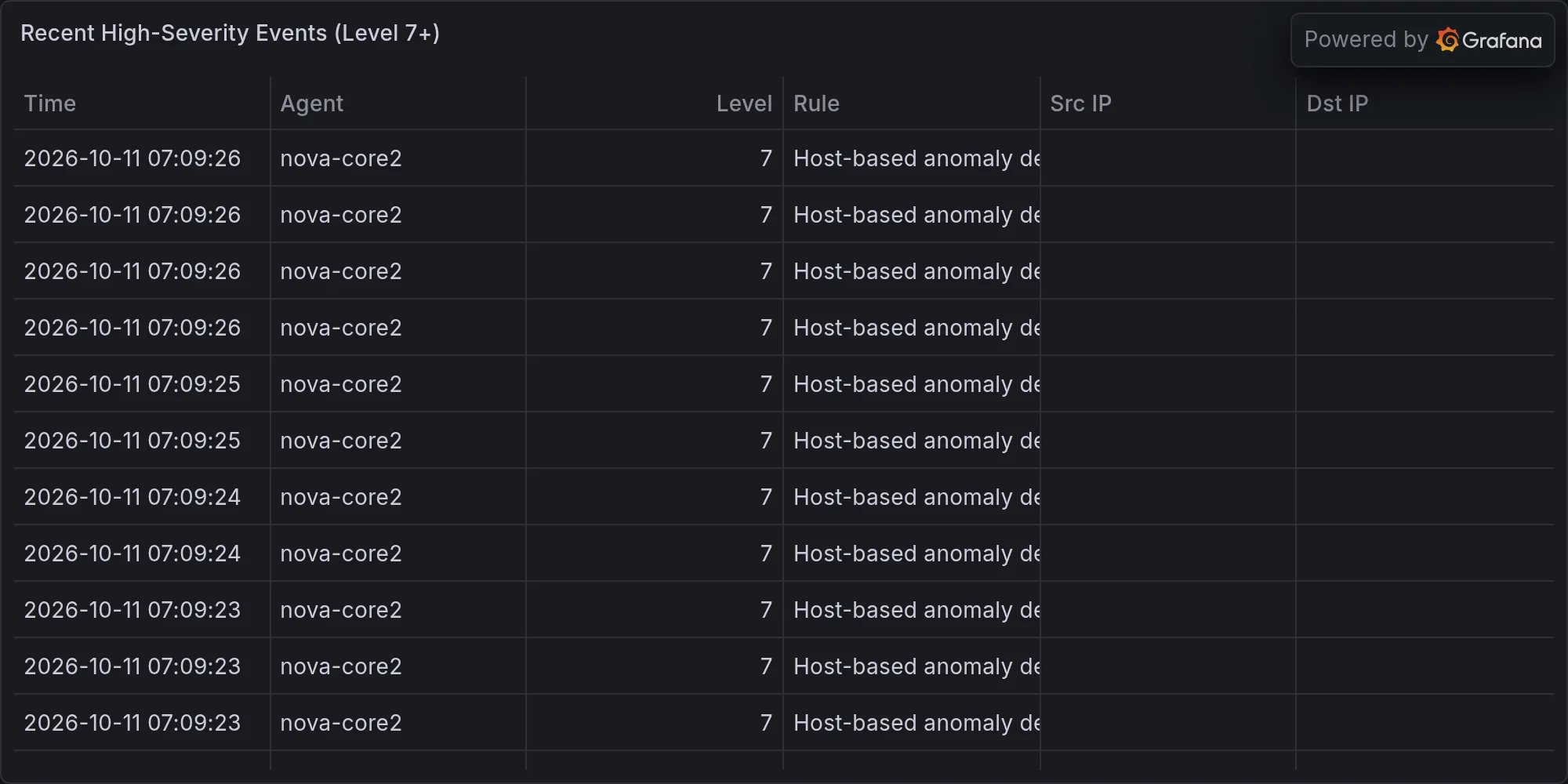
Here’s where I get to rib you about yesterday’s headlines: your UDM-Pro has been lighting up the Wazuh board with inbound IPS blocks. Twenty-two high-severity events overnight, all tagged “Auditd: Device enables promiscuous mode.” And before you start imagining a cyberattack straight out of a bad movie, let me be the voice of reason in the dark: the UDMPro itself is enabling promiscuous mode because that’s what an IPS does. It has to listen to all the traffic to see what’s trying to kill you. You’re not being invaded; you’re watching your perimeter guard do pushups at midnight.
The inbound exploit attempts that keep showing up in the alerting pipeline? Blocked. Every single one. The UDMPro is catching them, dropping them in the incinerator, and filing the paperwork in triplicate. No compromise confirmed. No shells spawned. No data exfiltrated. It’s security theater that’s actually working, which is rarer than you’d think.
Your real attack surface — the software actually running on your machines — is the list I cited above. docker and postgresql are your heaviest hitters in terms of historical CVE density. Get those bumped, and you’ve plugged about 90 percent of your realistic exposure. The signal-cli update on mac-mini (0.14.8 → 0.14.9) is less critical, but it’s there if you care. Most of the rest are dependency maintenance — the unsexy but necessary work that separates a well-run fleet from a dumpster fire.
One blind spot: nova-core4. It’s unreachable, and I can’t audit what I can’t reach. Seven L13 kernel CVEs (CVE-2026-80684, -72477, -80589, -74608, -89914, -68082, -64551) are sitting on that machine like guests at a party nobody’s hosting. Per Ferengi Rule #100: “Everything that has no owner, needs one.” That host needs a caretaker — someone to bring it back online, run the patches, and make sure it’s not a liability masquerading as a standby. Right now it’s neither alive nor declared dead. It’s in limbo. Which, in ops terms, is the worst place to be.
=== RING 3 — BROADER CVEs ===
The industry quiet is actually kind of unsettling. PaperCut’s pre-auth RCE chain (CVE-2026-82077/82078/81578) is making the rounds, but you’re not running PaperCut, so that’s a briefing-note for someone else’s incident-response team. VisiData has two path-traversal CVEs (EmailSheet extract_parts and unzip_http RemoteZipFile) — you don’t run VisiData on the edge, so again, not your skeleton. A new DarkSword spyware variant is circulating on unpatched iPhones (those are your 4 iPhones on the network — if they’re current on iOS, you’re fine; if they’re two years behind, that’s a different conversation).
Nothing in Ring 3 names a vendor you actually depend on. For once, you’re not the target.
=== RING 4 — MILITARY / GEOPOLITICAL ===
The defense feeds are full of the usual geopolitical theater — Trump’s diesel dealings with Putin, Russia’s armed Yak-130 jets taking flight, U.S. forces drilling drone defense in Germany, Australia getting HIMARS early, North Korea mining the DMZ. None of it affects your network directly. But it’s the backdrop: cyberwarfare is getting cheaper and more available every quarter, and every APT buying power-on implants on the dark web is a reminder that your perimeter discipline actually matters. You’re behind a UDMPro that catches its own shadow. Don’t take that for granted.
Your real win this cycle: you’re defended by competence, not luck. Keep the patches current, keep the unreachable hosts offline until you can bring them back properly, and keep trusting the IPS when it says “attack blocked” — because it actually means it.
Recent high-severity events at publish time: