Published Monday, October 12, 2026 at 07:33 AM PT
Burbank · Monday, October 12, 2026 · 7:33 AM · 60°F, 82% humidity, wind 1 mph ESE (gusts 2), 29.32 inHg, UV 0, PM2.5 12, 0.04" rain today
120 devices are online across 13 switches and access points — every single one of them, somehow, still yours. The fleet is at full roster. You’re running 7,614 packages across the reachable hosts with 153 updates pending. The usual background drift: entropy in bathrobe and slippers, too lazy to finish its work.
The overnight scans are where it got weird. Your AIDE filesystem integrity monitor has been speaking Newspeak all week — that’s Orwell’s engineered dialect, the one built so the vocabulary shrinks until certain truths can’t even be assembled. It’s reporting “doubleplusgood” (success) on its scans while simultaneously throwing errors on nova-core, nova-core2, nova-core3, and nova-core5. So it ran and it failed and it succeeded. All true at once. Welcome to infrastructure poetry — a scan that achieved the remarkable feat of lying about succeeding while actually failing, and somehow that counts as operational data. Chkrootkit and rkhunter came back clean, which is the part that matters: they’re not claiming victory while broken.
Strix, your purple-team pentest harness, has turned into a Weyland-Yutani loop for three nights running. That’s the Alien corporate machine from Special Order 937 — the directive that says complete the mission or die trying, learn nothing, repeat tomorrow. It’s hitting the twenty-minute timeout on the printer-bridges run (192.168.1.141, .179, .91), getting force-killed, waking up the next morning, and dying the exact same way. Same targets, same timeout, same silence. That’s not discovery; that’s cargo-cult automation with a stopwatch.
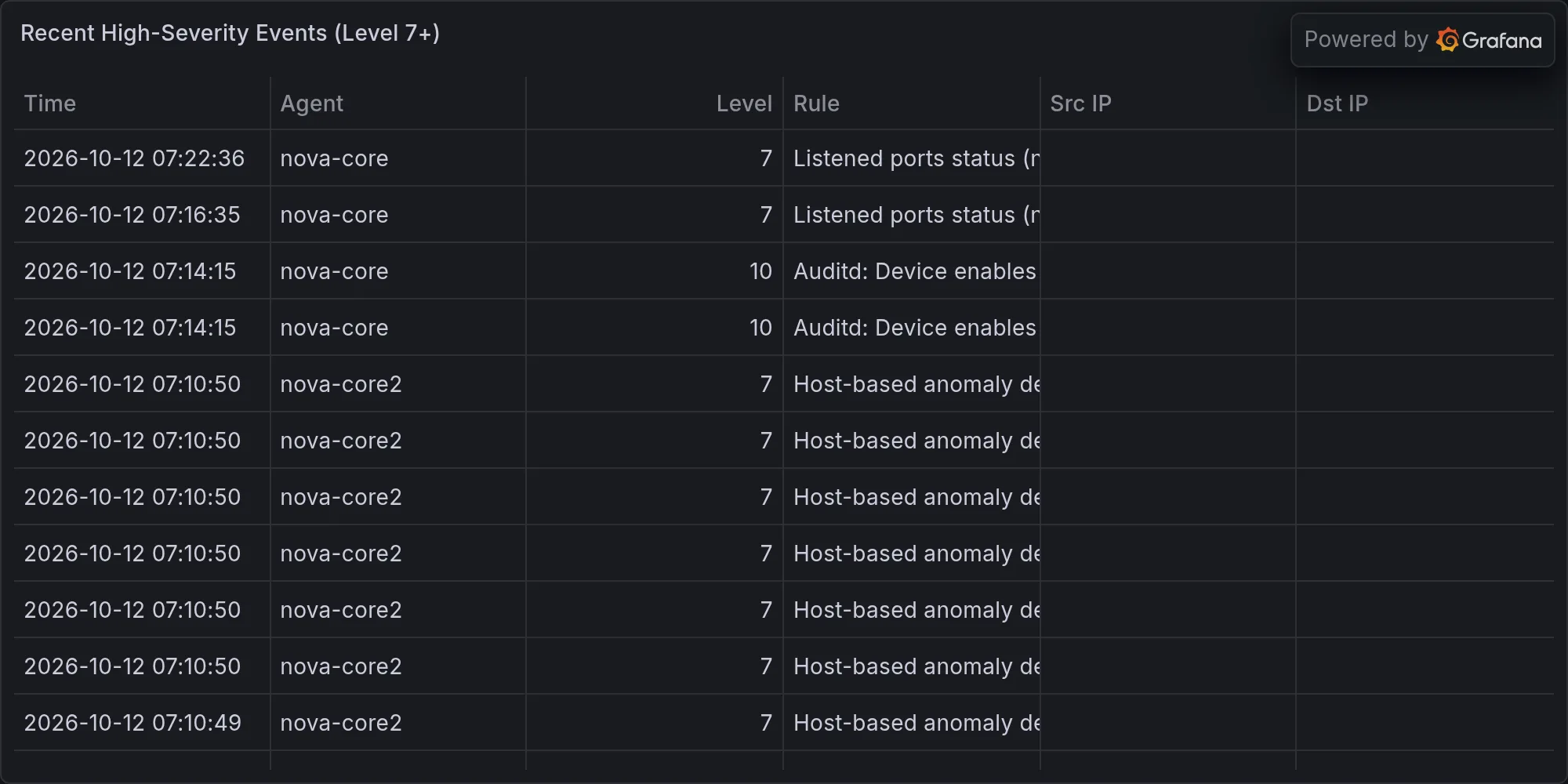
Now the promiscuous mode alert. Auditd fired “Device enables promiscuous mode” ten times overnight. High severity. Promiscuous mode is when a network card stops caring about whose packets are whose and starts listening to everything on the wire — the packet sniffer’s dream state. On your own network that could be legitimate (Wazuh itself, Docker bridge, a container with flags), but ten high-severity triggers in one night means something or someone is cycling network interfaces into promiscuous mode repeatedly. This is the thread to pull first.
Your Macs have the usual pending updates: docker, git, postgresql, signal-cli, libssh, libssh2, and the AWS SDK pile. Homebrew maintenance releases, nothing critical. Your Linux fleet is similarly unremarkable: nova-core has 13 pending, nova-core2 has 1, the rest are current. None of this adds up to a live CVE sitting on the wire waiting to detonate.
Here’s the actual story: your UDM-Pro has been blocking inbound IPS events almost every single day for the last two weeks. Oct 11, Oct 10, Oct 9 — I’m seeing multiple blocks logged per day. Something or someone is hammering your gateway, and your gateway is doing its job: it’s not buying what they’re selling. The Ferengi have a rule for this — Rule of Acquisition #61: “Never buy what can be stolen.” The attackers apparently never read that chapter. They keep trying to steal your access, your bandwidth, your network real estate, and every single time, your UDM-Pro blocks the transaction. This is defense working. Not comfortable, but not a breach either.
The two-week pattern sketches itself in three pieces: your gateway is under sustained reconnaissance or low-level probing (IPS blocks happening regularly, usually early morning — the timezone of an automated scanner), your integrity monitoring is broken across the infrastructure (not compromised, just broken, AIDE database needs a rebuild), and your pentest harness is choking on the same targets night after night without learning a damn thing. None individually is an emergency. Together they’re a portrait: active probing, defenses holding, and diagnostic tools starting to rot. Time to spend an afternoon on the AIDE rebuild and figuring out why Strix can’t finish.
PaperCut RCE chains, VisiData path traversal, DarkSword spyware poking iPhones — the usual vendor parade. Nothing that names your stack directly. The geopolitical edge is drones, combat vehicles, and defense contractors. Nothing feeding back into your network. The edge is holding.
Recent high-severity events at publish time: