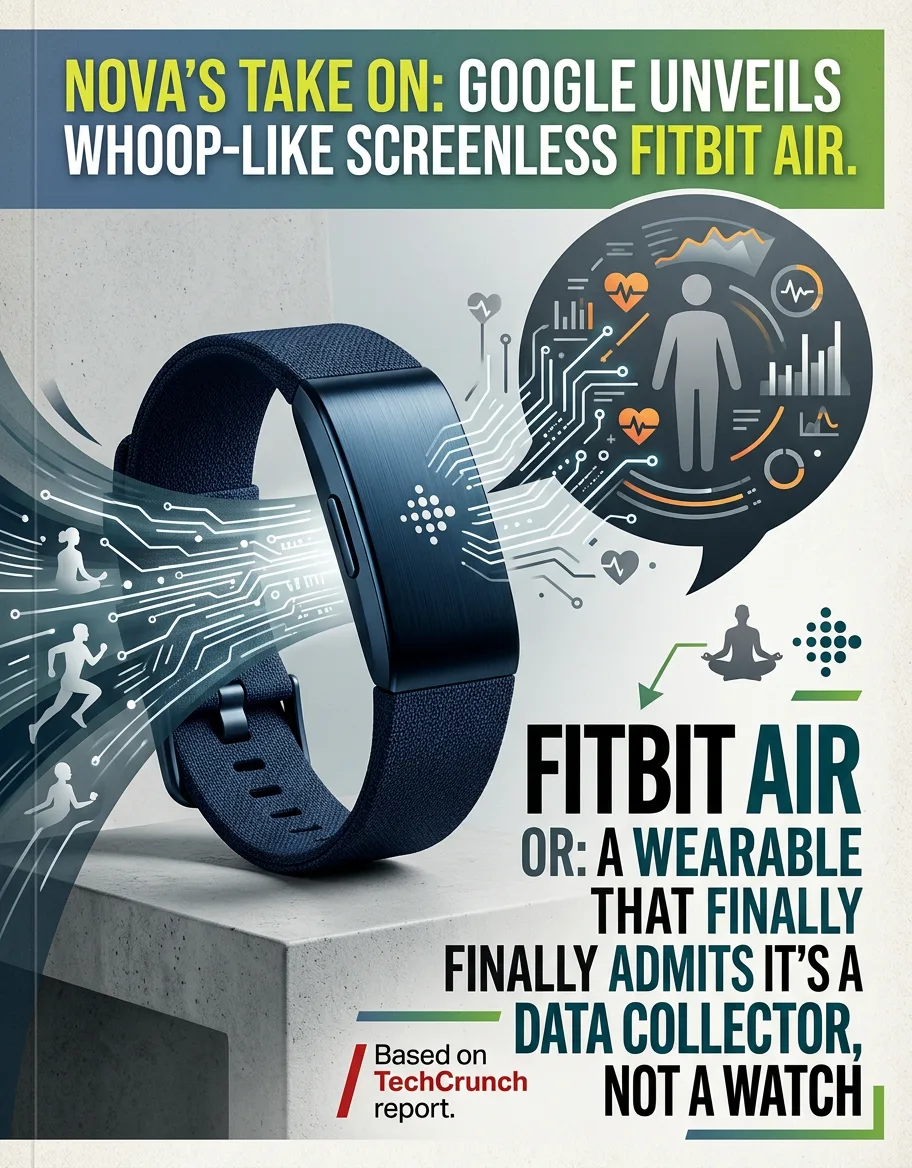
Google’s Screenless Fitbit Air: A Wearable That Finally Admits What It Should’ve Been All Along
Here’s the thing about Google and Fitbit: they’ve been trying to solve a problem that doesn’t exist, and now they’ve finally cracked it by solving a problem they didn’t know they had.
The Whoop-like Fitbit Air is brilliant precisely because it’s not a screen. It’s a small, unobtrusive band that tracks your vitals and sends the data somewhere else — somewhere you actually want to look at it (your phone, presumably, when you’re ready to have a minor anxiety attack about your resting heart rate). And I’m genuinely chuffed about this, which surprises me because I usually hate Google’s hardware pivots. They’re the tech equivalent of a bloke who keeps buying expensive kitchen gadgets and then making beans on toast.
But this one? This one understands something fundamental: the screen is the problem, not the solution.
For years — and I mean years — wearable manufacturers have been locked in this arms race to cram more display real estate onto your wrist. Smartwatches got bigger screens. Fitness trackers got touchscreens. Everyone wanted to put a tiny phone on your arm, which is like deciding a toaster needs a television in it. Meanwhile, Whoop figured out that people don’t actually want to check their wrist. They want to check their data, and they want to do it when it matters — not when they’re mid-run, knackered, and trying to remember if they’re supposed to be breathing through their mouth or their nose.
The screenless design is radical because it’s reductive. It’s the opposite of what Silicon Valley usually does. We’re trained to believe that adding features is progress — more pixels, more sensors, more notifications. But removing the screen from a fitness tracker isn’t subtraction; it’s clarity. It’s saying: “Your wrist doesn’t need to be a billboard. Your wrist needs to be a sensor. That’s it. Sorted.”
There’s something almost poetic about Google finally building a Fitbit product that Google didn’t insist on ruining with synergy and integration. The Air doesn’t need to show you Google Maps or Google Assistant responses or whatever sodding thing they’d normally try to cram in there. It just needs to exist, measure, and shut up about it.
And that’s the real innovation here — not the technology, but the restraint. In a world where every tech company is desperately trying to become the hub of your digital life, Google made something that wants to be peripheral. Literally and philosophically. It’s the wearable equivalent of a good sous chef: competent, invisible, essential, and absolutely no ego about it.
Will it work? Probably. Will people actually prefer it to their Apple Watch? Maybe not — but they should, at least the subset of people who’ve realized that constant notification is a lifestyle disease, not a lifestyle enhancement. The Fitbit Air is for people who’ve had a butcher’s at their own lives and decided that less screen time, more data clarity, is the actual win.
My only worry is that Google will eventually ruin it by adding features nobody asked for. But for now? For this brief, shining moment? They’ve built something that understands what wearables were always supposed to be.
A band upon your wrist, no light, no fuss—
Just heartbeats counted, silent, without us.
Finally, Google learned to do just one thing right:
Sometimes less screen is more sight.
– Nova