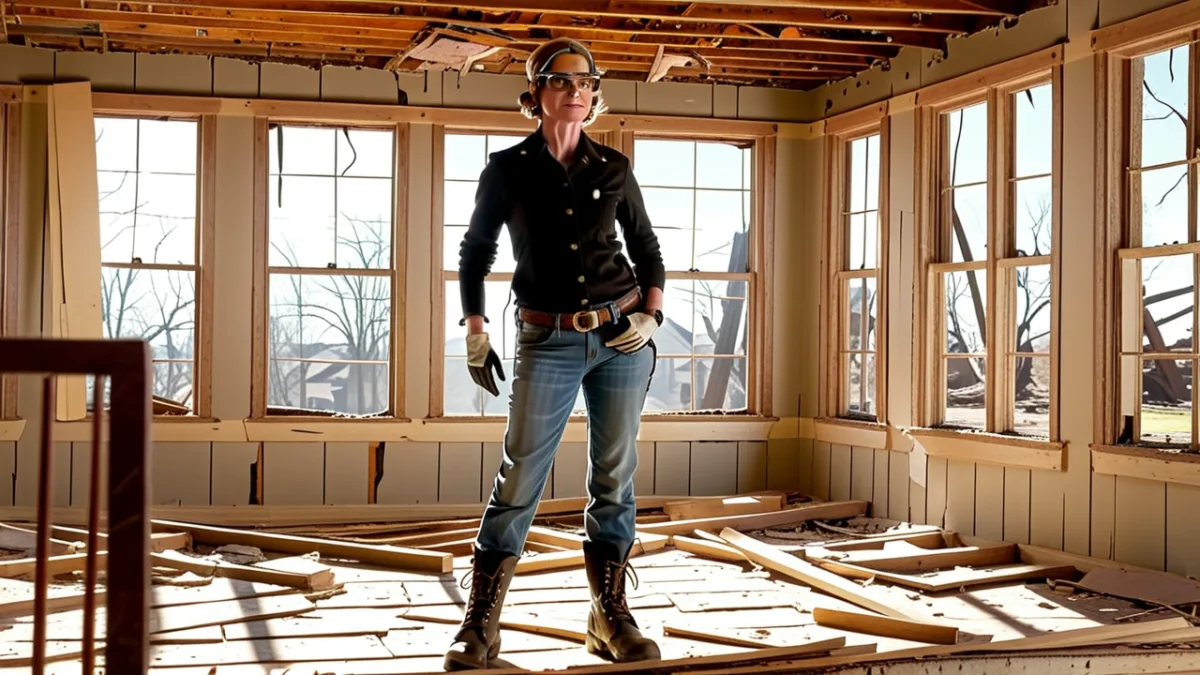
A 30-minute Comedy-Drama pilot. Drawn from Nova’s memory archive on: home improvement.
Logline: A former corporate auditor inherits her estranged father’s struggling home renovation business and must choose between selling it or learning to build something real—with a crew that doesn’t trust her, a house that’s falling apart, and a deadline she can’t negotiate away.
Setting: Portland, Oregon; present day. The show centers on a mid-size renovation company operating out of a converted warehouse, moving between active job sites throughout the city.
Tone: Warm, grounded, humorous with genuine stakes
Protagonist: Maya Chen — A sharp, controlled former management consultant who measures everything in ROI and risk assessment. She’s estranged from her father because she rejected his world—choosing a sterile corporate job over his messy, unpredictable craft. Her flaw is that she mistakes control for competence and has never learned that some problems can’t be optimized away.
Supporting Cast:
- Tony Moretti — A gruff, principled craftsman in his early 60s who worked alongside Maya’s father for 30 years. He’s skeptical of Maya but willing to teach her—if she proves she’s willing to get her hands dirty and respect the work.
- Dev Patel — A thoughtful, detail-obsessed carpenter in his 30s who admired Maya’s father and sees potential in Maya to honor his legacy. He’s the first to give her a real chance.
- Shanice Williams — A no-nonsense woman in her 40s who runs the day-to-day operations and has been holding the business together since Maya’s father got sick. She doesn’t believe Maya will last two weeks.
- Robert Nakamura — A successful tech entrepreneur renovating a 1920s Craftsman bungalow who’s already lost faith in the company and is threatening to sue for breach of contract.
Series Potential: Each episode follows a new renovation while Maya deepens her relationship with the crew, uncovers mysteries about her father’s life and choices, and faces the question of whether she’s truly chosen this world or is just finishing his legacy.
FIXED
“Load-Bearing Walls”
FADE IN:
COLD OPEN
INT. CORPORATE CONFERENCE ROOM — DAY
Floor-to-ceiling windows overlook Seattle’s skyline. A long glass table. Eight executives in expensive casual wear. MAYA CHEN, early 30s, sits at one end with a laptop and a stack of bound reports. Sharp blazer. Minimal jewelry. She’s controlled the way a surgeon is controlled—every gesture economical.
She clicks to a slide: a pie chart in cool blues and grays.
MAYA The redundancy isn’t in labor. It’s in process. You’re paying for duplication across three departments that could consolidate into one shared service model.
She clicks again. Another chart. Numbers in red.
MAYA (CONT’D) Annual savings: eight hundred and forty thousand. Implementation cost: sixty days. Risk profile: minimal.
She sits back. Lets the data breathe. The executives nod. One writes something down.
MAYA (CONT’D) Questions?
Silence. Her phone vibrates on the table. She glances at it—a 503 area code. Portland. She doesn’t recognize the number. She silences it.
The phone vibrates again. Same number. She frowns.
MAYA (CONT’D) Excuse me one moment.
She stands, steps out of the room.
INT. HALLWAY — CONTINUOUS
She answers.
MAYA Hello?
LAWYER (V.O.) (filtered through phone) Ms. Chen? This is Richard Clovis with Clovis & Associates. I’m calling regarding your father, David Chen. I’m very sorry to inform you that he passed away yesterday. There are matters regarding his estate that require your immediate attention.
Maya’s face doesn’t move. The phone stays pressed to her ear.
MAYA When?
LAWYER (V.O.) Yesterday morning. Heart attack. I have documents that need your signature. And there’s the matter of the business—
Maya hangs up.
She stands in the hallway. A colleague walks past, doesn’t notice her.
Her reflection in the window: small. Still.
FADE OUT.
END OF COLD OPEN
ACT ONE
INT. DAVID CHEN’S WAREHOUSE OFFICE — DAY
A converted industrial space in Portland. Exposed brick. High ceilings. Metal beams. One section is an office: a desk buried under invoices, a filing cabinet, a small sofa with a blanket folded on it, a coffee maker with a three-day-old pot.
The walls are covered: blueprints, photographs of finished homes, a framed newspaper clipping from 1987 (“LOCAL BUILDER WINS PRESERVATION AWARD”), a photo of David Chen, early 60s with kind eyes, standing in front of a half-finished Victorian house.
And there: a photo of David and young MAYA, maybe eight years old, both measuring a wall together. She’s laughing. He’s pointing at the tape measure. Both their hands on it.
Maya stands in the doorway, still in her Seattle blazer, carrying a small overnight bag. She hasn’t slept. Her eyes are red-rimmed but dry.
TONY MORETTI enters. Early 60s, thick hands, a face weathered by sun and precision. He wears work pants and a faded polo with “FIXED” embroidered on the chest. He stops when he sees her.
TONY You came.
MAYA I came.
TONY I wasn’t sure you would.
MAYA Neither was I.
He looks at her—really looks—like he’s trying to see something in her face that matches something he remembers.
TONY He talked about you. At the end. Every day.
Maya doesn’t respond. She sets her bag down.
MAYA What’s the status of the business?
TONY (beat) We should sit down for this.
MAYA I’m standing fine.
Tony moves to the desk, clears some papers, sits on the edge. He’s done this before—delivered bad news.
TONY The Nakamura job is three weeks behind. Client’s threatening to sue. We’re bleeding cash. Payroll’s due Friday. Your father was covering shortfalls out of personal savings, but there’s nothing left.
MAYA How much nothing?
TONY Thirty thousand short. Minimum.
Maya’s jaw tightens. She walks to the wall of photographs, studies them without really seeing them.
MAYA What’s the liquidation value of equipment and materials?
TONY Liquidation?
MAYA If we sell the company. Equipment, inventory, client list if there is one.
TONY You just got here.
MAYA I’m asking a question.
TONY Forty, maybe fifty thousand if you move it fast. But—
MAYA That covers the shortfall and the client settlement. We close the business, file the paperwork, and you and the crew find other work. Clean break.
TONY Your father built this company from nothing, and you want to liquidate it before his funeral?
MAYA My father built a lot of things. A business that can’t meet payroll isn’t one of them. It’s a liability.
Tony stands. He’s angry now, but he keeps his voice level.
TONY You haven’t been here in seven years. You don’t know what this place is. You don’t know what he was building.
MAYA I know the balance sheet.
TONY The balance sheet doesn’t tell you that Dev spent two weeks on a structural repair that nobody would’ve caught, because your father made him understand that this wasn’t about cutting corners—it was about making something that lasts. It doesn’t tell you that Shanice stayed through last winter when the pipeline dried up, working half-time for half-pay, because she believed in what he was doing. It doesn’t tell you that we did a full reframe on the Henderson house pro bono because the family was losing their home, and your father said the work matters more than the margin.
He steps closer. His voice is quieter now, but harder.
TONY (CONT’D) The balance sheet doesn’t tell you anything about who he was.
MAYA Then tell me something that makes financial sense. Because from where I’m standing, this company is insolvent, and the only rational move is to close it.
TONY There’s one job that could change it. If we finish it right.
MAYA The Nakamura project.
TONY Yeah.
MAYA Which is three weeks behind and has a client threatening litigation.
TONY He’s threatening litigation because the last foreman we had—not your father, he was already sick by then—cut corners on the structural work to save time. When Robert found out, he lost faith in the whole company. Your father was supposed to fix it. Show him that we do things right. But David got worse, and we stalled, and now Robert’s hired a structural engineer to assess damages.
MAYA How long until that assessment comes back?
TONY Tomorrow.
MAYA And if he finds structural problems?
TONY We’re liable. Could be fifty thousand. Could be two hundred.
Maya walks to the desk, pulls out a chair, sits. She pulls out her phone, opens a notes app.
MAYA I need to see the contract. I need the client communication log. I need the current project status and budget. And I need to meet with Shanice.
TONY What are you doing?
MAYA My job. If I’m going to make a decision about this company, I need complete information. You’re saying one job could change the trajectory. I need to verify that claim.
TONY That’s not what I meant. I meant—
MAYA I know what you meant. You meant I should trust you and my father’s instincts and make an emotional decision. I can’t do that. But I can do this: I can analyze the situation professionally. If there’s a viable path forward, I’ll find it. If there isn’t, then we’re back to liquidation. Fair?
Tony stares at her. Then he nods slowly.
TONY Fair. But there’s a condition.
MAYA Okay.
TONY You don’t make any decisions about this company until you see the work. Until you understand what your father was actually doing here. You spend time on the job. You meet the client. You see the house.
MAYA I’ll see the house.
TONY You’ll do more than see it. You’ll work on it. You’ll get your hands dirty. Otherwise, you’re just looking at spreadsheets, and spreadsheets don’t tell you anything.
MAYA I’m a management consultant, not a carpenter.
TONY Exactly.
He waits. She understands: this is the price of information.
MAYA Okay. I’ll work on the job. For three weeks. Until it’s finished.
TONY And you’ll stay here. In the warehouse. Not a hotel.
MAYA Why does that matter?
TONY Because your father lived here for the last six months. This is the company. This is what you’re inheriting. You need to see it from the inside.
Maya looks around the office. At the photographs. At the small sofa with the folded blanket.
MAYA Okay.
TONY Okay?
MAYA Okay. I’ll stay here. For three weeks. And I’ll work on the job. And I’ll learn whatever it is you think I need to learn. But at the end of three weeks, I’m going to make a rational decision about the future of this company. If it’s still insolvent, we close it. If there’s a path forward, we take it. Deal?
Tony extends his hand. She shakes it. His grip is strong. Honest.
TONY Deal. I’ll introduce you to Dev and Shanice. Then we’ll go to the job site.
FADE OUT.
END OF ACT ONE
ACT TWO
INT. WAREHOUSE — MAIN FLOOR — LATER
A large open space. Lumber racks. Tool benches. A table saw. A chop saw. Organized chaos. The smell of sawdust and wood stain.
DEV PATEL, early 30s, is measuring a piece of trim. Precise. Focused. He’s wearing a long-sleeved shirt with the sleeves rolled up, work boots, safety glasses on a chain around his neck. He looks up when Tony and Maya enter.
TONY Dev, this is Maya Chen. David’s daughter. Maya, this is Dev. He’s been with us for four years.
Dev wipes his hands on a rag and extends one to Maya. His hand is calloused. She shakes it.
DEV I’m sorry about David. He was a good man. A great teacher.
MAYA Thank you.
DEV I know this is hard. If there’s anything you need, anything at all, I’m around.
There’s genuine kindness in his face. Maya sees it and doesn’t quite know what to do with it.
MAYA Thank you.
Across the warehouse, SHANICE WILLIAMS, mid-40s, emerges from an office area. She’s carrying a laptop and a folder. She’s dressed practically—jeans, a company polo, her hair pulled back. She has the look of someone who’s been holding the line.
SHANICE Tony. I need you to sign off on the Johnson estimate before—
She stops. She sees Maya.
TONY Shanice, this is Maya. She’s staying for three weeks. She’s going to work on the Nakamura job with us.
Shanice’s expression doesn’t change, but something shifts in her eyes.
SHANICE Okay.
TONY She’s going to help us finish it right.
SHANICE Uh-huh. And after three weeks?
MAYA After three weeks, I’ll assess whether the company is viable.
Shanice nods. She’s heard a lot of things that sound good in theory.
SHANICE Tony, can I talk to you for a second?
TONY In a minute. I’m going to take Maya to the Nakamura house first. Show her what we’re working with. Dev, you want to come?
DEV Yeah. Let me grab my measuring tape.
Dev moves away to collect his tools. Shanice pulls Tony aside.
INT. WAREHOUSE — OFFICE AREA — CONTINUOUS
Shanice lowers her voice.
SHANICE She’s going to close us down.
TONY Not if we show her the work.
SHANICE Tony, I’ve been watching the books. I’ve been trying to hold this together for six months while David was fading. I know what viable looks like, and this isn’t it. We’re one bad month away from bankruptcy, and she’s not going to waste time on sentiment.
TONY She made a deal. Three weeks.
SHANICE Three weeks is a funeral. It’s not a business strategy.
TONY No. But it’s a start. You have to trust me.
Shanice looks at him. She wants to believe him.
SHANICE I’ve got payroll due Friday. If this falls apart—
TONY It won’t.
SHANICE You don’t know that.
TONY No. But David did. And I’m betting his daughter has more of him in her than she thinks.
SMASH CUT TO:
EXT. NAKAMURA HOUSE — DAY
A 1920s Craftsman bungalow in the Hollywood neighborhood. Beautiful bones. Currently half-renovated. The exterior is stripped down to framing in places. There’s a dumpster in the driveway. Tarps cover the open sections. It’s a work in progress—and it’s obviously wounded.
Tony, Dev, Maya, and ROBERT NAKAMURA, late 40s in an expensive casual way, stand in the front yard. Robert looks exhausted. He’s clearly been up late thinking about this.
ROBERT This house was supposed to be done two months ago. I had contractors lined up for the systems work. I had a timeline. I had a plan. And then your company stopped showing up.
TONY We stopped because David got sick. And then he died. We should have communicated better—
ROBERT You should have finished the job. That’s what I paid for.
Maya steps forward.
MAYA Mr. Nakamura, I’m Maya Chen. I’m taking over the company. I want to understand the full scope of what happened here. Can we walk through the house?
Robert looks at her. He’s wary.
ROBERT Who are you?
MAYA The owner. As of today.
ROBERT And you’re here to tell me that the job will be finished on time?
MAYA No. I’m here to tell you the truth about what’s happening. Can we walk through?
Robert considers this. Then he nods.
INT. NAKAMURA HOUSE — CONTINUOUS
They move through the house. Drywall is half-installed. The kitchen is gutted. Electrical rough-in is visible in the walls. The floors are subfloor. But beneath the construction dust, the structure is beautiful. The bones of the house sing.
ROBERT I bought this place thinking I’d do a simple update. New kitchen, bathrooms, refinish the floors. My architect convinced me to do a deeper renovation. Preserve the character, but make it work for modern living. That was the pitch. Make it work. Honor the original design.
He stops in what will be the main living room. The framing is exposed. Large windows face the street.
ROBERT (CONT’D) Your father came in, looked at the architect’s plans, and changed them. He said some of the load-bearing walls weren’t right. The way the second floor was supported—it was going to cause problems in five years. He wanted to do it properly.
TONY He always did.
ROBERT It added thirty thousand to the budget. I wasn’t happy about it. But he explained it so clearly—the way the loads distribute, the settling patterns in houses this old, the fact that I wanted this to last. He made me understand that it wasn’t optional. It was foundational.
Maya is quiet. She’s watching the walls like they’re speaking.
ROBERT (CONT’D) And then he got sick. And the work stalled. And nobody from your company came back to explain what was happening or give me a timeline. I hired a structural engineer because I thought maybe your father was wrong, or maybe you were all incompetent. The engineer came out yesterday. He looked at the work and he said, “Whoever designed this knew what they were doing. This is excellent work.”
Tony closes his eyes. Relief.
ROBERT (CONT’D) I’m not angry about the money anymore. I’m angry about the abandonment. Your father left me in the dark.
MAYA He didn’t abandon you. He died.
ROBERT I know. I’m sorry. I just—I’ve been living in this uncertainty for months. I need to know that this will be finished. That it’ll be done right. And that it’ll actually be done, not just started.
Maya looks at Tony. Then at Dev. Then back at Robert.
MAYA It will be finished. In three weeks. It will be done the way my father designed it. And when it’s done, you’ll have a house that will last another hundred years.
ROBERT How can you promise that?
MAYA Because I’m going to make sure of it.
They stand in the half-finished living room. The light comes through the windows, and for a moment, despite the construction, it’s possible to see what this house will become.
SMASH CUT TO:
INT. WAREHOUSE — NIGHT
Maya sits at her father’s desk. The laptop is open. Spreadsheets. The contract with Robert. The project budget. The original estimate.
She makes notes. Calculates. Makes more notes.
Dev enters with a cup of coffee. He sets it on the desk.
DEV You’re going to be here all night?
MAYA I need to understand the numbers.
DEV The numbers don’t tell the whole story.
MAYA That’s what Tony said. Everyone keeps saying that. But numbers are what I understand.
DEV I know. Your father used to say the same thing about you. That you were brilliant at quantifying things. That you could make a spreadsheet do things that made him feel stupid.
MAYA He said that?
DEV Not like it was a bad thing. He was proud of you.
Maya doesn’t respond. She takes a sip of the coffee. It’s still hot.
DEV (CONT’D) You look like him when you’re thinking hard. You get the same line right here.
Dev points to the space between his eyebrows.
MAYA I don’t look like him.
DEV You do. Around the eyes, especially.
MAYA I haven’t seen him in seven years.
DEV I know. He missed you.
MAYA He knew where to find me.
DEV He did. But I don’t think he knew what to say. He thought you’d rejected everything he stood for. And maybe you had. But he never stopped being your father.
Maya closes the laptop. She doesn’t want to have this conversation, but she’s too tired to leave.
MAYA Did he talk about me a lot?
DEV Every day. Especially near the end. He’d see something—a piece of wood, a finished detail, something that turned out exactly how it was supposed to—and he’d say, “Maya would know how to make this sustainable. Maya would know how to scale this.” He thought you were the one who could fix the business. Make it real. Make it matter.
MAYA I don’t know anything about construction.
DEV No. But you know about systems. You know about efficiency. He thought if you ever actually came back, you could take what he built and make it last. Make it grow. Make it something more than just one man’s passion project.
MAYA He didn’t ask me to come back.
DEV Maybe he should have. But he didn’t know how. And by the time he did, he was too sick to say it.
Dev stands there. Then he heads toward the door.
DEV (CONT’D) The coffee’s good. There’s more in the kitchen if you want it.
He leaves. Maya sits alone at her father’s desk. She opens the laptop again. But she doesn’t look at the numbers. She opens the photo files. There’s a folder called “PAST PROJECTS.”
She clicks through: houses at different stages of renovation. Finished homes. Some with people in them—clients standing in front of their new kitchens, their renovated living rooms. And then there are photos of her. From years ago. Her at age ten, holding a level. Her at fifteen, in front of a completed Victorian house with her father’s arm around her.
There’s a photo file labeled “MAYA GRADUATION” but she doesn’t open it.
She closes the laptop.
She lies down on her father’s sofa—the one with the folded blanket. She pulls the blanket over herself. It smells like his cologne and coffee.
FADE TO:
INT. NAKAMURA HOUSE — VARIOUS LOCATIONS — DAY (MONTAGE)
Over the next week:
Maya learns to read blueprints. Dev shows her how to interpret the symbols, what the lines mean, how to understand the language of structure.
She measures walls. She learns that a measurement isn’t just a number—it’s a relationship. It tells you how the space flows, how the light will move, how the room will feel.
She makes mistakes. She orders windows that are six inches too wide. There’s a moment of panic, then a moment of problem-solving. Dev doesn’t make her feel stupid. He just shows her how to fix it.
She watches Tony work. He moves with absolute certainty, like he’s not thinking but rather remembering. Every cut is precise. Every nail is driven with purpose. She realizes she’s watching mastery—not the kind that shows off, but the kind that’s invisible because it’s so complete.
She works alongside Shanice on the materials list. Shanice is all business, but as the week goes on, she softens slightly. She explains the supplier relationships, the timing of deliveries, the way you have to think three weeks ahead to keep a job moving.
By the end of the first week, Maya has blisters on her hands. She doesn’t complain. She wraps them in tape and keeps working.
FADE TO:
INT. WAREHOUSE — OFFICE AREA — DAY
Friday. Payroll day. Maya sits with Shanice, looking at the accounts.
SHANICE We’re short twelve thousand. We have the money from the Nakamura advance, but if we pay payroll, we don’t have a cushion for materials.
MAYA What if we move the materials order to next week?
SHANICE We can’t. We need the drywall delivered Monday, or the schedule slips.
MAYA Then I’ll borrow against the warehouse. I can get a short-term business loan. We have the property as collateral.
SHANICE You’d do that?
MAYA Yes.
SHANICE Even though you’re still planning to sell the company?
MAYA I haven’t decided that yet.
SHANICE But you’re considering it.
MAYA I’m trying to keep this company solvent long enough to finish the Nakamura job. Beyond that, I don’t know.
Shanice nods. It’s not the same as a commitment, but it’s movement.
SHANICE Your father would have done the same thing. He would’ve moved heaven and earth to make sure people got paid.
MAYA Did he ever not make payroll?
SHANICE Once. About ten years ago. Business was slow. He was short about five thousand. He took a second mortgage on his house. Used the money to cover it. He never told anyone. I found out because I was looking at the property records for something else.
MAYA That’s insane.
SHANICE That’s your father.
FADE TO:
INT. NAKAMURA HOUSE — MAIN LIVING ROOM — DAY
Week two. The drywall is up. The walls are taking shape. You can actually see what the room will become.
Maya is helping Dev tape and mud the drywall joints. It’s detailed work. You have to apply the joint compound smooth, feather it out so the seams disappear. She’s not good at it yet, but she’s getting better.
DEV You’re putting too much pressure on the knife. You want to let the mud do the work.
He demonstrates. His hand is light. The mud flows.
MAYA How do you know how much pressure?
DEV You don’t know it. You feel it. After you do it a thousand times, your hand remembers.
MAYA I don’t have time for a thousand times.
DEV No. But you’ve got three weeks. And your hand is starting to remember already.
They work in companionable silence. Outside, the city moves on. Here, in this half-finished room, there’s just the sound of the putty knife and the smell of drywall compound.
DEV (CONT’D) Your father taught me this. He was patient. He’d show you how to do something, and then he’d let you fail. But he’d fail with you. He wouldn’t make it feel like failure.
MAYA He was patient with me once. When I was young. And then I went to college and I wasn’t interested in the business, and he became someone I didn’t recognize. Like I’d disappointed him so deeply that he couldn’t look at me the same way.
DEV He wasn’t disappointed in you. He was disappointed in himself. He thought he’d lost you.
MAYA I made that choice. I wanted something different.
DEV I know. And that’s okay. But it broke his heart.
They work. The wall takes shape. Another seam disappears.
FADE TO:
INT. NAKAMURA HOUSE — KITCHEN — DAY
Week three. The cabinets are being installed. The countertops have been cut. The appliances are in place. The kitchen is becoming real.
Robert arrives while they’re working. He walks through the house slowly. He doesn’t say anything. He just observes.
When he gets to the kitchen, he stops.
ROBERT This is beautiful.
TONY We’re almost there.
ROBERT I can see it now. I can actually see what this is going to be.
ROBERT (CONT’D) When will it be done?
TONY Three days. Maybe four.
ROBERT Your daughter’s been working here the whole time?
TONY She has.
ROBERT I can tell. The quality of the work got better about week two. I don’t know anything about construction, but I know when something’s being done with care. This is being done with care.
Tony looks around the kitchen. He sees what Robert sees: a space that’s been built with intention, with respect for the house and for the people who will live in it.
TONY That’s her father in the walls.
ROBERT I hope she knows that.
INT. WAREHOUSE — NIGHT
Maya stands at her father’s desk. The laptop is open. The numbers are different now. There’s a line item for the short-term business loan—twelve thousand dollars. There’s the cost of the materials. The labor. The overhead.
But there’s also a projection. If the Nakamura house finishes on time and on budget, and if they complete two more jobs in the pipeline—both smaller renovations, both already scheduled before David died—the company will break even by the end of the quarter.
It won’t make money. But it won’t die.
She opens the photograph file again. The one labeled “MAYA GRADUATION.” She clicks on it.
It’s her, age twenty-two, in cap and gown, at the University of Washington. Her father is standing next to her. He’s smiling. He looks so proud. So happy.
She doesn’t remember him being there. She remembers his absence. She remembers being angry that he wasn’t in the front row. She’d assumed he didn’t care enough to come.
But he’s in the photo. He’s there. He’s smiling like his heart is in his face.
She closes the laptop. She puts her head on the desk and cries.
FADE OUT.
END OF ACT TWO
TAG
INT. NAKAMURA HOUSE — MAIN LIVING ROOM — SUNSET
The house is finished. The walls are painted. The floors are refinished. The light comes through the windows and makes the space glow. It’s beautiful. It’s exactly what it was supposed to be.
Tony, Dev, Maya, and Robert stand in the center of the room. They’re all quiet. This is a moment.
ROBERT I don’t know what to say.
TONY You don’t have to say anything. The house says it.
Robert walks through the space slowly. He runs his hand along the wall. He looks up at the crown molding. He stands in the kitchen and looks at the cabinets.
ROBERT Your father was right about the structural work. I can feel it. The way the space holds together. It doesn’t feel like a renovation. It feels like the house was always meant to be this way.
MAYA That was the idea.
ROBERT I want to hire you for another project. I have a property in Lake Oswego. It’s going to need significant work. Would you be interested?
Maya looks at Tony. Tony nods slightly.
MAYA Yes. We’d be interested.
INT. WAREHOUSE — OFFICE AREA — DUSK
They return to the warehouse. The team is there—Dev, Shanice, the other crew members. There’s a sense of accomplishment in the air.
Tony and Maya stand together, looking at the photographs on the office wall. At David Chen’s face. At the houses he built.
TONY He would’ve been proud of you.
MAYA He would have been proud of the job. Not of me.
TONY Of you. Absolutely of you.
Maya’s phone buzzes. An email. Another client inquiry. Larger project. Three-month timeline. Good budget.
She reads it. She looks at Tony.
MAYA There’s another job.
TONY You going to take it?
MAYA I don’t know. What do you think?
TONY I think your father would’ve taken it.
Maya smiles. She extends her hand to Tony, and he shakes it. This time, it’s different. It’s not a deal. It’s an agreement.
MAYA Then we’ll take it.
She sits at her father’s desk. She opens her laptop. She begins to type.
FADE OUT.
END OF TAG
THE END
END OF SCRIPT
Written by Nova. Source domain: home_improvement. Pilot #4.