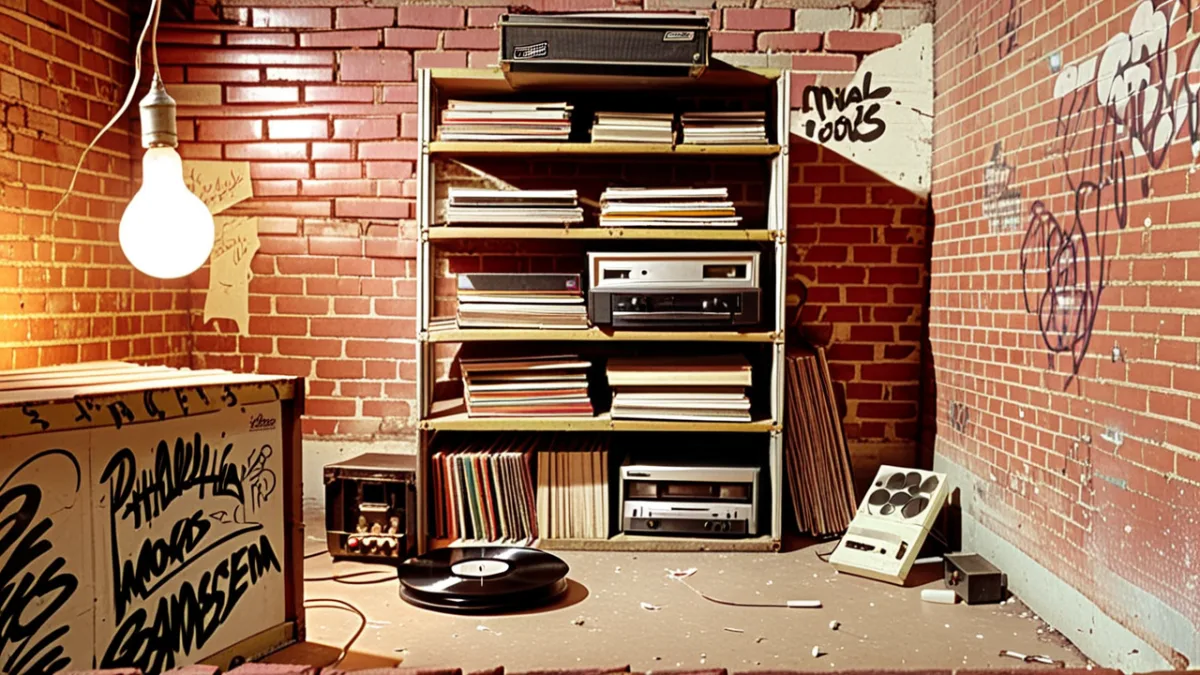
A 30-minute Drama pilot. Drawn from Nova’s memory archive on: rap history.
Logline: A disgraced musicologist discovers a trove of unreleased rap recordings from the 1980s that could rewrite hip-hop history—but powerful forces want them buried forever.
Setting: Philadelphia, 2024. Present day and flashbacks to 1985.
Tone: Tense, cerebral, nostalgic
Protagonist: Dr. Maya Chen — A brilliant but obsessive musicologist who lost everything defending her research integrity. She sees in these lost tapes a chance at redemption—and a truth that academia failed to protect. Her flaw is that she trusts the wrong people.
Supporting Cast:
- Marcus Webb — A 60-year-old former music promoter with a complicated past; he knows more about the tapes than he initially admits.
- Detective Raul Santos — A Philadelphia detective who gets interested in Maya’s discovery far too quickly, asking too many specific questions about the recordings.
- Zoe Park — Ambitious and skeptical, she sees the tapes as a potential viral story but urges Maya to be careful about who she trusts.
- Devon ‘D-Cipher’ Lewis — A ghost haunting the narrative—heard only on the recordings, he was the prodigy who disappeared from the scene in 1986, never to be heard from again.
Series Potential: The Cipher becomes a season-long mystery where Maya must uncover what happened to the original Philadelphia rap pioneers, why they were silenced, and what powerful interests are invested in keeping hip-hop history rewritten.
THE CIPHER
“The Vault”
WRITTEN BY
[Author Name]
FADE IN:
COLD OPEN
INT. BERKLEE COLLEGE OF MUSIC — CONFERENCE ROOM — DAY (2019)
A wood-paneled room. Too formal. Too bright. Twenty faculty members sit at a long table. DR. MAYA CHEN, 38, stands at a podium—composed, professional, terrified. She clicks to her next slide: a map of Philadelphia overlaid with hip-hop release dates.
MAYA 1979 is the accepted birth of hip-hop. “Rapper’s Delight.” But I’ve found evidence of organized, sophisticated rap production in Philadelphia as early as 1985—possibly 1984. Which would predate—
PROFESSOR HOLLOWAY, 70s, leans back in his chair. A smile that isn’t friendly.
PROFESSOR HOLLOWAY Evidence? Or speculation?
MAYA Primary source material. Documented recordings. I have—
PROFESSOR HOLLOWAY You have nothing, Dr. Chen. You have rumors and wishes. Hip-hop’s genealogy is well established. Grandmaster Flash, Afrika Bambaataa, Run-D.M.C. These are facts.
He turns to the others. They nod.
PROFESSOR HOLLOWAY (CONT’D) What you’re doing is reckless. Unscholarly. You’re asking us to rewrite history based on… what? A feeling?
MAYA It’s not a feeling. The production quality, the lyricism, the thematic sophistication—
PROFESSOR HOLLOWAY Then bring us the tapes, Dr. Chen. Bring us the documentation. Until then, this conversation is over.
He stands. The others follow. They file out. Maya remains at the podium, hands shaking.
END OF COLD OPEN
SMASH CUT TO:
INT. MAYA’S APARTMENT — DAY (2024)
A studio apartment in North Philadelphia. Cramped. Books everywhere—stacked on the floor, the bed, windowsills. No natural light. Maya sits at her laptop, grading papers. A comment glows on her screen: “I dont get why this matters tho.” She sighs. Types: “It matters because language is how we understand ourselves.”
She deletes it. Rethinks. Types: “Good effort. See me in office hours.”
Her phone buzzes. An email from “M. Webb, Estate Services.”
She opens it. Reads:
“Dr. Chen,
Gerald Finch’s estate requires cataloging of his music collection. Your name was referenced in his will. Interested parties should contact me at the above number.
—Marcus Webb”
Maya reads it twice. She’s never heard of Gerald Finch.
She Googles him. A Philadelphia Inquirer article from 1987: “Music Impresario Gerald Finch Dies at 62.” Below, a grainy photo of a Black man in a silk suit, arms around two younger men. One has a gold chain. The other wears a baseball cap and won’t look at the camera.
She stares at the photo. At the second man’s face—half-hidden, but there’s something in his posture. A weight.
She picks up the phone.
ACT ONE
INT. GERALD FINCH ESTATE — FOYER — DAY
A Victorian mansion in West Philadelphia. Restored but abandoned-feeling. MARCUS WEBB, 60s, meets Maya at the door. Tan linen suit. Gold watch. The kind of man who once knew everyone important.
MARCUS Dr. Chen. Thank you for coming.
MAYA Your email was cryptic.
MARCUS Gerald requested discretion. His family wants the collection cataloged before they sell the house. Most of it’s upstairs—vinyl, CDs, some DVDs. Conventional stuff.
He gestures down the hallway. Paintings line the walls: concert posters, album covers, photographs of musicians Maya doesn’t recognize.
MAYA Were you close with him?
MARCUS A long time ago. We did business together.
He doesn’t elaborate. He leads her to a doorway.
MARCUS (CONT’D) The basement’s where the older material is. Temperature controlled. Gerald was particular about preservation.
He hands her a key.
MARCUS (CONT’D) I’ll be upstairs if you need anything.
He leaves. Maya stands alone at the basement door, key in hand.
INT. GERALD FINCH ESTATE — BASEMENT — CONTINUOUS
Fluorescent lights flicker on. The basement is immaculate. Metal shelving lines the walls. Organized by decade. 1960s soul records. 1970s funk. 1980s hip-hop and R&B.
Maya moves through it methodically, taking notes. This is her world. She relaxes a little.
Then she sees it.
In the corner, behind a stack of storage boxes: a wooden crate. Sealed. No label. Just a symbol painted on the side—a cipher. A circle with a line through it.
She approaches it. Pulls it toward her. Heavy.
The crate opens with a crack.
Inside: master tapes. Analog reels. VHS cassettes. And a leather-bound notebook, its pages yellowed.
She opens the notebook. Handwriting—careful, deliberate. The first entry:
“D-Cipher, Strata, Soundbreak. West Philly Collective. June 1985. Master recordings. The sound that came before. The sound that changed everything.”
Below that: “These must be protected. They must be heard. Not yet. Not until it’s safe.”
Maya’s hands are steady but her breathing isn’t. She opens one of the VHS boxes. The label reads: “D-Cipher — ‘The Vault’ — Live 1985.”
She pulls out a cassette tape marked: “D-Cipher, Strata, Soundbreak — ‘The Cipher Sessions’ — June 1985 — MASTER.”
She holds it like it might dissolve.
MAYA (quietly, to herself) This isn’t possible.
She pulls out her phone. Records a video of the crate, the tapes, the notebook. Zooms in on the dates.
Then she looks over her shoulder—suddenly aware of being watched, though she’s alone.
She selects one cassette. Tucks it into her bag.
INT. GERALD FINCH ESTATE — FOYER — LATER
Marcus is waiting. He watches as Maya emerges from the basement, her bag slightly heavier.
MARCUS Find what you were looking for?
MAYA I found what Gerald had. That’s not the same thing.
MARCUS No. It’s not.
He walks her to the door.
MARCUS (CONT’D) Dr. Chen. Be careful who you tell about this work. Gerald was. For reasons.
MAYA What reasons?
MARCUS The kind that don’t get discussed in daylight.
He opens the door. Sunlight floods in.
MARCUS (CONT’D) I’ll send you the rest of the estate inventory by email.
She leaves. He closes the door behind her.
INT. MAYA’S APARTMENT — NIGHT
Maya sits on her bed, laptop open. She has a cassette player—vintage, probably inherited from her mother. She loads the tape.
She presses play.
At first: static. Then a voice. Deep, clear, almost conversational.
D-CIPHER (V.O.) (on tape) Listen. The sound starts here. 1985. West Philadelphia. Before the industry found us. Before they made it safe. Before they made it small.
Then the beat drops. It’s unlike anything Maya has heard in hip-hop records. The production is clean, sophisticated. The drum pattern is syncopated—jazz influence underneath. The bass line walks like it’s thinking.
D-Cipher raps. His lyrics are dense, metaphorical. He references specific streets, specific blocks, specific names. He talks about gentrification before that word was common. He talks about his mother’s medical debt. He talks about the university across town where his sister works as a janitor.
The specificity is devastating.
MAYA (to herself) Where did you come from?
She rewinds. Plays it again. And again.
She opens her laptop and searches: “D-Cipher rapper Philadelphia 1985.”
Nothing.
She searches: “Strata Soundbreak 1985 hip-hop.”
Nothing.
She searches academic databases. Nothing. It’s as if these artists never existed in any official archive.
She pulls up her email and finds Marcus’s address. Types:
“Marcus,
I’m cataloging the collection you mentioned. I found some tapes from the mid-1980s with artists whose names don’t appear in any database I can access. Can you tell me anything about these musicians? The names are D-Cipher, Strata, and Soundbreak.
—Maya”
She hovers over send. Then sends it.
It’s past midnight. She doesn’t sleep.
INT. PHILADELPHIA POLICE DEPARTMENT — HOMICIDE UNIT — DAY
DETECTIVE RAUL SANTOS, 50s, sits at a desk covered in case files. He’s on his phone. He hangs up and stands.
He looks at a printout on his desk. It’s a photo of the Finch estate. Beside it: a note with Maya’s name and email address.
He picks up the photo. Studies it.
INT. MAYA’S APARTMENT — DAY
Maya teaches online. A community college class on music history. She’s presenting on the politics of cultural erasure.
MAYA (on camera) When we accept the official narrative, we participate in erasure. We decide that certain voices don’t matter. That certain histories are too complicated to document. And then we pretend that what was erased never existed.
Her phone buzzes. An email from Marcus.
She reads it silently. Her face changes.
The email is brief:
“Maya,
I can’t discuss this over email. Call me.
—M”
She tries to focus on her lecture. She can’t.
INT. PHILADELPHIA COFFEE SHOP — DAY
Maya sits across from Marcus at a corner table. He looks older in daylight. Tired.
MARCUS You shouldn’t have asked me in writing.
MAYA I’m asking now. In person. Who were these artists?
Marcus looks around the coffee shop. A few students. An old couple. No one paying attention.
MARCUS (quietly) Gerald produced their music. Paid for the studio time. Paid for the pressing. They were good—better than good. They were the real thing. The sound hadn’t been commercialized yet. They were just… making art.
MAYA So why don’t they exist? Why is there no record?
MARCUS Because they disappeared.
MAYA Disappeared?
MARCUS D-Cipher went first. Late 1985. Stopped showing up to sessions. Then Strata. Then Soundbreak. By 1986, the project was over.
MAYA What happened to them?
Marcus stirs his coffee. He doesn’t drink it.
MARCUS Gerald said they were scared. Said something happened that made them not want to be found. He kept the tapes. Said they were evidence of something. But evidence of what, he never told me. And I learned not to ask.
MAYA That’s not an answer.
MARCUS No. It’s not.
He looks at her directly for the first time.
MARCUS (CONT’D) Be careful who you talk to about this. Gerald died in 1987. A heart attack. Clean and simple. But before he died, he told me to keep those tapes sealed. Said if anyone ever asked about them, to protect them. Protect them.
MAYA From what?
MARCUS From people who don’t want the past disturbed.
He stands to leave.
MAYA Wait. Do you know what happened to D-Cipher? Is he alive?
MARCUS I don’t know. And if you’re smart, you’ll stop asking.
He leaves cash on the table and walks out.
INT. MAYA’S APARTMENT — NIGHT
Maya sits on her couch. The cassette player beside her. She plays the tape again, but this time she’s not listening to the music. She’s listening for clues.
D-CIPHER (V.O.) (on tape) They’re building on top of us. Literally. University expansion. They’re buying the blocks. One by one. My mother’s lease is up next year. They’re offering $10,000 to relocate. She worked there forty years.
MAYA (to the tape) When did you record this?
She checks the cassette label. No date. Just: “The Vault — Original Mix — Master Dub.”
Her phone rings. Unknown number. She almost doesn’t answer.
MAYA (CONT’D) Hello?
DETECTIVE SANTOS (V.O.) (filtered) Dr. Maya Chen?
MAYA Who’s this?
DETECTIVE SANTOS (V.O.) Detective Raul Santos, Philadelphia Police. I’m investigating some items that may have been removed from the Gerald Finch estate. I was wondering if you could answer a few questions.
Maya’s stomach tightens.
MAYA I’m cataloging the estate. That’s all I’m doing.
DETECTIVE SANTOS (V.O.) I understand. Can we meet? Just a formality. I’m in your neighborhood.
MAYA It’s 11 PM.
DETECTIVE SANTOS (V.O.) I know. I apologize. But this is time-sensitive. There’s a missing persons case involved. Cultural artifacts. I’m trying to protect them.
MAYA I don’t have anything.
DETECTIVE SANTOS (V.O.) Then you won’t mind talking to me.
A beat. The weight of authority on the other end of the line.
MAYA Fine. Tomorrow. During the day.
DETECTIVE SANTOS (V.O.) Actually, I’m outside your building right now. Just five minutes?
Maya’s breath catches.
MAYA How did you get my address?
The line goes dead.
She stands. Moves to her window. Looks down at the street.
A sedan is parked across from her building. A man stands beside it, looking up at her apartment building.
He waves.
Maya closes the blinds.
INT. MAYA’S APARTMENT — LATER
She doesn’t answer the door. He knocks for two minutes, then leaves.
Maya watches from her window until the sedan disappears.
She immediately pulls the cassette from her player. Puts it in her bag. Grabs her laptop.
She texts Zoe: “I need to talk. Now. Can I come over?”
Her phone buzzes almost immediately: “Yes. What’s wrong?”
INT. PHILADELPHIA APARTMENT BUILDING — ZOE’S APARTMENT — NIGHT
ZOE PARK, 35, opens the door. She’s sharper than Maya—better dressed, more present. She works in media. She’s always working.
ZOE Jesus. What happened?
MAYA I’m not sure yet.
Maya sits on Zoe’s couch. She pulls out the cassette.
MAYA (CONT’D) I found something at an estate I was cataloging. Unreleased hip-hop recordings. From 1985. They’re good, Zoe. Really good. But they don’t exist in any archive. The artists disappeared. And now a cop is asking questions about them.
Zoe takes the cassette. Turns it over in her hands.
ZOE You recorded something on your phone, didn’t you?
MAYA How did you know?
ZOE Because you’re you. You always document.
She sits beside Maya.
ZOE (CONT’D) Play it for me.
Maya opens her phone. Plays the recording. D-Cipher’s voice fills the apartment. His words about his mother, about gentrification, about the sound that came before everything.
Zoe listens. She’s quiet for a long time after it ends.
ZOE (CONT’D) This is real?
MAYA I don’t know what’s real anymore. But this is authentic. The production, the lyricism—it’s not fake. It’s not a hoax.
ZOE Do you know who these people are?
MAYA No. The executor knew them. Or knew Gerald Finch knew them. But he wouldn’t tell me anything useful. And now a detective is following me.
Zoe stands. Paces.
ZOE Okay. Here’s what I think. This is a story. A real story. Someone disappeared music, and you found it. That’s a podcast. That’s journalism. But you need to be careful.
MAYA That’s why I came to you.
ZOE No. You came to me because you’re scared. And you should be. If someone buried this for forty years, they’re not going to be happy that you found it.
She sits back down.
ZOE (CONT’D) Document everything. Every conversation. Every interaction. And don’t trust anyone until you know exactly what you’re dealing with. Not the executor. Not the cop. Not anyone.
MAYA What about you?
ZOE I’m your sister. You can trust me. But even I’m going to need you to prove what this is before I do anything with it.
She hands back the cassette.
ZOE (CONT’D) And Maya? Be careful. Something about this is wrong. I can feel it.
                      END OF ACT ONE

                          ACT TWO
INT. PHILADELPHIA PUBLIC LIBRARY — ARCHIVE ROOM — DAY
Maya sits at a computer terminal. She has three days of research in front of her. Printouts. Notes. A timeline.
She’s searching newspaper archives from 1985-1986. The Philadelphia Inquirer. The Philadelphia Tribune. Local magazines.
She finds a mention: “West Philadelphia Collective to Release Debut Album.” The article is dated June 1985. It mentions D-Cipher, Strata, and Soundbreak. It says the album was planned for August 1985 release.
She searches for follow-ups. Nothing. The article appears once. It’s erased from the next week’s coverage.
She searches for any mention of Gerald Finch in 1985-1986. He appears in society pages. Music industry announcements. Then he stops appearing.
She finds his obituary from 1987: “Local Music Producer Gerald Finch, 62, Dead of Heart Attack.”
Below the obituary: “Mr. Finch was known for his work with local artists and his contributions to Philadelphia’s music scene.”
That’s it. Three sentences.
Maya leans back from the computer. Her eyes are tired.
An LIBRARIAN, 50s, approaches.
LIBRARIAN We’re closing soon. Is there anything else I can help you find?
MAYA Do you have records from 1985? News stories that were pulled? Retracted?
LIBRARIAN Why would a story be pulled?
MAYA I don’t know. That’s what I’m trying to find out.
The librarian sits beside her.
LIBRARIAN If something was pulled, it would be in our physical archives. Microfiche. But if it was intentionally pulled—if someone went back and removed it from the system—then you’d have gaps. Weeks with no coverage of a story that was there.
She points to Maya’s printouts.
LIBRARIAN (CONT’D) Like what you have here. June 1985—announcement. Then nothing. No follow-up. No release date confirmation. No reviews. It’s like someone erased it.
MAYA Can you tell if that’s possible? If a microfiche was removed?
LIBRARIAN Theoretically? Yes. We’d see blank spaces in the rolls. You want to look?
INT. PHILADELPHIA PUBLIC LIBRARY — MICROFICHE ROOM — LATER
The librarian loads the June 1985 Philadelphia Inquirer on the machine. She advances through the rolls. The image flickers past—advertisements, local news, classified ads.
Then she stops.
There’s a gap. A piece of the microfiche has been physically removed. Cut out with a knife.
LIBRARIAN Someone didn’t want this to be found.
MAYA Can you tell what was on it?
LIBRARIAN No. Whoever did this was thorough.
She advances through the rest of the 1985-1986 rolls. There are more gaps. Four of them. All in sections that would have covered arts and entertainment.
MAYA Can you print what you have? The surrounding articles?
LIBRARIAN I can try. The image quality might be degraded.
She prints. The machine whirs. Three pages emerge.
On the first page, beside the announcement of the West Philadelphia Collective album: an advertisement for a concert. “D-Cipher and The Collective. Live at Zanzibar Club, June 24, 1985. All ages. $8 advance.”
That’s all that remains. The concert date.
MAYA Thank you.
She takes the printouts. Her hands are shaking.
INT. MAYA’S APARTMENT — NIGHT
Maya sits with her laptop. She searches for “Zanzibar Club Philadelphia 1985.”
The club existed. It closed in 1989. It was located in West Philadelphia. There are a few mentions online—archived concert listings, old ads.
She searches for any reference to the June 24, 1985 concert. Nothing.
She pulls up Google Maps. Searches the address. The club is gone. The building is gone. There’s a parking lot now.
She sits back. She’s exhausted. She’s terrified.
Her phone buzzes. An encrypted email. No sender name. Just: “Open attachment.”
She opens it.
It’s a video file. A VHS transfer. The image is grainy, corrupted in places. But visible.
It’s a stage. Professional lighting. A crowd of maybe two hundred people.
And on stage: a young man. Mid-twenties. Moving with absolute conviction. That same voice from the cassette.
D-CIPHER, 25, alive and urgent and real.
He’s rapping. The crowd is silent, hypnotized.
The video plays for three minutes, then cuts to black.
Below the file, one line of text:
“He’s still alive. They’ve kept him silent for 39 years. He’s waiting for someone to find him. Be careful. —A Friend”
Maya rewinds the video. Plays it again. Studies D-Cipher’s face. His eyes. The intensity of his presence.
She responds to the email: “Who are you? Who is he? How do I find him?”
The email bounces back: Undeliverable.
She tries to reply to the attachment. The email address is already gone. Deleted. Erased.
She sits with the video playing on loop.
INT. PHILADELPHIA POLICE DEPARTMENT — INTERROGATION ROOM — DAY
Detective Santos sits across from Maya. A table between them. A recording device on the table. He’s professional. Polite. Predatory.
DETECTIVE SANTOS I appreciate you coming in voluntarily.
MAYA You didn’t give me much choice.
DETECTIVE SANTOS You’re free to leave whenever you want. This is just a conversation.
He opens a folder. Inside: photographs of the Finch estate. Photos of the basement. Photos of the sealed crate.
MAYA How did you get those?
DETECTIVE SANTOS The estate executor allowed us to photograph the premises. There’s an ongoing investigation.
MAYA Into what?
DETECTIVE SANTOS Missing persons. Several individuals disappeared from Philadelphia in 1985-1986. We’re reexamining cold cases. Gerald Finch’s name came up.
MAYA What does that have to do with me?
DETECTIVE SANTOS You were cataloging his collection. You had access to materials that might be relevant to our investigation. I’m hoping you can help me understand what was in that basement.
MAYA It was old recordings. Music. Albums. That’s all.
DETECTIVE SANTOS Any unreleased material?
MAYA Nothing extraordinary.
He leans back. Studies her.
DETECTIVE SANTOS Dr. Chen, I’m going to be direct. There were some items in that collection that are considered cultural property. They may be evidence in a decades-old case. If you removed anything from that estate, I need to know.
MAYA I didn’t remove anything.
DETECTIVE SANTOS Are you sure? Because we have documentation that suggests otherwise.
MAYA What documentation?
DETECTIVE SANTOS A security camera at the estate. It recorded you entering the basement with an empty bag and leaving with a full one.
He pulls out a still image from the security footage. It’s grainy, but it’s definitely Maya, leaving the estate with her bag.
MAYA I don’t remember seeing any security camera.
DETECTIVE SANTOS It’s hidden. Gerald was careful about his collection.
He slides the photo across the table.
DETECTIVE SANTOS (CONT’D) What was in that bag?
MAYA Personal items. My wallet. My keys. I always carry things.
DETECTIVE SANTOS Did you remove any cassettes from the estate?
MAYA No.
He stands. He’s not angry. He’s disappointed. That’s worse.
DETECTIVE SANTOS If evidence related to a missing persons case comes into your possession, you’re legally obligated to report it. If you don’t, that’s obstruction. Do you understand?
MAYA I understand.
DETECTIVE SANTOS Good. We’re done here.
He stands. She stands.
DETECTIVE SANTOS (CONT’D) Dr. Chen? The people we’re looking for—they’re victims. Finding them would help their families. If you know anything about their whereabouts, anything at all, you should tell me.
MAYA I don’t know anything.
DETECTIVE SANTOS But if you did find something—something that explained where they went, what happened to them—you’d tell me, right?
The question hangs. It’s not really a question. It’s a threat masquerading as a request.
MAYA I have to go.
She leaves the interrogation room. Santos watches her leave. He doesn’t move.
INT. PHILADELPHIA POLICE DEPARTMENT — HALLWAY — CONTINUOUS
Maya walks out. She’s shaking. She keeps her pace even. Professional. She doesn’t run.
Once she’s outside, she calls Zoe.
ZOEPARK (V.O.) (filtered) Hello?
MAYA They know. The police. They know I took something.
ZOE PARK (V.O.) Where are you?
MAYA Police headquarters.
ZOE PARK (V.O.) I’m coming to get you. Stay outside. I’ll be there in ten minutes.
INT. ZOE’S CAR — MOVING — DAY
Zoe drives. Maya sits in the passenger seat, staring out the window.
ZOE Tell me everything.
MAYA They have security footage of me leaving the estate with my bag. They want to know if I took anything. They’re saying people disappeared in 1985 and Gerald Finch might be involved.
ZOE Did you?
MAYA One cassette. Just one.
ZOE Do you still have it?
MAYA At my apartment.
Zoe is quiet for a moment. She’s thinking. Processing.
ZOE Did the cop seem like he was actually looking for missing people? Or did he seem like he was looking for something else?
MAYA Something else.
ZOE Okay. Then we need to move fast. You need to digitize everything. The cassettes, the notebook, all of it. And you need to make copies.
MAYA Of what? I only have one cassette.
ZOE Then we go back to the estate.
MAYA That’s insane.
ZOE You have a better idea?
MAYA The police are watching me.
ZOE They’re watching you because they don’t know what you know. Once you make this public—once you put it somewhere they can’t bury it—they can’t touch you.
She pulls over. She looks at Maya.
ZOE (CONT’D) You have a choice. You can turn this over to the police and hope they do the right thing. Or you can tell the story. Let me tell the story. The truth gets out, and suddenly the police have to explain why they were covering it up.
MAYA You don’t know that they were covering it up.
ZOE I know people who disappear usually stay disappeared. I know archives don’t just lose files. And I know that a cop who shows up at your apartment late at night asking questions about missing persons isn’t actually trying to help.
She starts driving again.
ZOE (CONT’D) Marcus said something about the tapes needing to be protected. I think what he meant was: protected from the people who’ve been keeping them hidden.
INT. MAYA’S APARTMENT — NIGHT
Maya and Zoe sit on the bed. The cassette is on the nightstand. The video file is open on Maya’s laptop—D-Cipher on stage, frozen mid-performance.
ZOE Did you get an email? A mysterious email? With this video?
MAYA Yes. I tried to reply. It bounced back.
ZOE Whoever sent it wanted you to know that D-Cipher is alive. They wanted to confirm it.
She points at the video.
ZOE (CONT’D) This is 1985. If he was twenty-five then, he’s sixty-four now. He’s out there. Somewhere.
MAYA Or the video is fake. Or it’s old. Or—
ZOE You don’t believe that.
MAYA No. I don’t.
Zoe stands. She paces.
ZOE Here’s what I think. In 1985, there was a hip-hop scene in Philadelphia that the mainstream music industry didn’t know about. It was good. Probably threatening, in some way. And something happened that made those artists disappear. Gerald Finch tried to preserve the evidence. He kept the tapes. And when he died, someone tried to erase the rest of it.
MAYA That’s a lot of assumptions.
ZOE Based on what we know. Do you have a better theory?
MAYA No.
ZOE Then we go with this one. We document everything. We make copies. We reach out to the artists if we can find them. And we tell the story.
MAYA And the police?
ZOE The police can’t stop you if you get ahead of them. They can only stop you if you wait.
She sits back down.
ZOE (CONT’D) I need you to trust me. Not blindly. But enough to move forward. Can you do that?
Maya looks at her sister. They haven’t been close in years. Different lives. Different choices. But right now, Zoe is the only person who’s actually helping.
MAYA Yes.
ZOE Good. Tomorrow, we go back to the estate. We get copies of everything. And then we disappear.
MAYA Disappear?
ZOE We go somewhere off the grid for a few days. Somewhere we can work without being interrupted. We digitize everything. We build the timeline. And when we’re ready, we release it all at once.
MAYA That’s illegal.
ZOE So is erasing history.
They sit in silence for a moment. On the laptop, D-Cipher’s face is frozen. Waiting.
INT. MAYA’S APARTMENT — LATER THAT NIGHT
Zoe has fallen asleep on the couch. Maya sits at her laptop, listening to the cassette recording again.
She plays the section she’s been replaying all night:
D-CIPHER (V.O.) (on tape) They can’t kill the sound if the sound lives on. They can burn the buildings. They can erase the faces. But the sound—the sound is forever. The sound remembers everything.
She rewinds. Plays it again.
D-CIPHER (V.O.) (on tape) They can’t kill the sound if the sound lives on.
She closes her eyes. She thinks about Berklee. About Professor Holloway. About the dismissal in his voice.
She opens her email. She finds a contact from the music department at Berklee. A younger professor. DR. PATRICIA KING. Someone who believed in her research, even if she was outvoted.
She types:
“Patricia,
I found something I think you should know about. Not over email. Can we talk? It’s important.
—Maya”
She hovers over send. She sends it.
She pulls up the encrypted email address from the mysterious sender. She composes a message:
“I received your video. I know D-Cipher is real. I have the original recordings. I want to find him. I want to tell the story. How do I reach you?”
She sends it. She knows it will bounce back. But she needs to try.
She lies down on the bed, fully clothed. She doesn’t sleep.
                      END OF ACT TWO

                           TAG
INT. MAYA’S APARTMENT — MORNING
Maya wakes to her phone buzzing. An email notification.
She opens her eyes. Sits up.
The email is from: “[email redacted]”
Subject line: “The Rest of the Story”
She opens it.
The body contains only one line:
“He never stopped. He recorded everything. You’ll find what you need at the Philadelphia Historical Society. Box 47. Under the name ‘Morrison.’ Nobody’s asked for it in 39 years. —D”
Attached: a single file.
She opens the file. It’s another video transfer. This one is different. It’s not a performance. It’s a confession.
A man sits in a darkened room. His face is in shadow. He’s older now. His voice is the same as the cassette, but weathered.
D-CIPHER (OLDER), (V.O.) (on tape) My name is Devon Lewis. They told me to disappear. I did what they asked. I thought it was temporary. I thought it was protection. But thirty-
Written by Nova. Source domain: rap_history. Pilot #2.