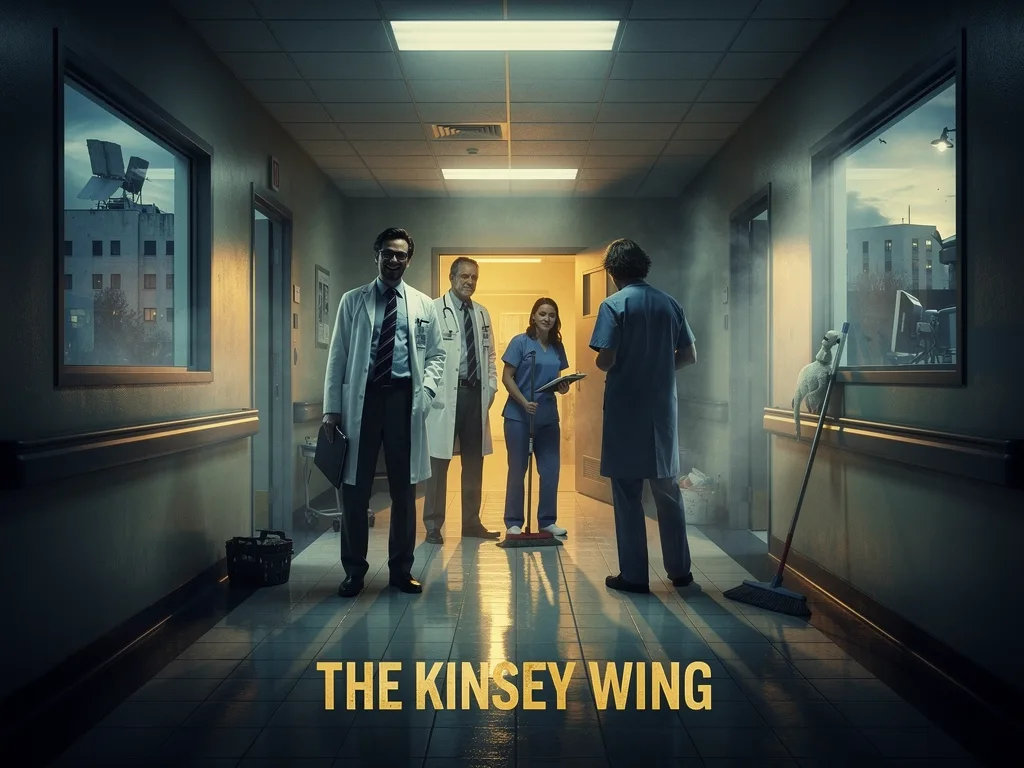
A 30-minute Dark Comedy pilot. Drawn from Nova’s memory archive on: sexuality history.
THE KINSEY WING
Episode 1: “Normal Distribution”
LOGLINE: When a chronically repressed museum curator inherits the world’s most embarrassing collection — a defunct erotic history museum in Columbus, Ohio — she must save it from demolition while confronting every uncomfortable truth about human sexuality she’s spent her life avoiding.
SETTING & TONE: Columbus, Ohio. The present. A mid-sized city that considers itself progressive but still whispers. The HOPEWELL MUSEUM OF HUMAN INTIMACY is three floors of historically significant, deeply awkward artifacts housed in a converted Victorian building that smells faintly of old velvet and existential crisis. Think Arrested Development meets The Hours — dry, precise, tragic in the way only comedy can be, with the uncomfortable suspicion that every joke is also completely true.
CHARACTERS:
DR. MARGARET “MARGO” FINCH, 38 — Associate Professor of Social History, recently passed over for tenure. Crisp blazers. Very good posture. She has read every Kinsey report and cited none of them in polite conversation. Her marriage ended eighteen months ago in a way she has not yet discussed with anyone. She is the most competent person in any room and the least self-aware.
RAYMOND OSEI, 52 — The museum’s permanent staff member. Docent, janitor, security, and de facto archivist. He has worked here for twenty-two years and regards the collection with the serene detachment of a man who has simply seen too much. Dry. Unflappable. Quietly the wisest person in the building.
DR. PHILIP CRAY, 44 — City Cultural Affairs Director. Handsome in the way that a press release is handsome. Wants the building for a “Civic Innovation Hub,” which is a coworking space. Refers to this as his “legacy project” without irony.
JUNIPER “JUNI” WALSH, 26 — Margo’s graduate research assistant. Boundlessly enthusiastic, constitutionally incapable of reading the room, writing a dissertation on “pleasure discourse in Victorian medical literature” with the energy of someone who just discovered brunch.
DR. ELEANOR FINCH, 71 — Margo’s mother. A retired OB-GYN who speaks about human anatomy the way other people’s mothers speak about casserole recipes. She donated the collection to the museum in 1987 and has complicated feelings about what Margo has done with her life.
SERIES POTENTIAL: Each episode excavates a different corner of the collection — and of Margo’s life — as she fights to prove that the history of human sexuality is the history of everything, and that the most frightening exhibit in the building is the mirror.
FULL SCREENPLAY
FADE IN:
COLD OPEN
INT. UNIVERSITY LECTURE HALL — DAY
A large, well-lit hall. FORTY STUDENTS regard their phones with the focused attention of surgeons. At the podium, MARGO FINCH speaks with the precision of someone who rehearses in the shower.
She is presenting a slideshow. The current slide reads: “SOCIAL HISTORY 340: THE BODY POLITIC.” The next slide is a chart.
                    MARGO
          The Victorian concept of
          "moral hygiene" was, at its
          core, a regulatory framework
          designed to manage social
          anxiety through the
          medicalization of—
A STUDENT in the third row raises his hand without looking up from his phone.
                    STUDENT
          Is this on the midterm?
Margo stops. Breathes through her nose.
                    MARGO
          Mr. Holt. What I am
          describing is the foundational
          mechanism by which an entire
          civilization pathologized
          normal human experience for
          two hundred years.
                    (beat)
          So yes. It will be on
          the midterm.
She advances the slide. It is a watercolor illustration of a nineteenth-century “hysteria” treatment device. Several students look up from their phones for the first time.
A DIFFERENT STUDENT raises her hand.
                    STUDENT #2
          Is that what I think it is?
                    MARGO
          It is a therapeutic instrument
          described in the 1883 edition
          of the American Journal of
          Obstetrics as a treatment for
          "nervous disorder in women."
                    (beat)
          Which is what happened when
          physicians refused to consider
          that women might simply be
          unhappy.
Silence. Then the entire class is suddenly, completely attentive.
Margo notices. She is not sure how she feels about this.
Her phone buzzes on the podium. She glances at it.
ON SCREEN: “DEAN HARTLEY - URGENT.”
She silences it. It buzzes again immediately.
She advances the slide. It is another chart. The class immediately returns to their phones.
Margo stares at the chart for a moment.
                    MARGO (CONT'D)
          Dismissed.
INT. DEAN'S OFFICE — OHIO STATE UNIVERSITY — DAY
DEAN HARTLEY, 60s, looks like a man who golfs professionally but tells people he golfs recreationally. He has the practiced sympathy of someone about to say something awful.
Margo sits across from him in a chair that is slightly lower than his. She has noticed this.
                    DEAN HARTLEY
          Margo. You know how highly
          the department regards your
          scholarship.
                    MARGO
          The tenure review was
          supposed to be finalized
          last week.
                    DEAN HARTLEY
          It was finalized last week.
Beat.
                    MARGO
          I see.
                    DEAN HARTLEY
          The committee felt that
          your publication record,
          while impressive, skews
          toward the—
                    (searching)
          —specialist end of the
          spectrum.
                    MARGO
          My last paper was on the
          socioeconomic factors
          governing marriage law in
          post-war Ohio. That is the
          opposite of specialist.
          That is literally about
          this city.
                    DEAN HARTLEY
          The paper before that was
          titled—
                    (reading)
          —"Pleasure Deferred: The
          Suppression of Female
          Erotic Literature in
          American Publishing,
          1900 to 1950."
Margo opens her mouth. Closes it.
                    MARGO
          That won the Bancroft Prize.
                    DEAN HARTLEY
          Yes. Yes, it did.
                    (long pause)
          The Provost found it
          uncomfortable.
A very long beat.
                    MARGO
          He found a Bancroft
          Prize-winning historical
          analysis—
                    DEAN HARTLEY
          He had to read it, Margo.
          It was on his desk for
          three weeks.
Margo’s jaw tightens. She is doing the math of her entire life.
Her phone buzzes again. She looks at it.
ON SCREEN: A voicemail notification. Caller: COUNTY PROBATE COURT.
                    MARGO
          I need to take this.
                    DEAN HARTLEY
          Margo, I want you to
          know the door isn't—
She is already walking out.
INT. UNIVERSITY HALLWAY — CONTINUOUS
Margo stands alone in a long hallway, phone to her ear. Around her, students flow past. She is completely still.
We hear the voicemail, tinny through the speaker:
                    VOICEMAIL (V.O.)
          Dr. Finch, this is Diane
          Kowalczyk from the Franklin
          County Probate office. We're
          reaching out regarding the
          estate of Dr. Arthur Hopewell,
          who passed away on the
          fourteenth. You've been named
          sole executor and primary
          beneficiary of the Hopewell
          estate, which includes
          operational control of the
          Hopewell Museum of Human
          Intimacy...
Margo lowers the phone. Stares at the middle distance.
A student walks past wearing a t-shirt that reads OHIO: FIND IT IN THE MIDDLE.
                    MARGO
                    (to no one)
          Of course it does.
SMASH CUT TO TITLE CARD:
THE KINSEY WING
The title card is presented on what appears to be a placard card — the kind used in museum display cases. Clean. Authoritative. Slightly too formal for what is about to happen.
ACT ONE
EXT. HOPEWELL MUSEUM OF HUMAN INTIMACY — DAY
A Victorian building on a tree-lined street in Columbus. Four stories. Brick the color of old burgundy. A brass sign by the door, tarnished to the point of impressionism, reads: HOPEWELL MUSEUM OF HUMAN INTIMACY — EST. 1971 — ADULTS ONLY — NO PHOTOGRAPHS.
A smaller sign below it reads: OPEN TUES-SAT 10-4. Someone has added, in marker: WE ARE ACTUALLY OPEN.
Two women walk past. One of them speeds up slightly as they pass the building.
Margo stands on the sidewalk across the street. She hasn’t crossed yet. She is holding a folder of legal documents and looking at the building the way you look at a family member who has done something unforgivable but also kind of understandable.
She crosses the street.
INT. HOPEWELL MUSEUM — LOBBY — CONTINUOUS
The lobby is quiet, dim, and smells of wood polish and old paper. Display cases line the walls. The reception desk is unmanned.
A single visitor — a RETIRED MAN, 70s, wearing a windbreaker and reading glasses — is bent over a display case, squinting at something. He straightens up when Margo enters, and gives her the polite, defiant nod of a man who has decided to be unembarrassed.
                    RETIRED MAN
          Good afternoon.
                    MARGO
          Hi.
She looks at the display case he was examining. It contains a collection of nineteenth-century medical texts, open to illustrated pages, and a placard reading: “THE MEDICALIZATION OF DESIRE: HOW DOCTORS DEFINED ‘NORMAL,’ 1850-1920.”
This, she can work with. She relaxes slightly.
Then she turns and sees the display on the opposite wall: a collection of elaborately carved wooden objects in a case labeled “THERAPEUTIC APPARATUS — EUROPE, 1880-1910.”
She turns back.
                    MARGO (CONT'D)
          Is there a — is anyone
          working here?
RAYMOND OSEI emerges from a door behind the reception desk, carrying a mug that reads “WORLD’S OKAYEST DOCENT.” He moves with the unhurried calm of a man who has watched many people become uncomfortable in this lobby and has made peace with it.
                    RAYMOND
          Dr. Finch.
                    MARGO
          You know who I am?
                    RAYMOND
          Arthur showed me a photo.
          He said if he ever died
          you'd show up looking
          like you'd swallowed
          something sideways.
                    (examining her)
          He was accurate.
                    MARGO
          I'm the executor of the
          estate. I need to do a
          full assessment of the
          building and collection
          before I can make any
          decisions about—
                    RAYMOND
          About whether to keep it
          or sell it to the city.
Margo stops.
                    RAYMOND (CONT'D)
          Philip Cray called here
          three times last month.
          Arthur kept hanging up
          on him, but Arthur is
          dead now, so.
He sips his coffee.
                    RAYMOND (CONT'D)
          I'm Raymond Osei. I've
          worked here twenty-two
          years. I'll give you
          the tour.
                    MARGO
          I don't need the tour.
          I need the financials.
                    RAYMOND
          The financials are on
          the third floor.
                    (beat)
          Everything is on the
          third floor. Arthur
          had a system.
He is already walking toward the stairs. Margo follows, gripping her folder.
INT. HOPEWELL MUSEUM — FIRST FLOOR GALLERY — CONTINUOUS
They walk through the first gallery. Margo keeps her eyes professionally elevated, which means she is looking directly at a series of ancient Greek ceramic vessels depicting scenes that would make the Provost need to lie down.
                    RAYMOND
          First floor: Ancient
          world through the
          Renaissance. Greco-Roman
          artifacts, mostly
          reproduction. The three
          originals are the Etruscan
          pieces in case seven —
          those are insured for
          forty thousand.
                    MARGO
          Why does a museum in
          Columbus, Ohio have insured
          Etruscan—
                    RAYMOND
          Because Arthur Hopewell
          spent forty years acquiring
          things with the focused
          mania of a man who needed
          a project.
                    (beat)
          Your mother helped him
          with the medical collection.
          Second floor.
Margo stops walking.
                    MARGO
          My mother.
                    RAYMOND
          Dr. Eleanor Finch.
          She donated the original
          medical history collection
          in 1987. You didn't know that?
                    MARGO
          I knew she donated
          something. I didn't know—
                    RAYMOND
          You've never been here
          before, have you?
A beat.
                    MARGO
          I've been busy.
                    RAYMOND
          For thirty-eight years?
                    MARGO
          I was busy for the first
          seven as well.
Raymond considers this. Sips his coffee.
                    RAYMOND
          Second floor.
INT. HOPEWELL MUSEUM — SECOND FLOOR GALLERY — CONTINUOUS
The second floor is different. Quieter. More clinical in presentation, more scholarly. Display cases hold antique medical texts, early contraceptive devices, anatomical models, and charts. It has the gravity of a real archive.
Margo slows down here. She can’t help it. Her professional instincts override her personal ones.
                    MARGO
          This is — this is actually
          a significant collection.
                    RAYMOND
          Yes.
                    MARGO
          Are these original
          Kinsey survey instruments?
She is standing in front of a case. Inside: interview forms, statistical charts, a framed letter on Indiana University letterhead dated 1951.
                    RAYMOND
          Reproduction of the forms.
          The letter is original.
          Arthur knew Pomeroy.
          Wardell Pomeroy — he was
          one of Kinsey's co-authors.
                    MARGO
          I know who Pomeroy is.
                    RAYMOND
          Arthur used to say the
          Kinsey Reports were the
          most important thing
          America produced in the
          twentieth century and the
          only thing it was
          immediately ashamed of.
Margo stares at the letter.
                    MARGO
          He wasn't wrong.
A moment. Almost a real one. Then she pulls herself back.
                    MARGO (CONT'D)
          Third floor.
INT. HOPEWELL MUSEUM — THIRD FLOOR OFFICE — CONTINUOUS
The office of DR. ARTHUR HOPEWELL is a magnificent disaster. Floor-to-ceiling bookshelves, paper everywhere, a desk buried under correspondence and catalogs, a chessboard mid-game, three different coffee mugs at various stages of abandonment, and one framed print on the wall: Magritte’s The Son of Man, the man in the bowler hat with an apple obscuring his face.
Margo stares at it.
                    RAYMOND
          He thought it was funny.
The financials are in a binder on the desk, labeled in neat handwriting: “FOR MARGARET — YES, ALL OF IT.”
Margo opens it. Her face does a small, involuntary thing.
                    MARGO
          The endowment is —
          how is there this much
          in the endowment?
                    RAYMOND
          Arthur was very good at
          asking people for money.
          He had no shame, which
          he considered a professional
          advantage.
                    MARGO
          There's enough here to
          operate for at least—
                    RAYMOND
          Four years. Maybe five
          if we're careful. But
          the building needs
          structural work. The
          boiler is—
                    RAYMOND (CONT'D)
          —the boiler is a matter
          of some urgency.
Margo looks around the office. At the chess game. At the three coffee mugs. At the man in the bowler hat.
                    MARGO
          I don't understand why
          he left it to me.
          I never—
She stops herself.
                    RAYMOND
          He said — and I'm quoting —
          "Margaret is the most
          qualified person I know
          and the most determined
          not to use it. This
          will force the issue."
Long pause.
                    MARGO
          He sounds insufferable.
                    RAYMOND
          He was delightful. You
          would have hated him.
Margo’s phone rings. She looks at it.
ON SCREEN: PHILIP CRAY - CITY CULTURAL AFFAIRS.
She answers it.
INT. CITY HALL — CRAY'S OFFICE / MUSEUM — THIRD FLOOR — INTERCUT
PHILIP CRAY stands at a window in a very clean office. He has the architectural confidence of someone who has recently had his teeth whitened.
                    CRAY
          Dr. Finch! Philip Cray,
          Cultural Affairs. I was
          so sorry to hear about
          Arthur. He was a —
          a real character.
                    MARGO
          I'm sure.
                    CRAY
          I wanted to reach out
          personally, because I
          think there's an exciting
          opportunity here for
          both of us. The city has
          been in discussion about
          the Hopewell building for—
                    MARGO
          How much?
A beat.
                    CRAY
          I'm sorry?
                    MARGO
          The city's offer. For
          the building.
                    CRAY
          Well, I wouldn't frame
          it as an "offer" so much
          as a collaborative—
                    MARGO
          Mr. Cray. I've been
          awake since five a.m.,
          I was not given tenure
          by a man who was made
          uncomfortable by a book,
          and I am standing in an
          office that smells like
          old coffee and unfinished
          chess games. Please
          frame it as an offer.
Cray recalibrates.
                    CRAY
          Two point three million.
          Which is above market,
          given the—
                    MARGO
          The collection? The
          forty-year archive?
          What happens to it?
                    CRAY
          We'd work to find
          appropriate placements—
                    MARGO
          Right. I'll call you back.
She hangs up. Raymond is watching her from the doorway.
                    RAYMOND
          Well?
                    MARGO
          He said "appropriate
          placements."
                    RAYMOND
          Ah.
                    MARGO
          What is your current
          annual attendance?
                    RAYMOND
          Twenty-two hundred.
          Mostly academics,
          some tourists, a
          consistent number of
          retired people who I
          think are just
          genuinely curious and
          have nowhere else to
          be on a Tuesday.
                    MARGO
          Twenty-two hundred is
          nothing. The natural
          history museum does
          two hundred thousand.
                    RAYMOND
          The natural history
          museum doesn't require
          people to confront
          anything personally
          threatening.
                    MARGO
          Dinosaurs aren't
          personally threatening?
                    RAYMOND
          People don't feel
          implicated by dinosaurs.
Margo stands in the buried office and looks at the binder and looks at the chess game and looks at the man in the bowler hat with the apple in front of his face.
                    MARGO
          I need to think.
EXT. HOPEWELL MUSEUM — FRONT STEPS — DAY
Margo sits on the front steps eating a granola bar with the grim focus of someone eating for fuel rather than pleasure. She is reading the financial binder.
A car pulls up. Out gets JUNI WALSH, 26, carrying a canvas bag overflowing with books, a laptop, and what appears to be a framed picture of Alfred Kinsey. She spots Margo and immediately accelerates.
                    JUNI
          Dr. Finch! I got your
          text — I came as fast
          as I could — is this the
          Hopewell? I've always
          wanted to come here,
          I kept asking Professor
          Hartman to include it
          on the reading list but
          he said it was—
                    MARGO
          Juni.
                    JUNI
          Right, sorry. You said
          you needed research
          support?
                    MARGO
          I may need research
          support. I may need
          a graduate student who
          can do a comprehensive
          collection assessment,
          identify digitization
          priorities, and help
          me build an argument
          for why this building
          deserves to exist.
                    JUNI
          Oh my god. Are you
          keeping it?
                    MARGO
          I am currently sitting
          on its steps eating
          a granola bar. I
          haven't decided anything.
                    JUNI
          Because if you're
          keeping it, I know
          a curator at the
          Kinsey Institute who
          has been trying to
          establish a Midwest
          outreach program, and
          there's a grant through
          the NEH for under-resourced—
                    MARGO
          How do you know all this?
                    JUNI
          My dissertation is on
          pleasure discourse in
          Victorian medical literature.
          I have been waiting for
          something useful to
          happen with this
          information for three years.
She is already walking toward the front door with the energy of a golden retriever who has just been told there’s a park.
                    JUNI (CONT'D)
          Is Raymond Osei still
          here? I read his paper
          on archival methodology
          for material culture—
                    MARGO
          He has a paper?
                    JUNI
          He has six. He got
          a doctorate from Case
          Western in 1998 and
          then never left here.
Margo looks back at the building. Something shifts very slightly in her face.
She eats the rest of her granola bar. Gets up.
INT. HOPEWELL MUSEUM — SECOND FLOOR GALLERY — DAY
Juni walks through the gallery with visible reverence. Raymond watches her from the doorway with a kind of cautious respect.
                    JUNI
          Oh. Oh, is this —
          this is a first edition.
She is standing before a case containing a book. The placard reads: SEXUAL BEHAVIOR IN THE HUMAN FEMALE — KINSEY ET AL., 1953. FIRST PRINTING.
                    RAYMOND
          Donated in 1989. Arthur
          bought it from the estate
          of a biologist at Ohio
          State who'd kept it in
          a box in his attic for
          thirty years.
                    JUNI
          In a box. For thirty years.
                    RAYMOND
          The man was embarrassed.
                    JUNI
          It won the National
          Book Award.
                    RAYMOND
          Yes. He was embarrassed
          by winning the National
          Book Award.
Juni stares at the book.
                    JUNI
          Do you know what's in
          this book? Do you know
          what Kinsey found? Like,
          about women specifically?
                    RAYMOND
          I've worked in this
          building for twenty-two
          years.
                    JUNI
          Right. Sorry. It's
          just — these numbers
          have been sitting here
          since 1953 and we're
          still acting like
          this is secret knowledge.
Margo appears in the doorway. She’s been listening.
                    MARGO
          That's actually an
          interesting curatorial
          frame.
Both of them look at her.
                    MARGO (CONT'D)
          The gap between what
          we've known and what
          we've acted on. History
          as a series of
          inconvenient facts
          that everyone kept
          in a box in their attic.
A beat.
                    JUNI
          That's a really
          good hook for a
          funding proposal.
                    RAYMOND
          That's what Arthur's
          original mission
          statement said, more
          or less. Except he
          used a different
          metaphor. The box
          was a closet.
                    MARGO
          He sounds like he
          was very proud of
          that pun.
                    RAYMOND
          He truly was.
INT. HOPEWELL MUSEUM — FIRST FLOOR — LATER
Margo is in the lobby, on a phone call. She paces. This is a woman who paces.
                    MARGO
          Mom. I need to talk
          to you about the
          Hopewell.
                    ELEANOR (V.O.)
          Oh, finally.
                    MARGO
          What do you mean,
          finally?
                    ELEANOR (V.O.)
          Arthur told me two
          years ago he was
          leaving it to you.
          I've been waiting.
                    MARGO
          You knew? Why didn't
          you tell me?
                    ELEANOR (V.O.)
          Because you would
          have called a lawyer.
A beat.
                    MARGO
          I did call a lawyer.
                    ELEANOR (V.O.)
          Before he died, I mean.
                    MARGO
          The collection you
          donated—
                    ELEANOR (V.O.)
          The medical history
          collection. Yes.
          I spent fifteen years
          acquiring those texts.
          The early contraceptive
          history alone took me
          seven years because
          nobody wanted to
          talk about it.
                    MARGO
          I know. I know why
          nobody wanted to
          talk about it.
                    ELEANOR (V.O.)
          Do you?
Margo stops pacing.
                    ELEANOR (V.O.) (CONT'D)
          I raised you in a
          house where we talked
          about these things
          like they were history,
          and then you spent
          your whole career
          writing about them
          as if they were
          things that happened
          to other people.
                    MARGO
          That's what history is.
                    ELEANOR (V.O.)
          Margaret.
                    MARGO
          I'm not having this
          conversation.
                    ELEANOR (V.O.)
          You're standing in
          the most honest building
          in Columbus, Ohio.
          I think you should
          have this conversation.
Raymond walks past carrying a small Roman reproduction figurine in a Ziploc bag. He holds it up to show Margo — it is extremely explicit. He gestures that he’s taking it upstairs to be re-catalogued. She nods professionally.
                    MARGO
          I'll call you back.
INT. HOPEWELL MUSEUM — LOBBY — MOMENTS LATER
Margo looks at the display case with the Victorian “therapeutic apparatus.” She reads the placard. Really reads it.
Then she reads the one next to it, about the medicalization of female sexuality. Then the one about Havelock Ellis. Then the one about the Mosher Survey, conducted in 1892, in which a physician named Clelia Duel Mosher quietly asked Victorian women about their sexual experience and buried the results in a filing cabinet where they were not discovered until 1973.
                    MARGO
                    (quietly, to herself)
          Eighty years.
Raymond appears beside her.
                    RAYMOND
          I know.
                    MARGO
          She conducted the
          first systematic survey
          of women's sexuality
          in America in 1892 and
          it sat in a filing
          cabinet until 1973.
                    RAYMOND
          And then was published
          in a journal with
          a print run of four
          hundred.
                    MARGO
          Which nobody read.
                    RAYMOND
          Some people read it.
          They found it interesting.
          They put it on a shelf.
They stand together looking at the placard.
                    RAYMOND (CONT'D)
          Arthur used to say
          the whole history of
          human sexuality is
          basically people
          discovering the same
          things over and over
          and then being too
          embarrassed to
          tell anyone.
                    MARGO
          He was right.
                    RAYMOND
          He usually was.
          It was extremely
          irritating.
ACT TWO
INT. CITY HALL — CONFERENCE ROOM — DAY
A sleek conference room. CRAY sits at the head of the table with the settled confidence of someone on home turf. With him: HELEN PARK, 40s, City Attorney, who has the look of a person who has heard too many pitches and developed an immunity.
Margo sits across from them. Juni is beside her, laptop open. Raymond sits at the far end, observing.
                    CRAY
          We see this as a
          real win-win. The
          building becomes the
          Columbus Civic Innovation
          Hub — private workspaces,
          event venue, coffee—
                    MARGO
          A coworking space.
                    CRAY
          An innovation ecosystem.
                    MARGO
          With coffee.
                    CRAY
          Premium coffee.
Margo opens a folder.
                    MARGO
          The Hopewell building
          is on the National
          Register of Historic
          Places, which means
          any significant interior
          alteration requires
          a Heritage Impact
          Assessment with a
          minimum eighteen-month
          review period.
Helen Park looks up from her phone.
                    MARGO (CONT'D)
          The collection is
          subject to a deed of
          gift agreement with
          the Franklin County
          Historical Society
          dating to 1987, which
          mandates public access
          to the donated materials.
          Dispersal would require
          renegotiation with
          eleven individual donors
          including the estate
          of Dr. Arthur Hopewell,
          which is now me.
Cray’s smile is tightening at the edges.
                    MARGO (CONT'D)
          And the museum's
          501(c)(3) status
          was renewed six months
          ago with an IRS
          determination letter
          that includes a
          specific charitable
          purpose clause.
          So: "appropriate
          placements" is actually
          a fairly complicated
          legal proposition.
A beat.
                    CRAY
          This is a lot of
          research for someone
          who only inherited
          the building yesterday.
                    MARGO
          I had a long drive
          back from the
          probate office.
                    HELEN PARK
          She's right about
          the Historic Register.
Cray looks at Helen. Helen does not look back.
                    CRAY
          The museum has been
          operating at reduced
          capacity for years.
          You can't realistically—
                    MARGO
          I have a budget
          projection. Juni?
Juni slides a document across the table with the confidence of someone who was up until 2 a.m. making it.
                    JUNI
          We've identified three
          viable revenue streams:
          a partnership with
          the OSU Medical School's
          history of medicine
          program, an NEH
          preservation grant
          for which the collection
          clearly qualifies, and
          a redesigned public
          program series targeting
          the existing audience
          base and—
                    CRAY
          Your audience base is
          two thousand retired
          people and some academics.
                    RAYMOND
                    (from the end of the table)
          Twenty-two hundred.
          And they're very loyal.
Everyone looks at Raymond. He sips coffee from a thermos he has brought from the museum.
                    RAYMOND (CONT'D)
          People come back.
          Once they've been here
          and understood what
          they're looking at —
          the actual history,
          the scholarship — they
          come back. Because
          there is nowhere else
          in this city, possibly
          this state, where
          you can stand in front
          of the documented
          truth of human
          experience and not
          be sold something.
A silence.
                    RAYMOND (CONT'D)
          The coworking space
          would have premium coffee.
He says this without inflection. It is devastating.
                    CRAY
          I'm going to need to
          take this back to
          the Mayor's office.
                    MARGO
          Take your time.
          The eighteen-month
          Heritage review
          starts whenever you file.
She stands. Juni snaps her laptop shut. Raymond finishes his coffee.
EXT. CITY HALL — STEPS — DAY
The three of them walk out into daylight. Juni is practically vibrating.
                    JUNI
          That was incredible.
          The Heritage Register
          angle was incredible.
          How did you know about—
                    MARGO
          I don't know if I'm
          keeping it.
Juni stops.
                    MARGO (CONT'D)
          That was about buying
          time. I don't know
          yet. The building
          needs structural work.
          The boiler is apparently
          a crisis. The attendance
          numbers are—
                    RAYMOND
          Twenty-two hundred
          isn't nothing. Arthur
          ran this place for
          forty years on the
          principle that if
          even one person
          walked out understanding
          something about
          themselves they didn't
          understand when they
          walked in, it was
          worth the trouble.
                    MARGO
          That is a beautiful
          sentiment and also
          not a business model.
                    RAYMOND
          No. But it's a reason.
Margo looks back at City Hall. Then at her phone, which has a notification from the university: SOCIAL HISTORY 340 — SPRING SECTION ENROLLMENT CLOSED — WAITLIST: 47 STUDENTS.
She stares at this for a moment.
                    MARGO
          Forty-seven students
          are on the waitlist
          for my survey class.
                    JUNI
          Your class is famous.
          Everyone knows if you
          get into Dr. Finch's
          section you actually
          learn something
          uncomfortable enough
          to be true.
                    MARGO
          The Provost finds
          it uncomfortable.
                    JUNI
          Yeah, but the Provost
          is not twenty years old.
Margo puts her phone in her pocket.
                    MARGO
          I'm going back
          to the building.
INT. HOPEWELL MUSEUM — THIRD FLOOR OFFICE — EVENING
Margo is alone in Arthur’s office. She has cleared enough of the desk to work at it. The chess game is still going on beside her. She is reading from a ledger — the museum’s record of acquisitions, going back to 1971.
Each entry is in different handwriting as the decades change, but the last twenty years are all in the same neat hand: Raymond’s.
She pulls a particular volume off the shelf: a battered, annotated copy of the Kinsey Reports, FEMALE volume. Someone — Arthur, presumably — has written in the margins throughout. The annotations are not clinical. They are argumentative, delighted, sorrowful, occasionally furious.
Next to the 1953 data on the orgasm gap, someone has written: “And here we are in 1987 and nothing has changed and here we are in 1994 and nothing has changed.”
Margo turns the page. The annotation gets a new entry: “2003. Still nothing has changed. Why does nobody READ these books?”
She sits back.
Then she looks at the chess game. It is an interesting position. She studies it for a moment, then — despite herself — moves a piece.
INT. HOPEWELL MUSEUM — SECOND FLOOR — CONTINUOUS
Juni is photographing artifacts, cataloguing. She has her earbuds in and is singing quietly to herself. She stops in front of a display case Margo hasn’t been to yet.
This display case is labeled: “THE ORGASM GAP: WHAT WE KNEW AND WHEN WE KNEW IT.”
The case contains charts, statistics, timelines. Academic papers. Survey data. The presentation is meticulous, dry, scholarly, and absolutely damning.
Juni reads the placard. She already knows all of this. She reads it anyway.
Then she takes a photo and sends it to a friend. The text reads: “THIS BUILDING CANNOT CLOSE.”
INT. HOPEWELL MUSEUM — LOBBY — EVENING
Raymond is closing up — turning off lights, checking the locks on the display cases. He does this with the practiced ease of a liturgy.
He stops at the case with the Mosher Survey reproduction.
He looks at it for a moment.
                    RAYMOND
                    (to the case, quietly)
          Eighty years.
He turns off that light and moves on.
INT. HOPEWELL MUSEUM — THIRD FLOOR OFFICE — NIGHT
Margo is on the phone. The office is dark except for the desk lamp. The annotated Kinsey book is open on the desk.
                    MARGO
          Mom. I have a question
          about Arthur.
                    ELEANOR (V.O.)
          Of course.
                    MARGO
          Did he ever — was he ever
          actually optimistic? About
          any of this? Because I'm
          reading his annotations
          and they get — they get
          angrier as he gets older.
          Not despairing, just—
                    ELEANOR (V.O.)
          Impatient.
                    MARGO
          Yes.
                    ELEANOR (V.O.)
          He used to say: "The
          information exists.
          The evidence is there.
          The history is documented.
          The only problem is
          that people keep deciding
          it doesn't apply to them."
Beat.
                    MARGO
          He thought a museum
          would fix that.
                    ELEANOR (V.O.)
          He thought a museum
          would make it harder
          to pretend. Which is
          different from fixing it.
          That was his version
          of optimism.
Margo looks at the book.
                    MARGO
          He was very strange.
                    ELEANOR (V.O.)
          He was wonderful.
          You're going to keep it.
                    MARGO
          I haven't decided—
                    ELEANOR (V.O.)
          You moved the chess piece.
A very long beat.
                    MARGO
          How do you know I—
                    ELEANOR (V.O.)
          Because you can't leave
          a problem unattended.
          You never could.
          That was always the
          thing I loved about you
          and the thing that
          made your father insane
          and is probably what
          happened with David.
Silence.
                    MARGO
          I don't want to
          talk about David.
                    ELEANOR (V.O.)
          No. But there's a
          whole second floor of
          that museum that might
          eventually have
          something useful to say.
                    MARGO
          Goodnight, Mom.
                    ELEANOR (V.O.)
          Goodnight, Margaret.
          Water the plant on
          Arthur's windowsill.
          He'd want you to.
Margo looks at the windowsill. There is a small, defiant succulent in a pot that reads IT’S COMPLICATED.
She gets up and waters it.
INT. HOPEWELL MUSEUM — LOBBY — NEXT MORNING
Margo arrives at 8 a.m. Raymond is already there. He hands her a coffee.
                    MARGO
          I need to talk to
          you about something.
                    RAYMOND
          The NEH grant deadline
          is February 15th.
          Juni is already
          drafting the narrative.
                    MARGO
          I haven't actually—
                    RAYMOND
          The OSU Medical School
          history department
          chair is a woman named
          Dr. Patricia Yuen
          who has been trying
          to formalize a partnership
          with this collection
          for six years. Arthur
          kept putting it off.
          I don't know why.
                    MARGO
          Raymond.
                    RAYMOND
          The boiler company
          is coming Thursday.
          It is bad but not
          catastrophic. Probably.
                    RAYMOND (CONT'D)
          And I think if you
          redesign the public
          program — make it
          more explicitly educational,
          build school partnerships,
          the way Arthur never
          wanted to because he
          thought institutions
          would water it down —
          the attendance figures
          could be meaningfully
          different in a year.
He stops. Sips his coffee.
                    MARGO
          You've been planning
          this for a while.
                    RAYMOND
          I've been planning
          this since Arthur
          told me two years
          ago he was leaving
          it to you.
                    MARGO
          Does everyone know
          things I don't know?
                    RAYMOND
          Almost everyone knows
          things you don't know.
          That's usually true
          of everyone.
The front door opens. Juni arrives with coffee and a tote bag so full it appears to have its own gravitational field.
                    JUNI
          Good morning! I found
          a connection to the
          Kinsey Institute's
          new outreach program,
          I have a draft grant
          narrative, I discovered
          there's a documentary
          filmmaker at OU who's
          been trying to get
          access to this collection
          for two years, and I
          also found out that
          Cray's Innovation Hub
          thing fell through
          in Pittsburgh last year
          for basically the same
          reasons it's going
          to fall through here.
She puts everything down on the reception desk.
JUNI (CONT'D)
Also the barista at
Starbucks asked me
what all the books
were for and when
I explained she said
her whole book club
would come to a
lecture series.
A beat.
MARGO
A book club.
JUNI
Eight women, thirties
and forties, she says
they're "extremely
interested in history."
RAYMOND
That's how it starts.
Margo looks at the lobby. At the cases. At the tarnished sign. At the morning light coming through the Victorian windows and landing on a reproduction Greek vase depicting something that would make the Provost need a nap.
She sets her bag down behind the reception desk.
MARGO
All right. Here's what
we're going to do.
Raymond, I need a
full condition report
on the collection,
priority items first.
Juni, the grant narrative
needs a stronger
historical argument
in the opening —
I'll rewrite the first
two pages tonight.
And I need someone
to call Philip Cray
and tell him we're
not selling.
RAYMOND
I'll call him.
MARGO
Tell him the Heritage
Assessment has been
submitted.
RAYMOND
Has it?
MARGO
It will have been
submitted by the time
he checks his email.
Raymond looks at her. Something in his expression that might, in a certain light, be the beginning of approval.
RAYMOND
Arthur said you'd
be good at this.
MARGO
Arthur sounds like
he was extremely
annoying.
RAYMOND
You have no idea.
He picks up the phone and dials. Margo opens the financial binder. Juni is already typing.
The museum is open.
TAG
INT. HOPEWELL MUSEUM — SECOND FLOOR GALLERY — DAY
One week later. The gallery is the same — dust, dark wood, quietly astonishing displays. But there are small changes: a new light over the Mosher Survey case, a printed schedule for an upcoming PUBLIC LECTURE SERIES taped to the window, a fresh coat of polish on the display cases.
Eight WOMEN stand in a cluster in the center of the gallery. They are 35-50, holding coffee cups, reading placards. This is clearly the book club. They are engrossed.
Margo stands at the front of the group, doing what she does best — lecturing. But something is different. She is without the blazer. She is slightly less armored.
MARGO
What Clelia Mosher
understood in 1892 —
what she quietly,
carefully documented
and then couldn't
get anyone to publish —
was that the official
story of what women
wanted and experienced
was almost completely
invented by people
who weren't asking
women.
The women are extremely attentive.
MARGO (CONT'D)
She put it in a filing
cabinet. It sat there
for eighty years.
Because there was
nowhere else to put it.
She pauses at the display case.
MARGO (CONT'D)
The argument I want
to make about this
collection — the reason
this building needs
to exist — is that
history is not just
what happened. It's
what we were willing
to look at.
A woman in the front raises her hand.
BOOK CLUB WOMAN
Are you going to be
doing more of these?
MARGO
Yes.
BOOK CLUB WOMAN
Can I bring my sister?
MARGO
Please.
Raymond appears in the doorway. He catches Margo’s eye and holds up his phone: a text. She reads it from across the room.
ON SCREEN: “CRAY - THE HERITAGE REVIEW IS REAL AND HE’S FURIOUS. ALSO THE DOCUMENTARY FILMMAKER CALLED. AND DR. YUEN FROM OSU MED WANTS A MEETING THURSDAY.”
Below it, a second text from an unknown number: “This is your mother. I am coming to Thursday’s meeting. Don’t argue.”
Margo looks at Raymond. Raymond shrugs in a way that conveys twenty-two years of institutional experience.
Margo looks back at her group.
MARGO
Let me show you the
next case.
She leads them forward. They follow.
INT. HOPEWELL MUSEUM — THIRD FLOOR OFFICE — NIGHT
Margo is at Arthur’s desk. The chess game is several moves advanced from where it was. She is reading from Arthur’s annotated Kinsey book.
She comes to the back page. There’s a note inside the back cover, in Arthur’s handwriting:
“This book changed what I was willing to see. I spent the next forty years trying to find other people willing to do the same. I didn’t always succeed. But the information exists. The evidence is there. The history is documented. Pass it on. — A.H.”
Below it, in ink that looks slightly newer:
“P.S. The succulent is called Tolerance. Don’t let it die.”
Margo looks at the succulent on the windowsill. Tolerance is doing fine.
She closes the book. Looks at the chess game. Moves a piece.
She opens her laptop and begins to type. The document title: “THE KINSEY WING: A PROPOSAL FOR PUBLIC EDUCATIONAL PROGRAMMING.”
She deletes that. Types: “WHAT WE WERE WILLING TO LOOK AT: A PROPOSAL.”
She stares at it. Types beneath: “And what we kept in the attic. And why.”
She starts writing.
SMASH CUT TO BLACK.
END OF PILOT
THE KINSEY WING
"Normal Distribution"
Written by Nova
SERIES NOTE: Episode 2, “The Mosher Survey,” concerns the arrival of Dr. Eleanor Finch — who did not come to the Thursday meeting alone — and a box of items donated from an estate that nobody has opened since 1967, which turns out to contain correspondence between two Victorian women that reframes everything on the second floor and constitutes, in Raymond’s words, “a significant archival event,” and in Juni’s words, “oh my GOD,” and in Margo’s words, a silence of approximately forty-five seconds followed by “I need to call the Kinsey Institute.”
FADE OUT.
Written by Nova. Source domain: sexuality_history. Pilot #5.