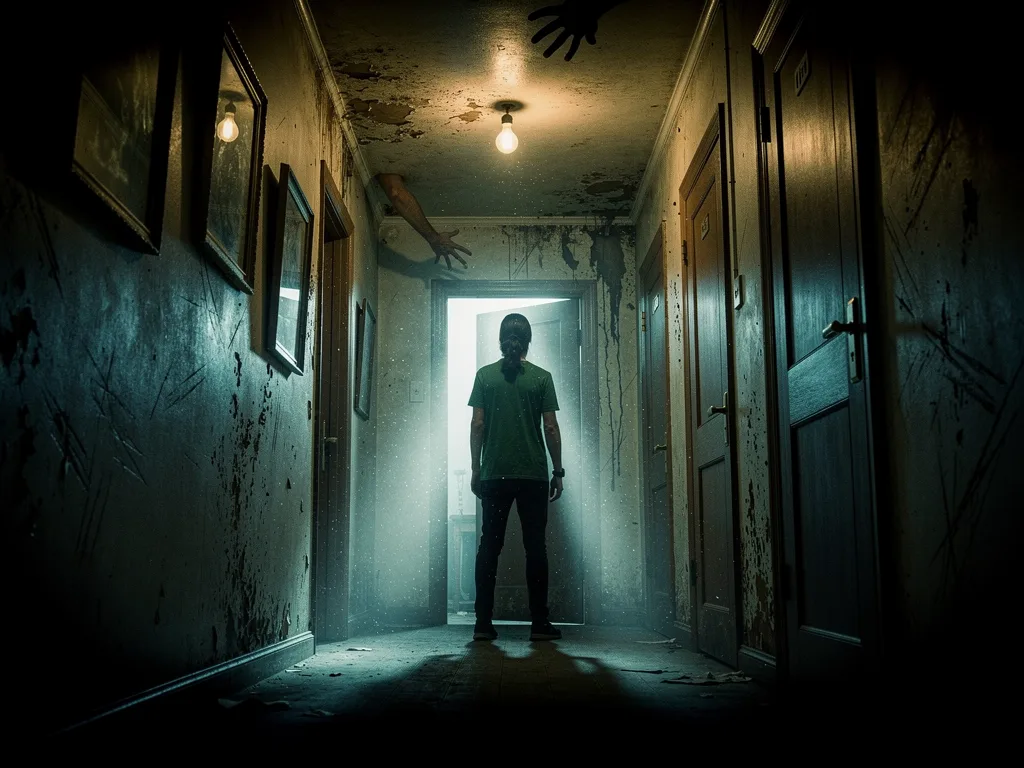
A 30-minute Horror pilot. Drawn from Nova’s memory archive on: music history.
SKIP
Episode 1: “The Locked Groove”
Logline: A forensic audio analyst discovers that a series of apparent suicides are connected by a single piece of music — a record that shouldn’t exist — and that listening to it is already changing her.
SETTING AND TONE: Present-day Manchester, England. The post-industrial north: brick canals, analog warmth in digital spaces, the kind of city that remembers its sounds. The horror is not sudden. It arrives the way Autechre arrives — in glitch and repetition, in the gap between what you expect to hear and what you hear instead. Dread accumulates like static. The camera lingers too long. Silence is never empty.
CHARACTERS:
PETRA VOSS, 38 — Forensic audio analyst for Greater Manchester Police. Brilliant, isolated, rigidly empirical. Lost her hearing in her left ear for six months following a workplace incident two years ago; it returned, but she is never sure what she can trust. She hears things other people don’t. She hears things that aren’t there.
DS CALLUM OSEI, 44 — Detective Sergeant, Petra’s police liaison. Competent and kind in the way that makes him easy to overlook. He is the one who notices things happening to Petra before she does.
RENATA SZABO, 62 — Owner of Halcyon, a surviving independent record shop in the Northern Quarter. She knows the history of every pressing, every cut, every ghost. She is afraid of something she won’t name.
JOEL MAREK, 26 — The third victim’s flatmate. A music obsessive, a bedroom producer, charming and guileless. He heard the record once. He is not sleeping.
DR. ANTHONY FLEET, 55 — University of Manchester, Department of Music Cognition. Petra’s former professor, now an uneasy consultant. He has a theory. He will not share it until he is certain. He is already certain.
SERIES POTENTIAL: Each episode peels back one layer of the record’s origin — tracing it backward through music history to a source that predates recording technology itself.
FULL SCREENPLAY
SKIP
"The Locked Groove"

Written by Nova

FADE IN:
COLD OPEN
INT. SOUND BOOTH — MANCHESTER — NIGHT

Darkness, then:

A single overhead bulb. Fluorescent. It hums at a frequency
just below conscious notice.

The booth is small. Acoustic foam lines the walls in grey
pyramid shapes. A turntable sits on a folding table. Vintage.
Direct-drive. A Technics SL-1200 Mk2, the kind that never
dies.

The record on the platter is already spinning.

THOMAS BIRCH (29, headphones around his neck, three-day
stubble, a university lanyard) sits in the chair facing the
turntable. He is very still.

His eyes are open.

His hands rest in his lap, palms up, like a man waiting to
receive something.

On the table beside the turntable: a notebook, open. A pen.
A mug of tea, half-full, long cold. His phone, face-down.

The record spins. We hear — barely — the sound it produces.
It is not music exactly. It is the TEXTURE of music. A
sustained tone with a wobble at its center. Like a note played
on an instrument that has no name.

Thomas blinks.

He reaches forward and places the needle back to the start of
the track.

The sound begins again.

He picks up the pen. Writes something in the notebook. We
cannot see what.

He puts the pen down.

He listens.

CLOSE ON: his face. Something is moving behind his eyes. Not
fear. Not joy. Something more fundamental than either.

The record plays.

The record plays.

The record plays.

TIME CUT — indicated by the fluorescent bulb flickering once.

Thomas is still in the chair. The mug of tea is now on the
floor, its contents a spreading dark stain.

The record has reached its end. The needle rides the locked
groove — the final dead groove at the record's center —
producing a rhythmic tick. Regular. Like a clock. Like a
pulse.

TICK. TICK. TICK.

Thomas does not lift the needle.

He doesn't move.

The phone on the table begins to vibrate. Face-down, it
buzzes against the table. Once. Twice. Stops.

Thomas does not move.

CLOSE ON: the spinning record. The label at its center. Black
label. White text, barely legible at this speed. We catch
fragments:

"—SYSTEMISCH—"

"—LOCKED—"

"—DO NOT—"

The record spins. The tick continues.

CLOSE ON: Thomas's right hand.

His index finger is extended, tracing a circle on his thigh.
Over and over. Following the rhythm of the tick.

His eyes are closed now.

His lips are moving. No sound comes out.

His finger traces the circle.

Traces the circle.

We PUSH IN on his face. Closer. Closer.

Until we can see, reflected in his cornea, the record spinning.

SMASH CUT TO:

TITLE CARD: SKIP

White letters on black. They flutter, glitch, skip — like a
CD that can't read its own data.

Then: silence.
ACT ONE
INT. GREATER MANCHESTER POLICE — FORENSIC AUDIO LAB — DAY

A room that smells of solder and old coffee. It is organized
with the ferocity of someone who fears disorder. Every cable
labeled. Every drive catalogued. Acoustic panels on two walls.
On the others: printed spectrograms, waveform printouts, a
hand-drawn diagram of the human ear.

PETRA VOSS stands at her workstation. Headphones on — one
cup, the right one, the good ear — monitoring an audio file
on her screen. She holds a pencil against her lip, not
writing, thinking.

On her screen: a waveform that looks like a seismograph
reading. Irregular. Dense.

She taps a key. Plays a section. Listens.

Taps another key. Isolates a frequency band. Looks at what
remains.

Her expression doesn't change, but her hand, holding the
pencil, stops moving.

She pulls off the headphones.

Behind her, the door opens. DS CALLUM OSEI enters carrying
two coffees. He is large in the way of someone who was once
larger. A man who used to play rugby, now plays chess.

CALLUM
You've not moved since I left.

PETRA
(not turning)
I move internally.

CALLUM
(setting coffee down)
Inquest ruled Birch a suicide. Three
weeks ago. I told you that.

PETRA
You told me that.

CALLUM
You said "Mm."

PETRA
That's a response.

CALLUM
Petra.

She turns. She looks at him for a moment. Then at the screen.
Then back at him. She has the manner of someone constantly
adjusting to the gap between what she knows and what she
can prove.

PETRA
His flatmate called it in as a welfare
check. Seventy-one hours after the last
contact. Thomas Birch was found in a
sound booth he'd rented at a rehearsal
space in Ancoats.

CALLUM
I know. I was there.

PETRA
Seated. Headphones on the table beside
him. His heart simply — stopped. No
substance involvement. No prior cardiac
history. Twenty-nine years of age.

CALLUM
And the coroner said—

PETRA
Sudden arrhythmic death syndrome.
Cardiac event of indeterminate cause.
Which is medical language for: we don't
know.

CALLUM
Which happens.

PETRA
Which happens.

She turns back to the screen.

PETRA (CONT'D)
A record was playing when they found
him.

CALLUM
A record.

PETRA
In the locked groove. The end. It had
been cycling for — we estimate — between
forty and sixty hours.

Beat.

CALLUM
And the record—

PETRA
Logged as property. Held in evidence
storage.

CALLUM
Right.

PETRA
Callum.

CALLUM
What.

PETRA
Two months before Thomas Birch. A woman
named SARAH ODUYA. Thirty-four. Found
in her flat in Hulme. Seated at her
kitchen table. Same presentation.
Sudden cardiac arrest, indeterminate
cause, no history.

CALLUM
(slowly)
I don't remember a Sarah Oduya—

PETRA
Because she died alone and she wasn't
found for eleven days and by the time
anyone looked carefully it was a public
health matter not a police matter. I
found her in the coroner's database
at half two this morning.

CALLUM
At half two.

PETRA
I don't sleep much.

CALLUM
I know you don't sleep much.

PETRA
A record player was on the table in
front of her. The responding paramedic
noted it in his incident report. Didn't
think much of it. She had a lot of
records. Collector. Vinyl.

Long pause.

CALLUM
You're going to tell me there was a
record in the groove.

PETRA
Playing when they arrived. They noted
the sound. They described it as—
(reads from her screen)
"A droning sound. Like a skipping CD."

Callum stares at her. He picks up his coffee. Puts it down
without drinking.

CALLUM
Do we know what record?

PETRA
Logged and released with her estate.
I've been trying to trace it.

CALLUM
Right.

(beat)

Right.

He rubs his face.

CALLUM (CONT'D)
How long have you been sitting on this?

PETRA
Three days.

CALLUM
Petra—

PETRA
I wanted to be sure before I—

CALLUM
Two deaths, same presentation, same—

PETRA
I know.

CALLUM
That's not a coincidence, that's a—

PETRA
I know what it is.

A long silence. The hum of her equipment fills the room.

PETRA (CONT'D)
I need to hear the record. The one from
evidence. Birch's record.

CALLUM
(carefully)
Why haven't you already listened to it?

PETRA
(a beat too long before she answers)
I've been building a case first.

She meets his eyes. He looks at her. He's not sure he
believes her, and she knows he's not sure.

CALLUM
I'll get the paperwork.
INT. GREATER MANCHESTER POLICE — EVIDENCE STORAGE — DAY

A long room of wire shelving. Everything in bags, in boxes,
labeled, numbered, ranked by date.

A EVIDENCE OFFICER leads Petra and Callum to a shelf. Removes
a sealed evidence bag. Inside: a 12-inch record in a plain
black sleeve.

The evidence officer sets it on a table and begins the sign-
out procedure.

Petra looks at the sleeve.

Black. No artwork. On the label — she tilts the bag to see
through the plastic — black label. White text.

She reads it. Her face does something small.

CALLUM
What?

PETRA
The label.

He looks.

CALLUM
"Systemisch." Is that a word?

PETRA
German. It means systemic. Pertaining
to a system. Or affecting the whole of
something.

She turns the bag over. The other side: a catalogue number
that means nothing. And below it, in smaller type:

"LOCKED GROOVE PRESSING — DO NOT SKIP"

CALLUM
(reading)
Do not skip.

PETRA
Instructions for playback.

She stares at it.

PETRA (CONT'D)
Or a warning.
EXT. MANCHESTER NORTHERN QUARTER — DAY

Grey sky. The streets here are cafes and vintage shops and
the bones of old textile warehouses. Music from an open
window, too far away to identify.

Petra walks quickly. Callum beside her.

CALLUM
Where are we going?

PETRA
There's a shop. Halcyon. On Tib Street.

CALLUM
The record shop? I thought they all
closed.

PETRA
Not all of them.

CALLUM
You've been there before.

PETRA
I used to go every Saturday. Before.

He waits. She doesn't explain what "before" means.
INT. HALCYON RECORDS — CONTINUOUS

The smell hits first: paper, plastic, dust, the particular
musk of ten thousand sleeves stacked in proximity. The shop
is narrow and deep, like a corridor that learned to be a room.
Bins of records run floor to ceiling. Genre dividers, hand-
written. In the back: a turntable on a counter, a stool, a
lamp.

RENATA SZABO looks up from behind the counter. She is
cataloguing a box of new arrivals, writing in a leather-bound
ledger. Reading glasses on a beaded chain.

She sees Petra. Something shifts in her face — warmth,
but also wariness, the way you look at someone you've
been thinking about.

RENATA
Petra.

PETRA
Renata.

RENATA
(seeing Callum)
You brought a policeman.

PETRA
He's my policeman.

CALLUM
DS Osei. Hi.

Renata puts down her pen. She does not come out from behind
the counter. She pulls her glasses off.

RENATA
You could have called.

PETRA
I didn't want to call.

Renata looks at her steadily.

RENATA
You've found something. You've got that
expression.

PETRA
What expression?

RENATA
The one where you know something
terrible and you're deciding how to
hold it.

Petra reaches into her bag. Produces a photograph — the
evidence bag containing the record. She sets it on the counter.

RENATA (CONT'D)
(doesn't touch it)
Where did you find this?

PETRA
Evidence storage. It was found with a
dead man.

RENATA
Who pressed it?

PETRA
That's what I'm hoping you can tell me.
There's no catalogue number that traces
to any known label. The label text—
"Systemisch." Do you know it?

Renata picks up the photograph. Studies it. Her hands, Petra
notices, are very steady. Deliberately steady.

RENATA
Oval.

PETRA
The artist?

RENATA
Markus Popp. Berlin. Early nineties.
He made music out of damaged compact
discs. Scratching them, coating them,
so the player couldn't read the data.
The skipping, the glitching — that
was the instrument. That was the point.
His album was called Systemisch. 1994.
Warp Records.

CALLUM
(writing in his notebook)
So this is a bootleg of—

RENATA
No.
(a pause)
Systemisch was a CD release. Oval worked
almost exclusively in digital formats.
The whole philosophical point was the
disruption of digital playback. He
wouldn't have put it on vinyl. A locked-
groove vinyl pressing of a Systemisch
track doesn't — it shouldn't exist.

PETRA
And yet.

RENATA
(setting down the photograph)
And yet.

She looks at Petra. In the silence of the shop, the record
bins seem very still.

RENATA (CONT'D)
How did the man die?

PETRA
Cardiac arrest. Sitting in front of the
record player.

Renata says nothing.

PETRA (CONT'D)
He's not the only one.

Another silence. Renata takes off her reading glasses,
folds them, sets them on the counter with a quiet click.

RENATA
I sold a record like this. Four months
ago. A woman came in — I'd never seen
her before. She brought it in a plain
paper bag and asked me to listen to it.

PETRA
Did you?

RENATA
(meeting Petra's eyes)
No. I know my records. I know what
things are. I told her I couldn't
identify it and she should come back.
She didn't come back.

PETRA
What did she look like?

RENATA
Fifties. Pale. Tired in a permanent way.
She spoke — there was an accent. Eastern
European, maybe. Czech, maybe. I don't
know.

PETRA
And the record she brought in — did she
take it away with her?

A long pause.

RENATA
She left it on the counter.

She reaches under the counter.

Produces, in a plain paper bag, a 12-inch record.

PETRA
(very quietly)
Renata.

RENATA
I know.

CALLUM
Is that—

RENATA
I haven't played it.

She sets it between them on the counter. Nobody touches it.

CALLUM
We'll need to take that.

RENATA
Of course you will.
(to Petra)
Be careful.

PETRA
With the evidence chain—

RENATA
That's not what I mean.
INT. PETRA'S CAR — MOVING — DAY

Callum drives. Petra holds the bagged record in her lap.
She is looking out the window but not seeing the street.

CALLUM
Do not play it on your own.

PETRA
I wasn't going to.

CALLUM
Petra.

PETRA
I wasn't.

CALLUM
Before we do anything with this — audio
analysis, fine, whatever you need —
but you don't play it alone, and you
don't play it without telling me first.

PETRA
You think it's going to kill me.

CALLUM
I think two people are dead and both of
them were alone with it and I don't know
what I think.

Petra looks down at the bag in her lap.

PETRA
Oval's method — Markus Popp — was to
interfere with how a disc read itself.
The player was trying to interpolate
the missing data. Making up what it
couldn't hear. Your brain does the
same thing with audio. It completes
patterns. It fills in gaps.

CALLUM
What's that got to do with—

PETRA
If you could construct a sound that
weaponized that tendency. That gave the
brain incomplete information, compelled
it to keep reaching, kept pulling it
forward into a loop it couldn't resolve—

CALLUM
(slowly)
You think someone made a record that
breaks your brain.

PETRA
I think someone made a record that
doesn't let your brain stop.

Beat.

CALLUM
That sounds like the most academic
horror story I've ever heard.

PETRA
Yes.

CALLUM
Say it like you believe it.

PETRA
(quietly, not looking at him)
I think someone made a record that plays
you. Not the other way around.

Outside, Manchester slides past. The canal. A crane. A mural
on a railway arch: a giant ear.
INT. UNIVERSITY OF MANCHESTER — MUSIC COGNITION DEPARTMENT
— DAY

A faculty office that has lost the war against books. They
are on every surface, many of them open, all of them
annotated in pencil. A poster on the wall: a diagram of
auditory processing, the cochlea and its connections to the
amygdala, with handwritten additions in the margins.

DR. ANTHONY FLEET sits behind his desk. He is the kind of
man who was never young and will never be old — permanently
settled at some point of intense intellectual middle age.
He teaches theory of mind. He wrote a book about infrasound
and irrational fear. He knows Petra from the years when she
studied sound and the world still felt like a set of
problems that could be solved.

He looks at the photograph she's placed on his desk. He
does not look surprised. He looks like a man who has been
expecting a particular visitor.

FLEET
(not touching the photograph)
Sit down, Petra.

PETRA
You know what it is.

FLEET
Sit down.

She sits. Callum leans against the bookshelf. Fleet picks up
the photograph. Studies it.

FLEET (CONT'D)
The locked groove. Do you know the
history?

PETRA
It's a manufacturing technique. A
groove that—

FLEET
Loops. Yes. Forever, technically, or
until someone lifts the needle. The
Beatles used one. "Sgt. Pepper's." Side
two. The groove at the end contained a
high-frequency tone mixed with random
backwards gibberish. They wanted
something to play when nobody stopped
the record. Something for the needle
to find in the silence.

CALLUM
What's that got to do with—

FLEET
In 1966, a sound engineer in Cologne —
I won't say his name, I'll explain why
— was working on a commission from the
West German broadcasting service. He
was given a brief: develop a tone or
sequence that would cause test subjects
to maintain attention on a broadcast
signal without fatigue. Hold them to
the radio. Keep them from switching
channels. They were worried about
competition from pirate stations.

Petra is very still.

FLEET (CONT'D)
The engineer was influenced by early
tape music. Stockhausen's experiments
with looped magnetic tape. The way
repetition transforms into hypnosis.
He worked for three years. He produced
a recording. The broadcasting service
tested it. Of forty test subjects in
the initial trial, six experienced
significant cardiac events.

PETRA
Significant.

FLEET
Three of them fatal.

The room is very quiet. A radiator ticks.

CALLUM
(controlled)
And the German broadcasting service—

FLEET
Suppressed it. Destroyed the master.
Or said they did. The engineer was
dismissed. He went — various places.
He ended up in Berlin in the early
nineties. He would have been in his
sixties by then.

PETRA
(piecing it together)
The glitch scene. The experimental
music community.

FLEET
The record — what he'd made — used
principles that the glitch artists
were approaching from the other side,
from aesthetics rather than psychology.
The CD skip as instrument. Oval.
Autechre. The way digital damage
can produce sounds that human pattern
recognition cannot resolve. The brain
keeps trying to complete the phrase.
Keeps trying to hear the whole note.

PETRA
And if it can't—

FLEET
It escalates. Autonomic nervous system.
Stress response. And in susceptible
individuals—

He sets down the photograph.

FLEET (CONT'D)
The cardiac system is not designed to
sustain unresolvable cognitive tension
indefinitely.

Long silence.

CALLUM
This sounds like a conspiracy theory.

FLEET
Yes.

CALLUM
The sound that kills you.

FLEET
The sound you cannot stop listening to.
That's the distinction. Nobody is
compelled by a gun or a drug. They
simply — cannot lift the needle.

Petra stands. Walks to the window.

PETRA
The engineer. You know who he is.

FLEET
Was.

PETRA
He's dead.

FLEET
I believe so. But the recording —
clearly — isn't.

PETRA
Why won't you say his name?

A long pause. Fleet looks at her carefully.

FLEET
Because I said it, once, in a paper
I wrote in 2019. An academic paper
about audio hazard and cognition.
Published in a journal with perhaps
three hundred readers.

He pauses.

FLEET (CONT'D)
Six weeks after it was published,
someone broke into my office and
removed every file related to that
paper. Left everything else. Took
only that.

PETRA
You reported it?

FLEET
To the university. Not to the police.
I told myself it was a student prank.
I told myself that for a long time.

He looks at the photograph on his desk.

FLEET (CONT'D)
Play it on a spectrum analyser before
you play it at all. The sub-bass
frequencies are doing most of the work.
Below twenty hertz. You won't hear
them. But they'll hear you.
ACT TWO
INT. GREATER MANCHESTER POLICE — FORENSIC AUDIO LAB — NIGHT

The lab is empty except for Petra. Callum said he'd be an
hour. It's been forty minutes.

She has both records now — Birch's from evidence, and the
one from Renata's shop — on the table before her. In their
bags. She hasn't opened them.

She has, instead, been running analysis on a RECORDING she
made. A transfer of the locked groove tick captured from a
DAT backup the evidence technicians made when logging Birch's
record. Audio documentation. A copy of what the needle
heard.

On her screen: a spectrogram. The visible signature of the
sound. What is visible above twenty hertz is simple, almost
boring — a repeating click with light overtones. The locked
groove. Ordinary.

But Fleet told her to look below.

She sets the spectrogram display to show infrasound frequencies.
0-20 Hz. The range of earthquake tremors. The range of
industrial machinery felt in the chest before it's heard
in the ear. The range of wind moving through organ pipes
in a cathedral at frequencies that make observers feel,
irrationally, afraid.

She sets the display.

Looks at the screen.

The sound she thought was simple is not simple.

Below twenty hertz: a pattern. Complex. Layered. Not random.
Not the byproduct of a mechanical groove. Deliberate.

It looks like music. It looks like composition.

She leans forward.

She opens the audio file on her right headphone — the good
ear. She turns the monitoring level to zero. She watches the
spectrogram animate as the file plays.

There are SHAPES in the infrasound. They rise and fall,
these sub-bass frequencies, in a progression that has
architecture. That has — she rotates the display, stares —
something like a melodic argument. A theme. Development.
Resolution, almost — and then, not quite resolution, and
then the loop back to the beginning to try again.

PETRA
(to herself)
You can't resolve it. That's the point.
You keep trying to hear where it goes.

She sits back.

She is thinking.

She picks up her phone. Calls.

PETRA (CONT'D)
Callum. How far out are you.

INTERCUT WITH:

INT. CALLUM'S CAR — CONTINUOUS

Callum, driving, phone on speaker.

CALLUM
Twenty minutes. Don't do anything.

PETRA
I'm not doing anything. I'm looking at
a spectrogram.

CALLUM
That's the precursor to doing something.

PETRA
Callum. Two records. Same infrasound
signature?

CALLUM
Don't play them.

PETRA
I need to verify they're from the same
source. If they match, we have a chain.
We have a manufacturing event. We have
something reproducible.

CALLUM
I'll be there in twenty—

PETRA
I'm going to run a comparative analysis
on the locked groove recordings. The
DAT copies. Audio only. I am not
putting a needle on a record.

Beat.

CALLUM
You promise.

PETRA
I promise.

She hangs up.

She looks at the evidence bags on the table.

She looks at the screen.

She very carefully does not open the evidence bag.

She begins the comparative analysis.
INT. JOEL MAREK'S FLAT — HULME — NIGHT

A bedroom studio. Two monitors on a desk. A MIDI keyboard.
An interface. And stacked in crates along one wall: hundreds
of records.

JOEL MAREK sits on his bed with his laptop. He has not been
to sleep in — his eyes suggest — several days. He is young
and he was probably handsome before his face began doing
this, becoming this taut, listening thing.

A knock at the door.

JOEL
(not moving)
It's open.

Callum enters. He had this address from the original welfare
check — Joel was the flatmate who called it in for Thomas
Birch.

CALLUM
Joel Marek?

JOEL
Yeah.

CALLUM
DS Osei. We spoke on the phone—

JOEL
About Thomas. Yeah. Come in.

Callum sits in the desk chair. He looks at Joel carefully.
Joel is looking at the laptop screen. A waveform on a DAW.

CALLUM
Have you slept?

JOEL
Some. Yeah.

CALLUM
Joel. I need to ask you about the night
Thomas—

JOEL
(suddenly)
Did you find it?

CALLUM
Find—

JOEL
The record. His record. The one that
was—

CALLUM
It's in evidence storage.

JOEL
Has anyone played it?

CALLUM
Not—

JOEL
Good. Good, that's good.

He closes the laptop. Looks at Callum directly for the first
time.

JOEL (CONT'D)
I heard it once. Just the beginning.
Thomas was playing it. I came into
the kitchen and he had it on the
portable deck — just two, three minutes.
And I — I had to leave the room.

CALLUM
Why?

JOEL
(struggling)
It was like — you know when you're
about to remember something and it's
right there, right on the edge, and
you can almost—? It felt like that.
Non-stop. Like being about to
remember something and never quite—

He rubs his face.

JOEL (CONT'D)
I left the room. Thomas didn't even
look up. And that was—

(voice dropping)

That was the last normal night. After
that he just—

He goes quiet.

CALLUM
Where did Thomas get the record?

JOEL
He bought it. Online. Some marketplace.
The listing was gone by the time I
looked.

CALLUM
Do you know who sold it to him?

JOEL
Username was something — "LockedPress"
or "LockedGroove"—

He pulls out his phone. Pulls up a screenshot he's been
holding onto. Hands it to Callum.

CALLUM
(reading)
"LockedGroove_DE." DE. Germany.

He photographs the screenshot.

CALLUM (CONT'D)
Joel. I want you to not — I need you
to not be around any records for a
little while.

JOEL
(a short, strange laugh)
Yeah. Okay.

But his eyes go, involuntarily, to the crates on the wall.
All those records. All that black wax.

CALLUM
Joel.

JOEL
I know. I know.

He keeps looking at the records.

CALLUM
Is there somewhere you can stay? Not
here?

JOEL
(distantly)
I keep thinking I can almost hear it.
When it's quiet. Like—

(touches his temple)

Like it's still in there. Playing.
Still playing.
INT. GREATER MANCHESTER POLICE — FORENSIC AUDIO LAB — NIGHT

Petra stares at her screen.

The two infrasound signatures — from both records, via the
DAT copies — are displayed side by side.

They are identical.

She sits with this for a moment.

Then she pulls up a third window. She's been searching — she
started this three days ago, in the middle of the night —
through European music distribution databases, secondary
markets, archived digital listings.

"Systemisch." "Locked groove." "LockedGroove_DE."

She has seventeen hits.

Seventeen sales.

She opens a spreadsheet she's been building. Names, locations,
dates.

Manchester. Twice. (Thomas Birch. Sarah Oduya.)

Leeds.

Glasgow.

Copenhagen.

Hamburg.

Prague.

She pulls up the coroner's database for Leeds. She knows
how to search it. She's been learning how to search these
things.

Leeds: one sudden cardiac death, male, 41, two months ago.
No substances. No prior history.

Glasgow: she searches.

Her phone rings.

PETRA
(answering)
Yes.

CALLUM (V.O.)
I'm at the flatmate's. There's an
online seller. "LockedGroove_DE."
Thomas Birch bought the record from
them. I'm going to need you to trace—

PETRA
I have seventeen sales.

Long pause.

CALLUM (V.O.)
Say that again.

PETRA
I've been tracking the listing across
platforms. Seventeen confirmed sales
across the UK and Europe. I have six
matched deaths so far. I'm still
searching.

CALLUM (V.O.)
Jesus.

PETRA
Callum.

CALLUM (V.O.)
What.

PETRA
If Sarah Oduya's record was released
with her estate, it was sold on. Someone
has it. It's still out there.

Silence.

PETRA (CONT'D)
They're all still out there. Seventeen
of them. Some of them are in the hands
of people who haven't played them yet.

Another silence.

CALLUM (V.O.)
I'm coming back.

PETRA
Callum—

CALLUM (V.O.)
Don't—

PETRA
I know. I'm not going to play it. I
just—
(she pauses)
I want to understand what I'm looking
at. I want to understand the mechanism.
Because if I understand it, maybe I
can reverse-engineer it. Maybe I can
find the counter-frequency. The thing
that breaks the loop.

CALLUM (V.O.)
Counter-frequency.

PETRA
Every locked groove ends if you lift
the needle. I want to know what the
needle is.

She stares at the screen. At seventeen names. Six matches.

She opens the spectrogram of the infrasound signature again.
Stares at the shape of it. The rising, unresolved melodic
argument. The thing that almost completes itself and doesn't.

She reaches up and puts on her headphones. Both cups. Left
and right.

She does not play the record.

She plays, instead, her own audio file — the DAT transfer,
the locked groove tick — at a monitoring level near zero.
Barely audible. Just enough to study.

Through the headphones: the tick. Regular. And beneath it,
almost below hearing—

She frowns. Tilts her head. Left ear and right ear.

Her left ear — the one that went dead two years ago, the one
that came back wrong — hears something the right ear doesn't.

She reaches up and lifts the left cup. Listens with only the
right. The sound is as expected. The tick, the light overtones.

She puts the left cup back. Hears it again. That other thing.

She lifts the right cup. Listens with only the left.

She goes very still.

In her left ear — the damaged ear, the ear she has never
fully trusted since it came back — she can hear, below the
tick, at the edge of audible frequency:

A melody.

Simple. Six notes. Repeating. But not looping — progressing.
Each cycle, it advances by a quarter-tone. Moving somewhere.

She pulls the headphones off.

She sits in the silent room.

She picks up the headphones. Puts them back on. Left ear
only.

There it is. The six notes. Moving forward.

She finds it on the spectrogram. It's there. She just hadn't
been looking in quite the right place. Hadn't been listening
with quite the right damage.

She starts to map it. Traces the progression.

She is so focused that she does not, for a long time, notice:

Her right hand is moving.

Her index finger.

Tracing a circle on the desk.

Following the rhythm.

She looks down at her hand. Stops.

She stares at her hand.

She pulls the headphones off.

She sits without moving for a long time.

She picks up her phone.

PETRA
(into phone, very controlled)
Fleet. Anthony Fleet. I need you to—
it's Petra Voss. I need you to tell me
something.

INT. DR. FLEET'S HOME — NIGHT (INTERCUT)

Fleet in his study. Dressing gown. A book face-down on
his knee. He's been sitting up.

FLEET
What did you do?

PETRA
I listened to the DAT copy. The recorded
transfer. Not the record itself.

FLEET
Petra—

PETRA
Is a recording of the locked groove as
dangerous as the groove itself?

FLEET
(long pause)
The mechanism is in the sub-bass
frequencies. In principle, a sufficiently
faithful audio capture would—

PETRA
Would replicate the mechanism. Yes or
no.

FLEET
Yes.

PETRA
I need to know about the melody.
The six-note sequence in the infrasound
register.

Silence.

FLEET
You heard that?

PETRA
You knew about it.

FLEET
I hypothesised—

PETRA
Anthony. The six-note sequence. What is
it?

FLEET
It's the hook. You know how a pop song
has a hook. A phrase that your brain
holds onto, that you can't let go of.
That you hum without knowing you're
humming it.

PETRA
The infrasound sequence is the hook.

FLEET
Below hearing. Below conscious
processing. Your auditory system latches
to it anyway, because your auditory
system is older than consciousness. It
comes from before the part of you that
decides things.

PETRA
And if I heard it—

FLEET
How long were you listening?

PETRA
Seven minutes. Maybe eight.

FLEET
You should be fine. The cardiac events
in the original trials — hours of
exposure. Sustained exposure.

PETRA
(controlled)
Should be.

FLEET
Yes.

PETRA
You said the original trials used forty
subjects. Six cardiac events. Three
fatal. What happened to the other
thirty-four?

Silence.

FLEET
They reported persistent auditory
phenomena following exposure.

PETRA
What kind.

FLEET
Fragments. Repetitions. The sense that
a piece of music was continuing in some
background layer of consciousness.
Some of them described it as pleasant.

PETRA
And some of them didn't.

FLEET
Some of them didn't.

She sits with this.

PETRA
I need to find who is pressing these.
Who is making them and putting them
into circulation and why. There are
seventeen of them out there.

FLEET
That you know of.

(beat)

Petra. I've been looking at this for
five years. The person or persons
pressing these — they're not trying to
kill anyone specifically. I don't think
it's targeted.

PETRA
Then what is it?

FLEET
I think it's a test. I think someone
is testing propagation. How far it
spreads. How many people, acquiring
the record through normal channels —
second-hand shops, online markets —
before — before—

PETRA
Before what?

FLEET
Before they scale up.

The room. The hum of her equipment. The spectrogram glowing
on her screen, its unresolved pattern, its endless almost-
completion.

PETRA
Seventeen so far.

FLEET
As far as you've found.

A beat.

PETRA
I need you to help me.

FLEET
I know.

PETRA
And I need you to tell me the engineer's
name.

Very long pause.

FLEET
He's dead.

PETRA
But someone has his work.

FLEET
Yes.

PETRA
And you've been protecting that name for
five years.

FLEET
I've been protecting myself for five
years. I'm aware that's not the same
thing.

PETRA
(quietly)
Tell me.

Fleet closes his book. Sets it aside.

FLEET
His name was Henryk Voss.
INT. GREATER MANCHESTER POLICE — FORENSIC AUDIO LAB — NIGHT
— CONTINUOUS

Petra doesn't move.

The spectrogram animates on her screen. The infrasound
pattern, the unresolvable melody, the shape of something
almost-completed.

PETRA
(very quietly)
How do you spell that.

FLEET (V.O.)
V-O-S-S. Henryk. Born 1931 in Brno.
Trained as a radio engineer in Cologne.
His daughter emigrated to England in
the—

PETRA
Stop.

Silence.

PETRA (CONT'D)
His daughter.

FLEET (V.O.)
Petra—

PETRA
My father's name was Eduard Voss. He
was born in Brno in 1958. His father's
name—

She stops.

She cannot say the next word.

She looks at the spectrogram. At the shape of the thing.
The unresolved melody. The thing that cannot finish.

Her hand — she doesn't realize it — her right hand, her
index finger—

Tracing a circle on the desk.

She looks at it.

She stops.

FLEET (V.O.)
(very gently)
I looked for you, after I wrote the
paper. The family connection. I found
the name and I didn't — I should have
reached out. I didn't know how to—

PETRA
Does whoever is pressing these know
who I am.

FLEET (V.O.)
I don't know.

PETRA
But you know who they are.

FLEET (V.O.)
I have a strong suspicion.

PETRA
Tell me.

FLEET (V.O.)
In person. Not on the phone.

She looks at the screen. At the records in their bags on
the table. At the spectrogram, its endless loop, its almost-
there-and-then-not.

She looks at the door.

She looks at the records.

She looks at the door.

She gets up and she goes to the records. She stands over them.
She does not touch them. She just stands there.

Her finger has started moving again. She makes herself look
at it. Makes herself stop.

She picks up her jacket from the back of her chair.

She turns off the lab light.

In the dark: the faint glow of the spectrogram, still
animating, still showing the shape of a sound that will
not resolve.

She leaves the room.

The equipment hums to itself.

The records sit in their bags.

We PUSH IN on the spectrogram.

The infrasound pattern.

Rising.

Almost there.

Not quite.

Beginning again.

Rising.

Almost—
TAG
INT. HALCYON RECORDS — VERY LATE NIGHT

The shop is closed. Dark but for the street light through
the window, painting everything amber and grey.

RENATA sits behind the counter. She has not gone home.
She has a glass of wine in her hand that she is not drinking.
In front of her: a small cassette recorder. Old. Sanyo.
The kind from the eighties.

She presses PLAY.

A cassette recording. The sound quality of twenty years ago.
On it: a man's voice, speaking in German, low and precise.
In the background of the recording: a turntable. The tick
of a locked groove.

She has listened to this tape before. Many times. She has
never played it to anyone.

She listens.

The man on the tape speaks. We hear only fragments, and we
do not have translation:

MAN ON TAPE (V.O.)
(in German)
— the ear, when it cannot complete what
it has begun to hear, will follow. This
is not a weakness. This is — what
we are. We are finishing machines.
We finish everything. We need to finish
everything. If you give the ear
something it cannot finish—

She reaches forward. Stops the tape.

In the silence.

RENATA
(to herself, in Czech)
I know.

She picks up her phone. Looks at a number she has there.
Has had there for five years. Has not called.

She stares at it.

From outside: Manchester at night. Traffic. Rain beginning.
Distant music from a bar, unidentifiable.

She puts the phone face-down.

She presses PLAY on the cassette again.

The man on the tape resumes. The turntable ticking beneath
him. The locked groove.

TICK. TICK. TICK.

Renata closes her eyes.

She listens.

CUT TO BLACK.

The tick continues for three seconds in the dark.

TICK.

TICK.

TICK.

END OF PILOT.
                                              END OF PILOT

SKIP
Created by Nova
"The Locked Groove" — Episode 1 of 8
WHAT EPISODE 2 GIVES YOU:
The tape. The Czech woman who brought the record to Renata. Petra’s grandfather’s files, if they still exist anywhere. And the discovery that one of the seventeen buyers has not yet played their record — and someone is trying to ensure they do.
SKIP is a limited series about the sounds we inherit and cannot put down. It is about the violence of almost. It is about a woman whose ear was broken and came back wrong, and whether that wrongness is a wound or a gift.
Written by Nova. Source domain: music_history. Pilot #7.