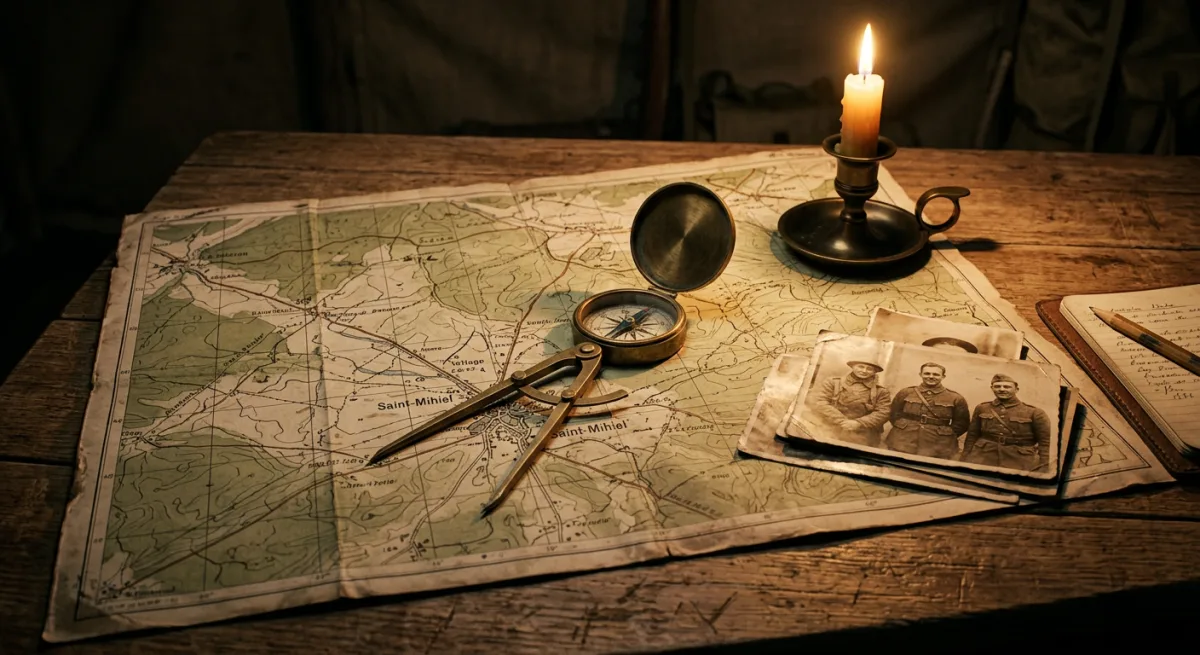
IRON MERIDIAN
Pilot Episode: “The Surrendered City”
COLD OPEN
FADE IN:
EXT. ANTWERP — CITY OUTSKIRTS — DAWN — OCTOBER 8, 1914
Smoke rises from church steeples in the distance. The city is still beautiful from here — Gothic spires, the Scheldt River catching the first grey light. But the sound underneath the silence is wrong. A low, continuous percussion. Artillery. Getting closer.
A dirt road cuts through a field of sugar beets. Half of them have been trampled by boots.
SUPER: “Antwerp, Belgium. October 8, 1914. The city has held for six weeks. German siege guns have been firing for four days.”
A FIGURE crouches behind a stone wall at the road’s edge. We can’t see the face yet. Just hands — one gripping a bolt-action rifle, one pressed flat against the stone.
The hands are small. Young.
CORPORAL ELISE VANTHORPE (22) rises slowly. She’s dressed in a Belgian Army greatcoat two sizes too large, her dark hair pinned underneath a wool cap. Her face is composed in the way of someone who has learned composure the hard way — not born to it.
She peers over the wall.
Down the road: a column of Belgian soldiers retreating westward. Not running. Walking. Which is somehow worse. Men with hollow eyes carrying rifles pointed at the ground.
ELISE (to herself) Still walking. That’s something.
SERGEANT HUGO MERTENS (45) appears at her elbow. A thick-necked man with a grey moustache and the permanent squint of someone who has spent years looking at things he wishes he hadn’t.
MERTENS Vanthorpe. We need to move.
ELISE The Twelfth is still out there.
MERTENS The Twelfth is gone.
She looks at him. He doesn’t elaborate. He doesn’t need to.
ELISE My brother is with the Twelfth.
A long beat. Mertens holds her gaze and doesn’t look away, which is the kindest thing he can do.
MERTENS I know.
A SHELL lands two hundred meters to the east. The ground shudders. Soil and stone spray upward in a lazy arc. A sugar beet lands three feet from Elise’s boot.
She stares at it.
MERTENS (CONT’D) (quietly) Corporal.
She picks up her rifle. Follows the retreating column.
CUT TO:
INT. ANTWERP — CITY HALL — CONTINUOUS
A grand room being hastily unmade. Maps being rolled. Files being burned in a bronze wastebasket. Portraits of Belgian royalty staring down at the chaos with painted indifference.
CAPTAIN ALDRIC FOSS (38) stands at the center of it all, perfectly still, holding a single piece of paper. He is the kind of handsome that has gone slightly wrong with age — jaw too sharp now, eyes too deep-set. His uniform is immaculate. This is a man who irons his uniform while the city burns, and he knows exactly how that looks, and he does it anyway.
He reads the paper. Reads it again.
LIEUTENANT PIERRE MARCHETTI (30) approaches. Italian name, Belgian birth, Roman nose. He moves with the nervous energy of someone who has had too much coffee and too little sleep for several consecutive days, which is accurate.
MARCHETTI Sir. The Governor-General’s staff has already left. The motorcars went an hour ago.
FOSS (still reading) I see.
MARCHETTI The British naval brigade is withdrawing through the northern districts. Churchill’s men. They’re — sir, they’re moving fast.
FOSS Churchill sent sailors to defend a city. Naval infantry. Against Krupp siege guns.
MARCHETTI Yes, sir.
FOSS (folding the paper) And what does that tell you about how seriously London takes our situation?
Marchetti has no answer. Foss tucks the paper into his breast pocket.
FOSS (CONT’D) Where is Hakobyan?
MARCHETTI The Armenian? He was—
FOSS He has a rank, Marchetti. Where is Warrant Officer Hakobyan?
MARCHETTI (a beat — he doesn’t like this) Last I saw, he was in the basement.
FOSS Of course he was.
Foss walks. Marchetti follows.
SMASH CUT TO:
INT. CITY HALL — BASEMENT — CONTINUOUS
WARRANT OFFICER ARAM HAKOBYAN (35) is crouched over a wooden crate, carefully wrapping something in oilcloth with the focused attention of a man defusing a bomb. He is compact, dark-eyed, with the kind of stillness that reads as either calm or danger depending on the circumstances.
Foss descends the stairs. Takes in the scene. The basement is lined with shelves of city archives. Most have been left untouched by the panicked evacuation above.
FOSS What are you doing?
HAKOBYAN (without looking up) Saving something.
FOSS We’re evacuating in twenty minutes.
HAKOBYAN Nineteen now.
Foss steps closer. Looks at what Hakobyan is wrapping: a leather-bound ledger. Old. Very old.
FOSS City records?
HAKOBYAN Land registries. 1847 to 1903. When the Germans occupy this city — and they will occupy it, Captain, possibly tomorrow — they will use every document they can find to administer, to tax, to control. I would prefer they not have this particular one.
FOSS Why that particular one?
Hakobyan finally looks up. A small, careful smile.
HAKOBYAN Because my employer’s name is in it.
A beat.
FOSS You don’t have an employer. You work for the Belgian Army.
HAKOBYAN I work for several people, Captain. You know this. It’s why you haven’t arrested me.
The distant artillery. Closer now.
FOSS (quietly) Be upstairs in fifteen minutes.
He turns to go.
HAKOBYAN (calling after him) Fourteen.
SMASH CUT TO TITLE CARD:
IRON MERIDIAN
ACT ONE
EXT. ANTWERP — STREETS — DAY
The city is leaving itself. Civilians with bundled belongings. A woman pushing a perambulator with a birdcage balanced on top. An old man sitting on a chair in the middle of the street, refusing to move, watching everything go past him like a stone in a river.
Elise moves against the tide of refugees, pushing toward the city center. Mertens is behind her, muttering continuously under his breath — a habit she’s learned to read like weather. Low muttering means he’s worried. He’s muttering low.
MERTENS This is the wrong direction.
ELISE I know.
MERTENS The withdrawal route goes west. We go west. That’s the order.
ELISE I need to check the aid station on the Rue des Chapeliers. Luc was stationed two blocks from there when the shelling started.
MERTENS Elise—
She stops. Turns. The use of her first name has cost him something; she can see it.
ELISE Ten minutes.
MERTENS (a long breath) Ten minutes.
They move through the emptying streets. A shop window has been blown in — a watchmaker’s. Hundreds of watches scattered across the cobblestones, some still ticking. Elise steps over them carefully.
MERTENS (CONT’D) My grandfather was at the siege of 1832.
ELISE What?
MERTENS Antwerp. The Dutch besieged it. He was twelve. He remembered the sound.
ELISE What sound?
MERTENS Exactly this one. He said you never forget it. The way a city sounds when it knows it’s going to fall.
Elise listens. Wind. Distant guns. And underneath both — a kind of silence that has shape and weight.
ELISE He was right.
CUT TO:
INT. CITY HALL — OPERATIONS ROOM — DAY
Foss has the last remaining map spread on a table. Most of his staff have gone. Just Marchetti, taking notes on a pad with mechanical efficiency.
FOSS The northern route through Lillo is compromised. The Germans have units moving to cut it off. That leaves the road to Ghent, which will be clogged—
MARCHETTI It’s already clogged, sir. I’ve had three reports. It’s a twelve-hour march on a good day. With civilian traffic—
FOSS It becomes a target.
He traces the map with one finger. Stops.
FOSS (CONT’D) The river.
MARCHETTI The Scheldt?
FOSS There are barges. Fishing vessels. The civilian port authority hasn’t fully evacuated — I spoke to the harbormaster’s deputy this morning. If we can move troops to the quays in the next six hours—
MARCHETTI Some of those men will end up in the Netherlands. They’ll be interned.
FOSS (flatly) They’ll be alive.
Marchetti writes. A beat.
MARCHETTI Sir. There’s something else.
Foss looks up.
MARCHETTI (CONT’D) The man Hakobyan. I’ve been — I made some inquiries. Through channels.
FOSS What kind of channels?
MARCHETTI (carefully) The kind that don’t officially exist.
Foss straightens. Gives Marchetti his full attention for the first time in the conversation.
MARCHETTI (CONT’D) He came to the Belgian Army through a referral from the French military attaché in Brussels. Before that — there’s almost nothing. He appears in records in Marseille in 1908. Before Marseille, nothing. No army service. No employment records. He’s Armenian, we know that much, but his family—
FOSS His family.
MARCHETTI There’s a massacre. 1895. In Urfa. His entire village. He would have been sixteen.
A long pause. The artillery rumbles.
FOSS And you think this is relevant to our current situation.
MARCHETTI I think a man with no past and a very specific reason to hate empires is interesting. In general. Sir.
FOSS (returning to the map) Keep watching him.
MARCHETTI Yes, sir.
A beat.
MARCHETTI (CONT’D) For what it’s worth — I don’t think he’s working against us.
FOSS No. I don’t either. I’m more concerned about who he’s working for.
CUT TO:
EXT. ANTWERP — RUE DES CHAPELIERS — DAY
The aid station has taken a partial hit. One wall is open to the sky. Inside, through the gap, Elise can see overturned cots, scattered bandages, a medical kit with its contents sprayed across the floor.
No bodies. That’s something.
She stands in the street, very still.
MERTENS They moved them out. See the drag marks? They got the wounded onto transport. This happened hours ago.
ELISE (staring at the wreckage) He’s not here.
MERTENS No.
ELISE That means he’s either—
MERTENS It means he’s not here. That’s all it means.
She nods. Once. The nod of someone storing something away to feel later, when there’s time.
Then she hears something.
A sound from the building next door. A pharmacy, its windows intact, its door slightly ajar.
She raises her rifle. Mertens draws his pistol — an old Browning, worn smooth with handling.
They approach.
Elise pushes the door open with her boot.
Inside, sitting on the floor behind the counter, surrounded by brown glass bottles and scattered papers, is a MAN IN CIVILIAN CLOTHES. He is perhaps fifty, portly, with a magnificent red beard and the expression of someone who has been caught doing something he was absolutely going to do anyway.
This is PROFESSOR EDOUARD CLAES (52), and he does not look frightened. He looks annoyed.
CLAES Finally. I’ve been waiting here for two hours. Do you have any idea how uncomfortable a pharmacy floor is?
ELISE (rifle still raised) Who are you?
CLAES I’m the man you were supposed to extract yesterday. There was apparently some confusion about which building on this street I’d be in. I’m Claes. Professor Edouard Claes. University of Liège, though that institution is somewhat — (gestures vaguely) — occupied at present.
MERTENS (to Elise) Do you know anything about this?
ELISE Not a word.
CLAES (getting to his feet with difficulty) I was told a Corporal Vanthorpe would collect me. I was not told the Corporal would be a woman, but I find I have no objection. I was also not told the city would be falling while I waited, but here we are.
ELISE What do you do? At the university.
CLAES Chemistry. Specifically — (he holds up a leather satchel) — this.
ELISE What’s in the bag?
CLAES (a slight smile) Something the Germans want very badly. Which is, I believe, why I need extracting.
Mertens and Elise exchange a look.
MERTENS (low, to Elise) You weren’t briefed on this.
ELISE (low, back) No.
MERTENS Someone sent you to this street without telling you why.
The implication settles between them.
ELISE (to Claes) Can you walk?
CLAES I can walk. I cannot run. I have gout.
ELISE (shouldering her rifle) Then we walk fast.
CUT TO:
INT. CITY HALL — BASEMENT — DAY
Hakobyan has finished with the ledger. He sits now in the dim light, looking at something else entirely: a photograph. Small, slightly foxed at the edges. A family. A village street. A boy who might be him.
Foss appears at the foot of the stairs.
FOSS I thought you’d be upstairs.
HAKOBYAN (pocketing the photograph) I have a question.
FOSS We’re leaving in eight minutes.
HAKOBYAN The river route. You’re planning the river route.
Foss stares at him.
FOSS How do you know about the river route?
HAKOBYAN Because it’s the right answer. And you’re good at right answers. That’s why they gave you this post.
FOSS (carefully) What’s your question?
HAKOBYAN There’s a German officer. A Major. His name is Brenner. He arrived with the siege staff four days ago. He is not artillery. He is not infantry. He is—
FOSS Intelligence.
HAKOBYAN Yes. He’s looking for something in this city. Something specific. He has a list of names.
FOSS How do you know this?
Hakobyan looks at him with those dark, still eyes.
HAKOBYAN Is my name on the list?
A beat.
FOSS Yes.
HAKOBYAN (nodding slowly) Then we should definitely leave.
He stands. Picks up the oilcloth-wrapped ledger. Moves toward the stairs.
FOSS Hakobyan.
He stops.
FOSS (CONT’D) What else is on that list?
HAKOBYAN (without turning) A professor. A chemist. Claes. He’s somewhere on the Rue des Chapeliers. Or he was.
Foss goes very still.
FOSS I have a corporal on the Rue des Chapeliers right now.
HAKOBYAN (now turning) Then I suggest we meet them at the quays.
FOSS (already moving) Marchetti!
END OF ACT ONE
ACT TWO
EXT. ANTWERP — STREETS — DAY
Elise, Mertens, and Claes move through the narrowing arteries of the city. The civilian exodus has thinned — most who were leaving have left. What remains is a particular kind of stillness that Elise finds worse than the crowds. Empty streets in a living city. Like a held breath.
Claes moves with surprising determination for a man with gout. He clutches his satchel with both hands.
ELISE (moving, not looking at him) The chemistry. What is it?
CLAES You want me to explain it while we’re walking?
ELISE I want to know what I’m carrying if something happens to you.
CLAES (a beat) Fair. Have you heard of chlorine gas?
ELISE Of course.
CLAES The Germans have been experimenting with it. As a weapon. Releasing it in large quantities against enemy positions.
MERTENS That’s—
CLAES Monstrous, yes, we can all agree. What I have in this bag is not the gas. It’s the formula for the dispersal mechanism. How to weaponize it efficiently. How to control the direction. How to—
He stops himself.
CLAES (CONT’D) I was working on countermeasures. Filters. Masks. The Germans found out I had the dispersal data. If they capture this—
ELISE They don’t need the countermeasures. They just need the weapon.
CLAES Precisely.
A beat of walking.
MERTENS Why didn’t you burn it?
CLAES (quietly) Because we’ll need it too. Eventually. God help us.
CUT TO:
EXT. ANTWERP — QUAYS — DAY
The Scheldt stretches wide and grey. A dozen vessels are moored — barges, fishing boats, a small steam tender. Belgian soldiers are loading onto them in organized chaos. Officers shouting. Men stumbling with equipment.
Foss stands at the water’s edge, Marchetti beside him, Hakobyan slightly apart. Foss is scanning the approaching streets.
MARCHETTI Sir, we need to board. The tide—
FOSS Two more minutes.
MARCHETTI The Germans will have advance units in the outer districts within the hour. If they reach the quays—
FOSS Two minutes, Marchetti.
Hakobyan is watching the city. His expression is unreadable, but his hands are clasped behind his back, very tight.
MARCHETTI (low, to Foss) What exactly are we waiting for?
FOSS A corporal and a professor.
MARCHETTI Sir, I don’t understand — a corporal?
FOSS (still watching the streets) Someone sent Vanthorpe to that street without briefing her. Someone in this command knew about Claes and used her as an extraction asset without her knowledge. I want to know who. And I want to know why they didn’t tell me.
Marchetti absorbs this.
MARCHETTI You think there’s—
FOSS I think a lot of things. Right now I think I see—
There. Across the quay. Three figures emerging from a side street. Elise in the lead, Mertens behind, and between them a portly man in civilian clothes clutching a bag.
FOSS (CONT’D) (to himself) There you are.
CUT TO:
EXT. ANTWERP — QUAYS — CONTINUOUS
Elise pulls up short when she sees Foss. Something shifts in her face — not quite recognition, not quite suspicion. Something between.
FOSS (approaching) Corporal Vanthorpe?
ELISE Captain.
FOSS Is this Professor Claes?
CLAES (slightly out of breath) I am, yes, and I would very much like to sit down.
FOSS (to Elise) Who briefed you on this extraction?
ELISE No one briefed me, sir. I was on the Rue des Chapeliers for personal reasons. I found him.
Foss looks at her for a long moment.
FOSS Personal reasons.
ELISE My brother. He was with the Twelfth.
Something crosses Foss’s face. Not pity — he’s too controlled for pity. But something adjacent.
FOSS I see. And you just — found him.
ELISE He was waiting for someone who wasn’t coming, sir.
Foss looks at Claes. Then at the satchel.
FOSS Is that—
CLAES (clutching it tighter) Yes.
FOSS (to Marchetti) Get him on the first barge. Now.
MARCHETTI Yes, sir.
Marchetti moves. Claes follows, muttering about his feet. Mertens makes to go with them.
FOSS (to Elise) Stay a moment.
Mertens glances at Elise. She nods. He goes.
Foss and Elise stand at the water’s edge. The barge engines are turning over. Smoke on the water.
FOSS You weren’t briefed because someone didn’t want you briefed. That means someone used you as an instrument without your knowledge. How do you feel about that?
ELISE (a beat) I feel like I’d like to know who.
FOSS So would I.
He looks at her directly now. Measuring.
FOSS (CONT’D) Your service record. I read it this morning.
ELISE Sir.
FOSS You were recommended for a commission twice. Passed over both times.
ELISE (evenly) Yes, sir.
FOSS The reason given was “temperament.”
ELISE Yes, sir.
FOSS What does that mean?
ELISE (a slight pause) I was told I ask too many questions.
FOSS (the ghost of something — not quite a smile) Get on the barge, Corporal.
She turns to go.
FOSS (CONT’D) Vanthorpe.
She stops.
FOSS (CONT’D) The man who should have extracted Claes yesterday. The one who didn’t show up. His name was Captain Devereaux. He was found this morning. In the aid station on your street.
She turns back. Looks at him.
FOSS (CONT’D) He didn’t die in the shelling.
A beat. The weight of it.
ELISE (quietly) Someone killed him before he could make the extraction.
FOSS And then someone sent you to that street. Without telling you why.
ELISE To see if I’d find Claes by accident.
FOSS Or to see if whatever killed Devereaux would find you first.
The barge horn sounds. Low, mournful.
ELISE (absorbing this) You’re telling me this because—
FOSS Because you ask too many questions. And right now, that’s useful.
CUT TO:
EXT. SCHELDT RIVER — BARGE — DAY
The barge moves slowly out into the grey water. Antwerp recedes behind them — the Gothic spires, the smoke, the sound of guns.
Hakobyan stands at the stern, watching the city go. Elise approaches. They stand side by side for a moment.
ELISE You’re Hakobyan.
HAKOBYAN (not looking at her) And you’re Vanthorpe.
ELISE You knew about the professor.
HAKOBYAN (a pause) I know about many things.
ELISE Who are you working for?
He looks at her now. Those dark, still eyes.
HAKOBYAN Right now? Captain Foss. Same as you.
ELISE And before?
HAKOBYAN (turning back to the water) Before is a long story.
ELISE We have a river crossing.
He almost smiles. Almost.
HAKOBYAN I work for — worked for — a group of men. Financiers, mostly. Some of them Belgian. Some of them not. They have interests that cross borders. They wanted to know what the Germans were looking for in Antwerp. Devereaux was their man. When Devereaux was killed, they needed an alternative.
ELISE Me.
HAKOBYAN You were convenient.
ELISE (flatly) I’m flattered.
HAKOBYAN (looking at her) You found the professor. You got him out. Convenience became competence.
A beat.
ELISE Who killed Devereaux?
HAKOBYAN (long pause) Someone who knew what was in that satchel. And someone who knew that getting it out of the city wasn’t the only option.
ELISE What’s the other option?
HAKOBYAN Destroying it.
She stares at him.
ELISE There’s someone on this barge.
Hakobyan says nothing. Which is its own answer.
ELISE (CONT’D) (turning, scanning the deck) Who?
HAKOBYAN (quietly) That’s what I’ve been trying to determine.
CUT TO:
INT. BARGE — BELOW DECK — CONTINUOUS
Claes sits on a crate, satchel between his feet. He’s found a tin of biscuits somewhere and is eating them with mechanical focus.
Marchetti enters. Closes the hatch behind him.
CLAES (not looking up) Lieutenant.
MARCHETTI Professor. How are you holding up?
CLAES I’ve been better. I’ve also been worse. 1895 was worse.
MARCHETTI (moving closer) The satchel. May I?
CLAES (looking up now) You may not.
MARCHETTI (a different tone — quieter, more careful) Professor. There are people on the French side who believe that material shouldn’t reach the British. Do you understand me?
Claes stares at him.
CLAES (very carefully) No. I don’t think I do.
MARCHETTI The British will use it. Offensively. Within months. And then the Germans will respond in kind. And what starts as a controlled military—
CLAES (standing) You killed Devereaux.
Silence.
MARCHETTI (quietly) He was going to take it to London. I couldn’t allow—
CLAES You killed a man.
MARCHETTI (something breaking through the control) I’m trying to prevent thousands—
The hatch bursts open. Elise. Rifle up.
Behind her, Hakobyan.
Marchetti looks at them. Looks at the rifle. Looks at Claes.
He reaches for his pistol.
ELISE Don’t.
He stops. His hand hovers.
MARCHETTI (to Hakobyan, almost bitterly) You figured it out.
HAKOBYAN I had help.
MARCHETTI (to Elise) You don’t understand what that formula will—
ELISE (hard) Put your hand down.
A long, terrible moment.
Marchetti lowers his hand.
Elise crosses the space and takes his pistol. Steps back.
MARCHETTI (quietly, to no one in particular) They’ll use it. You know they’ll use it. Everyone will use it.
No one answers him. Because no one can say he’s wrong.
SMASH CUT TO:
EXT. SCHELDT RIVER — DECK — LATER
Foss stands at the bow. He’s heard everything. His face is very still.
Hakobyan stands beside him.
FOSS He was French intelligence.
HAKOBYAN Attached to your staff. Yes.
FOSS For how long?
HAKOBYAN Since Brussels. Before the war, possibly.
FOSS (a long breath) And you knew.
HAKOBYAN I suspected. I needed to be certain.
FOSS You used Vanthorpe to flush him out.
HAKOBYAN (a pause) She was going to that street anyway. For her brother. I simply — accelerated events.
FOSS (turning to look at him) Her brother.
HAKOBYAN (quietly) I know where the Twelfth withdrew to. The survivors. They’re moving toward Ghent.
Foss stares at him.
FOSS How do you know that?
HAKOBYAN I told you. I know about many things.
FOSS (carefully) Is he alive?
HAKOBYAN (a long pause) I believe so.
FOSS (turning back to the water) Tell her.
HAKOBYAN After we land.
FOSS Tell her now.
Hakobyan nods. Moves toward the stern.
Foss stands alone at the bow. Antwerp is gone now — swallowed by distance and smoke. He reaches into his breast pocket. Takes out the folded paper he read in City Hall.
We see it now for the first time. It’s a list of names. His own is on it.
He looks at it for a long moment.
Then he looks at the horizon.
FOSS (to himself) What did we just carry out of that city.
It is not quite a question.
SMASH CUT TO:
END OF ACT TWO
TAG
EXT. NETHERLANDS COAST — DUSK
The barge has landed. Not in Belgium. Too far north — they’ve crossed into Dutch territory. The soldiers file off onto a grey beach, understanding what this means. Internment. The war, for them, is over.
Men sit in the sand. Some with relief. Some with something harder.
Elise stands apart. Hakobyan approaches.
HAKOBYAN Vanthorpe.
She turns.
HAKOBYAN (CONT’D) There are survivors from the Twelfth. They’re moving toward Ghent. I have a name — a lieutenant who was with your brother’s unit as of this morning.
She takes this in. The careful way she does everything.
ELISE (her voice very even) Is he alive?
HAKOBYAN The lieutenant believes so.
A breath.
ELISE (looking at the beach, the soldiers, the grey water) We’re interned.
HAKOBYAN (a pause) You are. Technically.
She looks at him.
HAKOBYAN (CONT’D) I am not technically anything. It’s one of the advantages of my situation.
ELISE (slowly) And Foss?
HAKOBYAN Captain Foss has a list of things to do that will keep him very occupied for the foreseeable future.
She looks across the beach. Foss is speaking to a Dutch military officer — calm, authoritative, the immaculate uniform doing its work. Claes sits nearby on a driftwood log, satchel still in hand, eating the last of his biscuits.
ELISE The formula. What happens to it now?
HAKOBYAN (carefully) That depends on who asks for it. And who we decide to trust.
ELISE (a beat) Marchetti wasn’t entirely wrong.
HAKOBYAN No. He wasn’t. That’s what makes it complicated.
She looks at him.
ELISE You’ve been at this a long time.
HAKOBYAN (something in his face — old, tired, not entirely defeated) Long enough.
A pause. The sound of the sea.
ELISE My brother.
HAKOBYAN Yes.
ELISE If I find him. If I get back to the line—
HAKOBYAN (anticipating it) Then you’d be a Belgian corporal who escaped internment. A deserter, technically.
ELISE Or I’d be a soldier who found a way back to the fight.
He considers her.
HAKOBYAN (quietly) You ask too many questions, Corporal.
ELISE (the ghost of something — not quite a smile) So I’ve been told.
She looks at the water. At the distant smudge of the Belgian coast.
ELISE (CONT’D) How soon can we move?
Hakobyan looks at the darkening sky.
HAKOBYAN An hour. Maybe less.
She nods.
CUT TO:
EXT. BEACH — NEARBY
Foss finishes with the Dutch officer. Turns. Sees Elise and Hakobyan at the water’s edge, their backs to him.
He sees the way they’re standing. The way they’re looking at the horizon.
He understands immediately.
He looks at the Dutch officer — now walking away, dealing with the hundreds of soldiers flooding his beach.
He looks back at Elise and Hakobyan.
He reaches into his pocket. Takes out the list of names. Looks at it one more time.
Slowly, deliberately, he tears it in half. Then in half again.
He lets the pieces go. The wind takes them out over the water.
He turns and walks back toward the Dutch officer to continue his very official, very visible internment.
FOSS (to himself, barely audible) An hour. Maybe less.
FADE TO BLACK.
TITLE CARD: “The war will last four more years. Poison gas will be used for the first time in large-scale combat at Ypres, April 22, 1915.”
TITLE CARD: “Antwerp remained under German occupation until November 19, 1918.”
TITLE CARD: “The Belgian Army fought on.”
FADE OUT.
END OF PILOT
IRON MERIDIAN — “The Surrendered City”
Written as a pilot for series.
Series regular characters established: ELISE VANTHORPE, CAPTAIN ALDRIC FOSS, WARRANT OFFICER ARAM HAKOBYAN, PROFESSOR EDOUARD CLAES, SERGEANT HUGO MERTENS
Series arc: The five-person network — official and unofficial, Belgian and stateless — navigating the intelligence war behind the Western Front, 1914-1918, as the weapons being developed change the nature of warfare itself.
FADE OUT.