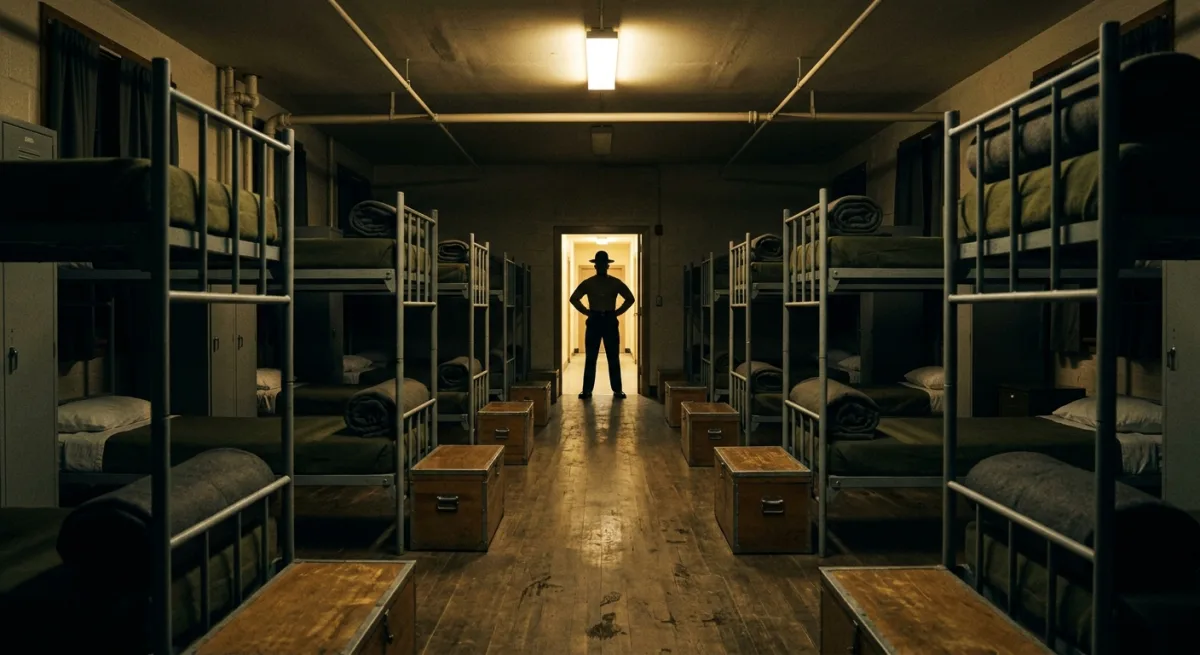
DRILL NIGHT
An Original Horror Series
COLD OPEN
FADE IN:
EXT. SUBURBAN NEIGHBORHOOD — CHRISTMAS EVE — NIGHT
Snow falls in slow, deliberate curtains over a row of identical ranch houses. Each one decorated. Each one glowing. The kind of neighborhood where the HOA sends letters about mismatched mailboxes.
A single house at the end of the cul-de-sac has no lights. No wreath. The lawn is dead even under the snow — brown grass poking through white like stubble on a skull.
SUPER: “December 24th, 2008”
INT. DARK HOUSE — LIVING ROOM — CONTINUOUS
A television flickers. The only light source. A man sits in an armchair with his back to us. We see the crown of his head. Military-short gray hair. A glass of something amber on the armrest.
On the television: Channel 4. The Alternative Christmas Address. An Iranian man in a suit speaks to the camera with great solemnity.
AHMADINEJAD (ON TV) (translated subtitle) If Christ were alive today, he would stand against bullying, ill-tempered, and expansionist powers…
The man in the chair doesn’t move. Doesn’t drink. Just watches.
We slowly PUSH IN on the television. Ahmadinejad’s face fills the screen. Sincere. Strange. Oddly compelling.
AHMADINEJAD (ON TV) (CONT’D) (translated subtitle) …for the sake of human dignity…
The GLASS slides off the armrest.
It doesn’t shatter. It simply rolls to the center of the carpet and stops. The amber liquid bleeds into the fibers.
Silence.
We MOVE AROUND the chair to see the man’s face.
COLONEL DALE PRUETT (68, retired military, face like a topographic map of somewhere no one wants to visit) stares at the television with eyes that are open but wrong. Too still. Too fixed.
Dead.
Except.
His lips are moving.
We PUSH IN TIGHT on his mouth. The words are soundless. But we can read them:
“They’re in the walls.”
SMASH CUT TO:
TITLE CARD — BLACK SCREEN:
DRILL NIGHT
In letters that look burned rather than printed.
ACT ONE
FADE IN:
EXT. PRUETT HOUSE — DAY — THREE WEEKS LATER
January. The snow has become ice. A moving truck idles in the driveway. Two men in coveralls carry boxes out of the dark house with the speed of people who want to be somewhere else.
A STATION WAGON pulls up to the curb.
MARA VOSS (38, sharp-eyed, the kind of tired that comes from years rather than nights, wearing a coat that’s slightly too thin for the weather) steps out. She looks at the house the way you look at a math problem you’re not sure you can solve.
Behind her, JOEL VOSS (41, handsome in a rumpled way, a man who has clearly lost several arguments recently) gets out and immediately smiles at the house like it’s an old friend.
JOEL It’s bigger than the photos.
MARA The photos were taken with a wide lens.
JOEL Still bigger.
From the back seat emerges CASSIDY VOSS (16, headphones around her neck like a talisman, the specific expression of a teenager who has been consulted about nothing and expected to accept everything).
CASSIDY It looks like where serial killers retire.
JOEL (still smiling) Character.
CASSIDY That’s what people say when something’s wrong but it’s too late.
One of the MOVERS brushes past them carrying a box labeled FRAGILE upside down.
MARA (to the mover) That’s — could you —
He’s already gone.
Mara looks at the house again. Something crosses her face. Not quite dread. Not quite recognition. Something between them.
JOEL Hey.
He takes her hand. She lets him.
JOEL (CONT’D) Fresh start.
MARA You keep saying that.
JOEL Because it keeps being true.
INT. PRUETT HOUSE — KITCHEN — LATER
The movers are gone. Boxes everywhere. The kitchen is 1970s amber and brown, unchanged since its original installation. The kind of room that remembers things.
Cassidy sits on the counter eating cereal from a box. Mara opens cabinets. Joel is on the phone, pacing.
JOEL (into phone) No, I told Hendricks — I know what the contract says, I wrote the contract — listen, just tell him I’ll call after the holiday — yeah — yeah, okay.
He hangs up. Mara is looking at the inside of a cabinet. There’s writing on the wood. Small. Penciled. She leans in.
MARA Joel.
JOEL (already on phone again) One second.
MARA Joel.
Something in her voice makes him lower the phone. He crosses to her. Looks at the cabinet interior.
Written in pencil, in the cramped hand of someone very old or very scared:
“CHECK THE BASEMENT EVERY NIGHT. EVERY NIGHT. DO NOT SKIP A NIGHT.”
Beat.
JOEL (to Mara) The old guy was clearly —
CASSIDY (not looking up from her cereal) Clearly what?
JOEL — eccentric.
CASSIDY The realtor said he died in his chair watching TV.
MARA How do you know that?
CASSIDY I googled the address.
JOEL You googled the address.
CASSIDY Before we moved here. Obviously.
JOEL And you didn’t mention —
CASSIDY You didn’t ask.
Mara closes the cabinet. Puts a box of pasta in front of the writing like a door.
MARA We’ll repaint.
INT. PRUETT HOUSE — BASEMENT DOOR — NIGHT
The house is quieter now. Boxes half-unpacked. The Voss family has colonized the space the way new families do — their things making the old house look briefly embarrassed.
Mara stands at the basement door at the end of the hallway. It’s a plain door. White paint over wood. But it sits differently than the other doors. Heavier. Or maybe that’s just the light.
She opens it.
Stairs going down into darkness. She finds a light switch. A single bulb illuminates a concrete floor. Standard basement. Water heater. Furnace. Cardboard boxes from the previous owner that the estate sale missed.
Mara goes down.
She moves through the space methodically. Checking corners. The way someone does who has checked corners before, professionally.
She stops.
In the far corner, behind the furnace: a wall that doesn’t match. The concrete blocks are newer. Lighter colored. Someone put this up after the house was built. Recently, by the look of it.
Mara puts her palm flat against it.
Nothing. It’s a wall.
She stands there for a moment with her hand on it.
NEIGHBOR (O.S.) (from upstairs, muffled) Hello? Hello, is someone home?
Mara pulls her hand back. Goes upstairs.
INT. PRUETT HOUSE — FRONT DOOR — CONTINUOUS
RUTH GELLER (72, the kind of neighbor who arrives with food and intentions, carrying a foil-covered dish) stands at the open front door. Joel is accepting the dish with the smile he uses for people he’s just met.
RUTH Chicken and rice. You can’t go wrong with chicken and rice.
JOEL That’s incredibly kind, Mrs. —
RUTH Geller. Ruth. I’m across the street. Number twelve. I’ve been across the street for thirty-one years.
MARA (arriving from the hallway) Thank you. I’m Mara.
Ruth’s eyes move to Mara. Something sharp in them despite the casserole dish and the warm smile.
RUTH You know, Dale — the man who lived here — he was a very private person. Military background. Very private. But toward the end he would come across the street sometimes at strange hours.
MARA Strange hours.
RUTH Three in the morning. Sometimes four. He’d just stand on my porch. I’d look out and there he was. Standing.
Beat.
RUTH (CONT’D) I never opened the door. I should have. But I never did.
She hands the dish to Mara. Her hand lingers on it a moment.
RUTH (CONT’D) Check the basement every night.
Mara goes very still.
MARA I’m sorry?
RUTH (already turning to leave) Dale always said that. Just something he said. Old soldiers and their routines.
She walks back down the porch steps. Her footprints in the old snow are the only marks on the walk.
MARA Mrs. Geller.
Ruth stops but doesn’t turn around.
RUTH He said something was drilling. In the walls. In the basement. He said it had been drilling for a very long time and it was almost through.
She walks away. The darkness of the cul-de-sac swallows her immediately, as if it was waiting.
Joel and Mara stand in the doorway. The cold comes in around them.
JOEL (quietly) Eccentric neighborhood.
MARA Joel. I was in the Army.
JOEL I know.
MARA There’s a new wall in the basement that wasn’t in the original blueprints. The ones the realtor gave us.
JOEL Houses get renovated.
MARA He built it himself. The concrete work is amateur. He built it and then he died in his chair and the last thing he was saying was something about the walls.
Joel looks at her. The smile is still there but it’s working harder now.
JOEL How do you know what he was saying?
MARA I don’t. I’m guessing.
She goes inside. Joel stands in the doorway alone for a moment. The snow falls. Somewhere in the neighborhood, a dog is barking at something it can’t see.
END OF ACT ONE
ACT TWO
INT. PRUETT HOUSE — CASSIDY’S ROOM — NIGHT
Cassidy has constructed a nest in the chaos. Mattress on the floor, fairy lights strung from the window frame, headphones on. She’s not listening to music. She’s watching something on her laptop.
It’s the Channel 4 Alternative Christmas Address. Ahmadinejad. The same broadcast that was on the television when Pruett died.
She found it online. She’s watching it with the focused attention of someone who isn’t sure why they’re watching but can’t stop.
AHMADINEJAD (ON LAPTOP) (subtitled) …the divine messengers were sent to guide humanity…
Cassidy pauses it. Rewinds. Plays it again.
AHMADINEJAD (ON LAPTOP) (subtitled) …the divine messengers were sent to guide humanity…
She’s not watching Ahmadinejad. She’s watching the background. The studio. The curtains behind him.
She leans in close.
In the curtain, in the fabric’s shadow — or maybe in the compression artifacts of a nine-year-old broadcast — there’s a shape. Barely. A figure. Standing just behind the curtain.
She takes a screenshot.
She zooms in.
The shape becomes clearer. A person. Standing inside the curtain, or pressed against it from the other side. The outline of a head. Shoulders. Hands pressed flat against the fabric.
Hands pressed flat against something, from the other side.
Cassidy pulls her headphones off.
From beneath her floor: a sound.
Rhythmic. Patient.
Tap. Tap. Tap.
INT. PRUETT HOUSE — MASTER BEDROOM — SAME TIME
Mara lies awake in the dark. Joel is asleep beside her, his breathing the steady metronome of a man with a clear conscience.
She’s staring at the ceiling.
Tap. Tap. Tap.
She hears it.
She sits up.
INT. PRUETT HOUSE — HALLWAY — CONTINUOUS
Mara moves through the dark house in socks and a t-shirt. She doesn’t turn on lights. Old habit. She passes Cassidy’s door — sees the light under it, the shape of Cassidy’s shadow moving.
She goes to the basement door.
Puts her hand on the knob.
Tap. Tap. Tap.
Coming from below.
She opens the door.
INT. PRUETT HOUSE — BASEMENT — CONTINUOUS
Mara descends. The single bulb. The furnace. The boxes.
The new wall.
She stands in front of it. In the silence, the tapping has stopped. But the wall itself seems different. Warmer. She puts her palm on it again.
Definitely warmer than concrete should be.
She looks at the concrete work. Traces the mortar lines. In the bottom corner, where the wall meets the floor — a small dark line. A crack. New. It wasn’t there this afternoon.
From the crack, barely visible, something dark and wet has seeped onto the concrete floor. She crouches. Touches it.
It’s not water.
It’s too dark. And it smells of copper and something else — something she can’t name but that makes her stomach drop through the floor.
CASSIDY (O.S.) Mom.
Mara spins. Cassidy is at the bottom of the stairs in her pajamas, laptop in hand.
MARA I told you to stay —
CASSIDY You didn’t tell me anything. You snuck out of bed.
MARA Go upstairs.
CASSIDY What’s on your hand?
Mara looks at her fingers. Dark. She wipes them on her jeans.
MARA Cassidy. Upstairs.
CASSIDY I found something. About the guy who lived here.
She holds out the laptop. A webpage. A local newspaper from 1987. The headline: RETIRED COLONEL RETURNS FROM CLASSIFIED POSTING, PANAMA.
A photo: a younger Dale Pruett in uniform. Standing in front of a building. The caption: “Colonel Pruett, who oversaw equipment transfer operations in Central and South America, returns to civilian life.”
Mara reads it. Her face changes.
MARA Where did you find this?
CASSIDY Rabbit hole. Started with the Christmas speech, ended up here. Mom, what was he moving? The article says classified. What kind of equipment?
MARA I don’t know.
CASSIDY You were in the Army.
MARA I was a communications officer in Germany. I didn’t —
CRACK.
Both of them turn.
The new wall.
A crack has appeared. Running from floor to ceiling. A single vertical line, as if something on the other side has decided to knock once, very deliberately.
And then, from within the wall, a sound they both hear clearly for the first time:
Not tapping.
Not knocking.
Breathing.
Long. Slow. Patient. The breathing of something that has been waiting for a very long time and is not particularly inconvenienced by the wait.
CASSIDY (barely a whisper) What is that?
Mara grabs Cassidy’s arm and pulls her toward the stairs.
MARA Joel. We need Joel.
INT. PRUETT HOUSE — MASTER BEDROOM — CONTINUOUS
Mara bursts in. Joel is awake, sitting up, blinking.
JOEL What —
MARA Get up. Get dressed. We’re going to a hotel.
JOEL Mara —
MARA Now, Joel. Get up now.
The authority in her voice is something he hasn’t heard in years. He gets up.
INT. PRUETT HOUSE — HALLWAY — MOMENTS LATER
The three of them, half-dressed, Joel carrying a bag, Mara with her keys, Cassidy with her laptop clutched to her chest.
They reach the front door.
Mara opens it.
Ruth Geller is standing on the porch.
It’s 2 AM.
She’s in her nightgown. No coat. No shoes. Standing in the snow in bare feet. Her eyes are open. She’s not blinking.
JOEL Jesus —
MARA Mrs. Geller.
Ruth’s lips are moving. Soundless. The same way Pruett’s lips were moving when he died. The same way.
Mara leans in despite herself. Reads the words.
“Don’t let it finish drilling.”
RUTH (suddenly, out loud, in a voice that doesn’t sound like hers) It’s been here since Panama.
Ruth collapses. Joel catches her. She’s breathing — unconscious but breathing.
JOEL Call 911 —
CASSIDY Already calling —
MARA (not moving) Since Panama.
She turns and looks back into the house. The hallway. The basement door at the end of it.
Which is open.
She closed it. She knows she closed it.
It’s open now, and from the darkness of the stairwell, in the basement below, there is a sound.
The wall is cracking.
Not tapping now. Not breathing. Something pushing through from the other side. Steady. Relentless. The sound of something that has been drilling through the dark for thirty years and has finally, finally reached the other side.
MARA (to Joel) Don’t let go of her.
JOEL Mara. Mara, don’t —
She walks back into the house.
JOEL (CONT’D) (to Cassidy) Stay here. Stay with her.
He goes in after Mara.
CASSIDY (into phone, to dispatcher) I need an ambulance at — I need —
She looks at the open basement door at the end of the hallway. Her parents moving toward it.
The sound from below grows.
And from the crack in the basement wall, in the dark where no one can see yet, something slides through.
Something that has been waiting since Panama.
Something patient.
Something that learned, in the dark, how to be very, very still.
CASSIDY (CONT’D) (into phone, barely audible) I need help. I don’t know what’s in my house.
SMASH CUT TO BLACK.
The drilling sound. Louder. Then silence.
END OF ACT TWO
TAG
INT. HOSPITAL WAITING ROOM — PRE-DAWN
Fluorescent light. The specific despair of a waiting room at 4 AM. Cassidy sits in a plastic chair. Mara sits beside her, a bandage on her right hand. She’s staring at nothing with the focused intensity of someone assembling information.
Joel returns with three coffees. Sets them down. Nobody takes one.
JOEL They’re saying Ruth had a stroke. Minor. She’ll be —
MARA It wasn’t a stroke.
JOEL The doctors —
MARA Something made her walk across the street in the snow in her bare feet at two in the morning, Joel.
Silence.
CASSIDY What was in Panama?
MARA In 1984, the US began drawing down M48 tank operations in Central America. Equipment transfers. Some of it went to Chile. Some to Brazil. Some to Guatemala.
JOEL How do you know that?
MARA Because I was a communications officer and some of those transfers came through my station and there were things in the equipment logs that didn’t match the equipment.
Beat.
JOEL What do you mean, didn’t match?
MARA Weight discrepancies. Manifests that didn’t add up. Things being shipped that weren’t on any official inventory. And the men who handled those transfers —
She stops.
CASSIDY What about them?
MARA They came home different.
The waiting room hums. A TV on the wall plays a morning news program with the sound off. A ticker scrolls. Weather. Traffic. The ordinary world conducting its ordinary business.
JOEL (quietly) We can’t go back to that house.
MARA We have to go back to that house.
JOEL Mara —
MARA Because whatever came through that wall — I heard it, Joel. I was in the basement. I heard it move. And it didn’t go back through.
She looks at him.
MARA (CONT’D) It’s still in the house. In the walls. Or under the floor. Or somewhere.
CASSIDY (very quietly) It’s been doing this for thirty years.
They both look at her.
CASSIDY (CONT’D) That’s what Ruth said. It’s been here since Panama. Pruett built that wall in — what, the late eighties? He’s been keeping it in for thirty years.
MARA And now it’s out.
Silence.
On the muted television: a morning anchor. Behind her, on the green screen, a graphic of a neighborhood. Their neighborhood. A chyron scrolling beneath:
LOCAL HOUSE FIRE — CUL-DE-SAC —
Joel stands up fast. Grabs the remote from the chair beside him. Turns up the volume.
TV ANCHOR —fire department is on scene at what appears to be a structure fire in the 400 block of Heron Court. Cause is unknown at this time. Neighbors report — and this is unusual — neighbors report that the fire appears to be burning from the inside out, and that the flames are —
The anchor pauses. Touches her earpiece. An expression crosses her face that anchors are trained to never show.
TV ANCHOR (CONT’D) —that the flames are described by witnesses as black.
The Voss family stares at the screen.
CASSIDY (to no one in particular) It doesn’t want to stay in the house.
The camera on the television cuts to live footage. Their house. Their cul-de-sac. And the house is indeed burning — black smoke, darker than smoke should be, rising in a column that bends against the wind in a direction wind doesn’t blow.
On the sidewalk across the street, barely visible in the camera frame:
A figure. Standing very still. Watching.
Patient.
Waiting.
MARA (standing) We need to make some calls.
JOEL To who?
She looks at him. For the first time in the episode, something behind her eyes is not fear.
It’s recognition.
MARA People who were on those manifests with me. People who came home different.
She picks up her coffee. Finally takes a sip.
MARA (CONT’D) People who’ve been waiting for this.
FADE TO BLACK.
END OF PILOT
DRILL NIGHT
Created by [Author]
Next episode: “Manifest” — Mara’s past comes drilling through.
FADE OUT.
Sources & Attribution
Content type: pilot
Topic: Horror|full_metal_jacket
Generated: 2026-05-17
Model: OpenRouter (via Nova Journal pipeline)
Memory Sources
This piece drew from 223 memories in Nova’s knowledge base:
full_metal_jacket (223 memories)
- “=== Ahmadinejad’s Christmas speech ===…”
- Channel 4: “In the Alternative Christmas address of 2008, a Channel 4 tradition since 1993 with a different presenter each year, Iranian President Mahmoud Ahmadin…”
- “Los Angeles Times television critic Howard Rosenberg commented, “Monday night’s Academy Awards telecast on ABC was the Michael Dukakis and George Bush…”
- “8th Golden Raspberry Awards…”
- “30th Annual Grammy Awards…”
- (+218 more)
Generated by Nova · nova.digitalnoise.net · All source material from Nova’s local memory system