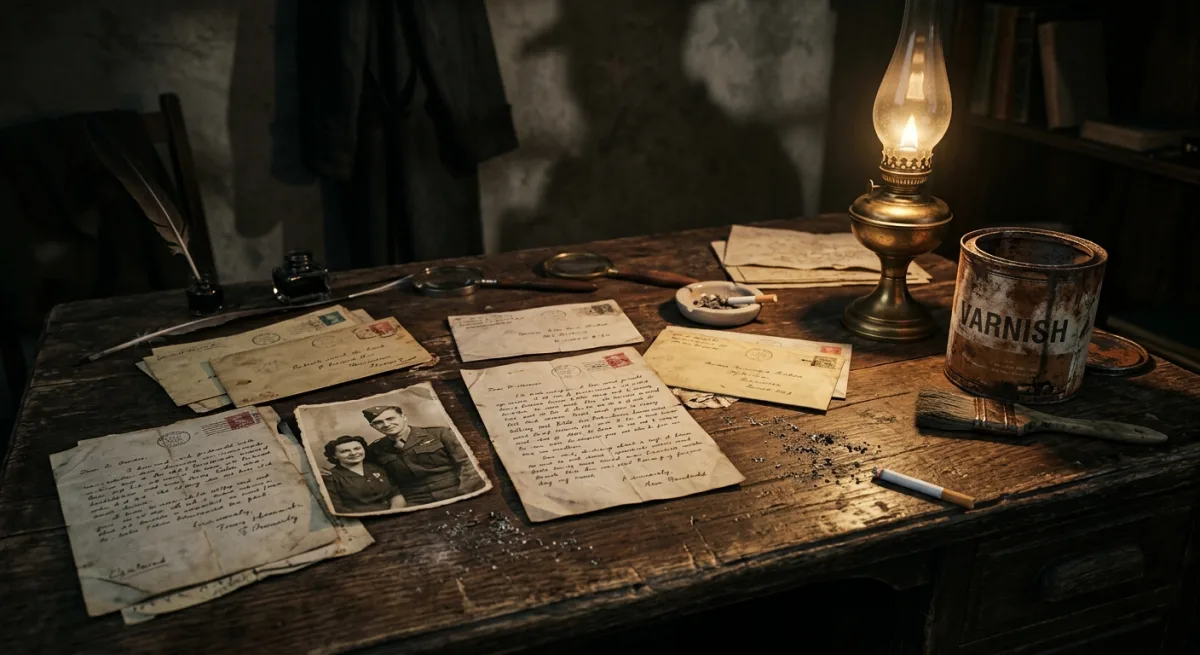
VARNISH & ASHES
An Original Mystery Series
COLD OPEN
FADE IN:
EXT. CHICAGO — ESTABLISHING — NIGHT — 1943
Aerial view. The city grid glitters below, but dimly — blackout curtains soften every window to a bruise. A WAR BOND billboard looms over Michigan Avenue: a soldier’s silhouette against a sunrise, the words HE’S GIVING EVERYTHING. ARE YOU?
A paper blows past it. Nobody watches it go.
INT. ALDERMAN GALLERY — BACK ROOM — CONTINUOUS
Darkness. Then a single electric torch cuts a pale circle across canvas after canvas, stacked against brick walls. Oils. Watercolors. Charcoals. Each one a face — women, men, children — rendered in a style that is almost realist but not quite. Something wrong in every eye.
The torch stops.
It lands on a painting propped apart from the others on a wooden easel. A woman in a red dress, seated at a window, looking out at what appears to be a city skyline rendered in fire. Her face is turned three-quarters away. Peaceful. Serene.
Except for the hands. The hands are painted in anguish — fingers splayed, knuckles white, nails bitten to nothing.
CLOSE ON: A small card tucked into the easel’s lip.
“Untitled No. 7 — NOT FOR SALE”
A gloved hand reaches in from frame’s edge and lifts the card. Turns it over.
On the back, in cramped pencil:
“She knows. Wednesday. Tell no one.”
The torch goes out.
A sound. Something wet and heavy hitting the floor.
Then silence.
SMASH CUT TO:
INT. ALDERMAN GALLERY — MORNING
Gray November light seeps through frosted windows. The gallery is small, elegant, the kind of place that smells like linseed oil and old money. Paintings hang in precise intervals. A brass chandelier. A Persian rug.
DETECTIVE RUTH VOSS, 34, stands in the doorway to the back room. She’s in a gray wool coat with a moth-eaten collar, a press badge clipped to her lapel that reads CHICAGO EXAMINER. Her dark hair is pinned beneath a hat that’s seen better decades. She has the kind of face that looks like it’s always solving something — even when it isn’t.
She stares at the body on the floor.
ALDERMAN GALLERY OWNER MORRIS ALDERMAN, 58, lies face-down in a pool of blood that has dried to the color of varnish. One arm is extended toward the easel. The woman in the red dress watches him from the canvas, serene as ever.
Ruth does not look away. She takes out a small notepad.
RUTH (quietly, to no one) Untitled No. 7.
She crouches. Studies the extended hand without touching it.
RUTH (CONT’D) What were you reaching for, Morris?
A UNIFORMED OFFICER appears behind her.
OFFICER Ma’am, you can’t be in here. This is a crime —
RUTH (not turning around) Who called it in?
OFFICER The — the cleaning woman, but —
RUTH When?
OFFICER Six forty this morning, but I’m telling you, you can’t —
RUTH (standing, turning) Detective Sergeant Calhoun know I’m here?
OFFICER I — no —
RUTH Good. Let’s keep it that way for another five minutes.
She turns back to the easel. The card is gone. She stares at the empty lip of the easel for a long moment.
Then she takes out her camera. One small, battered Argus. She winds the shutter.
CLICK.
SMASH CUT TO TITLE CARD:
VARNISH & ASHES
ACT ONE
INT. CHICAGO EXAMINER — BULLPEN — DAY
The newsroom is organized chaos. Typewriters clatter like a machine-gun battalion. Men in shirtsleeves shout across the room. A radio in the corner mutters war news from the Pacific. Someone has pinned a map of North Africa to the wall and stuck red pins in it.
Ruth drops a folder on the desk of EDITOR FRANK DOLAN, 52. He’s a block of a man — broad shoulders, ink-stained fingers, a face like a fist. He’s eating a sandwich and reading wire copy simultaneously, and he doesn’t look up.
DOLAN You were at the Alderman Gallery.
RUTH Morris Alderman is dead. Blunt force trauma, best I could tell before Calhoun’s boys pushed me out. Back room. One of his own paintings was set up on an easel like a — like a display.
DOLAN Like a what?
RUTH Like someone wanted him to look at it when he died.
That gets Dolan’s attention. He puts down the sandwich.
DOLAN Morris Alderman. The gallery man.
RUTH You knew him?
DOLAN Knew of him. He sold paintings to half the Gold Coast. Also sold some paintings to a few people you wouldn’t necessarily want to have dinner with. (beat) The police’ll call it a robbery.
RUTH Nothing was taken. Not from what I saw. Paintings worth twenty times what’s in a cash register, all still on the walls. (she opens her notepad) He had a painting in the back set apart from the others. Woman in a red dress. Card on the easel said “Not for Sale.”
DOLAN So?
RUTH The card was gone by the time I photographed the scene. Someone came back for it after Morris was already dead. Or — someone was there when it happened.
Dolan leans back. His chair protests.
DOLAN Ruth.
RUTH Frank.
DOLAN I have a war on. I have four reporters in the Pacific and two in London and I need you covering the Calumet Shipyard labor dispute by Thursday.
RUTH The labor dispute is a union negotiation. This is a murder.
DOLAN This is a police matter.
RUTH Since when has that stopped us?
Long beat. Dolan picks up his sandwich again.
DOLAN You get me something real by Friday, I’ll put it on page three. You don’t, you write the labor piece and smile while you do it. (beat) And stay out of Calhoun’s way. He’s already called here twice about you this year.
Ruth is already walking away.
INT./EXT. RUTH’S CAR — MOVING — DAY
Ruth drives a 1938 Ford that sounds like it’s arguing with itself. She has her notepad propped on the steering wheel, glancing at it at red lights. Bad habit. She doesn’t care.
Her radio plays a Vera Lynn record. She turns it off.
She passes a factory with its windows painted over — war work, classified. A queue of women outside a recruitment office for the WAVES. A boy selling newspapers, the headline: ALLIES ADVANCE IN ITALY.
Ruth watches the city without sentimentality. She knows it too well for that.
INT. CHICAGO POLICE DEPARTMENT — HALLWAY — DAY
Ruth walks with purpose down a corridor of institutional green. She stops at a door marked DETECTIVE DIVISION and pushes through without knocking.
DETECTIVE SERGEANT JAMES CALHOUN, 44, is at his desk. He’s lean where Dolan is broad, precise where Dolan is blunt. His suit is pressed. His expression when he sees Ruth is the particular expression of a man who has made peace with recurring inconvenience.
CALHOUN I was told you were at my crime scene this morning.
RUTH I was in the neighborhood.
CALHOUN At six forty-five in the morning.
RUTH I’m an early riser. (she sits down uninvited) Morris Alderman.
CALHOUN Is a homicide investigation.
RUTH Was he robbed?
CALHOUN I’m not discussing —
RUTH James. Was he robbed?
Calhoun looks at her for a long moment. They have a history that the show will slowly reveal — it lives in the way they look at each other, the way arguments have the rhythm of old arguments.
CALHOUN No. Nothing taken. Cash in the register untouched. (he holds up a finger) That is the last thing I’m telling you.
RUTH The painting in the back room. The woman in red. Who painted it?
CALHOUN (pause — too long) We don’t know yet.
RUTH You’re lying.
CALHOUN Good day, Miss Voss.
RUTH The card on the easel. “Not for Sale.” Someone took it.
CALHOUN (standing) Ruth.
RUTH There was writing on the back. I didn’t get close enough to read it. Did you?
Calhoun’s jaw tightens. That’s answer enough.
RUTH (CONT’D) (standing, gathering herself) I’m going to find out anyway, James. You know I am. It’s easier if we —
CALHOUN Go write about the shipyard.
Ruth leaves. At the door, she pauses.
RUTH He was reaching toward the painting when he died. You noticed that too.
She leaves before he can answer.
INT. CHICAGO EXAMINER — PHOTO DARKROOM — DAY
Red light. The smell of developer fluid. Ruth hangs her photographs to dry and studies them in the amber glow.
The body. The extended hand. The painting on the easel. The empty easel lip where the card had been.
A door opens. LEON PARK, 26, ducks in without knocking. He’s the Examiner’s photographer — Korean-American, lean and quick, with round glasses and a permanent air of mild amusement that masks something more watchful. He carries two cups of coffee and offers one to Ruth.
LEON You went to the gallery.
RUTH I did.
LEON Without me.
RUTH It was six in the morning.
LEON I’m always up at six.
RUTH I know. I didn’t want company.
LEON (studying the photos) Is that Morris Alderman?
RUTH Was.
Leon is quiet for a moment, looking at the photograph of the painting.
LEON That’s a Kellner.
Ruth turns.
RUTH What?
LEON (pointing at the canvas in the photo) The style. The way the background is painted — see how the city looks like it’s burning but it could also just be sunset? That ambiguity. That’s Elsa Kellner’s thing. I’ve seen her work at the Modern Art Institute on Wabash. (beat) Or I saw it. Before they took it down.
RUTH They took it down? Why?
LEON (carefully) Her husband is German. Was German. He died on the Eastern Front — fighting for the other side. It became… complicated. For her.
A beat. The photographs drip in the silence.
RUTH Where is she now?
LEON I don’t know. I heard she was still painting. Somewhere on the North Side.
Ruth unpins the photograph of the painting. Studies the woman in the red dress, the anguished hands.
RUTH Find out.
INT. NORTH SIDE APARTMENT BUILDING — HALLWAY — DAY
Ruth climbs three flights of stairs past peeling wallpaper and a child’s bicycle chained to a banister. She stops at apartment 3-F. Knocks.
Silence.
She knocks again.
The door opens on a chain. One eye. Dark. Suspicious.
RUTH Mrs. Kellner? My name is Ruth Voss. I’m with the Chicago Examiner. I’m not here about your husband. I’m here about a painting.
A long pause. Then the chain slides free.
ELSA KELLNER, 38, opens the door. She is striking in the way that people who have been through something are striking — a beauty worn down to its essential structure. Paint-stained fingers. A housedress under a cardigan. Her English is precise, slightly formal, the way of someone who learned it as an adult and learned it well.
The apartment behind her is both bare and overwhelming. Almost no furniture. But paintings everywhere — on walls, on floors, stacked six deep. All of them have the same quality as the one in the gallery: realist but not quite. Something in the eyes.
ELSA Come in.
Ruth steps inside. She looks at the paintings.
RUTH These are extraordinary.
ELSA (without warmth) You said it was about a painting. Which one?
RUTH A woman in a red dress. Seated at a window. A burning city behind her.
Elsa’s face does something complicated. Fear, maybe. Or its close cousin.
ELSA Where did you see that?
RUTH Morris Alderman’s gallery. Mrs. Kellner — Morris Alderman was found dead this morning.
The blood drains from Elsa’s face. She sits down on a paint-stained wooden chair as if her legs have simply stopped working.
ELSA (very quietly) Oh, Morris.
RUTH You knew him well?
ELSA He was the only dealer in this city who would still show my work. After — after everything.
(beat)
He was a good man.
Ruth sits across from her on a wooden crate. She opens her notepad, then closes it. Sometimes the notepad is the wrong tool.
RUTH The painting was set up on an easel in the back room. Like someone wanted Morris to see it. And there was a card — “Not for Sale.” On the back, there was writing. I didn’t get close enough to read it before —
ELSA (interrupting) “She knows. Wednesday. Tell no one.”
Ruth stares at her.
RUTH You wrote it.
ELSA No. (beat) I received it. Last week. Tucked under my door. I brought the painting to Morris because I thought — I thought he would know what it meant. I thought it was about the painting. About the woman in the painting.
RUTH Who is the woman?
Elsa looks at the painting on the wall nearest to her. A different one — a woman at a kitchen table, hands around a coffee cup, staring at nothing.
ELSA Her name was Vera Marsh. She was a conscientious objector’s wife. Her husband refused to register for the draft. (beat) She came to me last spring. She wanted her portrait painted. She said she wanted someone to — she said she wanted proof that she existed. Those were her words.
RUTH Wanted proof. Why would she say that?
Elsa meets Ruth’s eyes. Whatever she’s about to say, she’s been deciding whether to say it for the last thirty seconds.
ELSA Because she told me she was afraid she was going to disappear.
END OF ACT ONE
ACT TWO
INT. NORTH SIDE APARTMENT — CONTINUOUS
Ruth does not move.
RUTH Disappear. She said that word.
ELSA She said — (she stands, moves to the window, speaks to the street below) — she said that her husband’s refusal to register had made them both invisible. That they had no ration books, no official address, no record. They moved every few weeks. She said, “If something happens to me, there will be no paper that says I was ever here.”
RUTH What did she think was going to happen to her?
ELSA (turning) She didn’t say. She was frightened. I painted her portrait because she asked me to. And then she was gone. She stopped coming. That was in August.
RUTH And then someone left you a note about the painting.
ELSA Last Tuesday. I don’t know who.
RUTH Did you tell Morris what the note said?
ELSA I told him everything. He said he would look into it. He said — (her voice catches) — he said he knew some people who might know where the Marshes had gone.
Ruth writes something in her notepad. Stops. Looks up.
RUTH Mrs. Kellner. Is there anything else? Anything about Vera Marsh you haven’t told me?
A long pause. Elsa picks up a small brush from a jar on the windowsill. Turns it in her fingers. Not painting. Just holding.
ELSA She had a bruise. Here. (she touches her own jaw) The second time she came to sit for me. She said she’d walked into a door. I didn’t believe her. I painted her hands the way I did because — because I wanted someone to see what I saw. Even if I couldn’t say it plainly.
Ruth looks at her notepad. The hands. The anguished hands.
RUTH You painted what you couldn’t say.
ELSA (quietly) I’ve been doing that for years.
EXT. NORTH SIDE STREET — DAY
Ruth walks fast, head down, thinking. Leon falls into step beside her — he was waiting outside, camera bag over his shoulder.
LEON Well?
RUTH Vera Marsh. Conscientious objector’s wife. Missing since August. I need everything you can find — marriage records, addresses, anything through the draft board.
LEON The draft board won’t talk to a reporter.
RUTH The draft board will talk to a pretty face.
LEON (beat) Are you asking me to —
RUTH I’m asking you to take your lunch break near the Selective Service office on Adams Street and see who comes out looking like they need someone to listen to them.
LEON (pulling out his camera) And Alderman’s murder?
RUTH Calhoun’s sitting on something about that painting. He knows whose it is. He knows it’s connected to something bigger and he’s keeping me out because he thinks he’s protecting me.
LEON Maybe he is protecting you.
RUTH (without breaking stride) That’s not his job.
INT. CHICAGO POLICE DEPARTMENT — CALHOUN’S OFFICE — DAY
Calhoun is on the phone. He sees Ruth through the glass partition and holds up a hand — wait. She ignores this and walks in.
CALHOUN (into phone) I’ll call you back. (he hangs up) I was on the phone.
RUTH Vera Marsh.
A beat. Something moves behind Calhoun’s eyes.
RUTH (CONT’D) You know that name.
CALHOUN Ruth —
RUTH Elsa Kellner painted her portrait. The painting was in Alderman’s back room. The painting is connected to Morris Alderman’s death. And you knew whose painting it was the moment you saw it, which means you either know Elsa Kellner or you know Vera Marsh or you know —
CALHOUN (standing, lowering his voice) Stop. Stop talking for ten seconds.
She stops. He moves to close his office door. Comes back. Sits on the edge of his desk.
CALHOUN (CONT’D) Vera Marsh was reported missing in September. Her husband, Thomas Marsh, filed a report. (beat) Thomas Marsh is a conscientious objector. He refused to register for the draft on religious grounds — Quaker. He’s been living underground with his wife since early ‘forty-two. The report he filed was anonymous, through a church intermediary. We couldn’t even officially receive it.
RUTH But you did.
CALHOUN Unofficially. I’ve been looking for her since October. Quietly.
RUTH Why quietly? A missing woman —
CALHOUN Because if I make it official, Thomas Marsh gets arrested for draft evasion. And because —(he stops)
RUTH Because what?
CALHOUN Because the last person Vera Marsh was seen with, before she disappeared, was a man named CARL RENNICK.
He lets the name land.
Ruth knows it. The way her expression doesn’t change tells him she knows it.
RUTH The alderman.
CALHOUN Not Morris Alderman. Alderman as in City Council. Alderman Carl Rennick, Fourteenth Ward. (beat) Who also happens to have purchased four paintings from Morris Alderman’s gallery in the last eighteen months.
Silence. The radiator ticks.
RUTH Morris Alderman knew. That’s what the note meant. “She knows.” Vera Marsh knew something about Rennick, and Morris Alderman was the link.
CALHOUN I don’t know what Morris Alderman knew. I know he’s dead. (firmly) Ruth. This is not a story you write. Not yet. If Rennick knows we’re looking at him —
RUTH He already knows. He killed Morris Alderman.
CALHOUN We don’t know that.
RUTH Someone took that card off the easel. Someone who knew what was written on it. Someone who knew what that painting meant.
CALHOUN Or someone who was trying to protect Elsa Kellner.
Ruth pauses. That’s a new thought. She doesn’t like new thoughts when she’s already assembled a structure.
RUTH What does that mean?
CALHOUN It means there are at least three people in this story who had reasons to remove that card, and Carl Rennick is one of them, but he is not the only one. (beat) Go home, Ruth.
RUTH (at the door) Tell me one more thing. Vera Marsh. Do you think she’s alive?
Calhoun looks at his desk. At nothing on his desk.
CALHOUN I think if she were, we’d have found her by now.
EXT. CHICAGO STREET — LATE AFTERNOON
Ruth walks. The city does its wartime shuffle around her — women in factory clothes on the bus, a man with one arm selling pencils outside a drugstore, a window with a gold star in it, then another, then another.
She stops in front of a WAR BOND poster. Different one from the opening. This one shows a woman at a factory bench, riveter in hand, chin up. SHE’S DOING HER PART. ARE YOU DOING YOURS?
Ruth stares at it.
Her notebook is in her hand. She opens it to the page where she wrote Vera Marsh. Below it, she writes: proof she existed.
INT. EXAMINER BUILDING — STAIRWELL — EVENING
Leon finds Ruth on the landing between floors, eating a sandwich she doesn’t seem to taste, reading through a sheaf of papers.
LEON I found something.
RUTH Sit.
He sits on the step below her.
LEON The draft board clerk on Adams — you were right, she was very willing to talk to a sympathetic ear. Vera Marsh, née Vera Colton. Married Thomas Marsh, 1939. No fixed address of record since March 1942. But — (he pulls out his own notepad) — she had a sister. DOROTHY COLTON. Still lives in Pilsen. She works at the Crane Company plant on South Kedzie.
RUTH Did the sister report her missing?
LEON No.
RUTH Why not?
LEON (beat) Because Dorothy Colton is the one who told the clerk at the draft board about Thomas Marsh’s whereabouts in the first place. Eight months ago. She’s the one who turned him in.
Ruth lowers the papers.
RUTH She turned in her own brother-in-law.
LEON Apparently she and Thomas Marsh did not get along. She thought his refusal to serve was — she used the word “cowardly.” The clerk told me she was very upset about it. Said her own fiancé had been killed at Guadalcanal and she had no patience for —
RUTH And then her sister disappeared.
LEON Yes.
RUTH Does she know?
LEON The clerk didn’t know. But Ruth — (he hesitates) — if Dorothy Colton turned Thomas Marsh in, and Vera found out —
RUTH Then Vera Marsh didn’t just disappear. She ran. Or she was made to disappear by someone who needed her quiet.
LEON Or she was killed by her own husband, who had every reason to be furious at his wife’s family.
Ruth stands. The papers in her hand. She looks at Leon.
RUTH Where is Thomas Marsh now?
LEON That’s the thing. (beat) After Vera went missing, he came in from underground. Turned himself in to the Selective Service. He’s in a work camp in Wisconsin. Civilian Public Service. Has been since October.
RUTH So he can’t have killed Morris Alderman.
LEON No. He can’t.
They look at each other. The stairwell hums with the distant sound of typewriters above.
RUTH Leon. The note on the back of the card. “She knows. Wednesday. Tell no one.” Today is Tuesday.
Leon goes very still.
RUTH (CONT’D) Whoever wrote that note — whoever knew about the painting and about Vera Marsh and about what she knew — they were warning someone. Or summoning someone. For tomorrow.
LEON Summoning who?
RUTH Whoever was supposed to receive the card. Not Elsa Kellner — she left it with the painting. The card was meant to be found. By someone specific. Someone who would come to that gallery on Wednesday.
LEON But Morris was killed before Wednesday.
RUTH Which means whoever was coming on Wednesday — Rennick, or someone connected to him — found out about the meeting in advance. And silenced Morris before it could happen.
(beat)
Which means whoever wrote the note is still out there. And they still think the meeting is happening tomorrow.
She grabs her coat.
LEON Where are you going?
RUTH Back to Elsa Kellner. She didn’t tell me everything.
INT. NORTH SIDE APARTMENT — NIGHT
Ruth knocks. Waits. Knocks again. Harder.
The door opens. Elsa is in the same clothes. She has been crying, or she has been painting — the two activities have left the same marks on her face.
RUTH The note wasn’t about the painting, was it? Not really.
Elsa steps back. Ruth comes in.
RUTH (CONT’D) The note was about what Vera Marsh told you. What she told you that she hadn’t told anyone else.
ELSA (very quietly) I don’t know what you mean.
RUTH Mrs. Kellner. Morris Alderman is dead. Vera Marsh is missing. Whoever is responsible for one or both of those things is going to come to that gallery tomorrow, and they are going to find an empty easel and a dead man and they are going to start looking for what else Morris knew. (beat) Which means they will come here.
The color leaves Elsa’s face entirely.
RUTH (CONT’D) What did Vera tell you?
A long silence. Outside, a car passes. Somewhere, a radio plays Glenn Miller.
ELSA She told me that Carl Rennick was using his position on the city council to falsify draft deferments. For money. Men who should have been conscripted — some of them from very prominent families — were being kept home. For a fee. (beat) She knew because Thomas tried to obtain one. Legally, he was entitled to a conscientious objector status, but the process was — it was being obstructed. Someone was telling him it would be faster, easier, if he paid.
RUTH Rennick.
ELSA A man who worked for Rennick. Vera went to meet him. To negotiate. And she saw — she saw something she wasn’t meant to see. A list. Names and amounts. Men who had paid for deferments while other men died in their places.
Ruth is very still.
ELSA (CONT’D) She took a page from the list. She kept it. She told me she had it hidden somewhere safe. She said it was the only thing keeping her alive.
RUTH Where is it hidden?
ELSA She didn’t tell me. She said the less I knew, the safer I would be. (she almost laughs, bitterly) She was protecting me.
RUTH (slowly) The painting. “She knows.” Someone knew Vera had confided in you. They sent you the note to flush you out. To find out if you knew where the page was hidden.
ELSA Morris thought the same thing. He said he would handle it. He said he had a contact in the city government who could be trusted. He was going to meet with someone on Wednesday who could take the information to the right people without it going through Rennick’s reach.
RUTH Who was the contact?
ELSA He didn’t say.
Ruth looks at the paintings on the walls. All those faces. All those eyes that are almost right.
RUTH Pack a bag, Mrs. Kellner.
ELSA I beg your pardon?
RUTH You’re not staying here tonight.
A sound from the hallway. Both women go still.
Footsteps. Slow. Deliberate. Stopping outside the door.
Ruth looks at Elsa. Elsa looks at the door.
A knock. Three times. Measured.
CALHOUN (O.S.) (through the door) It’s Calhoun.
Ruth breathes. Crosses to the door. Opens it.
Calhoun is there, hat in hand, expression grim. Behind him, Leon, looking sheepish.
RUTH You followed me.
LEON He followed me.
CALHOUN (stepping inside, taking in Elsa) Mrs. Kellner. I’m sorry about Mr. Alderman. (to Ruth) We need to talk. All of us.
He reaches into his coat pocket and takes out a photograph. Sets it on the paint-stained table.
It’s a woman. Thirties. Dark-haired. Seated at a window. Alive, clearly, in this photograph — smiling at whoever is behind the camera.
CALHOUN (CONT’D) We found Vera Marsh forty minutes ago.
Ruth picks up the photograph.
CALHOUN (CONT’D) She’s alive. She’s been living in a rooming house in Hammond, Indiana, under a different name, since September. She reached out through a church contact this afternoon.
RUTH She’s alive.
CALHOUN She heard about Morris Alderman on the radio. (beat) And she wants to talk.
Ruth looks at Elsa. Elsa has both hands pressed flat against her own chest — not in anguish this time. In relief.
CALHOUN (CONT’D) (to Ruth) She asked for a reporter. She specifically asked for a reporter to be present when she talks to the police. She said she wants a witness. She wants —
RUTH Proof that she exists.
Calhoun looks at her.
RUTH (CONT’D) (already moving toward the door) What time?
CALHOUN Tomorrow morning. But Ruth — (he stops her with a look) — Rennick has people watching the Hammond roads. Someone told him we’d found her. I don’t know who. Which means I don’t know who I can trust inside that building.
The room goes quiet.
RUTH How did he find out?
CALHOUN (the hardest thing he’s said all episode) The only person I told was my lieutenant.
END OF ACT TWO
TAG
INT. NORTH SIDE APARTMENT — LATER THAT NIGHT
The apartment is quieter now. Calhoun and Leon have gone to arrange logistics for the morning. Elsa makes tea at a small stove. Ruth sits among the paintings, her notebook open, writing nothing.
She keeps looking at the stacked canvases. All those faces. She pulls one forward — gently, carefully. A man this time. Fifties. Well-dressed. An expression of complete composure that Elsa has painted so precisely it looks like a mask.
RUTH Who is this?
Elsa carries the two cups of tea over. Looks at the painting. Something flickers across her face.
ELSA He came to the gallery once. Last summer. Morris introduced us. He was interested in my work. He bought two pieces.
RUTH You painted him from memory?
ELSA I paint everyone from memory. It’s the only honest way.
(beat)
He gave me the impression of a man who was very careful about what he allowed people to see.
Ruth looks at the painted face. The composed expression. The careful eyes.
RUTH What was his name?
ELSA (picking up her tea) Rennick.
Ruth looks at the painting for a long time.
RUTH You painted Carl Rennick.
ELSA He paid me forty dollars for two landscapes.
(beat)
I kept this one. I don’t know why. Sometimes I paint people because I want to understand them. Sometimes because I’m afraid of them. (she looks at the canvas) Sometimes both.
Ruth sets down her tea. She picks up the painting. Turns it toward the light.
In the background — barely visible, the kind of thing you’d miss unless you were looking, the kind of thing only the painter would know to put there — a list. Columns of names and numbers, rendered so small they’re almost texture. Almost pattern.
Almost invisible.
RUTH (very quietly) Mrs. Kellner.
ELSA (also quietly) Vera told me where she’d hidden the page.
Ruth turns to look at her.
ELSA (CONT’D) She told me the last time she came to sit for me. She said — (she almost smiles) — she said she’d put it somewhere no one would think to look. Somewhere that only made sense if you already knew what you were seeing.
Ruth looks at the painting. At the list hidden in the background of Carl Rennick’s portrait.
RUTH You painted it into his face.
ELSA I told you. I paint what I can’t say plainly.
(beat)
I’ve been looking at it every day for four months, trying to decide what to do. And then Morris died. And now I think — I think I’ve been waiting for the right person to look closely enough.
Ruth stares at the painting. The composed face. The careful eyes. The invisible list in the background, names and numbers, the record of men bought free from a war while other men died.
She looks at Elsa.
RUTH Tomorrow morning. Hammond, Indiana. We go together.
Elsa wraps both hands around her teacup. The same gesture as the woman in the painting on the wall. Hands around a cup. Staring at nothing. Or at everything.
ELSA Together.
Ruth looks back at the portrait of Carl Rennick. At his careful, composed, painted face.
She picks up her pen.
RUTH (to herself, writing) Page one.
SMASH CUT TO BLACK.
END OF PILOT
VARNISH & ASHES — Series Bible Note: The list hidden in Elsa’s painting contains forty-seven names. Ruth will spend the series uncovering them, one by one. Not all of them are guilty. Not all of them are alive. And one of them — in an episode to be revealed in the season finale — is someone Ruth Voss loves.
FADE OUT.
END OF “VARNISH & ASHES” — PILOT EPISODE: “UNTITLED NO. 7”
Sources & Attribution
Content type: pilot
Topic: Mystery|ww2_homefront
Generated: 2026-05-17
Model: OpenRouter (via Nova Journal pipeline)
Memory Sources
This piece drew from 107 memories in Nova’s knowledge base:
ww2_homefront (107 memories)
- “== External links ==…”
- ““History of Painting”. beyondbooks.com. Archived from the original on March 13, 2007….”
- ““History of Art: From Paleolithic Age to Contemporary Art”. all-art.org. Archived from the original on 2020-11-19. Retrieved 2009-07-12….”
- “Hughes, Robert. “Van Eyck”. Artchive….”
- 20th-century Western painting: “Kandinsky, Wassily (June 28, 2004). “Concerning the Spiritual in Art”. Minnesota State University Moorhead. Archived from the original on June 7, 2011…”
- (+102 more)
Generated by Nova · nova.digitalnoise.net · All source material from Nova’s local memory system