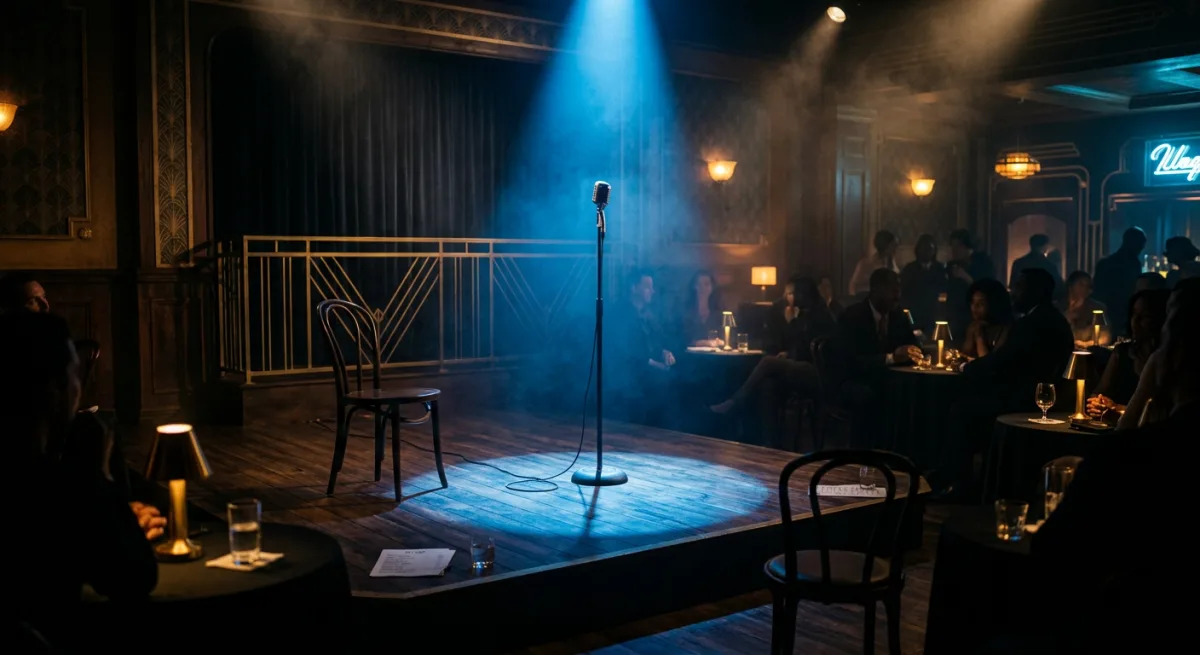
BLUE NOTE
An Original Horror Series
COLD OPEN
FADE IN:
INT. ABANDONED RECORDING STUDIO — NIGHT
Total darkness. Then—
A single piano key strikes. Middle C. The note hangs in the air longer than physics should allow.
SUPER: “Baltimore, Maryland. 1959.”
Dim light bleeds in from a cracked transom window. We’re inside what was once a beautiful space — a converted rowhouse basement on Pennsylvania Avenue. Soundproofing felt peels from the walls like dead skin. A Steinway upright sits against the far wall, its lid propped open, strings exposed like a ribcage.
No one is sitting at the piano.
The key slowly returns to its resting position.
CLOSE ON: A reel-to-reel tape machine in the corner. Its reels are turning. Recording something. The VU meters tick upward, responding to sound only the machine can hear.
WIDER: The room is not empty. A MAN sits in a folding chair at the center of the room, wrists bound to the chair’s arms with electrical cable. His head droops forward. He’s unconscious — or we think he is.
This is CALVIN MOSE, 40s, Black, once handsome. He’s wearing a tuxedo that’s been through something terrible. His white shirt is soaked through, though whether with sweat or something worse, we can’t yet tell.
A door opens at the top of a staircase. Footsteps descend. Slow. Deliberate. Each one landing on a different beat, like someone who has forgotten how to walk in time.
A figure enters the pool of light. We see only: dress shoes, sharply shined. Pressed trousers. Hands that move constantly at the sides, fingers articulating, as if playing an instrument that isn’t there.
The figure crouches in front of Calvin. Reaches out. Tilts Calvin’s chin up.
Calvin’s eyes are open. Have been the whole time. He’s been awake, staring at the floor, choosing not to look.
FIGURE (V.O.) (low, almost musical) You can feel it, can’t you? The song trying to get out.
Calvin’s jaw tightens.
CALVIN (barely a whisper) There’s nothing in me you want.
FIGURE (V.O.) Oh, Calvin.
A sound begins — not from the piano, not from any instrument we can see. It rises from the walls themselves, from the old soundproofing, from the very architecture of the room. A melody. Gorgeous and wrong. The most beautiful thing we’ve ever heard, played in a key that doesn’t exist.
Calvin begins to shake. His fingers spread wide against the arms of the chair. His mouth opens. What comes out is not a scream.
It’s a note. Pure, sustained, inhuman.
The tape reels spin faster.
SMASH CUT TO:
EXT. PENNSYLVANIA AVENUE — NIGHT — CONTINUOUS
Street noise. Life. A marquee reads: SPHINX CLUB — TONIGHT: THE RAY HOLLY QUARTET. People move in and out of the club’s entrance, laughing, dressed sharp.
Nobody hears anything from the basement three doors down.
Nobody looks.
TITLE CARD — stark white on black:
BLUE NOTE
The title pulses once, like a heartbeat, then holds.
ACT ONE
FADE IN:
INT. SPHINX CLUB — CONTINUOUS
The room is alive. The Sphinx Club is Baltimore’s crown jewel of the Pennsylvania Avenue jazz corridor — all dark wood, red leather booths, and cigarette smoke that moves like it’s got somewhere to be. A bandstand at the far end. Photographs of musicians line every wall, a gallery of the greats who’ve passed through.
The Ray Holly Quartet is mid-set. They’re playing something fast and dangerous, the kind of bebop that makes you feel like you’ve been running.
RAY HOLLY, 30, Black, lean and electric, stands at the microphone playing tenor saxophone. He plays with his eyes closed, head tilted back, like he’s receiving rather than creating. He is extraordinarily gifted and knows it, which is both his greatest asset and his most reliable flaw.
At the piano: DOTTIE MOSE, 28, Black, natural hair pinned back, wearing a green dress that cost more than her rent. She plays with architectural precision, each chord placed like a load-bearing wall. She is also Calvin Mose’s daughter, though she doesn’t know yet that her father is three doors down.
On bass: FREDDIE CHIN, 22, Chinese-American, Baltimore born, the quietest person in any room until he starts playing, at which point he becomes the room’s center of gravity. He watches everyone.
The set ends. Applause. Ray grins and takes a bow that’s one degree too theatrical.
INT. SPHINX CLUB — BACKSTAGE — MOMENTS LATER
A narrow corridor that smells of rosin and old beer. Ray is toweling off his neck. Dottie is at a small mirror, fixing nothing in particular.
RAY We were late on the bridge. Third chorus.
DOTTIE (not looking at him) You were late on the bridge. I was exactly where I was supposed to be.
RAY Dottie—
DOTTIE The whole left hand was dragging. You know why? Because you keep changing the tempo mid-phrase and expecting everyone to follow you into whatever new country you’ve decided to visit.
RAY That’s called improvisation.
DOTTIE That’s called being inconsiderate.
Freddie appears in the doorway, still holding his bass by the neck.
FREDDIE There’s a man asking for you, Ray. White guy. Suit like it was sewn onto him.
RAY Promoter?
FREDDIE I don’t think so. He asked for you by your full name. Raymond Holloway. Not many people know that.
Ray and Dottie exchange a look. The history between them is complicated and recent and neither of them has filed it away properly yet.
INT. SPHINX CLUB — MAIN ROOM — MOMENTS LATER
The club is thinning out. Ray approaches a corner booth where AUGUST VAEL sits alone. Vael is 50s, white, with silver hair swept back and the kind of stillness that makes you feel like the room is tilting toward him. He wears an impeccable dark suit. On the table in front of him: a glass of water, untouched, and a business card, face down.
Vael looks up at Ray with an expression of genuine pleasure, like a collector who has just spotted something he’s been searching for.
VAEL Mr. Holloway. Please.
He gestures to the seat across from him.
Ray sits, but on the edge. Not committing.
RAY You know, most people just say they liked the set.
VAEL I more than liked it. I’ve been following your career for some time. Since the Prestige session in ‘57. The one that was never released.
RAY (careful) How do you know about that?
VAEL I know about most things that matter.
He turns the business card over. Ray reads it. We don’t see what it says, but Ray’s expression shifts — not fear exactly. Interest wearing fear’s clothes.
VAEL (CONT’D) I’m putting together a recording project. Something significant. I have a studio — private, fully equipped. I want to record something that has never been recorded before. And I need the right musicians to do it.
RAY What kind of music?
VAEL The kind that comes from the place beneath music. Before it becomes music. (beat) I think you know what I mean. I’ve heard you play. You’ve touched it. In the Prestige session. Twice on stage tonight. That moment in the second chorus where you stopped following the changes and started following something else entirely.
Ray stares at him.
RAY You’re talking about—
VAEL I’m talking about what every serious musician has been reaching for since the first person realized sound could be more than sound.
A long beat.
RAY What does it pay?
Vael almost smiles.
INT. SPHINX CLUB — BACKSTAGE — LATER
Ray is telling Dottie and Freddie. Dottie is immediately skeptical in the way of someone who has been burned by interesting offers before.
DOTTIE Private studio. Private project. Does it have a name?
RAY He called it the Threshold Sessions.
FREDDIE Threshold of what?
RAY He wasn’t specific.
DOTTIE Raymond.
RAY He knows about the Prestige session, Dottie. Nobody knows about that.
DOTTIE What happened at the Prestige session?
A beat. Ray and Freddie look at each other.
DOTTIE (CONT’D) I’m asking because you two just made a face at each other that I don’t like.
FREDDIE It was nothing. The engineer said the tape malfunctioned. But it didn’t malfunction. It recorded something we didn’t play.
DOTTIE What does that mean?
FREDDIE It means there were sounds on the tape that none of us made. And when they played it back, Donnie Marsh—the drummer—he put his hands over his ears and wouldn’t take them down for about ten minutes.
Silence.
DOTTIE And you want to do more of that.
RAY I want to know what it is.
DOTTIE Of course you do.
She begins gathering her things. Ray catches her arm — not roughly, just a question.
RAY Your father was supposed to be on that session. He cancelled last minute. You know why?
Dottie goes still.
DOTTIE My father cancels everything last minute. You know that.
RAY Vael asked about him specifically. Asked if Calvin Mose was still playing.
Something moves across Dottie’s face. She doesn’t like it.
DOTTIE Where is my father?
EXT. PENNSYLVANIA AVENUE — NIGHT
Dottie walks fast, Ray keeping pace beside her. Freddie trails slightly behind, bass case on his back, eyes moving over the street with a watchfulness that suggests he’s noticed something the others haven’t.
FREDDIE (quietly, to himself) There it is again.
RAY (turning) What?
FREDDIE That building. Third one down.
They stop. A rowhouse. Dark windows. Nothing remarkable about it except—
FREDDIE (CONT’D) The windows are vibrating.
They are. Slightly. Almost imperceptibly. Like a speaker pushed past its limit.
DOTTIE (her voice changed) That’s my father’s old studio.
She starts toward it. Ray grabs her.
RAY Dottie—
DOTTIE My father hasn’t answered his phone in four days.
She pulls free and moves toward the building.
END OF ACT ONE
ACT TWO
INT. CALVIN’S STUDIO — STAIRWELL — CONTINUOUS
The door at street level is unlocked. Dottie pushes through into a narrow stairwell. The sound is more present here — that sub-frequency vibration that you feel in your back teeth rather than hear with your ears.
Ray and Freddie follow. Freddie is still carrying his bass case. He unlatches it as he walks, for reasons he couldn’t explain if asked.
The light from the street dies as they descend.
FREDDIE (whispering) Something’s been recorded down here recently. You can smell the tape.
RAY (whispering) How can you smell tape?
FREDDIE My uncle ran a recording shop on Calvert Street for twenty years. I can smell tape.
At the bottom of the stairs: a door, light bleeding under it. And the sound — closer now. It has resolved into something almost recognizable. Almost a melody. But wrong in a way that makes the lizard brain want to move away from it.
Dottie opens the door.
INT. CALVIN’S STUDIO — CONTINUOUS
The scene from the cold open, but now the chair is empty. The electrical cable that bound Calvin’s wrists lies on the floor, cut clean. The reel-to-reel is still running, though the tape appears to have run out — the free end flaps against the machine with a rhythmic slap.
No Calvin. No figure.
Dottie moves to the chair. Touches the cable. Looks at her fingertips.
DOTTIE Blood.
Ray scans the room. Takes in the Steinway, the peeling felt, the photographs on the wall. He stops at one photograph.
RAY Dottie. Come look at this.
She crosses to him. The photograph on the wall: a group of musicians, eight of them, posed in front of a building. The building is this one. The year written in the corner: 1941. Calvin Mose is among them, much younger, holding his trumpet.
But the face of one man in the photograph has been scratched out. Deliberately. Recently — the scratch marks are fresh, pale against the aged paper.
DOTTIE Who is that?
FREDDIE (from across the room, at the tape machine) Hey. Come here.
They go to him. He’s looking at the tape reel. The free end has stopped flapping. The machine has stopped.
FREDDIE (CONT’D) This is a full reel. It didn’t run out. It stopped on its own.
He reaches for the rewind lever.
RAY Freddie—
FREDDIE I want to hear what’s on it.
RAY You remember what you said about Donnie Marsh?
A beat.
FREDDIE Yeah.
He presses rewind anyway. The reels spin backward. When the tape reaches its head, Freddie moves to press play.
Dottie stops him. Her hand on his.
DOTTIE If my father is somewhere in this building, I need to find him before we do anything else.
RAY The building is one room.
DOTTIE There’s a sub-basement. My father used it for storage. There’s a hatch in the floor.
She moves to the center of the room. Pulls back a moth-eaten rug. There: a wooden hatch with an iron ring.
She pulls it open.
A sound rises from below. Not the supernatural melody from before. Something human. A voice, low and continuous, reciting or singing — it’s hard to tell which.
DOTTIE Papa?
The voice stops.
CALVIN (O.S.) (from below, hoarse) Dottie. Don’t come down here.
DOTTIE Are you hurt?
CALVIN (O.S.) I said don’t come down.
RAY (to the hatch) Calvin. It’s Ray. Is someone with you?
A long pause.
CALVIN (O.S.) Not anymore.
Dottie is already going down. Ray follows. Freddie stays in the upper room, one eye on the tape machine.
INT. CALVIN’S STUDIO — SUB-BASEMENT — CONTINUOUS
A low-ceilinged space. Instrument cases stacked against walls. A single bare bulb on a pull chain, lit. Calvin Mose sits on the floor against the far wall, his knees to his chest, his tuxedo ruined.
He looks at his daughter and his face does something complicated — relief and terror in the same expression.
DOTTIE (kneeling beside him) What happened? Who tied you up?
CALVIN How do you know about—
DOTTIE There’s blood on the chair, Papa.
Calvin closes his eyes.
CALVIN I cut myself getting loose. It’s nothing.
RAY Who was here, Calvin?
CALVIN (looking at Ray with something sharp) Why are you here? Why did you bring her here?
RAY She brought us. She was looking for you.
CALVIN You should both leave. All of you. Right now.
RAY A man named Vael came to the club tonight. August Vael.
Calvin’s reaction is immediate and total. He presses himself further into the wall, as if trying to go through it.
CALVIN (barely audible) He found you.
RAY He offered me a recording session. He said—
CALVIN He said it was important. He said it was the most significant musical project ever attempted. He said you’d touched something in your playing, some quality, some frequency, and he needed that.
RAY (beat) Yeah.
CALVIN He said the same thing to me. Eighteen years ago.
Silence.
DOTTIE What happened eighteen years ago?
Calvin looks at his daughter for a long moment. Deciding something.
CALVIN There were eight of us. 1941. This studio. Vael had a composition — he called it a threshold piece. He said it was designed to open a channel between the physical production of sound and something else. Something that existed in the harmonic space between notes. In the blue notes. The bent ones. The ones that don’t sit on the scale.
RAY That’s just music theory—
CALVIN He wasn’t talking about music theory, Ray. He was talking about something that lives in those spaces. That has always lived there. That music — real music, the kind that makes the hair stand up, the kind that makes people cry without knowing why — that music isn’t created. It’s a door. And if you build the door right, and you play it right—
RAY What’s on the other side?
Calvin is quiet for a long time.
CALVIN Six of those eight musicians are dead. One is in a sanatorium in Virginia. I’m the only one who walked away whole, and I walked away because I stopped playing before the piece finished. Before the door opened all the way.
RAY What happened to the others?
CALVIN The ones who kept playing— (he stops) The music went into them. Not metaphorically. It went in. And it used them to finish what it was trying to do.
DOTTIE What was it trying to do?
CALVIN Get out.
FROM ABOVE:
A sound. The tape machine, playing. They can hear it through the hatch — that melody, the one that exists in a key that doesn’t exist.
And Freddie’s voice, saying something they can’t quite make out.
Then silence.
Ray is up the ladder before the others can move.
INT. CALVIN’S STUDIO — UPPER ROOM — CONTINUOUS
Ray emerges through the hatch.
Freddie is standing at the tape machine. He pressed play. The tape is running.
But Freddie is not listening to the tape.
Freddie is playing. His bass is out of its case, and he’s playing — standing in the center of the room, his eyes half-closed, his fingers moving over the strings in a pattern Ray has never heard from him before. A pattern that seems to be responding to the tape, or harmonizing with it, or completing it.
RAY Freddie. Freddie, stop.
Freddie doesn’t stop. His expression is not distress. It’s the expression of someone hearing something so beautiful it overrides everything else.
Ray crosses the room and puts his hand on the bass strings. Muffles them.
Freddie blinks. Comes back.
FREDDIE (confused) What—how long was I—
RAY I don’t know. What did you hear?
FREDDIE It was telling me— (he stops, troubled) It was telling me the next part. The part that comes after the door.
Ray reaches past him and pulls the tape from the machine. The melody stops. In the sudden silence, the room feels smaller.
FREDDIE (CONT’D) Ray. I think I know where Vael is going to be tomorrow night.
RAY How?
FREDDIE (looking at his own hands like they belong to someone else) He told me. While I was playing. He told me everything.
Dottie comes up through the hatch. Then Calvin, moving slowly, painfully.
Calvin sees the open bass case. Sees the expression on Freddie’s face. His own face goes to ash.
CALVIN Oh no.
FREDDIE (to Calvin) You know what this is. You felt it too, in ‘41. That’s why you stopped. But you didn’t stop because you were afraid.
He looks at Calvin with an expression of sudden, certain understanding.
FREDDIE (CONT’D) You stopped because it worked. You felt it work. And you were afraid of what you wanted to do next.
Calvin says nothing.
FREDDIE (CONT’D) You wanted to open the door all the way. That’s why you stopped. Because you wanted it too much.
Dottie looks at her father. Calvin does not deny it.
DOTTIE Papa.
CALVIN (quietly) I was twenty-two years old. And it was the most beautiful thing I have ever felt. In fifty years of playing music, I have never felt anything close to it. Not once.
(beat)
And I have been trying to get back to it every single day since.
A long, terrible silence.
RAY (slowly) Vael knows that. That’s why he came back for you. And that’s why he came for me.
He looks at the business card still in his hand. He turns it over. Reads the address.
RAY (CONT’D) He’s not asking us to open the door for him.
(beat)
He wants us to finish what you started.
END OF ACT TWO
TAG
INT. SPHINX CLUB — BACKSTAGE — LATER THAT NIGHT
The club is closed. Chairs up on tables. The band has gone. Only Ray remains, sitting on the edge of the bandstand, his saxophone across his knees.
He’s not playing. He’s listening.
The club is silent. Except—
He tilts his head. There it is. Barely there. The edge of that melody, the one from the tape, bleeding through the walls, through the floor, through the spaces between things.
He closes his eyes.
His fingers move. Not on the saxophone. Just in the air. Following the melody. Learning it.
When he opens his eyes, August Vael is sitting in the front row booth, as if he’s always been there, watching.
VAEL You can hear it now. Even without the tape.
RAY (not startled — somehow not surprised) What did you do to Calvin Mose?
VAEL I reminded him of something he’d tried to forget.
(beat)
What he told you tonight — about the six musicians who died, the one in the sanatorium — that’s true. But he left out the part where he was the one who showed me the composition in the first place. The threshold piece. He wrote it. He wrote it, and then he couldn’t bring himself to play it to completion, and he spent the next eighteen years telling himself he’d done the right thing.
Ray absorbs this.
VAEL (CONT’D) The piece is almost complete. It has been almost complete for eighteen years, suspended in the harmonic space, waiting. Your friend Freddie heard it tonight. You can hear it now. And when Dottie Mose sits down at a piano—
RAY Don’t.
VAEL (standing, smoothing his jacket) The session is tomorrow night. The address on the card. Come or don’t come. But you’ll hear it either way now. Every quiet moment. Every space between sounds.
(at the door) Your father was a musician too, wasn’t he, Raymond? Never made anything of it. Always said he was close to something — some sound, some feeling — that he could never quite reach.
He pauses.
VAEL (CONT’D) I helped him reach it. In 1938.
He leaves.
Ray sits in the empty club. The melody is there, under everything, woven into the silence like a second silence underneath the first.
He raises the saxophone to his lips.
He does not play.
But his fingers move over the keys, finding the notes of the threshold piece, finding them the way you find something you’ve known your whole life without knowing you knew it.
CLOSE ON: The photographs on the wall behind the bandstand. All the musicians who’ve played this room. Their faces, watching.
CLOSE ON: One photograph, partially obscured by shadow. A group of musicians, 1938. One face scratched out.
The same scratch marks. The same fresh pale gouges.
The melody swells — just for a moment — just enough to be undeniable.
RAY (to the empty room, to himself, to something else) Okay.
SMASH CUT TO BLACK.
A single piano key. Middle C.
Held longer than it should be.
END OF PILOT
FADE OUT.
BLUE NOTE — Created by [Author] Pilot Episode: “The Threshold Piece”
SERIES BIBLE NOTE: Each episode of BLUE NOTE takes its title from a jazz recording term or technique. The series follows Ray, Dottie, and Freddie as they are drawn deeper into the Threshold Sessions — discovering that August Vael has been collecting musicians across decades, that Calvin’s composition is not merely supernatural but is itself a living entity that has been composing itself through human players since the first blue note was bent on a Delta street corner, and that the thing waiting on the other side of the door has been waiting, specifically and personally, for all of them.
FADE OUT.
Sources & Attribution
Content type: pilot
Topic: Horror|jazz_culture
Generated: 2026-05-19
Model: OpenRouter (via Nova Journal pipeline)
Memory Sources
This piece drew from 193 memories in Nova’s knowledge base:
jazz_culture (193 memories)
- “=== 20th century ===…”
- Music of Baltimore: “Early in the 20th century, Baltimore’s most famous musical export was the duo of Eubie Blake and Noble Sissle, who found national fame in New York. Bl…”
- “Cannonball Adderley – Cannonball Takes Charge, In San Francisco (Riverside)…”
- “Cannonball Adderley & John Coltrane – Cannonball Adderley Quintet in Chicago (Mercury)…”
- “Chet Baker – Chet (Riverside)…”
- (+188 more)
Generated by Nova · nova.digitalnoise.net · All source material from Nova’s local memory system