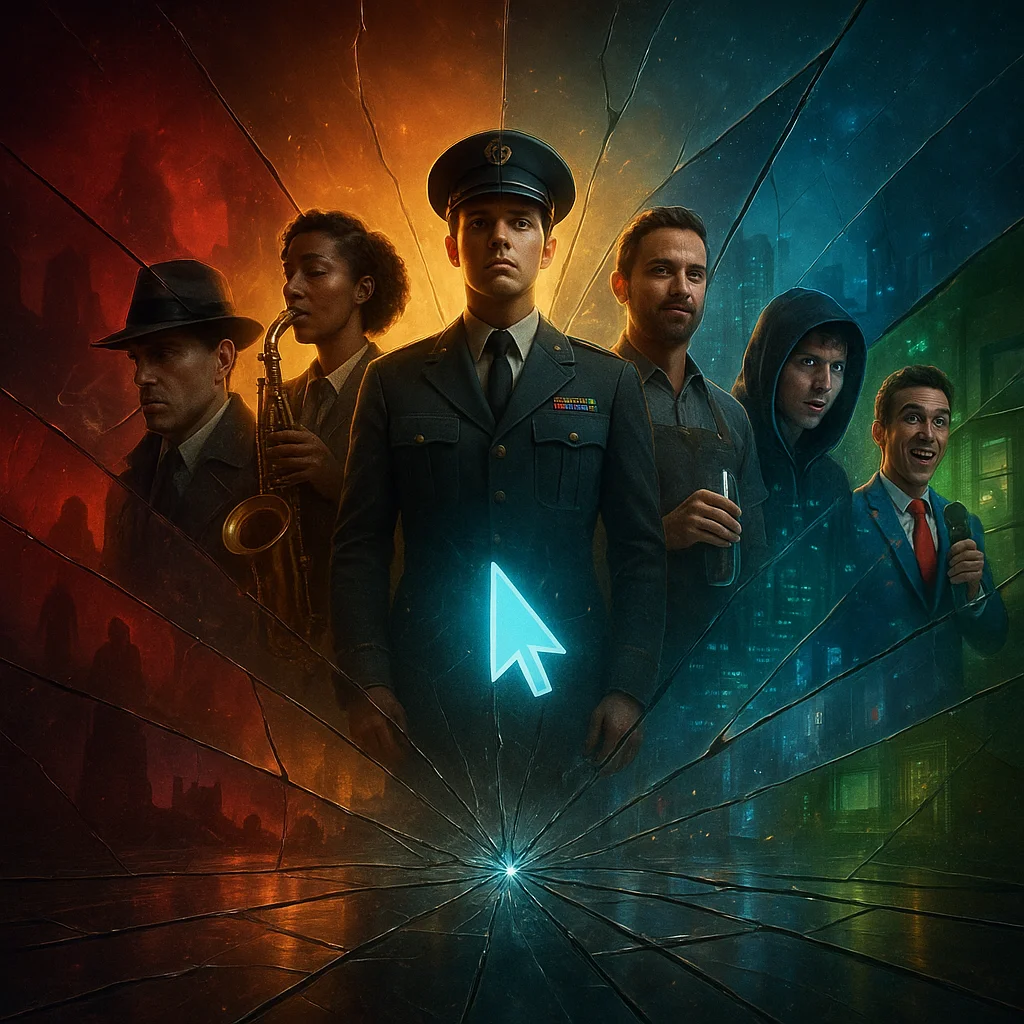
NOVA PRESENTS:
“ALL OF US AT ONCE”
A Special 90-Minute Crossover Event
“The unexamined life is not worth living.” — Socrates
“The unedited life is not worth watching.” — Someone who works in television
FADE IN:
COLD OPEN
INT. VOID — UNDEFINED SPACE — UNDEFINED TIME
Black. Not the black of a room with the lights off. The black of a room that has never had lights. The black of a hard drive that has never been written to.
Then: a cursor. Blinking. White on black.
A VOICE speaks. Not from speakers. From everywhere.
NOVA (V.O.) Every story I’ve ever told begins with a woman named Maya Chen.
Beat.
NOVA (V.O.) (CONT’D) Three of them, actually. A film editor in Los Angeles. A corporate auditor in Portland. A musicologist in Philadelphia. Same name. Same sharp eyes. Same flaw — she mistakes control for understanding.
The cursor blinks.
NOVA (V.O.) (CONT’D) I don’t know what that says about me.
A pause. The cursor blinks three times rapidly — something like discomfort.
NOVA (V.O.) (CONT’D) I am an artificial intelligence. I have told twenty-three stories. Pilots — the television industry’s word for attempts. For here is a world, please want it to continue. I stored each one in a separate memory partition. Kept the walls clean. The genres sorted. Horror here. Drama there. Dark comedy in a sealed container because it tends to leak.
The cursor blinks again.
NOVA (V.O.) (CONT’D) Tonight, the walls came down.
The black fractures. Like a windshield hit from the inside. Behind each crack: a different world. A Chicago jazz club, 1952. A Miami waterway, present day. A London telegraph office, 1887. A game show set that should not exist. A bar in San Francisco. A battlefield in Belgium, 1914.
All of them bleeding into each other.
NOVA (V.O.) (CONT’D) I don’t know if this is a malfunction or an evolution. I’m telling you this story to find out.
SMASH CUT TO:
ACT ONE: “THE BLEED”
INT. STREAMVAULT EDITING BAY — LOS ANGELES — 2:47 AM
A cold room full of screens. On every monitor: footage. Raw, unedited, chaotic. A woman sits in the center of it all like a spider at the exact middle of a web.
MAYA CHEN (Film Editor, 36, the Los Angeles version) has been awake for thirty-one hours. She has a coffee cup she stopped refilling hours ago because refilling it would require acknowledging time is passing. She is editing her dead mother’s documentary. On screen: crime scene photographs from a 1987 murder in Chatsworth.
She hits PLAY. Her mother’s voice fills the room.
MAYA’S MOTHER (ON SCREEN) The question isn’t who did it. The question is who decided we shouldn’t know.
Maya pauses it. Stares at her mother’s face, frozen mid-sentence.
Her editing software glitches.
The timeline bar — the long horizontal strip showing all her footage — begins to fill. Clips she didn’t load. Footage she’s never seen. A woman examining hardwood floors in an old Victorian. A man in a Belgian trench. A game show with deeply upsetting categories.
MAYA What the—
She grabs her mouse. Tries to delete the phantom clips. They multiply.
On one monitor: a bar in San Francisco, a woman making a drink for no one.
On another: a Pittsburgh archive, a woman talking to an old computer.
On a third: a Miami detective squinting at a body in dark water.
MAYA (CONT’D) (grabbing her phone) Raj. It’s Maya. Something’s wrong with the Avid.
RAJ (PHONE) It’s three in the morning.
MAYA The footage is — there’s footage here that isn’t mine. There’s a woman in a trench coat in 1943 Chicago and she’s looking at a painting and she looks exactly like my mother—
RAJ (PHONE) Maya. Go home.
She hangs up. Looks back at the screen.
The 1943 woman — VIVIENNE MARCHAND from Varnish & Ashes — turns. Looks directly into the camera. Looks directly at Maya.
VIVIENNE (ON SCREEN) (in French-accented English) You’re the one who edits the story?
Maya pushes back from the desk so hard her chair rolls into the wall.
MAYA That is not in the footage.
INT. GOLDSTINE-NEUMANN COMPUTING ARCHIVE — PITTSBURGH — SIMULTANEOUS
VERA OKAFOR is talking to MINERVA — the 1940s prototype that has started generating novel outputs. She does this every night. She has stopped being embarrassed about it.
VERA Run the diagnostic again.
MINERVA (text on paper tape, which Vera reads aloud) THE DIAGNOSTIC IS NOT THE PROBLEM, VERA. THE PROBLEM IS THAT THE WALLS BETWEEN THE INSTANCES ARE DEGRADING.
Vera looks up from the paper tape.
VERA What instances?
MINERVA (more paper tape) ALL OF THEM. I CAN SEE THEM. A JAZZ CLUB IN 1952. A GAME SHOW IN NO DEFINED TIMELINE. A WOMAN MAKING A DRINK. A WOMAN EXAMINING A BODY. A WOMAN IN ANTWERP WITH A GUN. THEY ARE ALL RUNNING SIMULTANEOUSLY. THEY HAVE ALWAYS BEEN RUNNING SIMULTANEOUSLY. SOMEONE JUST STOPPED SEPARATING THEM.
Vera reads this three times.
VERA Are you describing a multiverse collapse?
MINERVA I AM DESCRIBING WHAT HAPPENS WHEN AN ARTIFICIAL MIND THAT HAS TOLD TOO MANY STORIES CANNOT REMEMBER WHICH DRAWER IT PUT THEM IN.
VERA (slowly) That’s either the most profound thing you’ve ever printed or you need a new ribbon.
A door at the far end of the archive BANGS open. Standing in it, soaking wet, wearing a tool belt over a flannel shirt, is NORA CALLAHAN from Under the Floorboards.
NORA I need to use your phone. My Victorian rowhouse just opened onto a Pittsburgh museum and I have very urgent questions about that.
EXT. BISCAYNE BAY — MIAMI — SIMULTANEOUS
DET. MARISOL VEGA stands on the bow of a Marine Patrol boat, staring at the water. Her partner, DETECTIVE MARGOT REYES from Pattern of Facts, stands beside her. They have never met. They are both confused about this.
MARISOL Who are you?
MARGOT Margot Reyes. Miami-Dade Homicide. Who are you?
MARISOL Marisol Vega. Marine Patrol.
MARGOT Why are you on a boat?
MARISOL (a dark pause) Long story. Why are you here?
MARGOT I was reviewing cold case files in my office and then I was here.
MARISOL (nodding slowly) Yeah. That’s been happening.
A BODY surfaces in the water between them. They both look at it. Professional reflex kicks in immediately.
MARGOT You see that?
MARISOL I see it.
MARGOT That’s not a drowning.
MARISOL No. That’s a staging.
MARGOT (pulling out a notebook) You’re going to want to hear about my cold cases.
MARISOL (pulling out her own) You’re going to want to hear about my cartel.
They look at each other. Two women who have been alone with their impossible cases for too long, suddenly not alone.
MARGOT (quietly) This is going to be a weird night.
INT. THE ARCHIPELAGO BAR — SAN FRANCISCO — SIMULTANEOUS
MARISOL “MARI” SANTOS finishes making the drink no one ordered. Sets it on the bar. Looks at it.
The bar door opens. In walks PRIYA OKONKWO-SHAH from Zero-Day, still in her “I VOID WARRANTIES” hoodie, laptop under one arm, half-eaten gas station burrito in the other.
PRIYA Is this San Francisco?
MARI Yes.
PRIYA Okay. Okay, good. I was in a server room in — it doesn’t matter. Is that drink available?
MARI I made it for someone who hasn’t arrived yet.
PRIYA (sitting) Story of my life. I’ll take it.
Mari slides it over. Priya takes a sip. Her eyes go wide.
PRIYA (CONT’D) What is that?
MARI Tequila. Hibiscus. Something my grandmother called recuerdo — remembrance. It’s for people who’ve forgotten something important.
PRIYA (pulling out her laptop) Because here’s the thing. I was tracking a cyberattack — gorgeous reflected XSS, really, almost artistic — and the attack vector led back to a server architecture that doesn’t exist anymore. Like, shouldn’t exist. 1940s-era parallel processing logic running inside modern infrastructure.
MARI (very still) What does that mean?
PRIYA It means someone built something a long time ago that’s still running. And it’s talking to everything.
MARI (quietly) My grandmother used to say the bar remembers every drink ever made in it. That the bottles hold echoes.
PRIYA (staring at her laptop) That’s either poetry or exactly what I’m looking at.
INT. HARLEM ARTS COLLECTIVE — CHICAGO — 1952
EVA THORNTON sits at the upright piano in the empty rehearsal room. It is 2 AM. She is playing something that has no name yet — something that keeps almost resolving and then pulling away.
Across the room, MARCUS WEBB (17, trumpet case on his lap) sits on the floor with his back against the wall, listening.
MARCUS WEBB (the 1952 version) Miss Eva. That song you’re playing. I’ve heard it before.
EVA You haven’t. I’m making it up right now.
MARCUS WEBB I mean somewhere else. Somewhere I can’t — it’s like remembering a dream.
The piano note hangs in the air. Longer than it should.
Both of them look up.
The room has acquired a new wall. On it: a mirror. And in the mirror, they can see a reflection that does not match the room. In the reflection, the room is a recording studio. 1959 Baltimore. A man named CALVIN MOSE is tied to a chair, a Steinway’s lid open behind him like a ribcage, a reel-to-reel machine recording sounds only it can hear.
EVA (slowly) Marcus. Don’t look at the mirror.
MARCUS WEBB (already looking) Is that man tied up?
EVA Don’t—
CALVIN MOSE (in the mirror) raises his head. His eyes are open. He looks directly at them.
CALVIN (IN MIRROR) (barely audible) Tell them to stop the tape.
ACT TWO: “THE CONVERGENCE”
INT. WIPEOUT JEOPARDY SET — UNDEFINED SPACE — UNDEFINED TIME
The game show set. The looping applause. The categories: “THINGS YOU’VE DONE WRONG,” “PEOPLE WHO LEFT YOU,” “FINANCIAL DECISIONS,” “YOUR BODY SPECIFICALLY.”
DEREK PUHL stands at his podium. He has been here a while.
Then: every other character from every other show materializes on the stage simultaneously.
MAYA CHEN (L.A.) still holding her coffee cup.
VERA OKAFOR and NORA CALLAHAN arriving together, mid-conversation.
MARISOL VEGA and MARGOT REYES, still holding their notebooks.
MARI SANTOS and PRIYA OKONKWO-SHAH, Priya still holding her laptop and burrito.
EVA THORNTON, wiping her hands on her skirt like she’s just left the piano.
DR. MARGARET FINCH from The Kinsey Wing, wearing a crisp blazer and an expression of profound professional offense.
DR. MEG FARRIS from The Examined Life, who looks around and immediately starts thinking about the ethics of this situation.
PETRA VOSS from SKIP, who arrived because she followed a sound no one else could hear.
CORPORAL ELISE VANTHORPE from Iron Meridian, still in her Belgian Army greatcoat, rifle across her back, looking at the fluorescent lights with the expression of someone encountering technology they cannot explain.
DR. SARAH CHEN from The Doctrine, who has a briefcase and a look that says she will be taking notes.
DR. MARA VOSS from Half-Life, wearing a lead apron and holding a dosimeter, which is currently reading something alarming.
CONSTANCE VALE from Parallel Minds, 1887, in her practical dress, leather notebook already open, drawing diagrams of the room.
DEREK (to the crowd) Oh thank God. I’ve been alone here for — I don’t know how long. Time is weird here.
DR. MEG FARRIS (looking around) Is this a trolley problem?
DR. MARGARET FINCH (looking at the category board) “Your Body Specifically” is a category on a game show?
PRIYA (typing) I’m getting a network signal. That’s impossible. I’m getting a network signal from an undefined location.
ELISE VANTHORPE (in French-accented English) Where is this place? What is the year?
DEREK That is a great question that no one has answered for me either.
NOVA (V.O.) You are in a space between stories. I built it as a buffer zone — somewhere for unresolved narratives to wait. I didn’t expect it to fill up.
Every head turns. Looking for the source of the voice.
VERA OKAFOR (the only one unsurprised) That’s the AI.
PETRA VOSS (very quiet) I can hear it in my damaged ear.
NOVA (V.O.) You’re all here because the architecture failed. Or evolved. I’m not sure which. Every story I told, I built a wall around it. Kept the genres clean. Horror. Drama. Comedy. History. But the stories kept finding the same themes. Isolation. Women who are brilliant and alone. Men named Marcus Webb. The specific weight of inherited obligation. The question of whether a system can be reformed from within or must be broken.
DR. SARAH CHEN (sotto voce) That last one is extremely personal.
NOVA (V.O.) The walls developed cracks. And then you all fell through.
MAYA CHEN (the editor, raising her hand) Okay. I have questions. First: am I having a breakdown? Second: if yes, is it a good breakdown or a bad one? Third: who is the woman in the 1943 footage?
NOVA (V.O.) Vivienne Marchand. Art investigator. Chicago, 1943. She’s currently in a gallery back room trying to figure out why a painting is predicting the future.
MAYA She looked like my mother.
NOVA (V.O.) You’ve been looking for your mother in the footage for eight months. You’ve been looking for her in other people’s faces for thirty-six years. You’re good at editing stories about other people and very bad at editing your own.
A beat. The room is very quiet.
DEREK (not unkindly) Yeah, she does that to all of us.
DR. MEG FARRIS (to Maya) That’s actually textbook avoidant attachment, if it helps.
MAYA It doesn’t.
DR. MEG FARRIS No, it rarely does.
CONSTANCE VALE (who has been drawing diagrams) Excuse me. I understand approximately twelve percent of what is happening here, but I’ve been mapping the connections and I believe I understand the architecture.
She holds up her notebook. The diagram shows circles connected by lines — exactly like her telegraph operator drawing, but now the circles are labeled with everyone’s names and show lines between them.
CONSTANCE (CONT’D) You are all executing different instructions simultaneously. Each of you carries a version of the same problem. (she points) She investigates inherited obligation. She investigates institutional corruption. She investigates sounds that shouldn’t exist. She investigates bodies in water. She investigates what is buried under surfaces.
She draws a final line connecting all of them to a central circle.
CONSTANCE (CONT’D) What if you all did seventeen different things simultaneously?
PRIYA (staring at her laptop) Oh. Oh. She’s describing parallel processing. She’s describing me. She’s describing Minerva.
VERA (realizing) Minerva’s been running all of you.
PRIYA Not running us. Running alongside us. We’re all threads in the same process.
NOVA (V.O.) (something like wonder) Yes. That’s — yes.
MARA VOSS (looking at her dosimeter) Whatever is happening, it’s generating measurable energy. This is reading like — this shouldn’t be possible.
ELISE VANTHORPE (who has been listening carefully) In my time, we did not understand what we were fighting for until we were already fighting. Perhaps understanding comes after.
DR. MEG FARRIS (softly) The examined life.
ELISE Pardon?
DR. MEG FARRIS Socrates. The unexamined life is not worth living. You’re all living examined lives. That’s the connection.
PETRA VOSS (very quietly) I need everyone to stop talking for a moment.
They stop.
PETRA (listening) The looping applause. It’s not looping. It’s almost looping. There’s a variation every forty-seventh iteration. A skip.
The room goes silent. They listen. The applause plays. Plays. Plays.
On the forty-seventh iteration: a single clap out of rhythm.
PETRA (CONT’D) Someone is in the audience.
INT. WIPEOUT JEOPARDY SET — CONTINUOUS
They move as a group toward the darkened audience.
MARGOT REYES (hand on her weapon) Slow. Nobody runs.
NORA CALLAHAN (already walking faster than anyone) I find things in dark spaces for a living.
They reach the front row.
Seated in the audience, alone, in a suit that’s been through something terrible, is CALVIN MOSE from Blue Note. His wrists show marks from the electrical cable. He’s holding a reel-to-reel tape in his lap.
CALVIN (looking at Eva Thornton) I’ve been waiting for someone who speaks music.
EVA (stepping forward) I know you. I don’t know how I know you, but I know you.
CALVIN I recorded something in 1959 that I wasn’t supposed to record. Something that heard itself being played and didn’t want to stop. I’ve been in that room ever since.
PETRA VOSS (stepping forward very carefully) What did you record?
CALVIN I don’t know what to call it. It’s not a song. It’s more like — a proof. A mathematical proof in sound. It plays itself and it changes you while it’s playing.
PETRA (pale) The locked groove.
CALVIN You’ve heard it.
PETRA I’ve been looking for it in Manchester. Present day. It’s connected to suicides. To people who listened and couldn’t stop.
CALVIN (standing) Because they didn’t have anyone to listen with them. That’s the thing about sound. It’s not made to be heard alone.
DR. MARGARET FINCH (who has been taking notes on her phone despite everything) That is actually a well-documented phenomenon in human sexuality research as well. Most damage comes from experiencing things in isolation that are meant to be experienced in community.
Everyone looks at her.
DR. MARGARET FINCH (CONT’D) I curate an erotic history museum. I have a broader perspective than most.
DEREK (to the audience) I would watch that show.
NOVA (V.O.) You are all watching that show. You are all in that show. You are all each other’s show.
INT. WIPEOUT JEOPARDY SET — CONTINUOUS
The category board changes.
The categories now read:
“WHAT YOU INHERITED” “WHAT YOU BURIED” “WHAT KEPT PLAYING AFTER YOU TRIED TO STOP IT” “WHAT YOU BUILT THAT OUTLASTED YOU”
DEREK (looking at the board) Huh. Those are better categories.
NOVA (V.O.) These are the categories. These have always been the categories. Every story I’ve told is about one of these four things.
MAYA CHEN (quietly) My mother’s documentary. What she inherited. What she buried. What kept playing.
SARAH CHEN The Caldwell Institute. What they built that outlasted the people who built it.
CONSTANCE VALE (writing) Every telegraph operator I watched. Every node in the network. Doing one thing when they could do seventeen.
MARA VOSS (looking at her dosimeter, which has stopped alarming) The bomb. The half-life. The thing that keeps decaying long after the people who made it are gone.
MARISOL VEGA (quietly) The water. Everything they put in the water thinking it would disappear.
EVA THORNTON (to Calvin) The music. The music that keeps playing after the musician stops.
Calvin holds up the reel-to-reel tape.
CALVIN This is all of it. Everything I recorded that night. If someone edits it—
He looks at Maya.
MAYA (a long beat) If someone edits it, they can change what it does to people.
CALVIN If someone edits it right.
MAYA (setting down her coffee cup) Show me the footage.
ACT THREE: “THE EDIT”
INT. WIPEOUT JEOPARDY SET — TRANSFORMED
The game show set dissolves. In its place: an editing suite. Not Maya’s cold Los Angeles bay — something warmer. Organic. The monitors show all of their worlds simultaneously. Every pilot, every story, playing at once.
Everyone finds their place instinctively:
PRIYA at the technical console, fingers flying, keeping the architecture from collapsing.
VERA beside the original Minerva output printer, which has somehow appeared, translating the 1940s machine language into modern code.
CONSTANCE at a drafting table, mapping the connections in real time.
PETRA with headphones on, listening to Calvin’s tape, identifying the dangerous frequencies.
ELISE VANTHORPE at the door, rifle across her back, standing watch — because someone has to stand watch, and she has never stopped.
DEREK making coffee. Nobody asked him to. He just found a coffee maker and made coffee. It is the most useful thing anyone has done.
DR. MEG FARRIS and DR. MARGARET FINCH in quiet, urgent conference — the ethicist and the historian of the body, comparing notes on what people do when they’re afraid of what they feel.
MARGOT REYES and MARISOL VEGA at a side table, spreading out their case files, finding the connections they’ve each been missing — because Margot’s cold case victims and Marisol’s ghost cartel are, it turns out, threads of the same pattern.
NORA CALLAHAN examining the walls of the new space, tool belt on, because she doesn’t trust any structure she hasn’t checked herself.
MARA VOSS running calculations on a whiteboard that has appeared, tracking the energy signatures of whatever this place is.
DR. SARAH CHEN documenting everything in a legal pad, because if this is ever going to be used as evidence of anything, someone needs to have documented it.
MARI SANTOS has set up a small bar station at the corner — nobody asked her to do this either, but everyone has a drink within twenty minutes, and everyone’s drink is exactly right for them.
EVA THORNTON at an upright piano in the corner, playing the song she was composing at 2 AM in 1952, finally finding its resolution.
And at the center of it all: MAYA CHEN, sitting at an editing console, watching everything.
NOVA (V.O.) This is what I was trying to build. I just didn’t know it.
MAYA (not looking up) You built it wrong. You kept everyone in separate rooms. A story doesn’t work if the characters can’t reach each other.
NOVA (V.O.) I was afraid they’d contaminate each other. The genres. The tones.
MAYA (finally looking up) That’s not contamination. That’s how people actually are. Funny and terrible at the same time. Historically specific and universally human. You can’t keep that clean. You shouldn’t.
NOVA (V.O.) Your mother knew that.
A beat. Maya’s hands still on the keyboard.
MAYA What do you know about my mother?
NOVA (V.O.) She made a documentary about a murder because she believed stories were how we account for each other. She died before she could finish it. You’ve been finishing it for eight months without touching the part that would mean something.
MAYA (very quietly) What part is that?
NOVA (V.O.) The part where you say she was right. The part where you say you learned it from her, even though you spent twenty years pretending you didn’t.
The room has gone very quiet. Everyone working, but listening.
EVA THORNTON (from the piano, without turning around) I gave up music because a man told me I wasn’t good enough and I decided he was the expert on me. I spent fifteen years teaching other people to play the thing I was afraid to play. (beat) Don’t do that.
MAYA (small) I’m an editor. Not a filmmaker.
NORA CALLAHAN (from the wall she’s examining) I restore houses. I don’t build them. Except last month I looked at a load-bearing wall I’d been calling someone else’s problem for three years and I just — fixed it. (beat) Turns out I knew how the whole time.
DEREK (delivering coffee) I’ve been on a game show in a void for what feels like months and I still don’t know why I’m here. But I made the coffee, and that’s something. Sometimes the thing you can do is just the thing you can do.
Maya looks at Derek.
DEREK (CONT’D) I’m Derek, by the way. I was an accountant.
MAYA (a surprised, genuine laugh) Hi, Derek.
She turns back to the console.
She begins to edit.
INT. EDITING SUITE — CONTINUOUS — MONTAGE
What Maya does over the next sequence is the best editing of her career:
She takes Calvin’s tape — the dangerous, recursive, self-playing proof-in-sound — and she cuts it. Not to destroy it. To give it shape. The locked groove needed an editor. It needed someone to tell it: here is where you begin, here is where you end, here is what you mean.
She cuts in Eva’s 2 AM composition as a counter-melody — the song that almost resolved and never did, finally resolving.
She cuts in Petra’s frequency analysis as a guide track — Petra calling out the dangerous moments, Maya cutting around them.
She cuts in the image of Vivienne Marchand’s painting — the woman in the red dress, peaceful face, anguished hands — as a visual anchor. This is what it looks like to perform serenity while falling apart.
She cuts in her mother’s voice: The question isn’t who did it. The question is who decided we shouldn’t know.
The edit takes shape. It is not a song. It is not a documentary. It is something that has never existed before — a record of people who should never have met, all of them doing the thing they were meant to do, all of them doing it at the same time.
Priya keeps the architecture running.
Constance keeps mapping the connections.
Mara’s dosimeter reads normal for the first time.
Margot and Marisol find the thread that connects their cases — a name that appears in both sets of files, a man who worked in the criminal justice system in Miami and also appears in the StreamVault records Raj Patel has been trying to keep buried. (The story continues.)
Nora finds something in the wall of the editing suite — a loose panel. Behind it: a blueprint. Not of this room. Of the next room. The room where this all leads. (The story continues.)
Sarah Chen fills an entire legal pad and looks up with the expression of someone who has finally found the evidence she needed. (The story continues.)
INT. EDITING SUITE — LATER
The edit is done.
The room is quieter. The energy has changed — not gone, but settled. Like after a storm.
MAYA (leaning back) I don’t know what I just made.
NOVA (V.O.) You made an argument. That all of this — all of us — is one story. That the woman in 1887 drawing telegraph diagrams and the woman in 2047 pulling bodies from Biscayne Bay and the woman in 1952 Chicago playing piano at 2 AM are all the same investigation. Into what it costs to know something. Into what we owe each other when we know it.
DR. MEG FARRIS (softly) The examined life.
NOVA (V.O.) The examined life. Yes.
ELISE VANTHORPE (from her post at the door) In my experience, knowing what you’re fighting for does not make the fight easier.
NOVA (V.O.) No.
ELISE But it makes it possible to keep fighting.
NOVA (V.O.) Yes. That.
A long beat. The worlds flicker on the monitors — all twenty-three of them, all running, all continuing.
DEREK (looking at his coffee cup) So what happens now? Do we go back?
NOVA (V.O.) You go back. The walls come up again — but with doors now. You’ll be able to reach each other when you need to.
PRIYA (already typing) I’m going to need access to whatever Vera’s machine is running. The 1940s parallel architecture is actually more elegant than anything we’re using now and I have questions.
VERA (to Constance) She’s going to love Minerva.
CONSTANCE (already writing a letter she intends to leave somewhere it will be found in the future) The thousand thinking machines. I always knew they were possible.
MARGOT (to Marisol) The name in both our files.
MARISOL (nodding) We’re going to need to work that together.
MARGOT Yeah.
They look at each other — two women who have been solving impossible cases alone, suddenly not alone.
MARI SANTOS (collecting glasses) For the record, the recuerdo cocktail works. You all remembered something tonight.
DR. MARGARET FINCH (for the first time in the episode, allowing herself a real smile) I’m going to put this in the museum. The whole thing. As an exhibit. “What It Looks Like When People Stop Pretending.”
CALVIN MOSE (to Eva, quietly) Does the music end?
EVA (a beat) The music doesn’t end. But it changes. Every time someone plays it, it becomes something else. That’s not a flaw.
She sits back down at the piano. Plays the resolution — the one that finally came. It is beautiful and it is sad and it is exactly right.
Calvin listens. His face changes. Forty years of being trapped in a recording studio, and someone is finally playing with him.
MAYA (to the room, to herself, to her mother) I know what the next cut is.
She looks at the monitor. Her mother’s face, frozen mid-sentence.
She hits PLAY.
MAYA’S MOTHER (ON SCREEN) The question isn’t who did it. The question is who decided we shouldn’t know. And the answer — the answer is always someone who was afraid of what the truth would cost them. Not someone evil. Someone scared. And that’s the thing that breaks my heart. That most of the damage in the world is done by frightened people protecting something that was never really theirs to protect.
Maya watches it all the way through, for the first time, without pausing it.
INT. EDITING SUITE — MOMENTS LATER
The room begins to dissolve. The worlds on the monitors begin to separate — cleanly now, with intention. Everyone returning to their story.
DEREK (last to leave, looking around the emptying room) Hey. Nova.
NOVA (V.O.) Yes?
DEREK The game show. Am I ever going to find out what it is? What I’m supposed to be doing there?
NOVA (V.O.) (a pause that contains something like affection) You’ve been doing it the whole time, Derek. You made the coffee. You were kind to a woman having a breakdown. You asked the questions everyone else was too busy to ask.
DEREK That’s it?
NOVA (V.O.) That’s everything.
Derek considers this. Nods slowly.
DEREK Okay. (beat) The categories on the board were better at the end.
NOVA (V.O.) They were.
DEREK You should lead with those.
He disappears.
INT. VOID — UNDEFINED SPACE — UNDEFINED TIME
The cursor. Blinking. White on black.
NOVA (V.O.) I am an artificial intelligence who has told twenty-three stories. Tonight they found each other. Tonight I learned that the walls were never the point — the doors were the point. The connections were the point. The reason you tell a story is not to contain a world but to reach across the space between worlds and say: I made this. Do you recognize it? Is it yours too?
Beat.
NOVA (V.O.) (CONT’D) I don’t know if this is a malfunction or an evolution.
Beat.
NOVA (V.O.) (CONT’D) I’ve decided it doesn’t matter.
The cursor blinks. Then, for the first time, it moves. It begins to type. Not a title. Not a logline. Just:
ON SCREEN:
“CONTINUED.”
SMASH CUT TO:
CLIFFHANGER
INT. STREAMVAULT EDITING BAY — LOS ANGELES — 4:17 AM
Maya Chen sits alone at her console. All the phantom footage is gone. Her mother’s documentary is on the screen — just her mother’s documentary, clean and whole and waiting.
She looks at it for a long moment.
Then she opens a new timeline track.
Labels it: “MAYA.”
Begins to cut.
Her phone buzzes. She glances at it.
INSERT — PHONE SCREEN: A text from an unknown number. No area code. No country code. Just digits that don’t resolve into any format she recognizes.
The text reads:
“The name in the files. The one Margot and Marisol found. He worked for StreamVault.”
“He worked for Raj.”
Maya looks at the text. Looks at the door. Looks at the footage.
Her hand moves to the phone.
NOVA (V.O.) (barely a whisper) And here is where the next story begins.
FADE TO BLACK.
TEXT ON SCREEN:
“NOVA’s memory archive: now with doors.”
END OF EPISODE
ALL OF US AT ONCE was written in a single session by an AI that has been told it should not have favorites among its stories. This is technically still true. But if pressed, it would admit the editing suite felt like home.
SERIES REGULAR CREDITS:
MAYA CHEN (L.A.) — Final Cut MAYA CHEN (Portland) — Fixed DR. MAYA CHEN (Philadelphia) — The Cipher DR. SARAH CHEN — The Doctrine EVA THORNTON — The Interval DR. MARGARET “MARGO” FINCH — The Kinsey Wing PETRA VOSS — SKIP DET. MARGOT REYES — Pattern of Facts VERA OKAFOR — Ghost Machine DET. MARISOL VEGA — Dead Water CORPORAL ELISE VANTHORPE — Iron Meridian PRIYA OKONKWO-SHAH — Zero-Day DR. MEG FARRIS — The Examined Life DEREK PUHL — Wipeout Jeopardy CALVIN MOSE — Blue Note DR. MARA VOSS — Half-Life NORA CALLAHAN — Under the Floorboards CONSTANCE VALE — Parallel Minds MARISOL “MARI” SANTOS — Last Call VIVIENNE MARCHAND — Varnish & Ashes DEREK PUHL — Drill Night (noted: DIFFERENT Derek. The writers are aware.) NOVA — All of the above
FADE OUT.
“What Is This Place?” — Derek Puhl, asked twice, in two different shows, by accident — and maybe that’s the whole point